

Executive Overview
In the fast-paced ecosystem of digital product development, a silent and costly disconnect often thrives between creators and consumers. Companies routinely operate under the comforting illusion that they intimately know what their users want, how they make decisions, and why they abandon platforms. Yet, these organizational certainties are frequently built upon fragile foundations of corporate assumption, biased feedback loops, and superficial metrics.
What people say, what they think they feel, what they actually do, and their true underlying motivations are rarely aligned. Traditional methods of gathering user input—such as direct surveys, focus groups, and heavily moderated interviews—frequently fail because they treat human behavior as a linear equation. When organizations rely solely on literal words and surface-level data, they risk engineering solutions for imaginary problems, optimizing edge cases, or inadvertently introducing systemic friction.
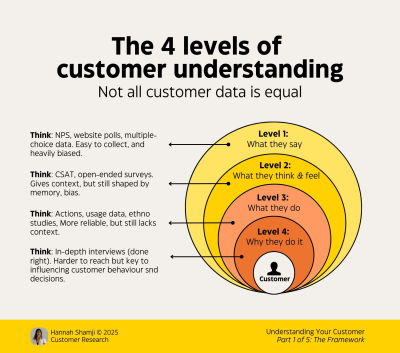
To bridge this gap, modern UX researchers and product strategists are turning to a more holistic framework: The Four Levels of Customer Understanding, originally conceptualized by Hannah Shamji. This comprehensive paradigm urges teams to look beyond literal statements and triangulate across four distinct dimensions:
- What users say
- What they think or feel
- What they do
- Why they do it
By shifting the organizational mindset away from passive “validation” toward active, empathetic observation and diagnosis, teams can unearth root causes, decode hidden motivations, and build products that resonate with the messy, complex reality of human behavior.
Detailed Chronology: The Evolution of Customer Research Methods
To understand how modern UX research arrived at this multi-layered framework, it is helpful to examine the historical trajectory of how companies attempt to understand their audiences.
Era 1: The Direct-Inquiry Paradigm (Surveys and Focus Groups)
For decades, the standard playbook for consumer research relied heavily on direct questioning. If a company wanted to know whether users would use a product feature, they put together a survey or assembled a focus group.
As prominent design thinker Erika Hall famously noted, asking a question directly is often the worst way to get a true and useful answer. Decades of behavioral psychology research have proven that human beings are notoriously poor witnesses to their own cognitive processes. We frequently lack conscious awareness of our true motivations, apply post-hoc rationalizations to our choices, and heavily distort our answers based on social desirability. Furthermore, respondents routinely focus on extreme edge cases, exaggerate short-term inconveniences, and favor short-term goals over long-term utility. If a user states in a focus group that they "need" a complex comparison data table, direct inquiry fails to reveal that their underlying goal could be achieved far more efficiently through a streamlined, visual filtering interface.
Era 2: The Nuance of Language and Probability
As the digital industry matured, researchers realized that words themselves are slippery tools. Even when users are cooperative, language introduces massive ambiguity. A breakthrough insight by Thomas D’hooge highlighted how subjective verbal probability terms—words like possible, plausible, probable, maybe, and likely—are interpreted wildly differently across populations.
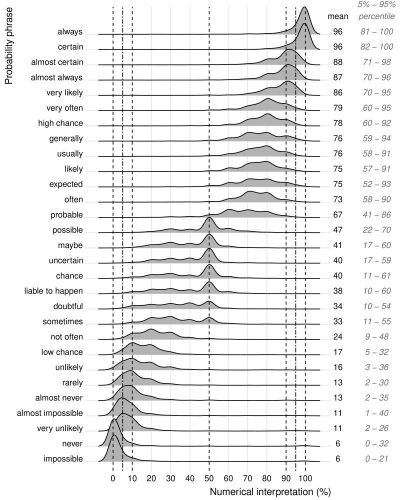
Research into verbal probability terms confirms that while extreme expressions carry some baseline consensus, everyday qualifiers result in a massive spread of numerical interpretations. A user telling a researcher that a feature is "likely" to be used might mean a 70% probability in their mind, while the product manager interprets it as a guaranteed 95%. Relying strictly on what people say exposes teams to dangerous semantic drift.
Era 3: The Rise of Mixed-Method Triangulation
Recognizing the limitations of self-reported data, the industry shifted toward mixed-method research. Practitioners began combining qualitative observations with quantitative tracking. Rather than asking users if they are satisfied, teams began examining behavioral telemetry—where users hover, how long they hesitate, where they click and backtrack, and where they ultimately abandon workflows.
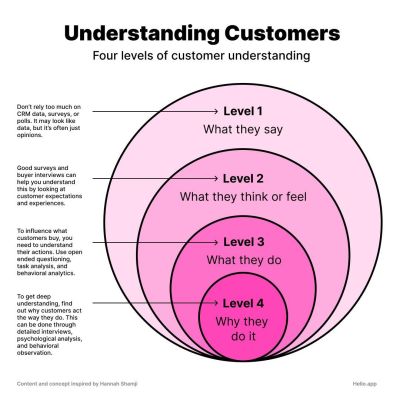
This evolution paved the way for Hannah Shamji’s Four Levels of Customer Understanding framework. By mapping data across the four concentric circles—from the outermost layer of speech to the innermost layer of core motivation—researchers developed the capacity to reconcile contradictory signals. When a Net Promoter Score (NPS) screams satisfaction, but user session recordings show widespread abandonment at checkout, triangulation allows teams to dig past the corporate dashboard and confront reality.
Supporting Context & Metrics: Unpacking the Four Levels
To operationalize customer understanding, product teams must systematically break down the barriers between what is said and what is experienced.
The Four-Tiered Model
- Level 1: What They Say (Explicit Data): This represents the outermost layer. It includes support tickets, survey responses, direct feedback, and interview statements. While easy to collect, it is the most heavily filtered and biased layer.
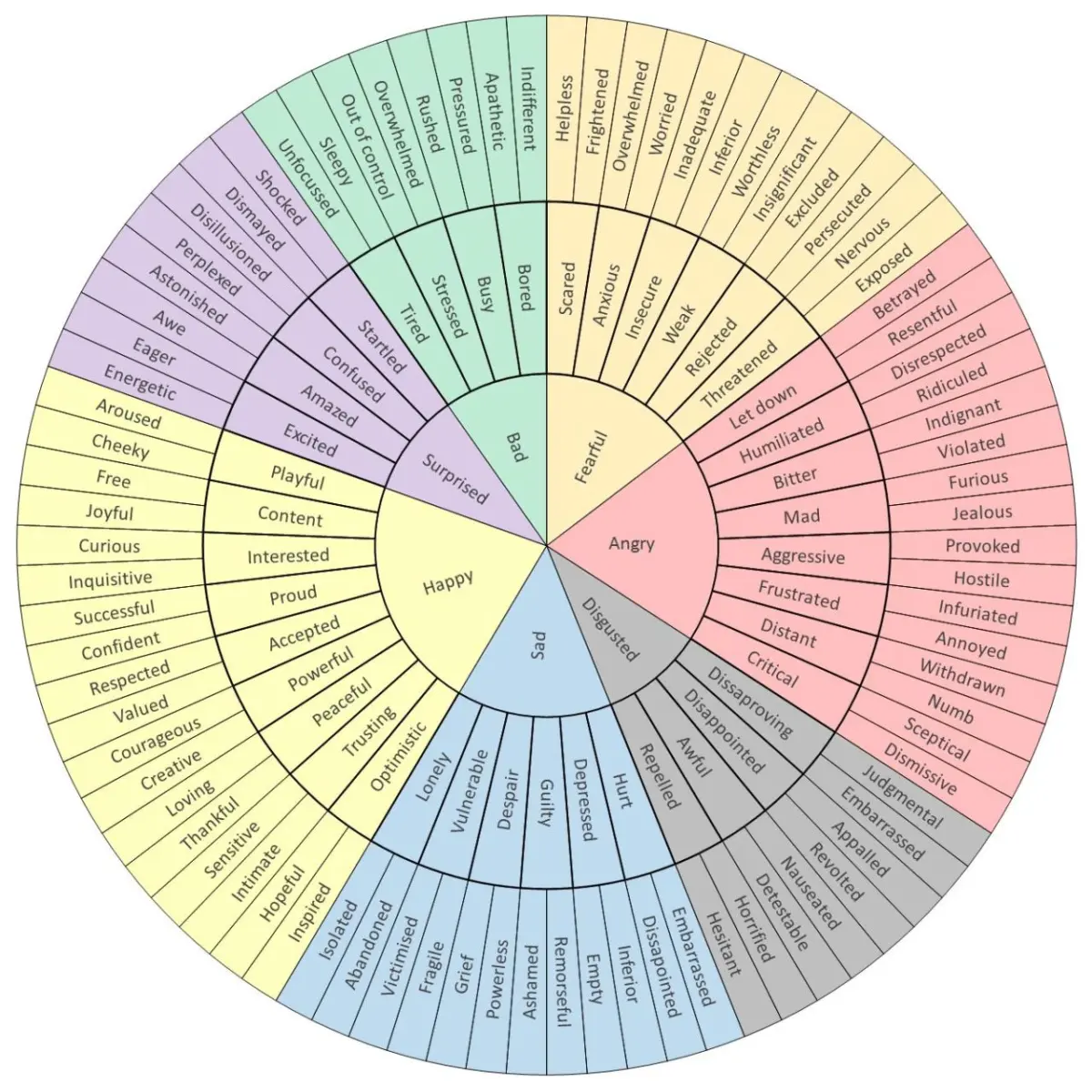
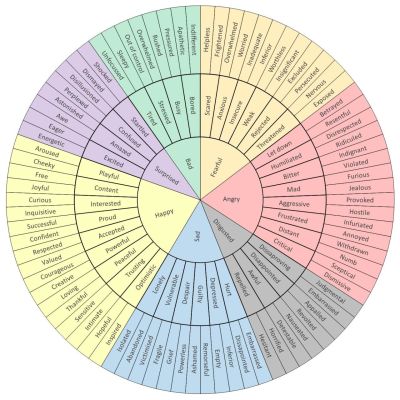
- Level 2: What They Think or Feel (Cognitive & Emotional State): This layer captures internal monologues, anxieties, shifting moods, and aesthetic reactions. Emotions are notoriously difficult to capture via direct prompts, requiring specialized tools like Geoffrey Roberts’s Emotion Wheel to move beyond blunt descriptors like "good" or "bad" toward nuanced sentiments like apprehensive, overwhelmed, or curious.
- Level 3: What They Do (Observed Behavior): This is the realm of telemetry, usability testing, and session replay analysis. It focuses strictly on actions: clicks, scrolls, taps, hesitations, and abandonment points. Actions often contradict explicit statements.
- Level 4: Why They Do It (Root Motivations & Mental Models): The innermost core of the framework. This answers the fundamental question of human intent. Why does the user need this task completed? What broader life objective, professional pressure, or psychological need is driving this workflow?
The Empathy Spectrum and Design Harms
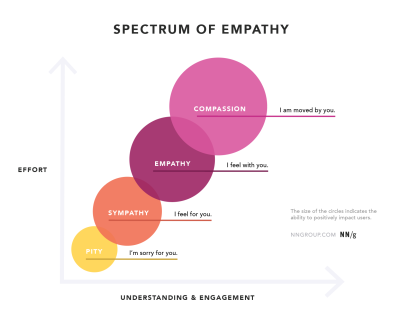
As noted by accessibility and research experts like Sarah Gibbons (Nielsen Norman Group) and Indi Young, true customer understanding requires navigating the "Spectrum of Empathy"—moving past superficial pity and sympathy toward deep empathy and actionable compassion.
However, a healthy counter-perspective has emerged from practitioners like Alin Buda, who argue against the notion that designers must emotionally absorb every ounce of user pain to build great things. Buda points out that the core duty of a designer is analytical sense-making and decisive action, not performative emoting.
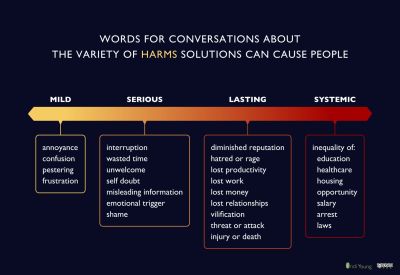
Complementing this, Indi Young’s research into potential design harms categorizes product failures not just by mild user annoyance, but by serious, lasting, and systemic harms. Understanding these deeper layers requires shifting our vocabulary entirely.
Official Perspectives & Industry Insights
Industry leaders emphasize that the terminology we use within product organizations shapes our psychological approach to research.
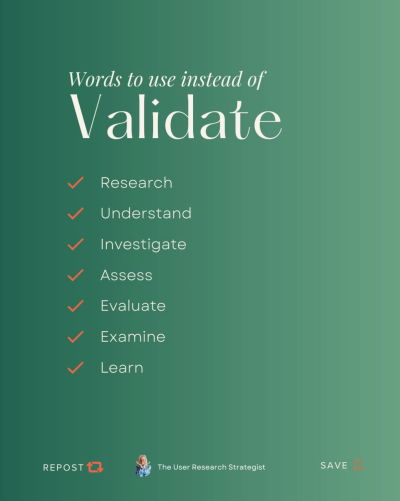
- Nikki Anderson on "Validation": The moment a team announces they are entering a phase to "validate this feature," confirmation bias sets in. Validation implies that the goal is to prove a preconceived hunch is correct. Anderson advocates replacing the word validate with terms that genuinely reflect open inquiry: research, understand, investigate, assess, evaluate, examine, and learn.
- David Travis on Accessible Research: Uncovering deep user needs does not require bloated budgets or corporate focus groups. Travis outlines dozens of scrappy, cost-effective methodologies—such as diary studies, customer support log analysis, contextual inquiries, and unmoderated digital observations—that democratize customer insights across marketing, engineering, and executive leadership.
- Vitaly Friedman on UX Metrics: Traditional metrics like the Net Promoter Score (NPS) often mask underlying customer friction. Friedman emphasizes that tracking true design and business impact requires moving beyond vanity metrics and connecting granular user behaviors directly to tangible business outcomes through rigorous, mixed-method evaluation.
Future Outlook: Moving from Assumptions to Empirical Diagnosis
As artificial intelligence, automated telemetry, and complex digital ecosystems continue to evolve, the future of UX research will rely less on what users tell us and more on our ability to holistically diagnose real-world behavior.
The organizations that win in the coming decade will be those that abandon the comfort of institutional assumptions. By rejecting the urge to simply "validate" existing roadmaps and embracing the rigorous, multi-layered pursuit of the Four Levels of Customer Understanding, product teams can transform raw observations into profound empathy.
Ultimately, bridging the gap between thought and action requires humility, structural curiosity, and a relentless commitment to looking beneath the surface. Without these practices, every product decision remains an expensive, unverified gamble—leaving companies to guess at answers while their users navigate entirely different realities.
