The design community has fallen prey to a pervasive systemic bias: conversational tunnel vision. Because Large Language Models (LLMs) are natively trained on sequential dialogue data, product developers and UX teams have collectively defaulted to the chat bubble as the universal container for every conceivable artificial intelligence capability. This "one-size-fits-all" approach treats chat interfaces as a blank slate capable of handling any user command, but it fundamentally misunderstands the core tenets of human-computer interaction (HCI).
Great user experience (UX) is not about forcing humans to adapt to a machine’s architectural constraints; it is about matching modality to the user’s immediate context, intent, and cognitive load. When an interface fails to respect physical dexterity, ambient noise, environmental stress, or processing capacity, it shifts an unnecessary psychological tax onto the user. Moving forward, the industry must dismantle the myth of the do-it-all chatbot and adopt a rigorous, evidence-based framework—incorporating Task Audits and Input/Output Alignment Matrices—to design adaptive, multi-modal experiences that truly serve human needs.
Detailed Chronology: The Rise and Trap of the Conversational Default
The generative AI boom of the early 2020s catalyzed a design monoculture. To trace the evolution of this phenomenon is to understand how the industry compromised user-centric design in favor of rapid technological deployment:
The Prompt-Engineering Paradigm Shift: When foundation models demonstrated unprecedented conversational prowess, consumer applications rushed to replicate the open-ended text box. The chat interface became the fastest path to market for exposing raw LLM capabilities.
The Normalization of Linguistic Barriers: As tools integrated into professional workflows, users quickly discovered that expressing complex operational commands required translating intuitive mental models into formal, linear text strings. The blank text box morphed from an open-ended canvas into a choice-paralysis engine.
The Accumulation of Cognitive Fatigue: Over successive years of enterprise and consumer integration, the hidden costs of reading dense, generated text outputs became apparent. Users were forced to perform sequential verification, parsing blocks of narrative text just to extract a single metric or status update.
The Watershed of Real-World Failure: High-stakes industrial, medical, and mobile environments exposed the fatal flaws of defaulting to text-heavy, touch-dependent interfaces. Incidents involving field operators, medical personnel, and fast-moving travelers highlighted an urgent need to break away from conversational monotheism and re-evaluate interface modalities based on real-world constraints.
Supporting Context & Metrics: The Mechanics of Cognitive and Linguistic Load
To understand why the default chat interface frequently fails, we must examine the hidden tolls it exacts on human users: the adaptation load, the linguistic barrier of input, and the cognitive cost of output.
Input: The Linguistic Barrier
In a traditional Graphical User Interface (GUI), menus, buttons, sliders, and drop-downs provide clear visual affordances. They signal what actions are possible without requiring the user to recall system syntax. Conversely, a blank chat box introduces severe choice paralysis.
Consider a data analyst attempting to filter a spreadsheet. In a traditional tool, a point-and-click filter makes the operation trivial. In a pure chat paradigm, the analyst must transform their analytical intent into a precise, descriptive natural language prompt. Composing a prompt is a creative act that requires translating vague thoughts into explicit instructions—a linguistic hurdle that turns routine tasks into frustrating chores.
Output: The Serial Medium Trap
When an AI responds in long, unbroken blocks of text, it transfers the burden of data extraction directly to the user. Text is an inherently serial medium; the human brain must process information word-by-word, line-by-line.
By contrast, visual dashboards allow for parallel processing, where a user can scan a color-coded chart or spatial layout in milliseconds. For time-pressed professionals—such as a medical doctor checking vital signs or a stock trader monitoring rapid price fluctuations—forced reliance on narrative text outputs introduces unacceptable latency, increasing the risk of human error and cognitive exhaustion.
Modality Taxonomy Reference
Modality Category
Specific Type
Best Suited For
Core Cognitive & Physical Rationale
Input
Button / Tap
Single-step, binary actions
Eliminates recall overhead; maximizes speed in time-sensitive tasks.
Input
Voice
Hands-busy / eyes-busy contexts
Offloads physical interaction to speech; bounded by noise and privacy.
Input
Natural Language Chat
Exploratory, ambiguous queries
Maximizes user expression freedom; requires careful prompt formulation.
Input
GUI (Sliders, Filters)
Complex parameter settings
Prevents errors by dividing tasks into manageable visual components.
Output
Push Notification
Ambient awareness, alerts
Delivers quick updates without demanding a full break in concentration.
Output
Visual Dashboard
High-density comparative analysis
Enables rapid outlier detection, bypassing linear reading friction.
Official Statements and Industry Insights
Leading voices in product design and user experience research emphasize that the future of software development lies in context-aware flexibility rather than rigid conversational loops.
"Modality is not merely an aesthetic preference; it is the fundamental bridge connecting human sensory systems to machine computation. When we force every AI feature into a chat bubble, we ignore the physical reality of the human body and the environmental pressures of the workspace."
— Principal UX Architect, Enterprise AI Systems
Product strategists point out that the rush to deploy generative AI models often bypassed foundational UX due diligence.
"We spent billions making models smarter, while inadvertently making interfaces dumber. A brilliant AI model wrapped in a lazy, text-only chat box ultimately fails the user the moment they step away from a quiet desk and into the messy, high-stakes reality of the physical world."
— Director of Human-Computer Interaction Research
Future Outlook: Designing for the Multi-Modal Ecosystem
The path forward for AI interface design requires a systematic departure from lazy conventions. Product teams must embrace the Task Audit framework—utilizing contextual inquiry, focused observation, and stakeholder workshops—to unearth the physical and cognitive realities of their users before writing a single line of code.
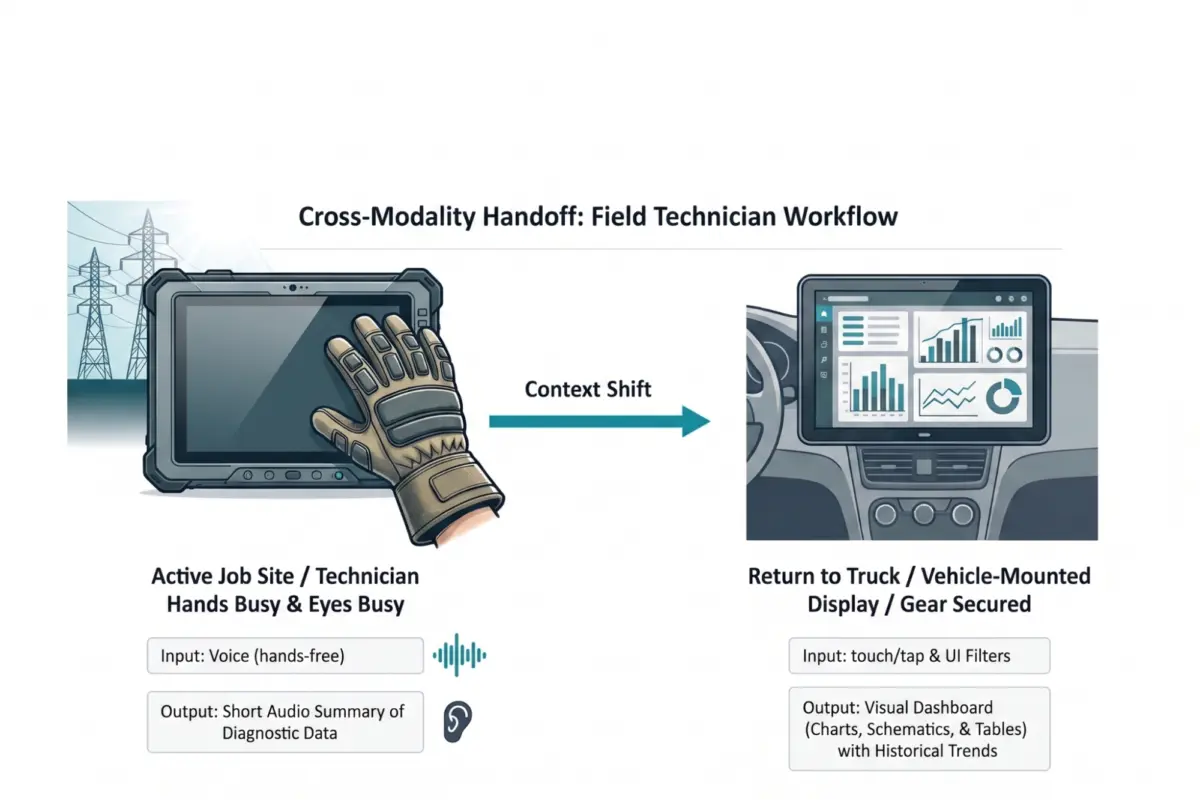
By mapping user intent against the Input/Output Alignment Matrix, designers can build dynamic, multi-modal workflows. Imagine an industrial field technician who initiates an inquiry via hands-free voice commands while wearing heavy safety gear, receives a rapid audio summary to maintain situational awareness, and later transitions seamlessly to a rich, high-resolution visual dashboard once safely inside a vehicle.
This is not science fiction; it is the necessary evolution of AI product design. By respecting the human user’s physical environment and cognitive bandwidth, the design community can finally shatter conversational tunnel vision and deliver intelligent tools that feel like a natural, effortless extension of human capability.