

Executive Overview
High above the bustling traffic of Manhattan, a few blocks east of the Port Authority Bus Terminal, the national headquarters of Ms. magazine resides on the 17th floor of an unpretentious commercial building. Far removed from the polished marble lobbies of traditional publishing giants, this modest labyrinth of cubicles, crowded bookshelves, and practical conference rooms serves as the operational heart for one of the most culturally transformative publications in American history. At the center of this movement is Gloria Steinem: co-founder, contributing editor, principal fundraiser, and arguably the most recognizable public face of second-wave feminism.
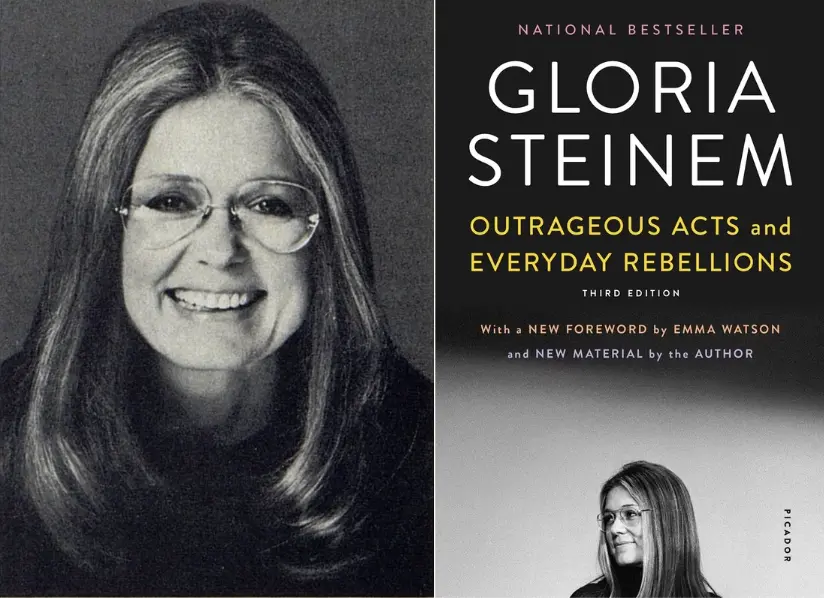
At 49 years old, Steinem stands at a pivotal juncture in her career. Long celebrated—and occasionally vilified—as a charismatic speaker, political strategist, and crusading journalist, she is preparing for the release of her first major book, Outrageous Acts and Everyday Rebellions. Published by Holt, Rinehart and Winston with an ambitious initial print run of 60,000 copies, the volume brings together more than two dozen essays spanning over two decades of reporting and commentary. The collection provides a comprehensive record of modern feminism’s core struggles while charting Steinem’s personal trajectory from an ambitious freelance reporter navigating a male-dominated press corps into an integrated figurehead for whom the personal, political, and professional have become inseparable.
Steinem’s transition from an observer of social upheaval to an active architect of political change illustrates the power of independent media. Through her early investigative reporting, her co-founding of New York magazine, and the historic 1972 launch of Ms., Steinem helped construct a critical platform for female voices. Today, as her prospective readers prepare for her retrospective essay collection, Steinem continues to redefine the boundaries of political journalism, asserting that real cultural transformation requires changing both state legislation and everyday social norms.
Detailed Chronology
[1934] Born in Toledo, OH ➔ [1956] Smith College Grad. ➔ [1957-58] India Fellowship ➔ [1959] NSA Vienna Fest.
                                                                                           │
[1972] "Ms." Launched  ◄─ [1970] Penney-Mo. Award ◄─ [1969] Covers Abortion Hearing ◄─ [1963] Bunny Exposé
       (Sells out 8 days)    ("After Black Power...")     (Political Awakening)        ("Show" Magazine)
       │
       ▼
[1983] "Outrageous Acts and Everyday Rebellions" Published (Holt, Rinehart & Winston)
Early Life and Academic Foundations (Toledo to Smith College)
Gloria Steinem’s political awakening was rooted in the working-class realities of Toledo, Ohio. Raised by parents who divorced during her youth, Steinem experienced an unconventional, insecure childhood. Her father worked as a summer resort operator and an itinerant antiques dealer—a nomadic lifestyle that instilled in Steinem an early comfort with financial uncertainty. Her mother, Ruth, a former journalist, sacrificed her professional ambition to support her husband and family, eventually suffering severe physical and psychological strains that required a young Steinem to act as caregiver during her adolescence.
Steinem’s escape from these hardship-bound origins came through higher education. Enrolling at Smith College, she majored in Government, finding refuge in the academic rigor and relative stability of campus life. Influenced by faculty members such as foreign policy analyst Vera Micheles Dean and a formidable Shakespeare scholar, Steinem initially harbored ambitions of becoming a fiction writer, drafting obscure short stories while contemplating her post-graduate trajectory.
International Exposure: The Indian Fellowship and Grassroots Organizing
Upon graduating from Smith in 1956, Steinem secured a two-year fellowship in India—a move prompted by an interest in Indian culture fostered by her mother’s theosophist background, as well as an imperative to break off a conventional marriage engagement.
Between 1957 and 1958, Steinem bypassed routine academic coursework at the University of Delhi to immerse herself in grassroots activism. Joining the Radical Humanists, an activist movement tied to India’s pre-independence struggle, she traveled across Calcutta, Madras, and southern India. When violent caste riots erupted in the south, Steinem was integrated into peacemaking teams sent to de-escalate village conflicts. Because cultural norms restricted male organizers from engaging secluded women, Steinem—adopting local attire and customs—entered women’s quarters to invite them to peace assemblies.
During this period, she published freelance pieces for Indian newspapers, including essays such as "Sari Psychology," and authored an official government guidebook. The stark wealth disparities and nonviolent organizing techniques she witnessed in India left a lasting mark on her political outlook.
+-----------------------------------------------------------------------+
|                 STEINEM'S FORMATIVE INFLUENCES                        |
+-----------------------------------------------------------------------+
|  1. Toledo Childhood      | Insecure upbringing; caregiving for mother|
|  2. Smith College         | Government major; analytical foundation   |
|  3. India Fellowship      | Grassroots organizing; peace teams        |
|  4. Satire & Undercover   | "Help!" magazine; "Playboy Bunny" exposé  |
|  5. Political Journalism  | "New York" magazine; political reporting  |
+-----------------------------------------------------------------------+
Early Career in New York: Satire, Undercover Work, and Political Journalism
Returning to New York in the late 1950s, Steinem endured financial hardship, sleeping on friends’ living room floors while pursuing writing assignments. Her early professional engagements included working with the National Student Association (NSA) to recruit American delegates for the 1959 Vienna Youth Festival. Although the initiative was later criticized due to its partial, indirect funding by the Central Intelligence Agency, Steinem maintained that the funding came without editorial conditions and reflected the idealistic, if naive, political assumptions of the era.
Steinem soon joined the editorial staff of Help!, a political satire magazine created by Mad co-creator Harvey Kurtzman. As one of three core staff members, she mastered magazine production while cultivating crucial industry connections. A successful pitch to Esquire for a feature on contraception launched her career as a full-time freelance writer.
In 1963, Steinem published "I Was a Playboy Bunny," a two-part undercover exposé in Show magazine detailing the exploitative working conditions and sexual harassment faced by women in Hugh Hefner’s Playboy Clubs. While the piece brought her national attention, it also threatened to categorize her as a writer of lighter feature stories. Throughout the mid-1960s, Steinem fought to secure substantive assignments, gradually earning political profiles that gave her a firsthand look at national power dynamics.
Political Awakening and the Genesis of Feminist Media
A major turning point occurred in 1968 when Steinem joined Clay Felker to found New York magazine, stepping into the role of political columnist and contributing editor. Her early essays for the publication, such as "Ho Chi Minh in New York," bridged her interest in international affairs with domestic politics.
In 1969, while covering an abortion hearing organized by the radical feminist group Redstockings, Steinem experienced a profound ideological shift. Hearing women speak publicly about their illegal abortion experiences resonated with her own private history, converting her "emotional feminism" into active political engagement. Shortly thereafter, she authored "After Black Power, Women’s Liberation," a landmark essay that won the 1970 Penney-Missouri Journalism Award.
Despite pushback from male editors and colleagues, Steinem stepped into public speaking alongside movement leaders like Dorothy Pitman Hughes and Bella Abzug. Recognizing the commercial publishing industry’s reluctance to give voice to feminist ideas, Steinem, along with journalist Jane O’Reilly and a collective of activists, sought to launch an independent, woman-owned publication.
+-----------------------------------------------------------------------+
|                    THE LAUNCH OF MS. MAGAZINE (1972)                  |
+-----------------------------------------------------------------------+
|  Preview Edition:    | 30-page insert in "New York" magazine          |
|  First Standalone:   | January 1972 ("Spring" issue)                  |
|  Initial Print Run:  | 300,000 copies                                 |
|  Sell-Out Time:      | 8 days nationwide                              |
|  Primary Innovation: | Commercial media owned and edited by women     |
+-----------------------------------------------------------------------+
In late 1971, Clay Felker financed the production costs for a test issue of Ms. magazine in exchange for a 30-page preview insert in New York magazine’s year-end double issue. The first standalone issue of Ms. hit newsstands in January 1972 with a "Spring" cover date and a 300,000-copy print run. It sold out completely in eight days, establishing Ms. as a major cultural force and proving the economic viability of feminist media.
Supporting Context & Metrics
Publishing and Media Metrics
The public release of Outrageous Acts and Everyday Rebellions highlights Steinem’s commercial and journalistic standing. The quantitative milestones underlying her career reflect the growing market demand for feminist writing during the 1970s and 1980s:
- Initial Book Print Run: 60,000 hardcover copies (Holt, Rinehart and Winston).
- Anthology Scope: 26 essays selected and revised from over 20 years of published reporting.
- Ms. Magazine Launch (1972): 300,000 copies sold in 8 days; initial preview distributed to 200,000 New York magazine subscribers.
- Journalistic Accolades: 1970 Penney-Missouri Journalism Award for "After Black Power, Women’s Liberation."
| Milestone Event | Year | Primary Medium / Partner | Operational Impact / Metric |
|---|---|---|---|
| "I Was a Playboy Bunny" Exposé | 1963 | Show Magazine | First major undercover investigation into workplace commodification. |
| Founding of New York Magazine | 1968 | Clay Felker / Independent | Establishes Steinem as a premiere political columnist. |
| Penney-Missouri Award Win | 1970 | New York Magazine | National recognition for feminist advocacy reporting. |
| Launch of Ms. Magazine | 1972 | Independent / Mass Distribution | First nationwide feminist commercial magazine; 300k sellout. |
| Publication of Outrageous Acts | 1983 | Holt, Rinehart and Winston | First collected anthology; 60,000-copy initial run. |
The Institutional and Cultural Landscape
When Steinem entered the press corps in the early 1960s, American journalism was heavily male-dominated. Female writers were routinely restricted to soft feature desks—covering fashion, home care, and celebrity profiles—while political and investigative beats were reserved for men. Steinem’s success required challenging these institutional barriers from within.
+-----------------------------------------------------------------------+
|                    STRUCTURAL INDUSTRY TRANSITION                     |
+-----------------------------------------------------------------------+
|  1960s Traditional Media          |  1970s–1980s Feminist Media Shift |
|  -----------------------          |  -------------------------------- |
|  - Women assigned to soft beats   |  - Women reporting core politics  |
|  - Topic control by male editors  |  - Collective, woman-led editing  |
|  - Skepticism of women's rights   |  - Direct reporting on health/work|
+-----------------------------------------------------------------------+
Furthermore, the mainstream media frequently presented second-wave feminism through hostile framing, characterizing activists as shrill or unorganized. Steinem’s polished media presence, combined with her professional writing background, countered these caricatures. By integrating rigorous reporting with personal commentary, Ms. magazine provided an alternative to traditional publications, tackling critical issues like domestic violence, reproductive health, equal pay, and workplace harassment long before they were acknowledged by mainstream outlets.
Official Statements
Throughout her career, Steinem has offered candid observations regarding media distortions, the politics of fame, and the ongoing struggle for civil rights.
On Media Perception and Public Image
Reflecting on the stark contrast between her public persona and her actual identity, Steinem points to the distorting lens of national profile:
"The media tends to do funny things to you. You get this incredible intimacy with strangers, because their lives have been changed by the movement in some way, and they feel they know you. It isn’t like being well known as someone else—for an actor it must be terrible, because people think you’re the role you play, and you’re not. But for us, we’re doing what we care about, so the connection is a real connection."
On Journalism, Objectivity, and Professional Rigor
Addressing the mechanics of sustaining a career as an independent journalist in a competitive market, Steinem notes:
"The secret of making a living is being dependably publishable. You don’t necessarily have to be good. On the other hand, some very good writers are so erratic, it’s hard for them to make a living. But if you’re always punctual and understandable, which I was, then you can make it work."
On Power Dynamics and Political Figures
Reflecting on her years covering state and national politicians, Steinem emphasizes the importance of maintaining an objective, critical distance from political authority:
"One of the most valuable things I learned from contacts with politicians was disrespect. That’s important. You learn they’re not as smart as you thought they were."
On the Long-Term Feminist Struggle and Civil Rights
In discussing the ultimate goals of second-wave feminism and the ongoing effort to pass the Equal Rights Amendment (ERA), Steinem frames the movement within a larger historical perspective:
"It’s a constant struggle. We still have to change the culture. It’s a young country; we’ve had only two waves of feminism. We spent the first 150 years trying to get a legal identity as human beings for women, instead of being chattels—literally, owned. This wave, we’re trying to get legal equality, which means reproductive freedom too. But I’m sure there will be many waves to come."
Future Outlook
As Gloria Steinem enters her fifties, her role within the women’s movement continues to evolve. Far from stepping back into a passive editorial role, she remains deeply engaged in political organizing, national speaking tours, and strategic planning for the survival of independent feminist journalism.
+-----------------------------------------------------------------------+
|                   FUTURE STRATEGIC PRIORITIES                         |
+-----------------------------------------------------------------------+
|  1. Institutional Sustainability | Securing ongoing funding for "Ms."  |
|  2. Constitutional Protections  | Advocacy for the ERA ratifications  |
|  3. Cultural Transformation     | Reforming workplace & domestic dynamics|
|  4. Intergenerational Waves     | Mentoring incoming feminist voices  |
+-----------------------------------------------------------------------+
Institutional Preservation and Media Expansion
The primary challenge facing Steinem and her editorial colleagues is securing the long-term financial independence of Ms. magazine. Operating an advertising-dependent feminist publication presents unique financial hurdles, as corporate advertisers often resist placing products alongside provocative political content. Steinem’s ongoing fundraising efforts aim to shield the magazine from commercial pressures, ensuring that Ms. remains an uncompromised platform for investigative reporting on women’s rights.
Systemic Culture Change Beyond Legal Milestones
While constitutional victories such as the ratification of the Equal Rights Amendment remain central policy goals, Steinem emphasizes that legal protections alone cannot fully dismantle deep-seated social inequities. The future work of the feminist movement, she argues, lies in transforming cultural attitudes surrounding family dynamics, shared parenting, wage parity, and reproductive rights.
By compiling her life’s work in Outrageous Acts and Everyday Rebellions, Steinem offers both a historical record and a practical guide for future activism. She views the contemporary women’s movement not as a short-term political campaign, but as part of a generational push toward systemic equality. Supported by an expanding network of writers, grassroots organizers, and engaged readers, Steinem continues to demonstrate that independent journalism remains an indispensable tool for challenging entrenched power and driving social change.