

Executive Overview
In the modern landscape of celebrity culture, brand alignment has evolved into an exercise in high-stakes risk management, where the intersection of commerce, personal branding, and socio-political climate creates an unpredictable minefield. Few modern stars understand—or perhaps willingly ignore—this volatile dynamic quite like Sydney Sweeney.
The two-time Emmy-nominated actress, whose meteoric rise through prestige television (Euphoria, The White Lotus) and bankable cinematic vehicles (Anyone but You, The Housemaid) has made her one of Hollywood’s most recognizable faces, has increasingly found her professional choices under intense public scrutiny.
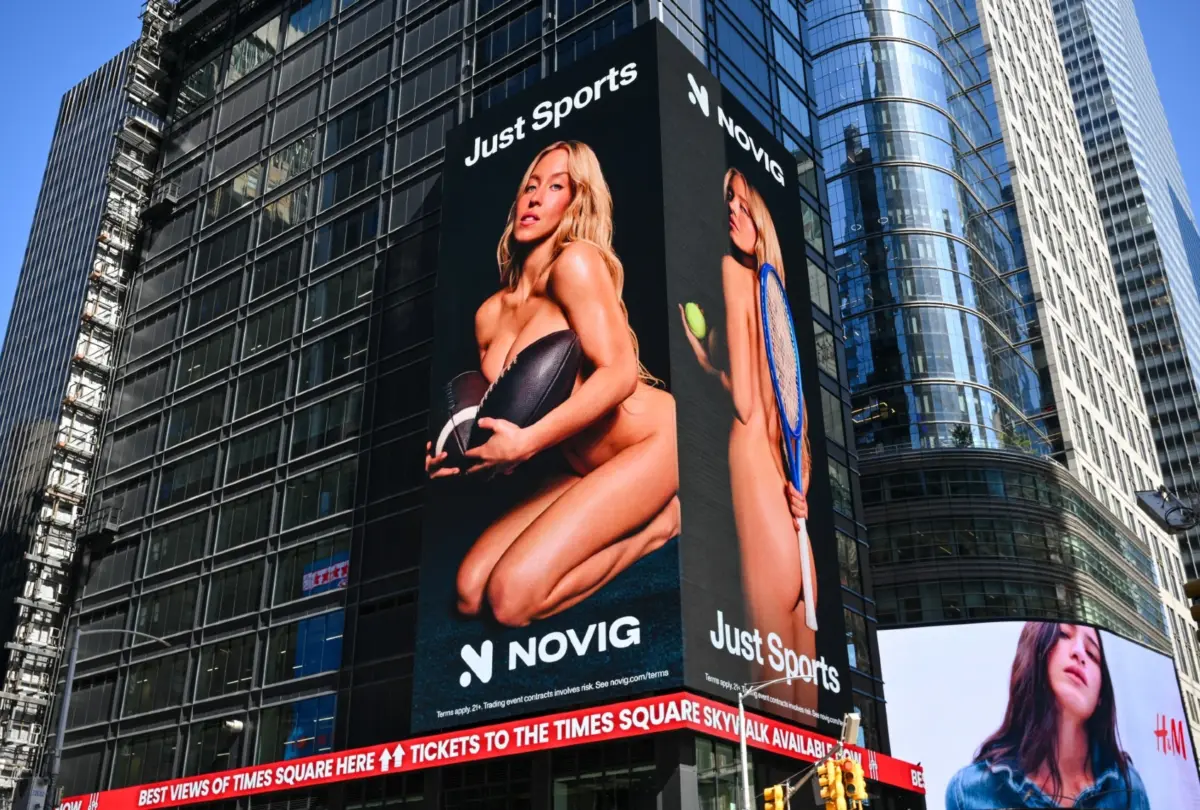
The latest catalyst for this controversy is a high-profile advertising campaign for the peer-to-peer sports betting platform Novig. Launched ahead of the 2026 NFL season, the campaign features Sweeney in a series of provocative, hyper-sexualized spots that have sent shockwaves through both the entertainment industry and the athletic community.
While commercial endorsements are a standard rite of passage for top-tier talent, Sweeney’s partnership with Novig—in which she is reportedly an equity holder—transgresses traditional boundaries. By leaning heavily into commodified sexuality, courting political ambiguity, and stepping into the ethically fraught world of online gambling promotion, Sweeney’s career trajectory is entering a precarious phase.
This commentary examines the anatomy of the Novig campaign, the immediate backlash from professional athletes and cultural critics, the underlying economic motives driving her branding decisions, and the long-term existential threat these choices pose to her credibility as a serious dramatic actress.
Detailed Chronology: The Novig Rollout and Immediate Backlash
The friction surrounding Sydney Sweeney’s partnership with Novig began in mid-September 2026, timed deliberately to capture the cultural momentum of the NFL’s opening week.
The Campaign Launch
The campaign’s centerpiece is a 60-second commercial in which Sweeney, strategically draped in various pieces of sports memorabilia while wearing minimal clothing, directly addresses the viewer. In one heavily circulated clip, she holds a football suggestively against her chest, offering a wooden, deadpan delivery of the campaign’s tagline: "It’s gamedaaayyyyyyyy."
Later in the spot, she explicitly attempts to distance Novig from other prediction markets by drawing a line in the sand regarding permissible wagers: "No betting on wars, or deaths, and no politics."
The delivery is marked by a conspicuous coyness—a winking self-awareness that feels less like authentic enthusiasm and more like an acknowledgment of the absurdity of the exercise. Yet, for all its performative irony, the campaign immediately achieved its primary corporate objective: generating massive media coverage, viral social media outrage, and relentless public discourse.
Athlete Backlash and Cultural Friction
The reaction from the professional sports community was swift and uncompromising. High-profile female athletes, who have spent decades fighting for structural equity, respect, and serious media coverage separate from their physical appearance, viewed the campaign as a regressive step.
- Ariarne Titmus, the Australian four-time Olympic gold medal-winning swimmer, took to Instagram to voice her profound frustration. In a widely shared post, Titmus condemned the ad as "a kick in the face to every woman who has dedicated her life to perfecting her craft," adding that it undermines women who celebrate sports for "teamwork, friendship, dedication, excellence, unity."
- Gracie Kramer, an American gymnast, echoed these sentiments by posting a compilation of her athletic routines accompanied by a sharp rebuke: "I don’t know what Sydney Sweeney was doing, but this is what a woman in sports looks like."
Rather than ignoring the backlash, Sweeney’s subsequent digital footprint compounded the controversy. She shared content highlighting athletes from ESPN’s annual body issue—implicitly drawing a parallel between professional athletes who utilize their physiques as a byproduct of elite athletic conditioning and her own commercialized objectification. This false equivalence erased the boundary between physical achievement earned through rigorous training and the transactional commodification of the human body for corporate profit.
Supporting Context & Metrics: Navigating the Intersection of Gambling, Fame, and the Attention Economy
To understand the weight of the Novig controversy, one must contextualize it within Sweeney’s broader professional portfolio and the shifting socioeconomic currents of contemporary Hollywood.
A Pattern of Contentious Campaigns
The Novig backlash does not exist in a vacuum. It follows closely on the heels of Sweeney’s collaboration with American Eagle, a campaign that similarly sparked intense cultural debate, drawing fire not only for its commercial aesthetics but for language and undertones that critics argued skirted uncomfortably close to controversial ideologies.
By consistently choosing campaigns that invite polarization, Sweeney has cultivated a distinct brand identity: one that deliberately courts outrage to maximize engagement. In an attention economy governed by algorithms, controversy functions as currency. However, this strategy operates on diminishing returns when applied to long-term artistic credibility.
The Financial Architecture of Novig and Equity Holdings
Sweeney’s involvement with Novig extends far beyond standard talent-for-hire endorsement deals. Public disclosures and corporate communications indicate that Sweeney holds a financial stake in the platform as an equity holder. This distinction is crucial. It transforms her participation from a passive artistic choice into an active, entrepreneurial investment in the hyper-growth, ethically ambiguous online sports betting sector.

The explosive expansion of peer-to-peer gambling platforms represents a significant modern flashpoint. These platforms have faced mounting scrutiny from regulators, financial watchdogs, and public health advocates concerned with the rise of gambling addiction among impressionable demographics, particularly young adults.
By tying her personal brand to a high-risk financial product, Sweeney exposes herself to a class of reputational fallout that traditional film and television projects rarely trigger. Unlike a poorly received movie—which can be attributed to weak writing or direction—an equity-backed endorsement of a predatory industry reflects direct commercial alignment.
The Intersection of Personal Life and Corporate Strategy
Observers of celebrity culture have also noted the broader ecosystem surrounding Sweeney’s recent career moves, including her relationship with high-profile music manager and celebrity tycoon Scooter Braun.
While it is reductive to attribute a grown star’s agency entirely to external influences, the convergence of high-profile management, strategic controversy, and aggressive brand monetization points to a calculated industrial playbook. This playbook leverages traditional systems of power—including patriarchal structures and male-dominated market segments—to maximize short-term financial returns and public notoriety.
Official Statements and Industry Response
As the debate surrounding the Novig campaign intensified throughout September 2026, representatives for both Novig and Sweeney maintained a calculated public silence regarding the criticisms, relying instead on the organic momentum of the controversy to drive user acquisition.
Industry analysts, however, have been vocal about the implications of the campaign. Major trade publications and cultural commentators have debated whether Sweeney is successfully subverting the patriarchal systems that commodify female beauty, or if she is merely profiting from them at the expense of her artistic legacy.
Novig’s corporate marketing team defended the campaign under the banner of the "Just Sports" initiative, emphasizing transparency and a streamlined user experience compared to legacy sportsbooks. Yet, the juxtaposition of a clean, peer-to-peer market thesis with hyper-sexualized marketing imagery revealed a profound disconnect that industry critics were quick to dissect.
Professional athletic organizations have largely declined to issue formal corporate statements, leaving individual athletes—such as Titmus and Kramer—to serve as the vanguard of public pushback against the trivialization of women’s sports.
Future Outlook: Can a Bombshell Transcend the Stereotype?
The central paradox of Sydney Sweeney’s career is the widening chasm between her undeniable commercial bankability and her stagnant artistic prestige.
On one hand, Sweeney remains a formidable box-office draw. Hits like Anyone but You and the anticipated adaptation of The Housemaid prove that audiences will turn out for her projects. Her performance in the recent season of Euphoria demonstrated that when her casting aligns precisely with her public persona, she can capture cultural intrigue. However, her cinematic output outside of that specific niche—such as her critically acclaimed work in the 2023 HBO film Reality—has been increasingly overshadowed by a barrage of unserious commercial side quests.
The Double-Edged Sword of Misogynistic Branding
Building a brand on the commodification of traditional aesthetic appeal within a male-dominated consumer market is a historically perilous venture.
- The Fading Currency of Youth: Youth and conventional beauty standards are finite commodities in Hollywood. As decades progress, relying primarily on physical objectification invites inevitable displacement by younger iterations of the same archetype.
- The Pamela Anderson Precedent: Cinematic history offers cautionary tales and redemption arcs alike. Consider Pamela Anderson, whose early career was entirely defined by the societal stigma of physical objectification, yet who later leveraged that very stigma into a profound, critically acclaimed late-career renaissance (The Last Showgirl). Anderson’s trajectory proves that true artistic skill and presence can outlast superficial categorization—but only through a deliberate pivot toward rigorous, substantive artistry.
The Danger of the "Middle Ground"
Sweeney currently occupies a precarious middle ground. Her coyness—attempting to straddle the line between serious actress and provocateur-for-hire—threatens to ossify her public image into something one-dimensional.
As the cultural novelty of her shock-value marketing wears off, the underlying gaps in her dramatic range and the reputational sludge of associations with predatory industries like online gambling will become harder to wash away. Gravity eventually asserts itself in Hollywood: the suspension of disbelief required to view an actor as a chameleon of the craft shatters when the audience can no longer separate the performer from the algorithmic hustle.
Ultimately, Sydney Sweeney’s tenure as the reigning titan of modern commercial branding serves as a masterclass in short-term monetization. Whether she can transition from a transient viral sensation into an enduring cinematic icon will depend entirely on whether she recognizes a fundamental truth of the industry: no star can indefinitely have their cake, show it off to the highest bidder, and expect the audience to take their art seriously. Gameday, eventually, has to come to a close.