

Executive Overview
In recent months, the digital product landscape has been gripped by a wave of anxiety, fueled by sensationalized headlines warning of “drastic measures,” “ruinous fines,” and “sweeping new AI rules” descending from the European Union. However, a deeper examination of the regulatory text reveals a framework that is considerably more targeted—and substantially more sensible—than the panic suggests. At its core, the European Union’s new transparency mandates are not designed to stifle technological innovation or paralyze product development teams. Instead, they represent a pragmatic legislative push to ensure that when artificial intelligence generates content capable of mimicking human authorship, that provenance is unmistakably clear to the end-user.
With enforcement deadlines approaching, compliance is no longer a theoretical exercise for future roadmaps. Under Article 50 of the EU AI Act, strict AI labelling requirements apply to any organization serving EU citizens. Crucially, much like the General Data Protection Regulation (GDPR) and the European Accessibility Act (EAA), this legislation possesses extraterritorial reach. It is not limited to companies headquartered within the EU; any business worldwide operating within or targeting the European market must comply if its AI outputs are consumed by people residing in the union.
For product managers, UX designers, legal counsels, and engineering leads, this regulatory shift demands an immediate operational pivot. The ubiquitous, ambiguous "AI sparkle" icon—long used as a catch-all indicator for any machine-learning-powered feature—is no longer sufficient. As regulators, industry groups like the Nielsen Norman Group (NN/g), and design systems pioneers point out, users need clear, unambiguous disclosures that differentiate between general AI assistance and specific, machine-generated outputs. This article explores the precise requirements of the new EU guidelines, breaks down what must be labelled (and what remains exempt), contrasts human editorial oversight with automated generation, and outlines how product teams can build compliant, user-friendly interfaces for a global market.
Detailed Chronology and Regulatory Milestones
Understanding how we arrived at the current compliance landscape requires tracing the deliberate, multi-year rollout of European and international AI governance. The journey toward mandatory AI transparency is characterized by systematic public consultations, legislative drafts, and finalized codes of practice.
- April 2021: The European Commission tables its initial proposal for the Artificial Intelligence Act, marking the world’s first comprehensive horizontal legal framework for AI. From its inception, the draft places a heavy emphasis on risk categorization, fundamental rights, and transparency.
- December 2023: After intense trilogue negotiations between the European Parliament, the Council, and the Commission, a provisional political agreement is reached on the final text of the AI Act. Provisions regarding General-Purpose AI (GPAI) and transparency obligations (enshrined largely in Article 50) begin to crystalize as critical focal points for industry stakeholders.
- March 2024: The European Parliament formally votes to adopt the AI Act, setting off a cascading timeline of phased implementations.
- August 2024: The AI Act formally enters into force, initiating countdown timers for various compliance tiers.
- Late 2024 to Mid-2025: The European Commission initiates extensive drafting processes for the Code of Practice on AI-Generated Content. Working groups comprising industry experts, civil society organizations, and academic researchers collaborate to define practical standards for machine-readable watermarking, metadata tagging, and visual labelling.
- July 2025: The European Commission publishes the final, definitive version of its guidelines on transparency obligations, validating the Code of Practice as an adequate mechanism for legal compliance. Alongside these guidelines, the Commission releases the official EU AI icon set—a standardized suite of visual markers designed to communicate basic AI integration, fully generated content, and partially modified media.
- August 2, 2026: The official enforcement date for the EU’s transparency obligations and AI system labelling requirements takes effect. Companies providing or deploying covered AI systems must ensure their products fully comply with disclosure rules or face severe penalties.
This chronology highlights that the rules are not sudden, arbitrary decrees. They are the culmination of years of transparent legislative debate, providing the tech industry with ample runway to adapt their system architectures and user experiences.
Decoding the Mandate: What Actually Needs Labelling?
To build compliant products, cross-functional teams must understand the precise scope of the regulation. The foundational objective of the EU AI Act’s labelling mandates is to empower consumers, citizens, and businesses to effortlessly recognize when content has been artificially generated or manipulated.

Providers versus Deployers: Shared Legal Liability
Under Article 50(4) of the AI Act, legal obligations fall upon two distinct entities within the AI supply chain:
- Providers: The organizations that build, train, or supply the foundational AI model or system.
- Deployers: The enterprises, public bodies, or individuals that integrate and use the AI system within their own workflows or customer-facing products.
A critical takeaway for corporate leadership is that licensing an off-the-shelf AI tool from a third-party vendor does not absolve a company of its transparency duties. If your organization deploys an external AI model to generate marketing collateral, customer service responses, or data analysis for EU consumers, your organization shares the legal responsibility for ensuring appropriate disclosure.
The Scope of Disclosure
It is a common misconception that all AI-assisted work must bear an explicit disclaimer. The vast majority of everyday AI interactions—such as using an LLM to brainstorm corporate strategy, structure internal documentation, or draft rough outlines—are exempt from public transparency requirements, provided they do not cross into specific sensitive domains.

However, mandatory labelling applies strictly to content categories that carry a high risk of public deception:
- Deepfakes and Synthetic Media: Any AI-generated or manipulated image, audio, or video file that realistically depicts persons, places, objects, or events that do not actually exist or look/sound real.
- Text Published in the Public Interest: AI-generated articles, reports, or communications touching upon matters of public interest—defined broadly to include health, safety, the environment, the economy, financial markets, politics, science, and culture.
- Commercial and Advertising Content: Realistic illustrations, promotional photos, or marketing posters used in commercial contexts that mimic real photography or illustration.
The Fine Line Between “Edited” and “AI-Generated” Content
One of the most nuanced challenges facing product teams is determining where human intervention strips away the requirement for an AI label. When does an AI-assisted asset officially become human-authored?
The European Commission’s guidance draws a sharp distinction between routine, assistive edits and substantive, generative alterations.

What Does NOT Require a Label (Assistive Edits)
Minor, functional modifications made by software to improve usability or correct mechanical errors do not trigger disclosure obligations. These include:
- Automated spelling and grammar correction (e.g., standard spellcheckers).
- Document and code formatting, structural layout adjustments, and typography scaling.
- Basic digital photo retouching, such as cropping, brightness/contrast adjustments, and rudimentary color correction.
- AI-powered translations of human-written text.
What DOES Require a Label (Generative Alterations)
Conversely, actions that introduce entirely new semantic content or fundamentally transform existing assets are classified as AI generation. These include:
- AI-generated textual summaries or substantive rewrites of source material.
- Composite imagery (combining multiple elements into a seamless fake photograph).
- In-painting or out-painting (adding or removing objects, people, or background scenery from an image).
- Generating entire paragraphs or articles from scratch, even if a human subsequently skims the output.
The Commission has explicitly clarified that a human simply "skimming" an AI-generated article before publication does not constitute a valid editorial review. For an exemption to apply, there must be substantive editorial control, with a named human editor or corporate entity taking full legal responsibility for the final output. If the machine did the heavy lifting of composition, the consumer must be informed.

The "AI Sparkle" Fallacy and Official Visual Standards
For years, the tech industry has relied on a shorthand visual indicator to denote artificial intelligence: the sparkle symbol ($✨$). From mobile operating systems to enterprise software suites, sparkles have adorned buttons, sidebars, and input fields. However, recent UX research and regulatory scrutiny reveal that sparkles are fundamentally inadequate for legal compliance.
Why Sparkles Fail UX and Legal Standards
According to extensive usability research by organizations like the Nielsen Norman Group (NN/g), the sparkle icon suffers from severe ambiguity. In contemporary interface design, sparkles are frequently used to signal an "AI-powered feature"—such as an intelligent search bar, a predictive text assistant, or an automated summarization tool. They tell the user that intelligence is available, but they fail to answer the critical question: "Was this specific piece of content generated by a machine?"
A user looking at a dashboard cannot reliably determine whether a data visualization, a paragraph of text, or an image was crafted by a human expert or hallucinated by a neural network. Because the EU mandate requires a signal that is "clear and distinguishable," relying solely on an ambiguous sparkle icon leaves companies dangerously non-compliant.

The Official EU AI Icon Set
Recognizing this design vacuum, the European Commission released an official set of AI label icons as part of its Code of Practice. This standardized iconographic family provides explicit visual markers distinguishing between:
- Basic AI system interactions.
- Fully AI-generated content.
- Partially AI-modified media.
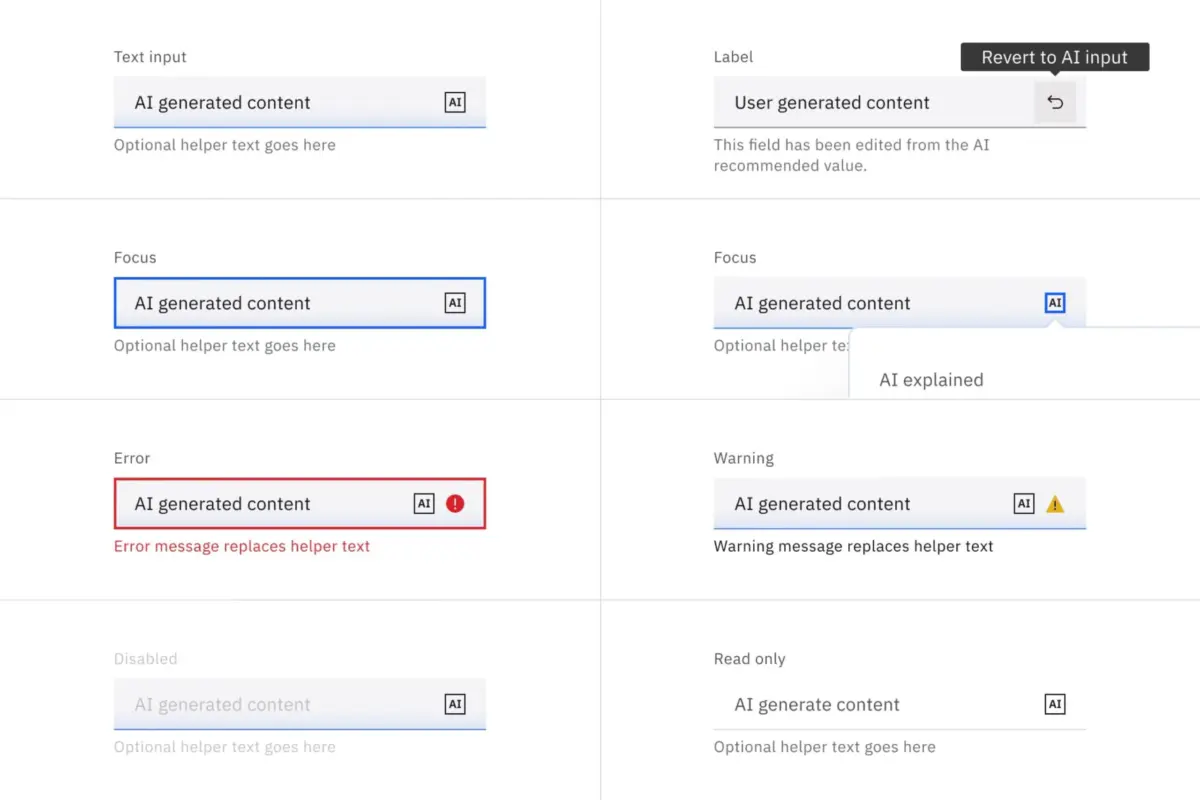
Leading design systems—such as IBM’s Carbon Design System—have begun adopting similar robust UI patterns, incorporating inline text labels, explicit aria-labels for screen readers, and expandable explainability panels.
To satisfy regulators, organizations must adhere to strict display criteria:

- No Hidden Disclosures: Icons buried deep in website footers, labels rendered in low-contrast grey-on-grey, or badges that flash for a fraction of a second are explicitly illegal.
- Plain-Language Pairing: Icons should be paired with explicit, human-readable text, such as the clear label "AI-generated".
- Persistent Metadata: Disclosures cannot exist merely in the DOM of a webpage; they must persist when content is downloaded, shared, or exported across platforms via machine-readable watermarking and metadata tagging.
Global Context: A Worldwide Regulatory Convergence
While European businesses feel the immediate weight of the AI Act, international stakeholders must recognize that the EU is not operating in a regulatory vacuum. A global pattern of AI transparency legislation is rapidly solidifying across major economic superpowers.
| Region / Jurisdiction | Key Regulation / Legislative Focus | Primary Target Areas |
|---|---|---|
| European Union | EU AI Act (Article 50) | Comprehensive horizontal rules covering synthetic media, public interest text, and commercial imagery. |
| United States | State-Level Legislation (e.g., California, New York) | Synthetic human performers (deepfakes of actors/politicians) and political advertising disclosures. |
| China | CAC Generative AI Measures | Mandatory watermarking and explicit tagging for deep synthesis and generative text/video services. |
| South Korea & Japan | Emerging Digital Agency Frameworks | Content provenance standards and copyright-aligned labelling for creative industries. |
This synchronized global shift indicates that transparency is becoming a baseline cost of doing business in the digital age. Designing systems with built-in, modular AI labelling is no longer just about satisfying European bureaucrats—it is a future-proof product strategy for a globalized market.
Future Outlook: Turning Compliance into a Trust Advantage
The arrival of the EU’s August 2026 enforcement deadline should inspire strategic preparation rather than panic. At its heart, the regulation champions a profoundly simple consumer right: When artificial intelligence generates content that could easily be mistaken for human work, creators and deployers must say so clearly and unambiguously.

Far from being a mere regulatory burden, this shift offers a unique opportunity for product designers and brands. In an internet increasingly flooded with low-quality automated output—often dismissed as "AI slop"—provenance and authenticity are becoming luxury commodities. By embracing transparent, accessible, and user-centric UI patterns for AI disclosure, companies can build profound trust with their audiences.
Product teams should immediately audit their current feature sets, review their usage of ambiguous sparkle icons, and establish rigorous editorial workflows that clearly delineate human oversight from machine generation. By treating transparency as a core design principle rather than an afterthought, organizations can protect themselves from penalties while championing clarity in an increasingly synthetic world.
Meet “Design Patterns For AI Interfaces”
As product teams grapple with these complex UX and regulatory challenges, practical education is vital. Design Patterns For AI Interfaces is a comprehensive video course created by interface design expert Vitaly Friedman. Featuring practical, real-world examples from cutting-edge digital products, the course dives deep into how to design ethical, accessible, and compliant AI interactions.

Whether you are designing chat interfaces, autonomous agents, or complex data dashboards that require clear AI labelling, this course provides the blueprints you need. Jump to a free preview on YouTube or explore the complete curriculum at Design Patterns For AI Interfaces.