

Executive Overview
For years, the conventional wisdom of freelance writing relied on exhausting cold-email campaigns, hyper-competitive job boards, and endless bidding on content mills. Today, the operational landscape of the freelance economy has fundamentally shifted. According to industry surveys and independent contractor data, LinkedIn has evolved from a digital resume repository into the single most powerful inbound lead generator for professional copywriters, content strategists, and niche scribes.
Yet, simply having an account or lazily sharing an article once a month is no longer enough. LinkedIn’s underlying platform algorithm has undergone rigorous transformations. Modern updates heavily penalize automated spam, engagement-pod manipulation, and generic self-promotion while aggressively favoring deep industry relevance, thought leadership, and organic human engagement.
For the modern freelance writer, mastering LinkedIn is no longer a tertiary nice-to-have; it is an absolute commercial imperative. This comprehensive playbook details five strategic pillars designed to help independent writers overcome posting anxiety, optimize their digital storefronts, engage directly with high-value enterprise prospects, and cultivate a predictable pipeline of inbound clients—all within 20 to 30 minutes a day.
Detailed Chronology: The Evolution of Freelancer Lead Generation
To understand why LinkedIn dominates the modern freelance landscape, we must examine how lead generation has evolved over the past decade:
- The Era of Content Mills (Early 2010s): Freelancers relied on platforms like Elance (later Upwork) and specialized content farms, trading volume for pennies per word in an unsustainable race to the bottom.
- The Rise of Cold Pitching (Mid 2010s): Writers took control of their destinies by building cold-email funnels, sending dozens of speculative pitches daily to agency owners and marketing directors with low single-digit conversion rates.
- The Job Board Boom (Late 2010s to 2020): Curated job boards (like ProBlogger or MediaBistro) became hotbeds for employment opportunities, though increased competition meant single postings often drew hundreds of applications within hours.
- The Inbound Social Shift (2021–Present): With the saturation of traditional channels, decision-makers shifted their attention to professional social networks. LinkedIn matured into a primary search engine for B2B procurement, forcing a pivot from outbound hunting to inbound positioning.
As the platform matured, LinkedIn altered its algorithm to curb low-effort engagement loops. The era of dropping arbitrary links or spamming generic "Great post!" comments died. In its place arose an ecosystem that rewards authentic problem-solving, structural readability, and peer-to-peer authority. Writers who recognized this shift early capitalized on it; those who ignored it found themselves struggling to find consistent work.
Supporting Context & Metrics: Why LinkedIn Outperforms Traditional Channels
The data supporting LinkedIn’s dominance among independent professionals is striking. Industry benchmarks indicate that more than 70% of B2B decision-makers use LinkedIn data when researching potential vendors, agencies, and contract talent.
Algorithm Realities: What Works vs. What Fails
To maximize your visibility, you must align your content strategy with what the platform’s distribution engine currently rewards and penalizes:
- What Gets Rewarded:
- Original, text-forward thought leadership supported by strong formatting (short paragraphs, bold hooks).
- Niche-specific expertise demonstrated consistently over time.
- Authentic conversations sparked in the comments section by the author.
- Document/carousel PDFs that encourage users to swipe and dwell on the post.
- What Gets Penalized:
- Outbound links in the main body of a post (which drive users off the platform).
- Engagement bait (e.g., "Comment ‘YES’ below to get my free guide").
- Irrelevant tagging of hundreds of unassociated accounts to artificially inflate reach.
- Generic cross-posting of corporate press releases without a personal voice.
When you consistently post about a specific vertical for a specific target audience, LinkedIn’s algorithm recognizes your authority within that niche, systematically amplifying your content to secondary and tertiary networks of individuals who match those exact buyer profiles.
Five Core Strategies to Master LinkedIn for Freelance Writers
+--------------------------------------------------------------------------+
|                        THE LINKEDIN FREELANCE FUNNEL                     |
|                                                                          |
|  1. TARGETING CLIENTS    -> Focus on B2B buyers, not fellow writers.     |
|  2. CONSISTENT CADENCE   -> Post 1-2 times weekly to beat anxiety.         |
|  3. STRATEGIC ENGAGEMENT -> Use the "Walking the Marketing Dog" method.   |
|  4. PROFILE OPTIMIZATION -> Turn your page into a high-converting sales  |
|                             page.                                        |
|  5. IDEA BRAIN           -> Maintain a continuous backlog of 10 daily      |
|                             content ideas.                               |
+--------------------------------------------------------------------------+
Strategy 1: Write to Potential Clients, Not Other Freelancers
A trap that ensnares countless emerging freelance writers is the "echo chamber" phenomenon. Writers log onto LinkedIn, join writing communities, and spend all their time networking, commiserating, and exchanging tips with other freelance writers.
While peer support networks are valuable for emotional resilience and occasional referral sharing, they will not fill your bank account. Marketing directors, startup founders, and content managers do not hire freelance writers who spend all day talking about how hard it is to be a freelance writer. They hire writers who deeply understand their business challenges.
Actionable Implementation Steps:
- The 10-Post Audit: Review your last ten LinkedIn posts. Tally how many are focused on general freelancing tips versus topics that directly address your ideal client’s pain points. If the scale tips toward peer-focused content, execute an immediate pivot.
- Define 3–5 Client-Centric Pillars: Identify the core themes your prospective buyers care about. If you are a freelance medical writer, discuss regulatory updates, clinical trial trends, or content bottlenecks in biotech. If you write for financial technology (Fintech) brands, focus on compliance, payment gateways, or customer acquisition strategies.
- Demonstrate Expertise Without Violating NDAs: Share insights derived from recent client projects (anonymized, of course), break down why a major brand’s marketing campaign succeeded, or offer a contrarian take on a breaking industry trend.
When a corporate marketing lead lands on your profile, they should instantly realize they have found an insider who speaks their commercial language.
Strategy 2: Overcome Posting Anxiety Through Sustainable Cadence
Conventional social media advice often mandates daily—or even twice-daily—publishing schedules. For a working freelance writer managing tight client deadlines, this advice is not only unrealistic; it is a direct expressway to severe burnout and imposter syndrome.

The paralyzing fear of "not having anything smart to say" causes many talented writers to freeze and publish nothing at all. The truth is liberating: posting consistently once or twice a week over several months yields exponentially better results than erratic daily posting followed by weeks of silence.
Actionable Implementation Steps:
- Establish a Realistic Cadence: Commit to a frequency you can maintain indefinitely. Every Monday and Thursday, or simply every Wednesday, works wonders. Consistency matters vastly more than volume.
- Batch Your Content: Block out a dedicated 30-minute window every Sunday to outline and write your posts for the upcoming week. Use LinkedIn’s native scheduler to queue them up, freeing your mind for billable client work the rest of the week.
- Lean Into Proven Text Formats: You do not need expensive graphic design software or video production equipment. Clean, well-formatted text posts with strong hooks dominate reach. Focus on simple frameworks:
- The Case Study: Problem -> Approach -> Results achieved.
- The Contrarian Take: State a common industry belief, explain why it is flawed, and offer your better alternative.
- The Framework Breakdown: List a step-by-step process your clients can use to solve a specific internal problem.
Strategy 3: Focus on High-Value Engagement ("Walking the Marketing Dog")
LinkedIn is a marathon, not a sprint. Organic visibility builds cumulatively over time. However, you can dramatically accelerate your pipeline by prioritizing proactive engagement over passive broadcasting.
Content marketing strategist Sarah Greesonbach refers to this daily discipline as "walking the marketing dog." Just as a pet owner must take their companion out for a daily stroll, an independent professional must regularly take their business out into the digital public square.
Actionable Implementation Steps:
- Curate a Prospect List: Compile a target list of 20 to 30 decision-makers—such as marketing directors, VP of content, editorial heads, or startup founders at companies you dream of writing for. Follow every single one of them.
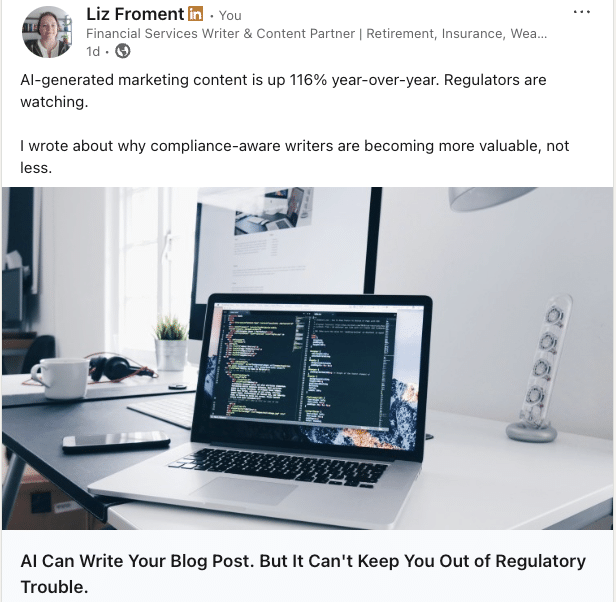
- Engage Meaningfully: Spend 15 to 20 minutes daily reviewing their activity feeds. Avoid lazy, generic responses like "Great post!" or "So true!" These get ignored. Instead, deploy insightful commentary that adds value:
- Expand upon their premise with a complementary data point.
- Politely offer a nuanced perspective or counter-argument.
- Ask a thoughtful follow-up question that deepens the professional dialogue.
- Adopt the 3-2-1 Method: Popularized by B2B consultant Ed Gandia, this framework keeps daily networking simple and structured:
- 3 Connection requests sent to prospective clients.
- 2 Thoughtful, value-add comments left on target accounts’ posts.
- 1 Original post published to your profile.
When you execute this routine daily, your name becomes a familiar, trusted fixture in your prospects’ notifications. Eventually, curiosity drives them to click your profile.

Strategy 4: Optimize Your Profile to Act as a Sales Page
If your content and engagement strategy successfully drives eyeballs to your profile, your digital real estate must be primed to convert those visitors into paying clients. Treat your LinkedIn profile less like a static resume and more like a high-converting landing page.
Actionable Implementation Steps:
- Rewrite Your Headline: Erase the generic title "Freelance Writer." Replace it with a value-driven statement that clearly communicates your niche and outcome:
- Instead of: "Freelance Writer | SaaS & Tech"
- Use: "B2B SaaS Content Writer | Helping cloud infrastructure brands turn complex tech into high-converting case studies & guides."
- Transform the "About" Section: Write this section in the second person, addressing the prospective client directly. Detail the exact problems you solve, the industry verticals you serve, and measurable outcomes you have delivered. Conclude with a clear call to action (CTA) directing them to your portfolio website or booking link.
- Leverage the "Featured" Section: Pin two or three of your absolute best writing samples, case studies, or glowing client video testimonials to the top of your profile.
- Upgrade Your Experience Section: Avoid vague descriptions like "Wrote articles for various clients." Instead, specify scope and impact: "Authored 50+ deep-dive technical guides on artificial intelligence and banking compliance for Series B fintech startups."
Strategy 5: Build an "Idea Brain" to Eliminate Writer’s Block
Even the most prolific writers occasionally stare at a blinking cursor wondering what to post. The permanent antidote to creative paralysis is the systematic cultivation of an "Idea Brain."
Actionable Implementation Steps:
- The Daily Ten Challenge: Set a recurring daily reminder on your phone. Every morning over coffee, open your notes app and rapidly jot down ten raw ideas. They can be rough post concepts, article topics, frustrations you experienced during a client call, or questions a reader asked. Do not judge the quality; prioritize raw volume.
- Weekly Curation: At the end of each week, review your list of 70 raw ideas. Typically, 5 to 10 will stand out as viable gems ready for development into full LinkedIn posts.
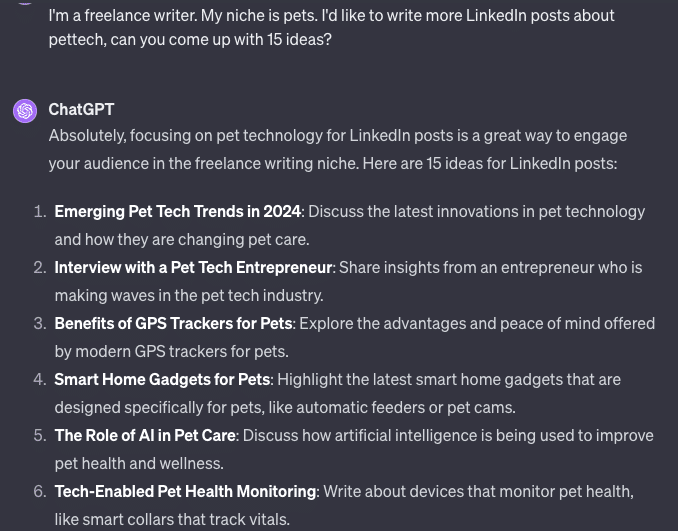
- Leverage AI as a Sparring Partner: When you feel genuinely stuck, utilize modern AI writing tools like ChatGPT to break the friction of a blank page. Prompt the system with: "Give me 10 unique angles for LinkedIn posts targeting marketing directors in the medical device industry." Use the generated output not as final copy, but as a structural springboard to infuse your own unique voice, case studies, and perspective.
Future Outlook: The Sustainable Future of Freelance Writing
The macroeconomic landscape for independent contractors is evolving rapidly. As automated content generation tools flood the internet with generic, commoditized text, the value of authentic human insight, strategic thinking, and verified industry expertise has skyrocketed. Brands no longer need cheap typists who can spin out thousands of generic words; they need strategic partners who can help them build authority, earn trust, and capture market share.
LinkedIn sits directly at the intersection of this high-value shift. By dedicating just 20 to 30 minutes a day to strategic targeting, overcoming posting anxiety, engaging thoughtfully with buyers, optimizing your profile, and building a sustainable content system, you insulate your business from the feast-or-famine cycle.
The platform rewards consistency, authority, and genuine human connection. Stop hiding behind traditional job boards and cold-email spreadsheets. Claim your digital real estate on LinkedIn today, put in the strategic effort, and watch your freelance writing business transform into a predictable, high-earning enterprise.