The landscape of search engine optimization (SEO) has fundamentally transformed. Gone are the days when digital marketers could rely on static, manually updated weekly spreadsheets to gauge organic visibility. In 2025, search engine results pages (SERPs) are volatile, hyper-localized, and dominated by dynamic elements—ranging from traditional local map packs and featured snippets to complex AI Overviews and video carousels. For modern enterprises, digital agencies, and e-commerce giants, accurately measuring this shifting ground is no longer just a technical exercise; it is a core business imperative.
Investing in robust SERP (Search Engine Results Page) tracking software allows organizations to transition from reactive troubleshooting to proactive strategy formulation. Modern tracking platforms provide granular insights across devices, localized zip codes, and alternative search engines, mapping keyword movements directly to business metrics like organic traffic, conversions, and revenue.
This comprehensive review examines the current state of rank tracking, outlines the nine essential features required in modern SEO stacks, and provides an in-depth evaluation of the seven best SERP tracking tools available in 2025. Whether you are looking for a dedicated, standalone monitoring engine or an all-in-one digital marketing suite, this guide will help you select the right tool to safeguard and scale your organic growth.
Detailed Chronology & Industry Evolution
The evolution of rank tracking mirrors the maturation of the SEO industry itself.
The Early Era (Pre-2010s): Optimization was largely localized and straightforward. Webmasters tracked a small, static basket of keywords manually or via basic desktop scrapers. Search engines delivered uniform, blue-link results across desktop browsers globally, making simple rank tracking sufficient.
The Mobile & Local Revolution (2010–2018): As mobile internet usage surpassed desktop and search engines introduced aggressive geo-targeting, the SERP fragmented. A ranking in New York City no longer matched a ranking in Los Angeles. Rank trackers had to adapt by engineering location-aware scraping architectures and split-screen mobile versus desktop monitoring.
The Feature-Rich SERP & AI Era (2019–Present): Search engines evolved past simple vertical listings. Knowledge graphs, People Also Ask (PAA) boxes, video carousels, and local packs began dominating above-the-fold real estate. Most recently, the integration of generative AI Overviews has rewritten the rules of organic visibility. Today’s top-tier SERP trackers do not merely record a numerical position (e.g., "Position 4"); they capture the entire SERP ecosystem, tracking visibility share, feature ownership, and semantic market penetration in real-time.
Supporting Context & Metrics: Why Invest in Modern SERP Trackers?
Accurately validating SEO efforts requires more than vanity metrics. When boardrooms demand accountability for marketing budgets, digital leaders must prove ROI through granular visibility data. Modern SERP tracking software serves several critical functions:
Validating SEO Investments: By continuously monitoring SERP feature movements and ranking positions across diverse search engines and devices, marketers can demonstrate tangible progress toward key business objectives.
Mitigating Algorithm Volatility: Search engine algorithm updates occur with increasing frequency. Advanced trackers isolate performance dips caused by algorithmic shifts versus those caused by technical site errors.
Uncovering Low-Hanging Fruit: Granular filtering allows SEO teams to identify content pieces hovering just outside the top three positions—prime candidates for minor content optimizations to capture high-value SERP features like Position #0.
Connecting Visibility to Revenue: Integrating rank trackers with analytics suites bridges the gap between keyword movement and financial outcomes, clarifying which landing pages drive the most conversion volume.
The 9 Essential Features to Look for in SERP Tracking Software
When auditing software solutions, professionals should evaluate platforms against a strict checklist of capabilities.
1. Access Accurate On-Demand Ranking Updates
SERP positions fluctuate rapidly throughout the day. Waiting days for scheduled batch updates leaves teams blind to sudden drops or traffic spikes. The best tools offer automated 24-hour cycles paired with on-demand, single-click manual refreshes. Tools like AccuRanker lead this category, allowing users to pull fresh data instantly.
2. Monitor Performance Across SERP Features
Securing a traditional blue link is only half the battle. Modern search queries trigger AI Overviews, featured snippets, local packs, and knowledge cards. Leading platforms track 50+ distinct SERP features, mapping out who owns these high-visibility spaces and highlighting actionable paths to capture them.
3. Track SERP Movement Across All Major Search Engines
While Google commands the majority of global search market share, multi-engine tracking remains essential for international campaigns targeting regions where platforms like Bing, Baidu, Yandex, or YouTube dictate consumer behavior.
4. Granular Tracking (Location and Device)
High-level national averages obscure local nuances. Top-tier tools offer location-based tracking down to the zip code or city level, alongside clear segmentation between mobile and desktop user experiences.
5. Map SERP Movements to Traffic and Revenue/Conversions
Visibility without context is incomplete. Advanced tracking integrations pull organic visitor metrics, bounce rates, and conversion goals from platforms like Google Analytics or Adobe Analytics, synthesizing them into comprehensive landing page performance reports.
6. View Historical Rank Performance
Point-in-time snapshots fail to tell the whole story. Comprehensive historical data allows analysts to plot long-term trends, evaluate performance across multi-year horizons, and benchmark historical trajectories against direct competitors.
7. Run Competitor Comparisons
Rankings exist in a zero-sum environment. Grouping keywords into position buckets (e.g., 1–3, 4–10, 11–50) allows teams to run comparative distribution analyses, revealing precisely where competitors are gaining or losing ground.
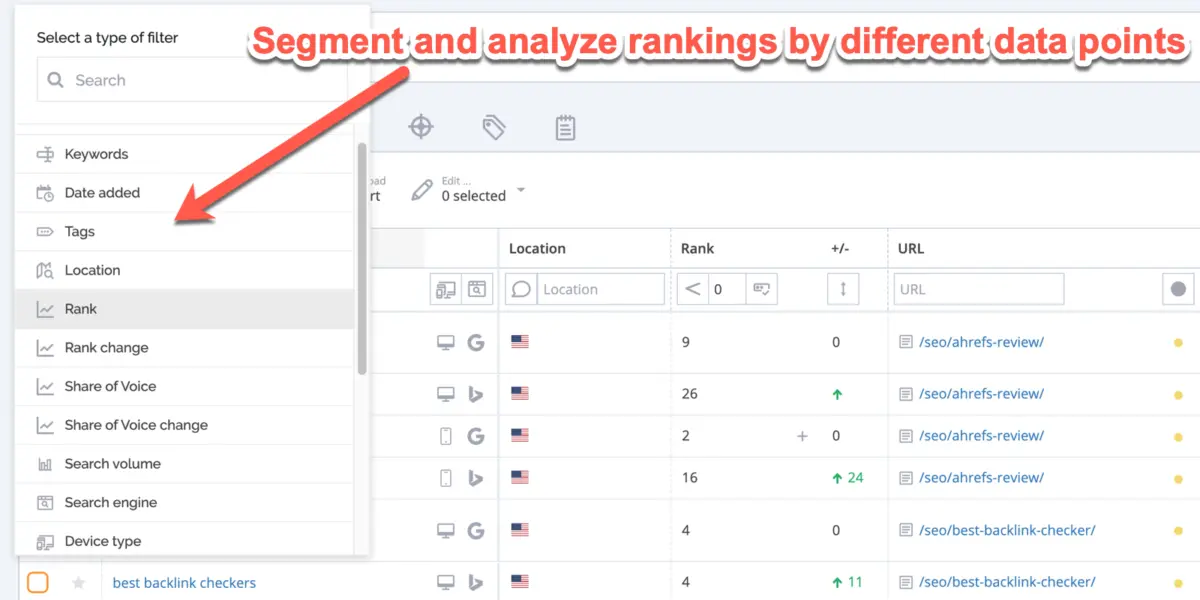
8. Tag and Segment Rankings Data
Not all keywords hold equal weight. Effective platforms offer deep tagging functionalities, enabling users to segment data by topic, sales funnel stage, content asset type, device, and geographic market.
9. Generate White-Label Reports
Agency workflows demand polished, client-ready reporting. Native white-label scheduling capabilities—supported by seamless connectors to tools like Google Looker Studio (formerly Data Studio) or Databox—ensure stakeholders receive clear, digestible insights.
Official Statements & Industry Perspectives
Industry leaders emphasize the shifting value of modern rank tracking infrastructure. Ian Howells, Co-Founder of Traffic Think Tank, notes:
"The thing that really got me using them heavily in the last month or two is their [reporting] connector. Combining the tag feature, as well as the Share of Voice metric… has been a big help in making these reports immediately digestible."
Similarly, Matthew Howells-Barby observes:
"It’s by far the best keyword ranking tracker in the market and has a ton of great reporting functions. If you want visibility on large volumes of keywords housed within a nice dashboard — this is for you."
The 7 Best SERP Tracking Tools to Consider in 2025
The market features countless options, but a select few platforms consistently deliver the accuracy, speed, and analytical depth required by modern enterprises.
1. AccuRanker
Overview: AccuRanker is a premier standalone SERP tracking platform trusted by over 32,000 companies, including HubSpot, IKEA, and Kinsta. Designed for agencies and enterprise brands, it delivers lightning-fast, highly accurate data.
Best Features: On-demand data refreshes, robust SERP analysis covering 50+ features, multi-search engine support (Google, Bing, Baidu, Yandex, YouTube), and deep Google Analytics integrations.
Who is it for: SEO agencies, consultants, and enterprise organizations prioritizing raw data speed and laser-focused rank monitoring.
Pricing: Starts at $116/month for up to 1,000 tracked keywords.
2. Semrush (Position Tracker & SERP Gap Analyzer)
Overview: As an all-in-one digital marketing powerhouse utilized by over 10 million users (including Samsung and Vodafone), Semrush integrates world-class rank tracking directly into a massive suite of SEO, content, and competitive research tools.
Best Features: Hyper-accurate daily position tracking, granular location filters down to local map packs, and the innovative SERP Gap Analyzer app available in the Semrush App Center, which scans SERPs to uncover under-optimized content opportunities.
Who is it for: Digital marketing professionals, e-commerce brands, and enterprises seeking a comprehensive, all-in-one platform with enterprise-grade rank tracking.
Pricing: Subscription plans start at $139.95/month.
3. ProRankTracker
Overview: ProRankTracker is a cost-effective, standalone rank monitoring solution trusted by over 60,000 users worldwide, specializing in accurate international tracking and comprehensive reporting.
Best Features: Advanced multi-language support, accurate local tracking across devices, and automated executive reporting features.
Who is it for: SEM agencies, international businesses, and video marketers seeking reliable performance metrics on a budget.
Pricing: Plans start at $39/month.
4. Advanced Web Ranking (AWR)
Overview: AWR is an established standalone SERP tracker relied upon by major brands and global enterprises like Microsoft to monitor multi-device, multi-location visibility.
Best Features: Exceptional scalability, customizable white-label reporting engines, and flexible data export capabilities.
Who is it for: In-house SEO teams and enterprise agencies requiring robust data pipelines and deep customization.
Pricing: Subscription plans start at $99/month.
5. SERPWatcher (by Mangools)
Overview: Developed by Mangools, SERPWatcher offers a streamlined, user-friendly approach to rank tracking, backed by a unique Performance Index metric that forecasts organic traffic potential. Trusted by global brands like Airbnb and Adidas.
Best Features: Intuitive UI, the proprietary Performance Index metric, and seamless bundling with sibling tools like SERPChecker.
Who is it for: Startups, small business owners, and agencies looking for simplified, highly visual SEO tools.
Pricing: Starts at $29.90/month.
6. SE Ranking
Overview: SE Ranking is a versatile all-in-one SEO platform featuring a robust Position Tracking module that simulates real user behavior across major search engines and precise geographic coordinates.
Best Features: 100% accurate localized tracking simulations, comprehensive competitor ranking distribution charts, and integrated marketing task planners.
Who is it for: Small-to-medium businesses and digital agencies looking for balanced feature sets and strong value.
Pricing: Starts at $52/month (based on daily tracking for 500 keywords).
7. Nightwatch
Overview: Trusted by enterprises such as Shopify, Scotiabank, and Coinbase, Nightwatch is celebrated for its deep data granularity, pulling exact rankings from over 107,000 global locations.
Best Features: Hyper-local geographic granularity, robust data segmentation, and clean, modern visualization dashboards.
Who is it for: Freelancers, SMBs, and enterprise agencies scaling localized or global search campaigns.
Pricing: Paid plans start at $32/month for up to 250 keywords, backed by a 14-day free trial.
Future Outlook
As we look toward the horizon of digital marketing, the role of SERP tracking software will only expand. With search engines increasingly tailoring results through artificial intelligence and personalized search vectors, static rank tracking is officially obsolete.
Future-proofed organizations will adopt hybrid strategies: pairing dedicated standalone trackers (such as AccuRanker) for high-frequency, raw data precision, or leveraging comprehensive all-in-one platforms (such as Semrush) to tie rank fluctuations directly into broader content optimization workflows. By prioritizing accurate on-demand updates, rich SERP feature analysis, and seamless revenue attribution, modern SEO professionals will maintain a competitive edge through every algorithmic shift.

![7 Best SERP Tracking Tools for 2022 [In-Depth Review]](https://www.robbierichards.com/wp-content/uploads/2020/05/Best-SERP-Trackers.jpg)
![7 Best SERP Tracking Tools for 2022 [In-Depth Review]](https://www.robbierichards.com/wp-content/uploads/2020/04/image16-2.png)
![7 Best SERP Tracking Tools for 2022 [In-Depth Review]](https://www.robbierichards.com/wp-content/uploads/2020/04/image2-3.png)
![7 Best SERP Tracking Tools for 2022 [In-Depth Review]](https://www.robbierichards.com/wp-content/uploads/2020/04/image6-2.png)
![7 Best SERP Tracking Tools for 2022 [In-Depth Review]](https://www.robbierichards.com/wp-content/uploads/2020/04/image15.jpg)
![7 Best SERP Tracking Tools for 2022 [In-Depth Review]](https://www.robbierichards.com/wp-content/uploads/2020/04/image12-1.png)
![7 Best SERP Tracking Tools for 2022 [In-Depth Review]](https://www.robbierichards.com/wp-content/uploads/2020/04/image13-2.png)
![7 Best SERP Tracking Tools for 2022 [In-Depth Review]](https://www.robbierichards.com/wp-content/uploads/2020/04/image3.jpg)
![7 Best SERP Tracking Tools for 2022 [In-Depth Review]](https://www.robbierichards.com/wp-content/uploads/2018/08/rj-employee_Robbie-color-new.png)
![7 Best SERP Tracking Tools for 2022 [In-Depth Review]](https://www.robbierichards.com/wp-content/uploads/2020/05/Databox-SEO-dashboard-1.jpg)
![7 Best SERP Tracking Tools for 2022 [In-Depth Review]](https://www.robbierichards.com/wp-content/uploads/2020/04/image4-2.png)
![7 Best SERP Tracking Tools for 2022 [In-Depth Review]](https://www.robbierichards.com/wp-content/uploads/2020/04/image5.jpg)
![7 Best SERP Tracking Tools for 2022 [In-Depth Review]](https://www.robbierichards.com/wp-content/uploads/2020/05/AccuRanker-Google-Data-Studio-integration.jpg)
![7 Best SERP Tracking Tools for 2022 [In-Depth Review]](https://www.robbierichards.com/wp-content/uploads/2018/11/Ian-Howells2.png)
![7 Best SERP Tracking Tools for 2022 [In-Depth Review]](https://www.robbierichards.com/wp-content/uploads/2019/01/Google-Data-Studio-KW-rankings-dashboard.png)
![7 Best SERP Tracking Tools for 2022 [In-Depth Review]](https://www.robbierichards.com/wp-content/uploads/2025/01/AccuRanker-home-page.jpg)
![7 Best SERP Tracking Tools for 2022 [In-Depth Review]](https://www.robbierichards.com/wp-content/uploads/2015/01/matthew-barby.jpg)
![7 Best SERP Tracking Tools for 2022 [In-Depth Review]](https://www.robbierichards.com/wp-content/uploads/2022/06/image1-1.png)
![7 Best SERP Tracking Tools for 2022 [In-Depth Review]](https://www.robbierichards.com/wp-content/uploads/2025/01/Semrush-SERP-Gap-Analyzer-1024x447.png)
![7 Best SERP Tracking Tools for 2022 [In-Depth Review]](https://www.robbierichards.com/wp-content/uploads/2025/01/Semrush-SERP-Gap-Analyzer-Search-Console-integration.png)
![7 Best SERP Tracking Tools for 2022 [In-Depth Review]](https://www.robbierichards.com/wp-content/uploads/2020/04/image10-2.png)