

Executive Overview
As the nation barrels toward the November 2026 midterm elections, the political landscape is dominated by mounting anticipation of a powerful Democratic blue wave. Caught squarely in the crosscurrents of this national undertow is Senator Susan Collins of Maine. Having represented her state for nearly three decades, Collins has long cultivated a reputation as a political Houdini, routinely evading defeat in hostile cycles through a carefully managed facade of moderation and independence. Yet, as the fall campaign reaches a fever pitch, that vaunted political survival artistry is facing its most severe test to date.
No longer able to effectively insulate herself from the polarizing national fallout of the Donald Trump era, Collins finds her decades-long brand significantly eroded. Her pivotal, yet deeply consequential, vote to confirm Justice Brett Kavanaugh to the Supreme Court—and the subsequent dismantling of Roe v. Wade—turned her once-vaunted stance on reproductive rights into a glaring political liability. Compounding these vulnerabilities are damaging investigative reports detailing suspicious, high-level campaign fundraising and pay-to-play allegations involving defense contractor networks.
While Collins continues to lean heavily on her seniority, her leadership on the powerful Senate Appropriations Committee, and her traditional appeals to bring home federal resources for Maine, her Democratic challenger, former Maine Senate President Troy Jackson, has weaponized her record of compliance. Portraying her as an entrenched insider tethered to a corrupt Washington establishment, Jackson’s populist message resonates deeply in an environment defined by voter exhaustion with executive overreach. For Mainers, the central question of this election cycle has distilled into a stark choice: whether to reward long-standing legislative seniority or to reject a senator whose record shows a consistent pattern of enabling the erosion of democratic norms and constitutional boundaries.
Detailed Chronology: From the Kavanaugh Confirmation to the 2026 Battleground
To understand the precariousness of Collins’s current standing, one must trace the critical milestones that steadily dismantled her moderate credentials over the past eight years. The fracture lines of her political support began to show visibly during the turbulent confirmation battle of Brett Kavanaugh in the autumn of 2018.
The Turning Point: 2018 and the Kavanaugh Vote
Facing immense national pressure, Collins cast the decisive vote to confirm Kavanaugh to the highest court in the land. In defending her decision to her constituents, she publicly vouched for his judicial temperament and mainstream credentials, assuring voters that Kavanaugh regarded Roe v. Wade as "settled law."
That assurance evaporated in June 2022 when the Supreme Court issued its landmark Dobbs v. Jackson Women’s Health Organization ruling, formally overturning nearly fifty years of constitutionally protected abortion access. While Collins subsequently claimed she had been "misled" by Kavanaugh, she steadfastly refused to repudiate her vote. For a state with a majority-female electorate that deeply values bodily autonomy, the disconnect between her justifications and the stark reality of post-Dobbs America proved irreversible. The issue transformed from a minor policy disagreement into a definitive breaking point for thousands of moderate and independent voters.
The 2026 Democratic Primary Turbulence
As the 2026 election cycle materialized, the Democratic strategy to unseat Collins experienced multiple iterations. Senate Minority Leader Chuck Schumer initially pursued a playbook aimed at mirroring Collins’s demographic profile, successfully persuading popular Democratic Governor Janet Mills, 79, to enter the race. However, as progressive factions advocated for a younger, working-class populist outsider, lobster fisherman Graham Platner emerged as a formidable alternative whose rough-hewn persona struck a chord with voters.
Mills eventually stepped aside as her heart wasn’t fully in the grueling campaign. Shortly thereafter, Platner’s campaign collapsed entirely when he was forced to withdraw due to credible allegations of sexual assault. Democrats quickly rallied around a seasoned, salt-of-the-earth replacement: Troy Jackson, a fifth-generation logger and former president of the Maine Senate. Jackson’s deep roots in the state and authentic working-class background made him an ideal compromise candidate, allowing him to quickly outpace Collins in several key state polls, though high-profile surveys like the New York Times/Portland Press/Siena poll continue to show a razor-thin contest.
The Pay-to-Play Allegations and the 2023–2026 FBI Investigation
The ground beneath Collins shifted further in September 2026, when an investigative report published by ProPublica, supported by parallel reporting from the New York Times, revealed that the senator’s campaign finances were entangled in a high-stakes pay-to-play scandal.
According to federal documents, the former CEO of a defense contractor admitted to the FBI that he orchestrated a shell company scheme to conceal a $150,000 donation to a super PAC supporting Collins. The contribution was allegedly made in direct exchange for her assistance in securing millions of dollars in federal defense contracts—contracts the firm ultimately received. Evidence suggested Collins was not only aware of the arrangement but actively facilitated the bureaucratic maneuvers required to execute it.
Although an initial preliminary FBI inquiry in 2023 stalled without formal charges, subsequent evidence reportedly pointed toward an expanded investigation. However, that probe was effectively neutralized when the Trump Justice Department intervened, purging investigators and attorneys handling political corruption cases. While Collins maintains her innocence and insists she was fully cleared of wrongdoing, the revelations cast a long, damaging shadow over her campaign at a time when voters are increasingly cynical about government ethics.
Supporting Context & Metrics: Judicial Loyalty and Legislative Record
Collins has long attempted to straddle a fine political line, presenting herself as an independent voice while quietly anchoring the Republican legislative and judicial agenda. A closer examination of her voting metrics reveals a stark divergence between her moderate rhetoric and her actual legislative footprint.
- Judicial Confirmations: According to a comprehensive analysis by Planned Parenthood, Collins has voted to confirm approximately 95% of Donald Trump’s federal judicial nominees. This includes numerous jurists with explicit records of hostility toward reproductive freedom and civil rights protections. While defenders note this compliance rate aligns with her voting patterns under previous administrations, the cumulative effect has been a wholesale conservative transformation of the federal bench.
- The Equality Act: In a stark illustration of shifting political alignments, Collins previously co-sponsored the Equality Act, which sought to explicitly add sexual orientation and gender identity to federal civil rights protections. However, after major LGBTQ+ advocacy organizations withdrew their endorsements of her campaign due to her broader alignment with the conservative judicial agenda, Collins formally pulled her support for the legislation, alienating core progressive and moderate coalitions alike.
- Executive Overreach and the Power of the Purse: Despite her positioning as a institutionalist who defends the separation of powers, Collins has routinely failed to check executive encroachment on congressional authority. Notably, she voted to confirm Russell Vought as budget director. Vought, the principal architect of Project 2025, has openly argued that the executive branch possesses the inherent constitutional authority to unilaterally cancel congressional appropriations it finds unfavorable—a direct assault on Congress’s foundational power of the purse.
Official Statements and Campaign Rhetoric
The ideological battle lines of the 2026 Maine Senate race have been drawn sharply between Collins’s appeals to institutional seniority and Jackson’s populist denunciations of Washington corruption.
Senator Susan Collins:
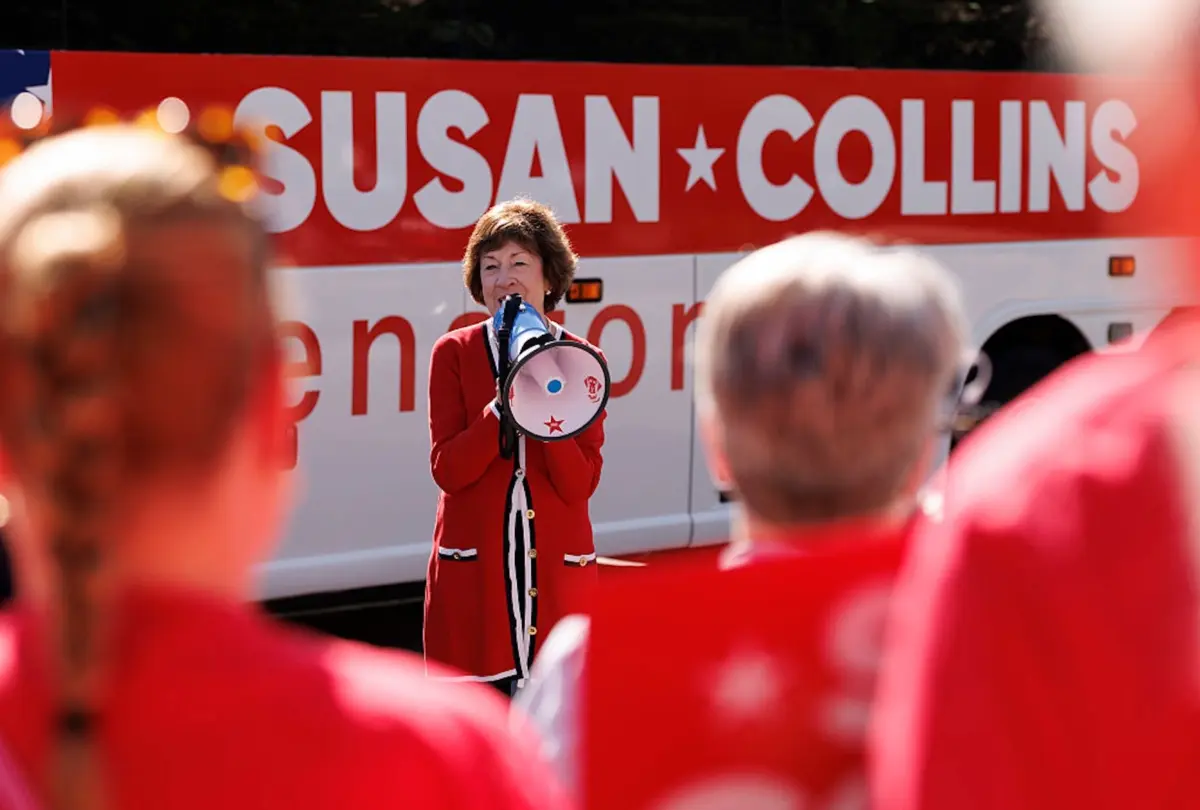
Throughout her bus tour across Maine, Collins has doubled down on her core value proposition: seniority, institutional power, and the tangible economic benefits she delivers to her constituents as a senior member of the Appropriations Committee.
"At a time of profound economic uncertainty and national division, Maine needs a proven leader who can deliver results and command respect at the highest levels of government," Collins told supporters during a campaign stop in Kittery. "My entire career has been dedicated to fighting for the people of this state, cutting through bureaucratic red tape, and ensuring our communities have the resources they need to thrive."
Addressing the swirling controversies regarding her campaign finances and judicial votes, Collins’s campaign has issued categorical denials, dismissing the investigative reports as politically motivated opposition research designed to derail her reelection.
Challenger Troy Jackson:
Jackson has countered by framing Collins as a compromised career politician who has traded her independence for party loyalty, while tying her directly to the systemic corruption of the Washington establishment.
"For nearly thirty years, Susan Collins has asked Mainers to trust her independence, while quietly rubber-stamping the judges who took away our fundamental rights and enabling an administration that views the rule of law as optional," Jackson declared during a recent rally in Bangor. "Mainers don’t need a fixer for the political swamp or a Washington insider facing federal corruption probes. We need a voice that actually understands what it means to work for a living and stand up for working families."
Future Outlook: The Stakes for Maine and the Senate
As the calendar ticks down to November 2026, the race in Maine represents a crucial bellwether for the national political landscape. The outcome will depend heavily on which narrative ultimately resonates with the state’s fiercely independent electorate.
If Collins successfully executes her historic political recovery, it will stand as a testament to the enduring power of retail politics, local infrastructure, and the traditional appeal of federal pork-barrel projects—even in the face of intense national headwinds. It would prove that decades of grassroots goodwill can occasionally survive severe national polarization.
Conversely, a victory for Troy Jackson would signal a seismic shift in American politics. It would demonstrate that voters are no longer willing to look past structural complicity in democratic backsliding, judicial radicalism, and ethical controversies simply in exchange for seniority and legislative favors. For Susan Collins, the final weeks of the campaign present an inescapable reckoning: she can no longer hide her record as an enabler, and Maine voters are prepared to render their final judgment.