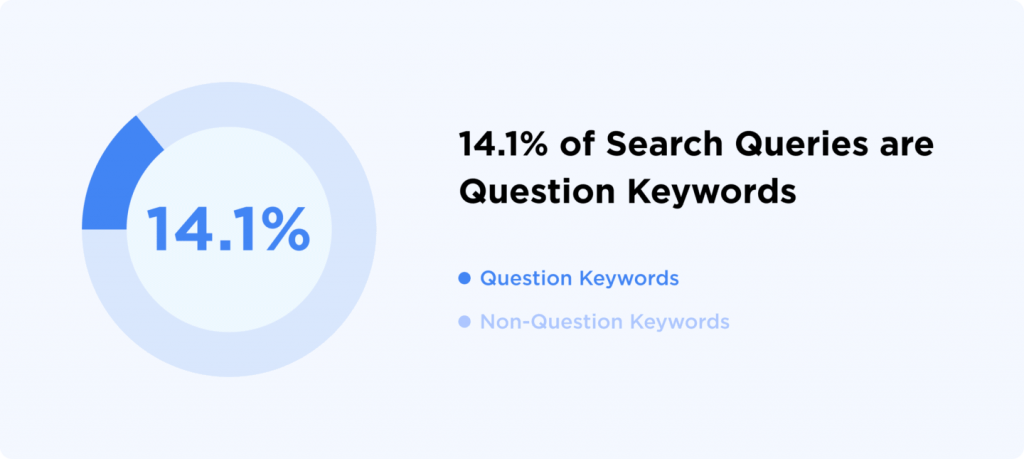
In the modern digital landscape, billions of digital queries are processed daily by search engines and community forums. Amidst this vast ocean of data, consumer behavior has undergone a profound structural shift. Users are no longer typing fragmented, short-tail keywords into search bars; instead, they are asking complete, conversational, and hyper-specific questions. Recent industry studies reveal that a staggering 14.1% of all Google searches are question keywords. When applied to a baseline of 3.5 billion daily global searches, this translates to an unprecedented 490 million questions being posed to search engines every single day.
For digital marketers, content strategists, and SEO professionals, this phenomenon represents an immense strategic opportunity. Questions are predominantly long-tail terms—largely fueled by the explosive adoption of voice search technology on mobile devices and smart speakers. Whether a user is querying a quick procedural tip on how to grind coffee beans or conducting rigorous enterprise research on the best Enterprise Resource Planning (ERP) system to implement, they are expressing an active intent to solve a problem.
Capturing this traffic allows brands to step directly into the consumer’s decision-making journey, delivering precise answers while seamlessly introducing products, services, or affiliate offers. However, scale remains the primary operational bottleneck for content teams: How do you reliably and systematically identify the exact questions your target audience is asking? This report explores four advanced methodologies for scaling question-based keyword research, leveraging enterprise SEO suites, browser automation tools, and community-driven data mining to secure first-page rankings with minimal link-building overhead.
Detailed Chronology: The Evolution of Search Query Behavior
To understand why question-based keyword optimization has become the cornerstone of modern search engine optimization (SEO), it is vital to trace how search queries have evolved over the past two decades.
Phase 1: The Era of Fragmented Keywords (Early 2000s)
In the infancy of commercial search engines, algorithms relied heavily on exact-match keyword matching. Users adapted by inputting truncated, robotic strings of text—such as "best CRM software" or "cheap flights London." Search engines rewarded websites that stuffed these exact phrases into metadata and body text, often at the expense of readability and user experience.
Phase 2: The Semantic Web and Natural Language Processing (2010s)
With the deployment of major algorithm updates like Google’s Hummingbird and BERT, search engines evolved from matching strings to understanding things. Natural Language Processing (NLP) enabled algorithms to comprehend the contextual nuance of human speech. Concurrently, the proliferation of smartphones and voice assistants (Siri, Alexa, Google Assistant) transformed user behavior. People stopped typing like computers and started speaking like humans. The era of the conversational query had arrived, driving a massive surge in question-based search terms dominated by interrogative pronouns.
Phase 3: The Dominance of "How" and "What" Queries (Present Day)
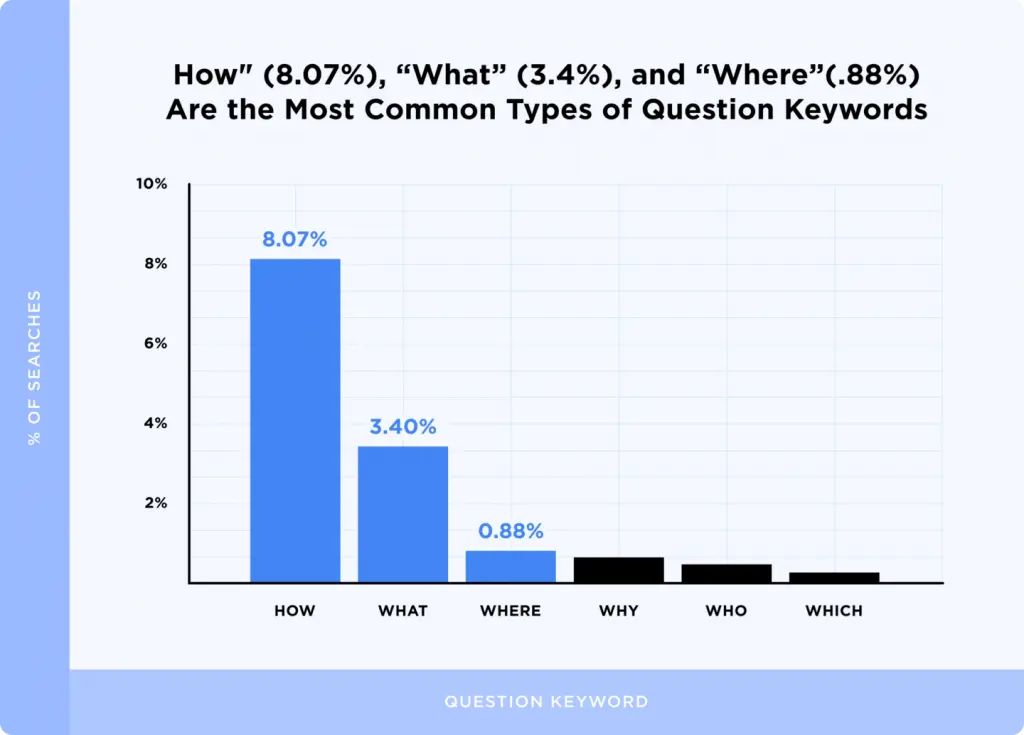
Data analytics from major SEO platforms show that question keywords are now heavily skewed toward specific interrogatives. Leading the pack are "how" queries, accounting for approximately 8.07% of search queries, followed by "what" queries at 3.4%.
This structural shift has fundamentally changed how content must be architected. Modern search algorithms favor content that provides immediate, authoritative, and direct answers to user queries, frequently elevating these responses into rich snippets and People Also Ask (PAA) boxes.
Supporting Context & Metrics: Why Question Keywords Are an SEO Goldmine
Investing resources into question-based keyword strategies yields two distinct, quantifiable advantages over traditional broad-match SEO: high user intent and low keyword competition.
1. Exceptional User Intent
When a user enters a question into a search engine, they are rarely browsing aimlessly. They are experiencing a specific friction point, a technical roadblock, or an informational deficit, and they require a solution immediately.
For instance, a search for "CRM software" is broad and ambiguous; the user could be looking for definitions, academic papers, or login pages. Conversely, a query like "Can a CRM be integrated with an ERP?" exhibits high commercial intent. The searcher operates an enterprise system, faces a workflow integration challenge, and is actively evaluating software capabilities. By answering this question comprehensively, a business can position its product as the definitive solution at the exact moment of highest cognitive receptivity.
2. Lower Keyword Competition and Easier Ranking
Broad head terms are fiercely contested by enterprise domains with massive domain authority and extensive backlink profiles. However, long-tail question keywords are inherently more fragmented and specific.
In many cases, question-based keywords exhibit a significantly lower degree of keyword difficulty (KD). Consequently, content creators can successfully rank on the first page of search results for these terms without investing months into exhaustive, expensive link-building campaigns or producing 5,000-word comprehensive guides. A well-structured, direct answer on a targeted support page or blog post is often sufficient to capture top-tier visibility.
Methodological Framework: 4 Ways to Scale Question-Based Keyword Research
Scaling question-based research manually is impractical. Below are four systematic, automated tactics utilizing industry-standard tools like Semrush, SEO Minion, and community forums to unearth hundreds of high-yield keyword opportunities in minutes.
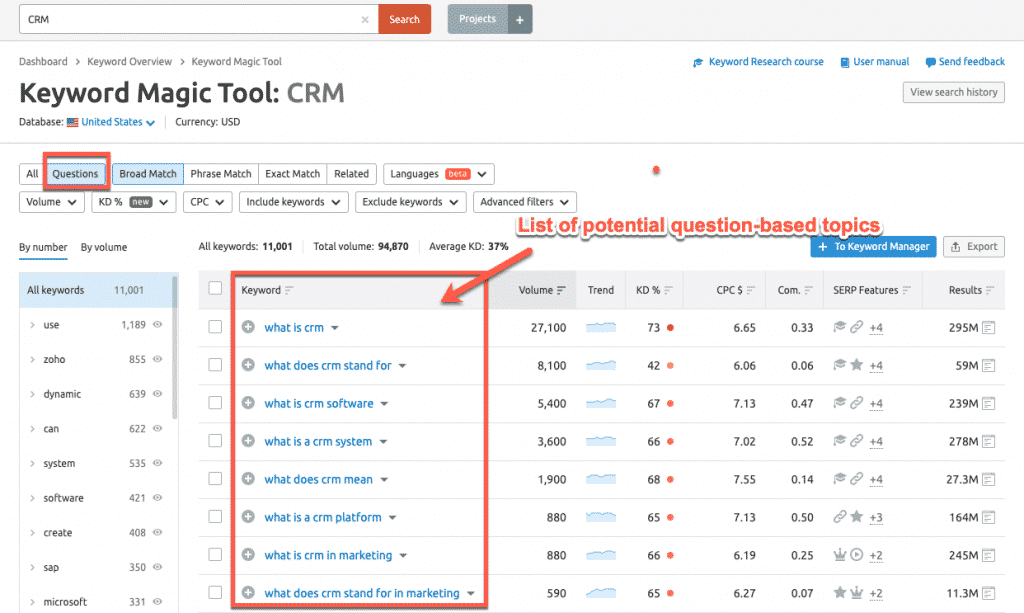
Most enterprise SEO platforms feature dedicated query mining engines. By entering a broad seed topic into platforms like Semrush or Ahrefs, users can generate comprehensive question-based keyword reports.
Step 1: Enter your core product, service, or industry category (e.g., "CRM") into the Keyword Magic Tool.
Step 2: Apply the "Questions" filter to isolate interrogative variations.
Step 3: Analyze the hierarchical distribution of the report.
Top of the report: High-volume, highly competitive broad questions (e.g., "What is a CRM?").
Deep into the report: Ultra-specific, low-competition long-tail questions (e.g., "Can a CRM be integrated with an ERP?" or "What are the essential features to maintain a CRM database?").
Step 4: Utilize advanced platform filters—such as Intent and Grouping—to filter out informational noise and focus strictly on commercial or transactional question variants.
[Seed Topic: CRM]
  ├── Broad Question (High KD): "What is a CRM?"
  ├── Intermediate Question (Medium KD): "How to use a CRM for sales pipelines?"
  └── Niche Long-Tail (Low KD): "Can a CRM be integrated with an ERP?" -> [Target Opportunity]
Tactic 2: Mining the "People Also Ask" (PAA) Box at Scale
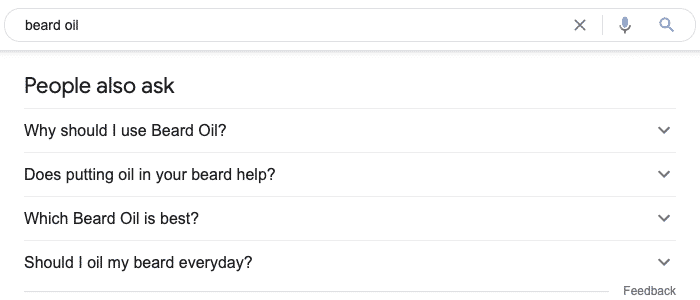
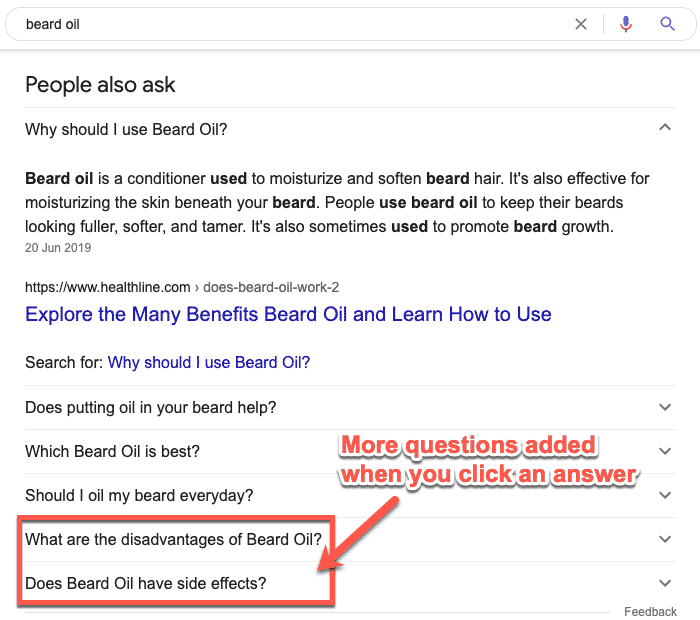
Google’s People Also Ask boxes represent a direct window into real-time user behavior. However, manually expanding, copying, and pasting PAA boxes is labor-intensive.
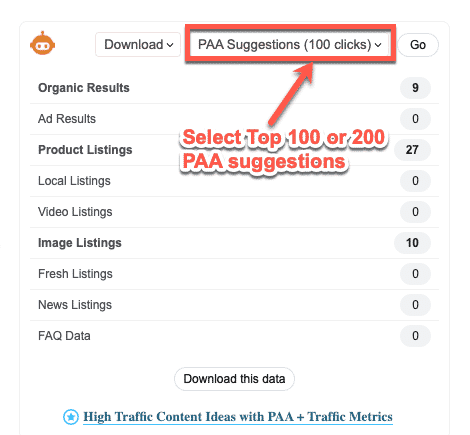
Step 1: Install SEO Minion, a free browser extension widely utilized by enterprise SEO consultants.
Step 2: Enter your seed keyword into Google and open the SEO Minion interface in the browser pane.
Step 3: Select the "All Organic Results" or PAA export function, specifying a depth of 100 to 200 records.
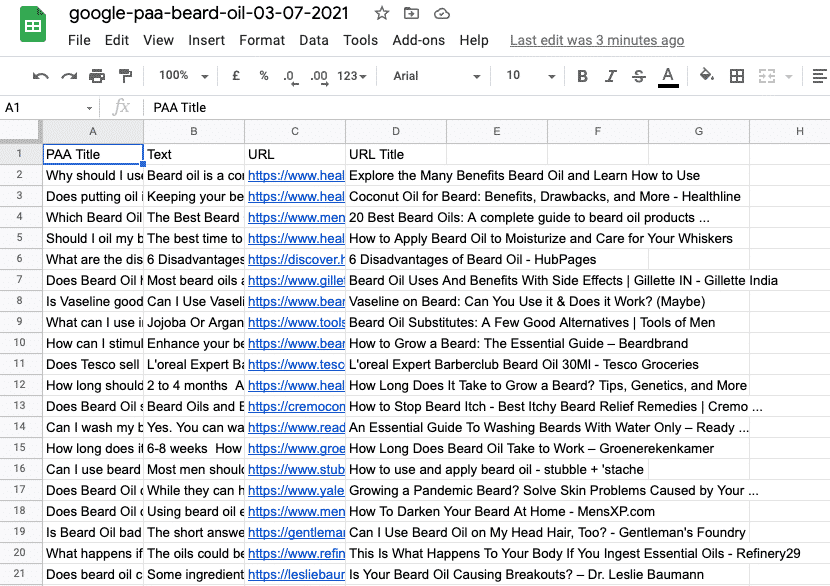
Step 4: Export the generated dataset into a CSV file. The file will organize data across four distinct columns: PAA Title, Text, URL, and URL Title.
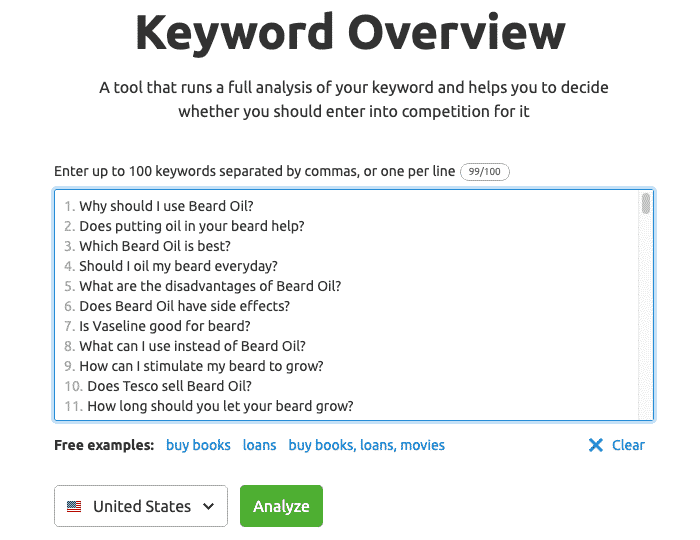
Step 5: Copy column A (the extracted questions), paste them into the Semrush Keyword Overview batch analysis tool, and click analyze.
Step 6: Filter the results by search volume and Keyword Difficulty to identify low-competition, high-yield topics ready for content production.
Tactic 3: Extracting Niche Pain Points from Subreddits
Online communities like Reddit house millions of unfiltered consumer conversations, discussions, and product grievances. Subreddits serve as an unrivaled goldmine for discovering unoptimized, highly specific user queries.
Step 1: Identify a subreddit dedicated to your industry, product category, or direct competitor (e.g., r/CRM).
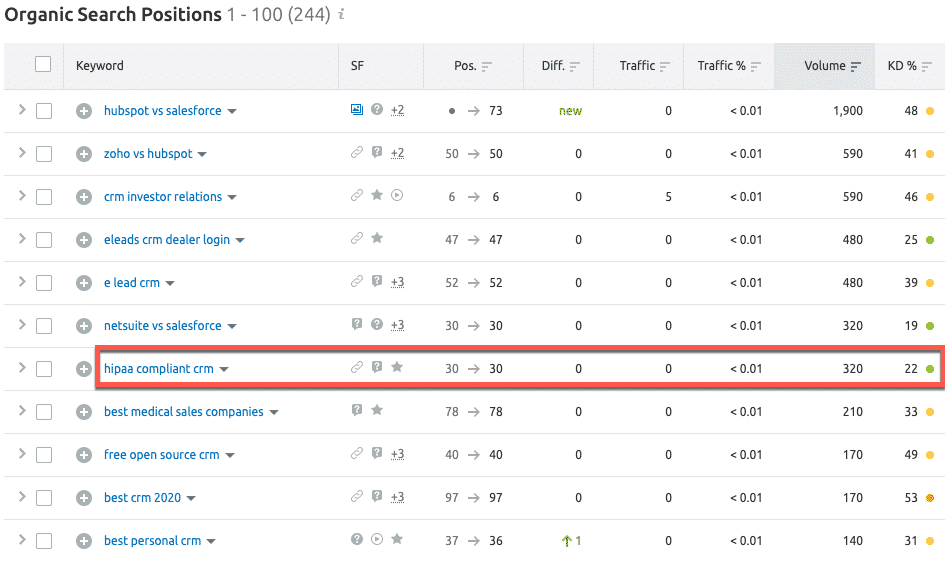
Step 2: Open the Organic Research report in Semrush and enter the specific subreddit URL or subfolder path.
Step 3: Apply advanced organic filters to refine the dataset:
Set a minimum search volume threshold (e.g., Volume $ge$ 20).
Add a word count modifier to include phrases greater than two words.
Step 4: Analyze the keyword profile for low-competition gems (indicated by green or light-yellow Keyword Difficulty scores). For instance, unearthing a query like "HIPAA compliant CRM" with steady search volume and an easy KD score highlights an immediate opportunity to create targeted comparison content or compliance guides.
Tactic 4: Mining High-Traffic Quora Threads
Quora is a powerhouse forum that frequently dominates organic search rankings for niche advisory queries. Rather than answering questions one by one for sporadic referral traffic, SEO professionals can use Quora as a keyword discovery engine.
Step 1: Access the Organic Research report within Semrush.
Step 2: Target the Quora domain and apply advanced URL/subfolder filters alongside keyword modifiers such as "how", "best", or "vs" combined with a seed topic (e.g., "beard oil" + "how").
Step 3: Scroll through the resulting keyword lists to discover long-tail advisory queries that traditional keyword tools frequently miss (e.g., "How to stop beard oil from breaking out skin").
Step 4: Click the "+" icon next to high-potential terms to add them directly to your master keyword list within the platform’s Keyword Manager.
Official Statements & Industry Expert Perspectives
Industry leaders continue to emphasize the paradigm shift toward intent-driven, conversational search strategies.
"As search algorithms become increasingly sophisticated at parsing human intent, the traditional boundaries between keyword research and audience research are dissolving," notes digital marketing strategist Robbie Richards. "When you analyze the data behind question queries, you aren’t just looking at search volume—you are reading a direct transcript of your prospective customer’s daily operational frustrations."
Furthermore, enterprise SEO platforms have adjusted their data architectures to support this shift. Advanced filtering mechanisms now allow organizations to segment keywords by granular intent classifications—Informational, Navigational, Commercial, and Transactional—ensuring that question-based content strategies align precisely with bottom-line revenue goals.
Future Outlook: The Next Frontier of Conversational Search
Looking ahead, the integration of generative artificial intelligence and conversational search interfaces (such as Google Search Generative Experience and LLM-powered search agents) will only accelerate the demand for question-based optimization.
As users transition toward multi-turn, conversational dialogues with AI search agents, the traditional keyword model will continue to evolve into a semantic framework. Content creators who master the art of extracting, analyzing, and authoritatively answering long-tail questions will capture dominant market share. By systematically deploying the four scaling methodologies outlined in this report—automated SEO reporting, PAA extraction, subreddit mining, and forum analysis—content teams can build a resilient, future-proof keyword pipeline that consistently outperforms competitors with minimal link-building overhead.