

Executive Overview
To the average observer, time is absolute and unyielding. The sun rises, the sun sets, and the Earth completes a single, flawless rotation precisely every 24 hours. This temporal rhythm anchors human civilization, dictating everything from international financial markets to the synchronized atomic clocks that govern global satellite communications. Yet, beneath our feet, this foundational constant is an illusion.
Earth’s rotation is not a steady, metronomic heartbeat; it is a dynamic, fluctuating dance governed by the gargantuan, hidden forces of our planet’s deep interior. While the variations are infinitesimal—measured mere milliseconds off the standard clock—they reveal a profound physical truth: the planet is constantly trading momentum with itself.
A landmark study published on September 23 in the prestigious journal Nature has finally illuminated the mechanics behind this subterranean tug-of-war. Authored by University of Alberta physics PhD student Huifeng Zhang and Professor Mathieu Dumberry, the research solves a decades-old geophysics mystery. By demonstrating how a hidden gravitational torque operates between Earth’s solid inner core and its rocky outer mantle, the study bridges a critical gap in our understanding of planetary dynamics.
Furthermore, the implications stretch far beyond the simple curiosity of a slightly longer or shorter day. The findings suggest that Earth’s deepest, most inaccessible realms are far more fluid and malleable than previously assumed, capable of viscous deformation over remarkably short timescales. As science continues to peer deeper into the abyss of our world, we are forced to confront a humbling reality: even the length of a day is subject to the restless tides of the Earth’s molten and solid core.
Detailed Chronology: Unraveling the Subterranean Mystery
The journey toward understanding how Earth’s core influences the surface clock has been slow, marked by decades of piecing together invisible, planet-spanning puzzles. To appreciate the breakthrough achieved by Zhang and Dumberry, it is necessary to retrace the chronological steps that brought geophysicists to this juncture.
The Discovery of Decadal Fluctuations (Late 20th Century)
For generations, scientists treated the Earth as a monolithic flywheel spinning in the frictionless vacuum of space. However, the advent of high-precision space geodesy and Very Long Baseline Interferometry (VLBI) in the latter half of the 20th century shattered this assumption. Researchers began tracking the orientation of Earth in space with unprecedented accuracy, discovering that the planet’s rotation rate wobbled unpredictably.
By the 1990s, geophysicists had established a pattern: over spans of roughly three decades, the length of a day would stretch or shrink by a fraction of a millisecond. These fluctuations could not be explained by surface phenomena alone, such as seasonal wind patterns, ocean currents, or the melting of polar ice caps. The source of the disruption had to be internal, originating deep within the planet’s thick mantle and metallic core.
The Mantle-Core Seesaw Effect
As data accumulated, scientists deduced that the Earth’s liquid outer core—a roiling ocean of molten iron and nickel situated roughly 3,000 kilometers beneath our feet—does not rotate in sync with the rocky mantle and crust that we inhabit. Through intricate analyses of Earth’s magnetic field, researchers realized that the liquid core undergoes massive, decadal oscillations. It can gradually accelerate over the course of thirty years, only to decelerate during the subsequent decades.
To satisfy the laws of physics—specifically, the conservation of angular momentum—the rest of the planet had to respond in reverse. When the core speeds up, the mantle must slow down slightly to balance the equation. Conversely, when the core drags its feet, the mantle compensates by spinning faster. Because the mantle is directly attached to the crust where we live, even a microscopic change in its rotational velocity alters the duration of a day.
The Missing Link: The Gravitational Puzzle
While the core-mantle momentum exchange became an accepted paradigm, a glaring theoretical roadblock persisted. Scientists struggled to explain how this momentum was successfully transferred. The liquid outer core sits between the solid inner core and the solid mantle. Traditional models suggested that magnetic coupling at the core-mantle boundary was the primary driver. However, calculations involving magnetic drag alone often fell short of accounting for the magnitude of the rotational shifts observed in the real world.
For years, the role of the innermost region of the planet—the solid inner core, a ball of iron roughly the size of Pluto—was largely overlooked in day-length calculations. Because it is shielded deep within the liquid outer core, it was long thought to be a passive passenger.
This status quo was upended on September 23, when Zhang and Dumberry published their paradigm-shifting research in Nature. By introducing the concept of a hidden gravitational torque driven by an imperfectly shaped inner core, the researchers provided the missing link that finally harmonized theoretical models with empirical data on day-length variations.
Supporting Context & Metrics: The Physics of Planetary Rotation
To fully grasp the significance of Zhang and Dumberry’s work, one must dive into the underlying physics of our planet’s interior structure and the specific metrics that govern its rotation.
+-----------------------------------------------------------------+
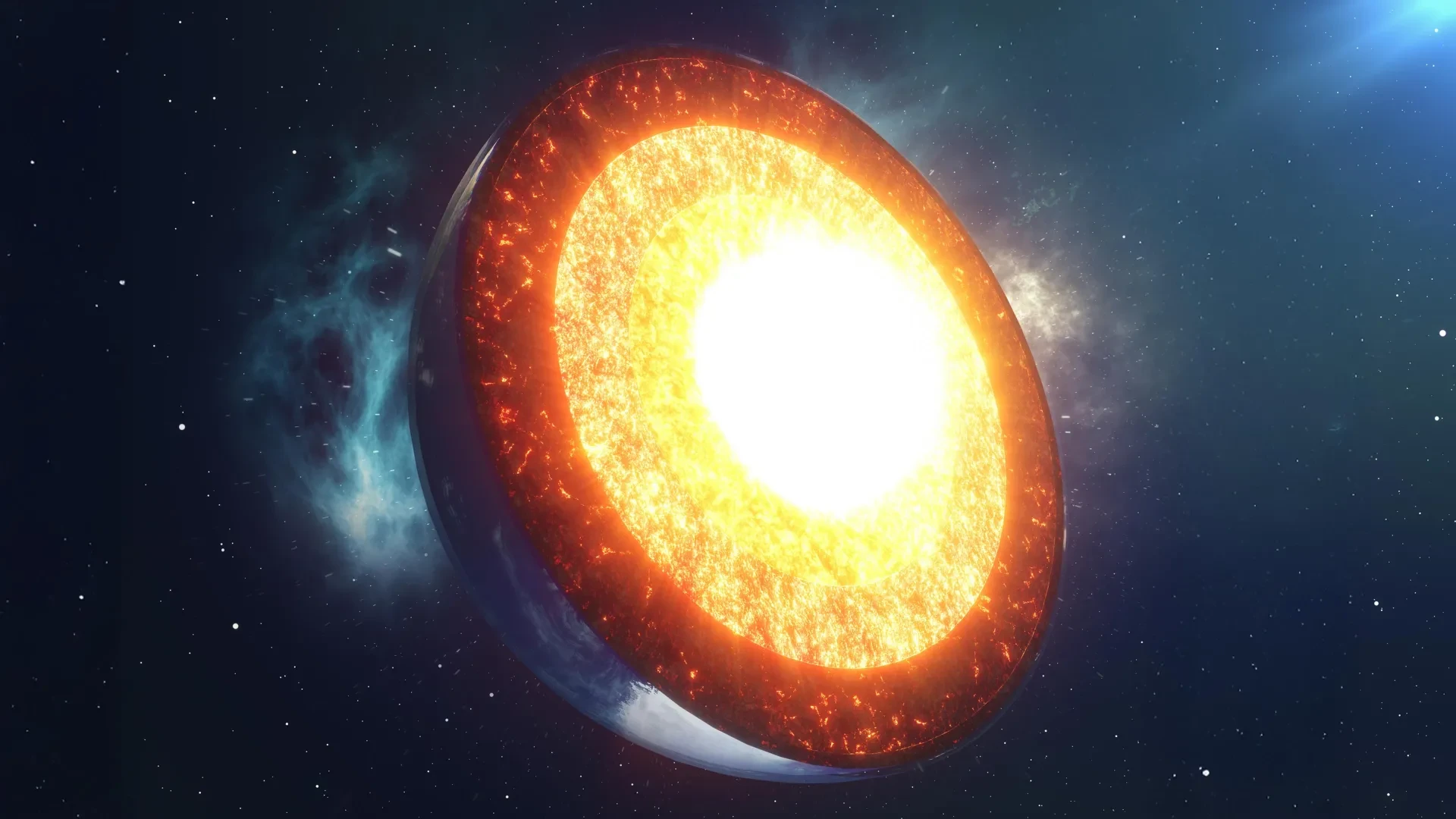
                    EARTH'S LAYERED INTERIOR
+-----------------------------------------------------------------+
|                                                                 |
|  [ Crust & Mantle ] -> Rocky outer layer (approx. 3,000 km thick)|
|         |                                                       |
|         v (Gravitational & Magnetic Torque Interactions)        |
|  [ Liquid Outer Core ] -> Roiling molten iron and nickel        |
|         |                                                       |
|         v                                                       |
|  [ Solid Inner Core ] -> Dense iron-nickel ball (Pluto-sized)  |
|                                                                 |
+-----------------------------------------------------------------+
The Architecture of the Abyss
Earth is divided into distinct geological layers, each with unique material properties and rotational behaviors:
- The Crust and Mantle: Comprising the outer 3,000 kilometers of the planet, this rocky shell is where human civilization resides. While brittle at the surface, the mantle behaves like a very slow-moving, ductile solid under immense heat and pressure.
- The Outer Core: A churning, liquid ocean of iron and nickel extending from roughly 2,900 kilometers to 5,150 kilometers below the surface. Its convective currents generate Earth’s protective magnetic field.
- The Inner Core: A blazing-hot, solid sphere of iron and nickel centered at the heart of the planet. Despite temperatures rivaling the surface of the sun, immense pressure keeps it in a solid state.
Angular Momentum: The Inflexible Ledger
In physics, angular momentum is a conserved quantity. In a closed system like the Earth, the total rotational momentum must remain constant unless acted upon by an external torque (such as the gravitational pull of the sun and moon, which causes tidal friction and gradually slows Earth’s rotation over millions of years).
On a decadal scale, however, internal redistribution dictates the tempo. The formula for angular momentum ($L = I cdot omega$, where $I$ is the moment of inertia and $omega$ is the angular velocity) means that any shift in mass distribution or internal speed within the Earth’s layers requires an immediate compensatory adjustment elsewhere to keep the total sum balanced.
Gravitational Torque vs. Boundary Drag
The core of Zhang and Dumberry’s study centers on two competing forces acting within the deep Earth:
- Gravitational Torque: The inner core is not a mathematically perfect sphere; its mass is unevenly distributed, featuring subtle bulges and depressions. Because of these asymmetries, shifts in the rotational speed and orientation of the inner core create a gravitational pull on uneven distributions of mass within the mantle and outer core. This gravitational tug-of-war is potent enough to subtly accelerate or decelerate the mantle.
- Core-Mantle Boundary (CMB) Torque: Acting in direct opposition to gravitational torque is the friction and electromagnetic drag generated right at the interface of the liquid outer core and the rocky mantle. This resistance serves as a natural brake, preventing the gravitational pull from spinning the mantle out of control.
According to Zhang and Dumberry, the minute, observable variations in the length of a day are the direct result of a delicate, shifting equilibrium between these two forces: the gravitational torque attempting to twist the mantle, and the CMB torque resisting that motion.
Official Statements and Expert Analysis
The publication of the University of Alberta study has sent ripples through the international geophysics community, prompting praise and deep analysis from leading researchers in the field.
In discussions surrounding the paper, the authors emphasize that their findings reframe our understanding of the deep Earth’s material properties. Huifeng Zhang, the lead author and physics PhD student, notes that the research provides a unified framework for phenomena that previously seemed disconnected.
"For a long time, we knew the mantle and core were trading momentum, but the exact mechanisms were shrouded in ambiguity," Zhang explains. "By accounting for the gravitational interaction driven by the inner core’s non-spherical geometry, we can finally trace the pathway of this angular momentum from the very center of the planet all the way up to the surface where we measure time."
Co-author Professor Mathieu Dumberry highlights the surprising revelations regarding the inner core’s structural behavior. According to their models, the inner core is not as rigid and unyielding as its solid iron composition might suggest. Instead, it appears to "deform viscously" on a decadal timescale—roughly every 10 years.
"To see that the inner core responds to forces by changing its shape over a decade-long period is remarkable," Dumberry states. "It tells us that the deepest interior of our planet is far more dynamic, responsive, and malleable than traditional solid-mechanics models would predict."
Independent geophysicists not involved in the study have lauded the research for its methodological rigor. By integrating fluid dynamics, gravitational physics, and seismological data, Zhang and Dumberry have successfully closed a longstanding chapter in geodynamics, while simultaneously opening up new avenues for exploring planetary interiors—not just on Earth, but potentially on rocky exoplanets across the galaxy.
Future Outlook: What This Means for Science and Timekeeping
As we look to the future, the implications of this study extend across multiple scientific disciplines, touching everything from high-precision timekeeping to our broader comprehension of planetary evolution.
Refining Global Timekeeping
In an era dominated by global positioning systems (GPS), telecommunications networks, and high-frequency financial trading, precision timekeeping is paramount. The International Earth Rotation and Reference Systems Service (IERS) routinely monitors the planet’s rotational irregularities, occasionally introducing "leap seconds" to keep Coordinated Universal Time (UTC) aligned with solar time.
While a millisecond variation in day length might seem trivial to everyday life, understanding the exact mechanisms—such as the gravitational and boundary torques modeled by Zhang and Dumberry—allows scientists to build more accurate predictive models of Earth’s rotation. This predictive capability is vital for space navigation, satellite tracking, and maintaining the stability of global digital infrastructure.
A New Window Into Planetary Interiors
Perhaps the most exciting prospect of this research is its application to planetary science at large. Earth is the only rocky planet in our solar system with an active dynamo, a liquid outer core, and a solid inner core that interact in this complex manner. By understanding how Earth’s inner core deforms viscously and couples gravitationally with the mantle, scientists gain a powerful analog for studying other worlds.
As astronomers discover rocky exoplanets orbiting distant stars, determining whether those worlds possess active magnetic fields, molten interiors, and dynamic inner cores will be critical in assessing their potential to harbor life. Magnetic fields shield planets from harmful cosmic radiation, and those fields are intrinsically tied to the very core-mantle dynamics that Zhang and Dumberry have mapped out beneath our feet.
Conclusion: The Restless Earth
Ultimately, the research by Zhang and Dumberry serves as a poetic reminder of the restless, ever-changing nature of our home planet. We tend to view the ground beneath us as the ultimate symbol of permanence—a solid, unmoving stage upon which human history unfolds.
Yet, deep within the Earth, rivers of liquid metal flow in opposite directions, a Pluto-sized iron sphere slowly deforms under crushing pressures, and invisible gravitational threads pull and tug at the mantle. These subterranean convulsions ripple upward, subtly stretching and compressing the hours of our days. As science continues to decode these profound planetary rhythms, we are reminded that time itself is inextricably bound to the fiery, fluid heart of the Earth.