

Executive Overview
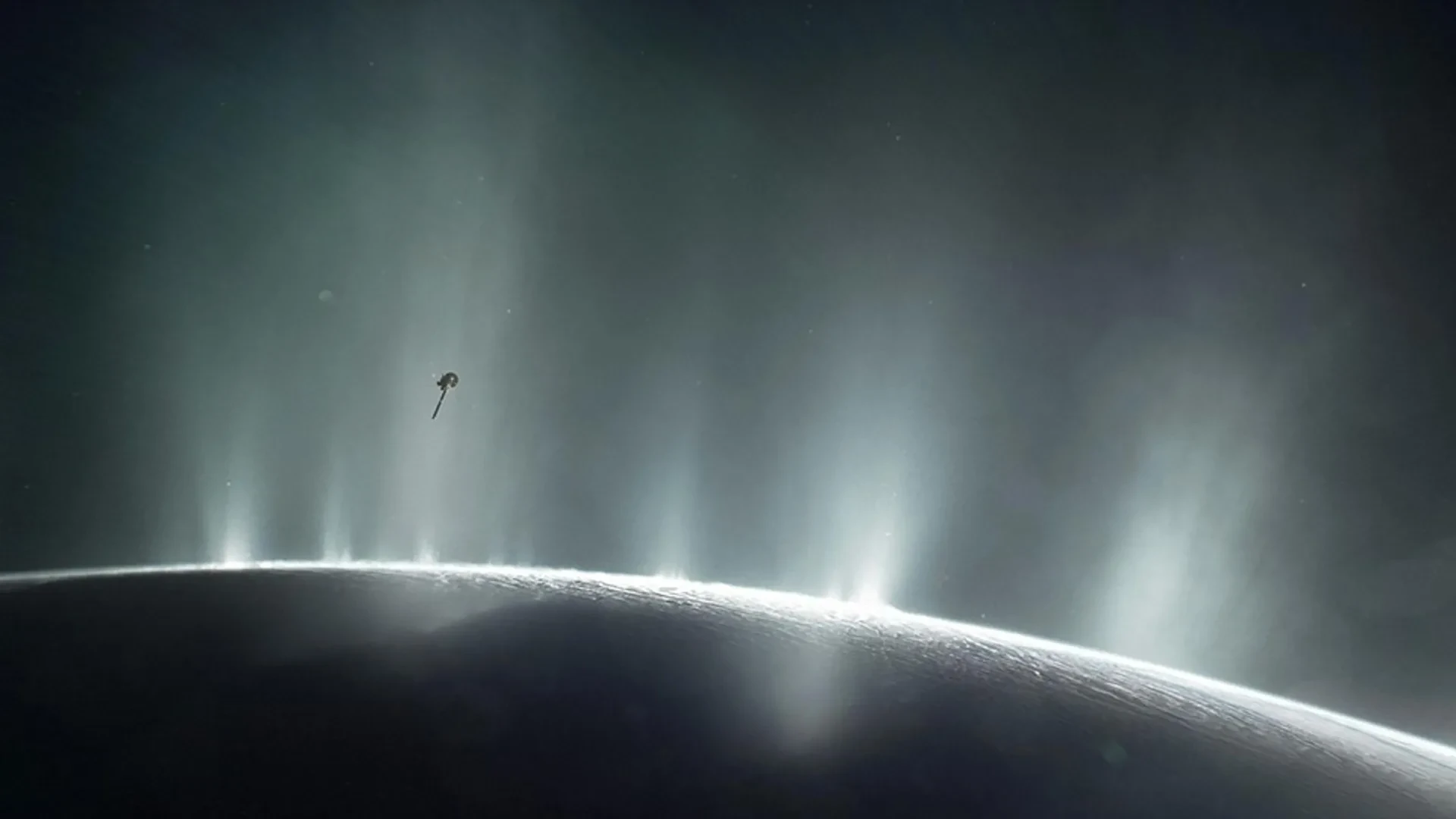
Deep beneath the frozen, reflective crust of Saturn’s moon Enceladus lies a global ocean of liquid water, shielded from the vacuum of space by kilometers of solid ice. For years, planetary scientists have marveled at the dramatic plumes erupting from fractures near the moon’s south pole—active geysers that spew water vapor and ice particles directly into the Saturnian system. This natural phenomenon offers a rare and tantalizing shortcut in planetary exploration: the ability to sample an extraterrestrial ocean without the immense technological and financial burden of drilling through an ice shell.
However, examining these icy messengers has presented a profound scientific mystery. Between 2004 and 2017, NASA’s Cassini spacecraft analyzed the composition of individual ice grains within Saturn’s E-ring—a ring continuously fed by the plumes of Enceladus. Led by Professor Frank Postberg of Freie Universität Berlin, researchers scrutinized 961 mass spectra from salt-rich grains known as Type 3 particles. Under standard assumptions, if these grains were direct, uniform samples of the subsurface ocean, their chemical profiles should display a consistent, homogenous mixture of salts.
Instead, the data revealed baffling chemical diversity. Some grains were heavily saturated with sodium chloride, while others exhibited high concentrations of carbonates, phosphates, or potassium chloride. Most strikingly, chloride and carbonate rarely coexisted within the same sodium-rich particle. Why would tiny ice grains originating from the exact same body of water display such wildly disparate chemical makeups?
A new international study—conducted by a collaborative team including researchers from the Earth-Life Science Institute (ELSI) at the Institute of Science Tokyo, led by Professor Yasuhito Sekine—has finally solved this puzzle. Through meticulous laboratory simulations, the team discovered that the physical mechanics of how ocean spray freezes and travels through the moon’s icy crust can completely alter the chemical distribution of ice grains.
Far from being a simple, instantaneous flash-freeze, the journey of Enceladus’s ocean water involves slow freezing, mineral segregation, and high-speed mechanical fragmentation inside underground vents. This natural "sample preparation" not only explains decades of enigmatic Cassini data but also reveals that Enceladus actively concentrates key chemical compounds and organics. This mechanism could have profound implications for astrobiology, prebiotic chemistry, and the future search for life in our solar system.
Detailed Chronology: From Cassini’s Flybys to Breakthrough Laboratory Physics
To fully appreciate the magnitude of the recent findings, it is necessary to retrace the scientific journey that began more than two decades ago during the operational lifetime of the Cassini-Huygens mission.
The Cassini Era and the E-Ring Enigma (2004–2017)
When the Cassini spacecraft arrived at the Saturnian system in 2004, it revolutionized our understanding of the outer solar system. Among its most monumental discoveries was the active cry volcanism of Enceladus. Plumes of gas and ice erupting from the "tiger stripe" fractures at the south pole were found to supply Saturn’s diffuse E-ring with continuous material.
Equipped with the Cosmic Dust Analyzer (CDA), Cassini was able to fly directly through these plumes and the E-ring, capturing and analyzing the chemical composition of individual ice particles on the fly. While these analyses confirmed the presence of organic molecules, salts, and silica nanoparticles—signifying a warm, hydrothermal-active seafloor—they also uncovered the persistent anomaly of Type 3 salt-rich ice grains. The extreme chemical fractionation observed within these particles defied easy explanation, forcing scientists to look deeper at the physical processes governing the transport of ocean water into space.
Recreating the Enceladus Ocean in the Lab
To test hypotheses regarding the origin of this chemical diversity, Professor Yasuhito Sekine and his team at the Earth-Life Science Institute (ELSI) designed a series of controlled physical experiments. The objective was to simulate the lifecycle of an ocean droplet as it transitions from a liquid state beneath the ice shell to a solid grain ejected into space.
The researchers prepared liquid droplets containing major salt species hypothesized to exist within the subsurface ocean of Enceladus, such as sodium chlorides, carbonates, and potassium compounds. These droplets, varying in size, were subjected to carefully monitored cooling and freezing conditions.
The results highlighted the critical role of freezing kinetics:
- Slow Freezing (Below 10 K per minute): In droplets approximately 200 micrometres across, cooling at a relatively slow rate allowed dissolved salts to physically segregate into distinct micro-regions within the solidifying droplet.
- Rapid Freezing: When droplets were frozen quickly, their chemical ingredients remained homogeneously mixed, failing to reproduce the diversity observed by Cassini.
These findings confirmed that if relatively large ocean droplets freeze slowly, internal mineral separation naturally occurs. If those structurally differentiated frozen droplets subsequently fracture, they yield smaller ice grains, each carrying a radically different chemical fingerprint.
Mapping the Journey Through the Icy Crust
Armed with experimental data, the research team reassessed the subterranean pathway taken by the erupting plumes. Previous scientific consensus held that seawater spray from the ocean freezes almost instantaneously upon exposure to the cold subsurface environment and races rapidly toward space.
The new experimental evidence points to a far more complex, multi-stage journey:
- Initial Spray and Formation: Ocean water breaches the seafloor-to-ice interface, atomizing into initial droplets ranging from tens to hundreds of micrometers in size.
- The Slower Ascent: Rather than rushing instantly to the surface, these droplets navigate a tortuous maze of deep underground vents and fractures within the moon’s thick ice shell.
- Gradual Freezing: As they traverse the deeper, warmer sections of the vent system, the droplets freeze gradually over extended periods. This slow phase change provides the necessary time for salts and compounds to segregate into distinct pockets within the ice.
- High-Speed Fragmentation: As the frozen droplets approach the surface, gas velocities increase dramatically. The solid or semi-solid particles slam into the constricted walls of narrow ice channels at high speeds.
- Ejection: These violent collisions shatter the larger frozen droplets into micro-fragments. Because each fragment originates from a different salt-rich micro-domain within the parent droplet, the resulting dust particles possess wildly divergent chemical compositions as they escape into the E-ring.
Supporting Context & Metrics
Understanding the physical scale and chemical implications of these processes requires a close look at the quantitative metrics governing Enceladus and the Cassini dataset.
- 961 Mass Spectra: The primary dataset analyzed by Prof. Frank Postberg’s team at Freie Universität Berlin comprised nearly a thousand individual mass spectra collected by Cassini’s Cosmic Dust Analyzer, focusing specifically on Type 3 salt-rich grains.
- 10 Kelvin per Minute: The critical thermal threshold identified by the ELSI laboratory experiments. Freezing rates at or below this speed allowed for the clear spatial segregation of salts within 200-micrometre droplets.
- 10 to 100+ Micrometres: The estimated size range of the initial ocean spray droplets formed as subsurface water is forced into the moon’s vent system.
- 2004–2017: The operational timeline of the Cassini mission, during which thousands of particulate samples were cataloged, providing the foundational baseline for modern Enceladusan oceanography.
- Global Scale: Enceladus boasts a global subsurface liquid water ocean sitting atop a rocky core, interacting hydrothermally to produce the minerals, salts, and organics detected by spacecraft instrumentation.
| Parameter / Metric | Value / Observation | Scientific Significance |
|---|---|---|
| Analyzed Spectra | 961 Mass Spectra | Provided a statistically robust sample size of Type 3 salt-rich ice grains from Saturn’s E-ring. |
| Cooling Rate Threshold | $le 10$ K per minute | The maximum freezing velocity required to allow mineral segregation in micro-droplets. |
| Droplet Size (Initial) | $10 – 200, mutextm$ | The scale of ocean spray hypothesized to form within the subsurface vent infrastructure. |
| Primary Compounds | $textNaCl, textNa_2textCO_3, textKCl$ | Major ionic components whose mutual exclusion in single grains baffled early modelers. |
Official Statements
The collaborative nature of this breakthrough research brought together leading astrobiologists, geochemists, and planetary scientists from institutions across Japan and Europe.
Discussing the core revelation of the study, Professor Yasuhito Sekine of the Earth-Life Science Institute (ELSI) noted:
"What surprised us was that the diversity seen by Cassini could emerge from droplets originating from essentially the same ocean water. Our experiments show that when relatively large ocean droplets freeze slowly, different salts can separate within them. If those frozen droplets are later broken apart, they can produce much smaller ice grains, each with very different chemical compositions."
Highlighting how laboratory physics validates spaceborne observations, Professor Frank Postberg of Freie Universität Berlin explained:
"The Cassini data showed us that these salt-rich grains are far more chemically diverse than an average ocean composition would suggest. Combining those observations with the freezing experiments gives us a physical explanation: Cassini may have sampled fragments of larger frozen ocean droplets, each preserving different components that became separated during their journey towards the surface. The abundance of each individual component in the ocean is then reflected in the number of fragments in which a particular component is found."
Future Outlook: Implications for Astrobiology and Prebiotic Chemistry
Beyond resolving a decade-old planetary science mystery, these findings fundamentally reshape how future space missions will approach the exploration of ocean worlds.
Nature’s Own Laboratory Pre-Concentration
In terrestrial analytical laboratories, researchers must dedicate significant time, equipment, and chemical reagents to separate, isolate, and concentrate trace compounds before analysis can occur. Enceladus appears to execute these exact sample preparation steps naturally.
As droplets freeze and fracture, individual compounds—including various salts and complex organic molecules—become heavily concentrated within distinct subsets of ice particles. Compounds that exist in highly diluted states within the bulk ocean can thus appear at elevated concentrations in specific micro-grains. This natural pre-concentration makes trace signatures vastly easier for visiting spacecraft instrumentation to detect.
Relevance to Prebiotic Chemistry
The dynamics of slow freezing hold even deeper implications for the origin of life. As ice crystals grow slowly within confined spaces, small pockets of liquid brine remain trapped between the crystal lattices. Inside these microscopic pockets, salts and organic molecules can reach extreme levels of concentration.
A persistent bottleneck in prebiotic chemistry—the suite of chemical reactions that may precede the development of biological life—is the challenge of bringing dilute molecules into close enough physical proximity to react. The freeze-concentration mechanisms demonstrated by the ELSI team provide a natural reactor environment where organic molecules can be concentrated, sorted, and brought together. Furthermore, because much of the material ejected into the E-ring eventually falls back onto the surface of Enceladus, this cycle of freezing, concentration, fracturing, and recycling can occur repeatedly over geological timescales.
Preparing for the Next Generation of Ocean World Missions
As space agencies look toward future flagship missions designed to return to the Saturnian system or investigate other icy moons like Europa and Ganymede, understanding the lifecycle of plume-emitted ice grains is paramount. Future mass spectrometers will not simply measure raw ocean composition; they will read the complex history written into the physical structure of ice fragments.
By bridging the gap between orbital dust analysis and terrestrial laboratory physics, scientists are now better equipped to interpret incoming data, optimize instrument design for the detection of biosignatures, and ultimately answer whether life has found a foothold in the dark, mineral-rich waters of Saturn’s most dynamic moon.