

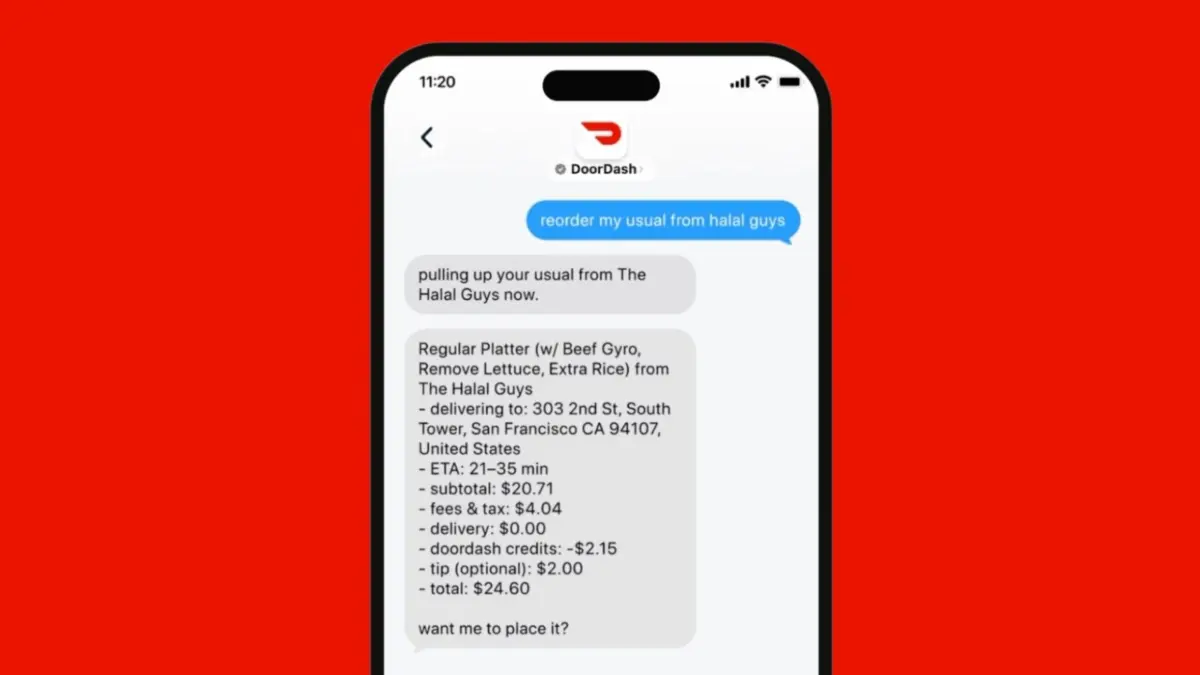
SAN FRANCISCO — In a milestone announcement that underscores the rapid convergence of artificial intelligence and everyday consumer logistics, delivery giant DoorDash has officially entered the conversational commerce era. During a high-profile media event in San Francisco, which was simultaneously broadcast to a global audience on Tuesday, DoorDash co-founder and Head of Consumer Product Andy Fang unveiled a suite of revolutionary, AI-powered features designed to fundamentally alter how individuals and corporations interact with the platform.
At the heart of this technological leap are two distinct innovations: the introduction of a Model Context Protocol (MCP) tailored for corporate ordering, and an experimental text-to-order capability integrated directly into Apple Messages. Together, these tools eliminate the traditional friction of navigating mobile applications, moving the delivery industry closer to a frictionless, intent-driven paradigm where a meal, snack, or office supply restock is summoned as easily as sending a text to a friend or a message to a colleague on Slack.
As the retail and food-service sectors increasingly lean on generative artificial intelligence to capture consumer mindshare, DoorDash’s latest move signals a strategic shift from an app-centric ecosystem to an ambient, everywhere-available utility. Currently in active deployment with an initial cohort of 20,000 consumers across the United States, this pilot program offers a compelling glimpse into the future of automated commerce.
Executive Overview
The retail and delivery landscapes are experiencing a seismic shift. For over a decade, third-party delivery services have relied on dedicated mobile applications and web interfaces as the primary gateways for consumer transactions. While these platforms have successfully integrated into daily routines, they still require users to navigate complex menus, manage filters, and manually execute checkout workflows.
DoorDash’s latest technological push shatters this paradigm by embedding ordering capabilities directly into the communication channels consumers and employees already use dozens of times a day.
By leveraging advanced natural language processing (NLP) and context-aware protocols, DoorDash is transforming from a digital directory of restaurants into an intelligent, conversational agent. For the average consumer, the new Apple Messages integration means cravings can be satisfied instantaneously through native text messaging, bypassing the DoorDash app entirely. For corporate clients, the newly introduced Model Context Protocol (MCP) introduces a higher degree of automation, allowing enterprise teams to orchestrate complex office catering and pantry restocks directly from workplace collaboration platforms like Slack.
This comprehensive report examines the mechanics of these new features, evaluates their strategic positioning within the broader tech ecosystem, analyzes the macroeconomic and operational metrics driving their rollout, and forecasts the long-term implications for the multi-billion-dollar delivery industry.
Detailed Chronology: The Road to Conversational Commerce
The unveiling of DoorDash’s AI-powered ordering features did not happen in a vacuum. It represents the culmination of a multi-year investment in artificial intelligence, machine learning infrastructure, and enterprise-grade software architecture.
Early AI Experiments and Recommendation Engines
Long before Tuesday’s announcement in San Francisco, DoorDash was quietly laying the technical groundwork for predictive ordering. Over the past five years, the company transitioned from a simple logistics matcher—connecting diners with couriers—to a sophisticated data platform. Machine learning models were deployed to analyze historical ordering habits, time-of-day preferences, local weather patterns, and traffic conditions to curate personalized restaurant recommendations.
However, these early implementations were largely confined within the walls of the proprietary DoorDash mobile application. The user still had to open the app, scroll past promotional banners, and manually tap through checkout screens.
The Rise of Generative AI and API-First Architectures
The landscape changed dramatically with the generative AI boom of 2023 and 2024. As large language models (LLMs) matured, consumer expectations shifted. Users increasingly demanded conversational interfaces capable of understanding nuanced, multi-part requests rather than rigid keyword searches.
Recognizing this shift, DoorDash engineering teams began exploring ways to decouple their core transactional engine from the traditional user interface. This led to the conceptualization of API-driven, context-aware ordering systems that could live anywhere—whether inside a messaging app or a corporate workspace tool.
The San Francisco Reveal
On Tuesday, under the bright lights of a San Francisco stage and broadcast live to thousands of industry stakeholders, Andy Fang pulled back the curtain on these initiatives. The announcement centered on two major pillars:
- The DoorDash Model Context Protocol (MCP) for corporate clients, designed to automate complex office procurement.
- The Apple Messages Pilot, bringing conversational, text-based ordering to everyday consumers.
Fang’s presentation emphasized that the ultimate goal of DoorDash is to reduce friction to absolute zero. By meeting users where they already communicate, DoorDash is positioning itself not just as an app on a smartphone screen, but as an invisible utility woven into the fabric of daily communication.
Supporting Context & Metrics: Under the Hood of the New Features
To fully appreciate the significance of DoorDash’s announcements, it is essential to examine the technical mechanics, target demographics, and initial performance metrics associated with these rollouts.
1. The DoorDash Model Context Protocol (MCP) for Corporate Ordering
Corporate catering and office supply management have historically been administrative headaches. Office managers often juggle multiple vendor portals, track individual dietary restrictions, manage recurring invoices, and handle last-minute head-count changes.
The introduction of the DoorDash MCP changes this dynamic by allowing businesses to place their office restaurant orders and supply restocks on autopilot.
- Integration with Workplace Tools: Through protocols designed to integrate seamlessly with platforms like Slack and enterprise resource planning (ERP) software, administrative staff or automated systems can issue plain-text commands. For example, an office manager can type, "Order lunch for the engineering team of 15 from local Italian spots, keeping dietary restrictions in mind," and the MCP handles the orchestration, curation, checkout, and scheduling.
- Supply Chain Autonomy: Beyond hot meals, the MCP can monitor office inventory levels—such as coffee, snacks, and paper goods—and automatically trigger restock orders when thresholds fall below acceptable limits, minimizing human oversight.
2. The Apple Messages Pilot: Conversational Cravings
For the retail consumer, the integration with Apple Messages represents a profound leap in convenience.
- How It Works: Consumers participating in the initial pilot can open Apple Messages on their iPhone, iPad, or Mac and text DoorDash directly. The interaction can be as casual as typing, "I need my usual iced coffee and breakfast sandwich from that place downtown," or "I’m craving spicy tacos tonight."
- Contextual Intelligence: The system uses natural language understanding to parse the request, cross-reference it with the user’s order history and saved preferences, confirm payment details securely via Apple Pay or stored DoorDash credentials, and dispatch the order without the user ever launching the DoorDash app.
- Current Scale: DoorDash has confirmed that the product is currently live with an initial cohort of 20,000 consumers in the United States. This controlled rollout allows engineering and product teams to monitor server loads, refine natural language parsing models, and gather critical user feedback before expanding the feature nationwide.
+-----------------------------------------------------------------+
|                    DOORDASH AI ECOSYSTEM                        |
|                                                                 |
|   [ Apple Messages ] --------+         +--- [ Slack / ERP ]     |
|   (Consumer Cravings)        |         |    (Corporate MCP)     |
|                              v         v                        |
|                     +---------------------+                     |
|                     | DoorDash AI Engine  |                     |
|                     | (NLP & Context)     |                     |
|                     +---------------------+                     |
|                              |                                  |
|                              v                                  |
|                     +---------------------+                     |
|                     | Transaction &       |                     |
|                     | Fulfillment Engine  |                     |
|                     +---------------------+                     |
+-----------------------------------------------------------------+
Official Statements and Industry Reactions
The announcement has sent ripples through the technology, retail, and venture capital sectors. Industry analysts are already dissecting the strategic implications of DoorDash’s move toward ambient commerce.
During the live-streamed event, Andy Fang elaborated on the philosophy driving the company’s product roadmap:
"We live in a world where technology should adapt to human behavior, rather than forcing humans to adapt to technology. For years, ordering food or office supplies meant opening an app, navigating through layers of menus, and manually inputting preferences. With our new AI-driven features, we are stripping away that friction. Whether you are an office manager trying to feed fifty employees via a quick Slack message or an individual texting your cravings through Apple Messages, DoorDash is becoming an invisible, intelligent layer that gets you what you need, exactly when you need it."
Technology strategists have noted that this move positions DoorDash favorably against rival ecosystem players. By integrating deeply into Apple’s native messaging infrastructure, DoorDash secures prime real estate on the world’s most ubiquitous mobile operating systems, bypassing the fierce competition for app store visibility and home-screen real estate.
Corporate clients participating in early beta testing of the MCP have also reported substantial efficiency gains. Initial case studies shared by enterprise partners highlight a significant reduction in time spent on administrative procurement tasks, allowing office managers to reallocate hours toward core business operations.
Future Outlook: The Horizon of Conversational Commerce
As DoorDash evaluates the performance of the initial 20,000-user Apple Messages pilot and scales its corporate MCP integrations, the long-term roadmap points toward even deeper automation and predictive capabilities.
1. Expansion Beyond Apple and Slack
While the current consumer pilot is anchored in Apple Messages, industry observers anticipate that DoorDash will eventually expand conversational ordering to Android ecosystems, web-based chat interfaces, and voice-activated assistants. Similarly, the corporate MCP framework is expected to expand compatibility beyond Slack to include Microsoft Teams, Google Workspace, and proprietary enterprise dashboards.
2. Predictive AI and Proactive Delivery
The ultimate evolution of conversational commerce is proactive commerce. Rather than waiting for a user to text a craving or an office manager to request a restock, future iterations of DoorDash’s AI engine aim to anticipate needs before they are articulated.
- Imagine an AI assistant that analyzes your calendar, notices you have a grueling back-to-back meeting schedule, and texts you: "It looks like a stressful afternoon. Would you like your usual lunch from Sweetgreen delivered by noon?"
- For corporate offices, an MCP could seamlessly predict inventory depletion based on employee attendance trends, conference room bookings, and seasonal consumption patterns, ordering supplies autonomously without human intervention.
3. Challenges and Regulatory Considerations
Despite the immense promise, this new frontier is not without challenges. Privacy advocates will undoubtedly scrutinize how consumer data—particularly conversational context within messaging apps—is handled, stored, and utilized for algorithmic training. Ensuring ironclad data security, transparent user consent, and robust fraud prevention mechanisms will be paramount as these features scale.
Furthermore, restaurant partners must adapt to an ecosystem where orders originate not from a visual menu where high-margin items can be visually promoted, but from algorithmic text suggestions. Restuarants may need to optimize their digital presence to ensure their offerings are accurately captured and recommended by natural language processing engines.
Conclusion
DoorDash’s unveiling in San Francisco marks a watershed moment for the delivery and retail industries. By pivoting toward conversational AI through Apple Messages and deploying the Model Context Protocol for corporate logistics, DoorDash is redefining what it means to be a delivery platform.
By dissolving the boundaries of the traditional app interface and embedding commerce directly into daily communication channels, the company is creating a frictionless future where fulfillment is as simple as sending a text. As the initial 20,000-user pilot expands and enterprise adoption of the MCP accelerates, the message to the market is clear: the future of delivery is conversational, intelligent, and omnipresent.