


Executive Overview
In Primetime, director Lance Oppenheim’s tense psychological crime thriller, television is depicted not merely as a medium of mass broadcast, but as an aggressive, apex ecosystem. The film chronicles the meteoric rise and dizzying fall of Dateline NBC’s sensational segment To Catch a Predator and its iconic, unyielding anchor, Chris Hansen (portrayed with predatory precision by Robert Pattinson). Set against the backdrop of the mid-2000s, Primetime does more than simply recount a bygone era of sensationalist journalism; it holds up a chilling mirror to the rapid, unchecked escalation of the modern surveillance state.
Capturing 69% of its audience from Gen Z during its opening weekend, Primetime has sparked intense cultural discourse. Younger viewers, largely too young to have experienced the original broadcast era firsthand, are turning out in droves. They are drawn not just to A24’s cinematic pedigree or Pattinson’s star power, but to the unsettling clarity with which the film traces a direct lineage from mid-aughts reality television to the omnipresent, algorithmic surveillance of the present day. By examining how To Catch a Predator and contemporary pop culture phenomena like Gossip Girl weaponized digital connectivity, Primetime forces modern audiences to confront the uncomfortable reality of how we built, and willingly moved inside, a transparent cage.
Detailed Chronology: The Anatomy of a Broadcast Apex Predator
To understand the world of Primetime, one must understand the broadcast biome of 2006. In an era before streaming monopolies, television networks engaged in ruthless, Darwinian competition for ratings and audience share. Even a skilled investigative reporter like Chris Hansen operated under constant threat. To assert dominance and secure his place atop the media food chain, Hansen needed to constantly monitor the digital waters and hook a major target.
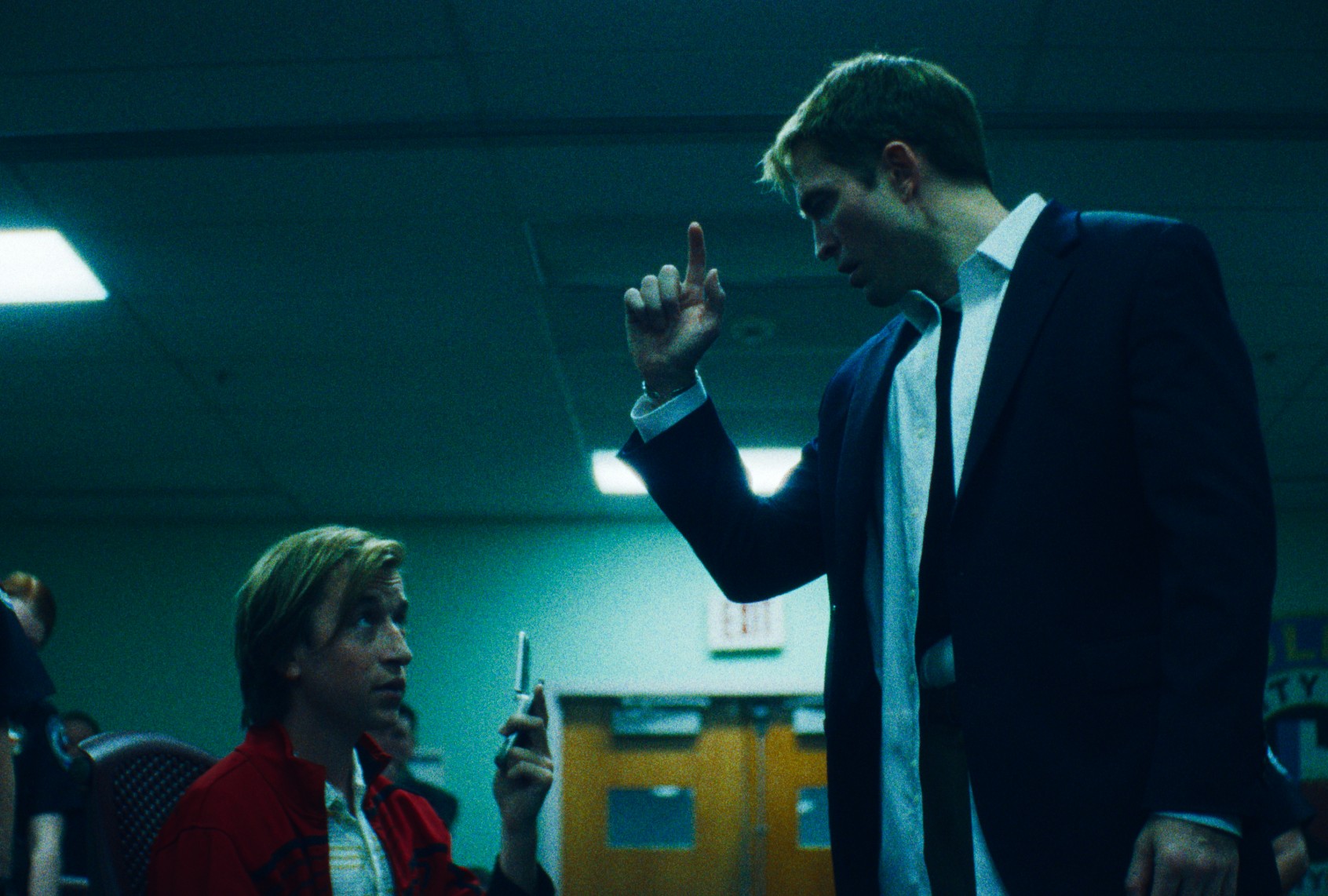
The film vividly illustrates this dynamic through Hansen’s partnership with Xavier Von Erck (played by Matthew Maher), the real-life founder of Perverted-Justice, the vigilante group responsible for luring the show’s targets out of internet chat rooms. In one pivotal sequence, Erck approaches Hansen with a new lead, breathlessly declaring, "This is big, the biggest. A whale."
Oppenheim frames this pivotal exchange in eerie, monochromatic blue. The unnatural glow of a computer screen illuminates both men from below, washing out the color in Pattinson’s eyes and fusing his iris and pupil into a solid, obsidian circle. The visual metaphor is unmistakable: Hansen is a shark that has caught the scent of fresh blood, ready to weaponize private data and go in for the kill.
However, the methods depicted in Primetime—and practiced by Perverted-Justice in reality—exposed deep legal and ethical fractures. The sting tactics frequently crossed the line into entrapment. Vigilante decoys waded into chat rooms, extracting personal information while actively encouraging reluctant subjects to commit acts they otherwise might not have pursued. When targets expressed hesitation, decoys routinely feigned distress or anger to manipulate them back onto the hook.
Furthermore, the public interventions and arrests orchestrated for the cameras were legally precarious. Hansen was a journalist, not a law enforcement officer; he never read suspects their Miranda rights. Meanwhile, police officers lying in wait routinely greeted suspects with aggressive, martial force. Primetime captures this environment as a digital wilderness operating under the laws of the jungle: identify, lure, attack, consume.
Supporting Context & Metrics: The Box Office Phenomenon and the Gen Z Fascination
The cultural resonance of Primetime cannot be overstated, particularly given its demographic footprint. According to recent box office analytics, Gen Z viewers accounted for an astounding 69% of the film’s opening weekend audience. This massive turnout underscores a profound generational curiosity about the inflection points that birthed our current surveillance culture.
| Metric / Demographic Factor | Data Insight & Cultural Implication |
|---|---|
| Opening Weekend Demographic | Gen Z accounted for 69% of ticket sales, proving massive interest from digital natives. |
| Historical Setting | Centered on 2006, bridging the gap between pre-smartphone ubiquity and modern hyper-connectivity. |
| Key Technological Catalyst | Released just months after the debut of the iPhone (2007) and the concurrent run of Gossip Girl. |
| Legislative Milestones | Fueled by post-9/11 frameworks like the Patriot Act and the USA Freedom Act, laying the groundwork for normalization of data harvesting. |
For zoomers who grew up navigating the internet via curated TikTok algorithms and viral meme culture, To Catch a Predator was largely encountered through decentralized clips: isolated chat logs stripped of context or compilation videos highlighting the show’s bizarre moments. This digital sanitization trivialized the very real dangers and survivors’ experiences while simultaneously proving how effectively the show commodified criminal intent into prime-time entertainment.
For those who already understood these structural flaws, Primetime occasionally risks repeating the very sensationalist mistakes of Hansen’s original broadcasts. Yet, for younger viewers attempting to map out how the modern surveillance state swallowed society whole, Oppenheim’s film serves as a vital historical waypoint.
To fully grasp this evolution, one must also look at parallel cultural artifacts from the same era, such as the teen drama Gossip Girl, which premiered in 2007 just as cellphones were becoming mandatory accessories for American youth. While To Catch a Predator reflected the state-sanctioned, militaristic arm of surveillance—heavily influenced by post-9/11 nationalism and the Iraq War—Gossip Girl served as the prototype for civilian-on-civilian electronic monitoring.
The fictional Upper East Side elites chronicled by an anonymous blogger demonstrated the wicked possibilities of wireless connectivity. Gossip became currency, and digital espionage transformed from a government tactic into a social weapon accessible to anyone with an internet connection. As Gossip Girl brilliantly illustrated, the surveillance state perseveres precisely by making itself invisible—framing constant observation not as an authoritarian imposition, but as an entertaining, frictionless facet of daily life.
Official Statements & Critical Industry Reception
The release of Primetime has triggered widespread debate among film critics, cultural historians, and privacy advocates regarding the ethics of revisiting 2000s media spectacles through a modern dramatic lens.
In an interview surrounding the film’s theatrical rollout, director Lance Oppenheim addressed the delicate tightrope of adapting a cultural touchstone fraught with ethical landmines:

"We didn’t set out to make a hagiography, nor did we want to mount a simplistic takedown," Oppenheim stated. "Chris Hansen and the media apparatus he spearheaded existed at a very specific neurological crossroads in American history. People were terrified, desperate for security, and hungry for spectacle. We wanted to examine how easily the public accepted the erosion of privacy in exchange for the theatricalized illusion of safety."
A24’s promotional campaign has similarly leaned into the psychological tension of the film, emphasizing its exploration of the "digital panopticon." Industry analysts have noted that Primetime benefits immensely from public fatigue regarding modern data privacy abuses. By contextualizing the mid-2000s as the incubator for today’s data-mining conglomerates and social media voyeurism, the film bridges a historical gap that resonates deeply with audiences weary of corporate and governmental surveillance.
Legal scholars, however, have voiced caution regarding how dramatic adaptations handle the murky legal realities of vigilante stings. Former media ethicists have pointed out that while Primetime visually dazzles with its neon-noir aesthetic and Pattinson’s magnetic performance, it occasionally flirts with romanticizing the very predatory journalism models that compromised due process two decades ago.
Future Outlook: Navigating the Permanent Panopticon
As Primetime continues to dominate box office conversations and spark discourse across digital platforms, it leaves viewers with a sobering question: Where do we go from here?
The convergence of historical retrospectives like Primetime with contemporary anxieties over artificial intelligence, facial recognition, and ubiquitous data harvesting suggests that society’s obsession with surveillance is only intensifying. Gen Z’s fascination with the mid-aughts is not mere nostalgic longing for a simpler time; rather, it is an investigative expedition to discover the exact moment the digital trap snapped shut.
Ultimately, Primetime acts as a stark reminder that the modern surveillance state is an ouroboros—a self-regulating serpent consuming its own tail. Whether viewed as an indictment of sensationalist journalism or as a sleek psychological thriller, the film successfully forces a generation raised inside the panopticon to look up, recognize the camera lenses overhead, and question the true cost of living life in the glaring lights of prime time.