

Executive Overview
For decades, modern astrophysics has relied on fleeting, high-energy cosmic signals to map the most extreme events in the universe. Among the most prized of these signposts are short bursts of gamma rays—intense, highly energetic flashes that typically vanish in less than two seconds. Historically, these abrupt bursts served as the primary electromagnetic fingerprint for catastrophic collisions between neutron stars: the ultra-dense, city-sized remnants of massive stars.
However, a groundbreaking study published in the journal Science Bulletin is now upending conventional wisdom. New observational evidence reveals that some neutron star mergers do not merely blink out of existence in a fraction of a second; instead, they can unleash prolonged, luminous X-ray flashes that remain visible from Earth for upwards of ten minutes.
This monumental discovery bridges a stubborn gap in high-energy astrophysics. For years, astronomers have tracked mysterious, bright X-ray flashes emanating from deep space—phenomena dubbed "fast X-ray transients." While some of these signals have been definitively linked to the dramatic deaths of massive stars, many others have remained stubbornly unexplained, defying categorization due to uncertainties regarding their distance and energy output.
Spearheaded by an international collaboration—including researchers from Professor Eleonora Troja’s group and supported by a prestigious European Research Council (ERC) Consolidator grant—astronomers managed to capture and diagnose one such enigmatic event: EP250704a/GRB 250704B. By orchestrating a rapid-response global observation campaign utilizing elite facilities like the European Southern Observatory’s Very Large Telescope (VLT) and the Very Large Array (VLA), the research team gathered compelling evidence that this record-shattering, ten-minute X-ray emission signaled the birth of a newly minted magnetar—a rapidly spinning neutron star endowed with an unfathomably powerful magnetic field, forged instantly in the fiery crucible of a stellar collision.
This discovery not only redefines our understanding of how neutron star mergers evolve in their immediate aftermath, but it also provides astronomers with a brand-new, powerful tool to hunt down cosmic collisions across the observable universe, paving the way for upcoming multi-messenger astronomy breakthroughs.
Detailed Chronology: From Deep Space Alert to Groundbreaking Discovery
The unfolding of event EP250704a/GRB 250704B reads like a masterclass in modern, high-stakes observational astronomy. It required a delicate synchronization of space-faring x-ray observatories, automated alert networks, and frantic terrestrial interventions.
The Trigger: July 4, 2025
On July 4, 2025, a sudden, high-energy flare pierced the cosmic void. The transient was autonomously captured by an array of sensitive space telescopes: the Space-based multi-band variable object monitor (SVOM) mission, the Hard X-ray Modulation Telescope (Insight-HXMT), and crucially, the recently launched Einstein Probe (EP) satellite.
Operating since its deployment in January 2024, the Einstein Probe has revolutionized our view of the X-ray sky by regularly detecting hundreds of bright transients from distant galaxies. The initial signature of EP250704a featured a brief gamma-ray burst lasting approximately half a second—a duration entirely consistent with classical, short gamma-ray bursts associated with merging neutron stars.
However, what happened next shattered expectations. As the gamma-ray emission subsided, the Einstein Probe’s wide-field X-ray telescopes registered a continuous, highly luminous X-ray glow. This prompt X-ray emission persisted for nearly ten unbroken minutes.
The Race Against Time
Upon receipt of the automated space alert, the scientific community sprang into action. Among them was Niccolò Passaleva, a doctoral student at the University of Rome Tor Vergata and a core member of Professor Eleonora Troja’s research team. At the precise moment the alert flashed across communication channels, Passaleva was far from a quiet laboratory.
"I was traveling home by train," Passaleva recalls, recounting the adrenaline-fueled moments that followed. "And all of a sudden I was rushing against time to commandeer one of the largest telescopes in the world from my laptop."
Operating under the framework of large program 114.27LW—titled QUEENB: a QUEst for Elusive Neutron star and Black hole mergers—Passaleva and his colleagues coordinated an immediate follow-up campaign. By rapidly tasking the European Southern Observatory’s Very Large Telescope (VLT) in Chile, alongside radio data from the Very Large Array, the team secured critical observations while the transient’s afterglow was still bright enough to dissect in high fidelity.
Spectral Breakdown and Redshift Measurements
With the VLT’s advanced X-Shooter instrument, the researchers captured the fading light of the transient and split it into its component wavelengths. This spectral breakdown allowed the team to identify distinct absorption lines—chemical fingerprints etched into the light as it passed through intervening gas clouds on its multi-billion-year journey.
By analyzing these spectral lines, the team calculated the event’s redshift at $z = 0.6610$. In cosmological terms, this measurement revealed that EP250704a/GRB 250704B occurred far outside our local galactic neighborhood. The light captured by the VLT had traveled uninterrupted across the cosmos for more than six billion years—meaning the cataclysmic event took place long before our Sun and its planetary system ever coalesced from interstellar dust.
Ruling Out the Alternatives
To cement their hypothesis that this unprecedented X-ray flash originated from a neutron star merger rather than the collapse of a massive star (a core-collapse supernova), the team conducted a rigorous elimination process.
Using deep, high-resolution observations from the VLT’s FORS2 instrument, the researchers scoured the exact location of the transient for the telltale optical signature of a bright supernova. In scenarios where a long-lasting X-ray flash is driven by the death of a massive star, a luminous supernova inevitably blossoms weeks later.
Yet, when the team analyzed the deep optical fields, no supernova appeared. The absence of a stellar collapse signature, combined with the extreme distance, the half-second gamma-ray trigger, and the record-breaking ten-minute X-ray afterglow, provided an airtight body of evidence. The signal could only point to one extraordinary origin: the violent coalescence of two neutron stars resulting in the birth of an exotic stellar remnant.
Supporting Context & Metrics: Decoding the Physics of Neutron Stars and Magnetars
To truly appreciate the magnitude of this discovery, one must examine the extreme physics governing neutron stars, the mechanics of gravitational-wave astronomy, and the specific metrics that make EP250704a/GRB 250704B a landmark in astrophysics.
The Nature of Neutron Stars
Neutron stars represent the crushed, hyper-dense cores left behind when massive stars (typically exceeding eight to ten times the mass of our Sun) exhaust their nuclear fuel and detonate as core-collapse supernovae. Packed into a sphere roughly the size of a modern city—around 20 kilometers (12 miles) in diameter—a single teaspoon of neutron star material weighs roughly a billion tons on Earth.
When two such stellar remnants become locked in a binary orbital decay, they spiral inward toward one another, radiating away orbital energy in the form of gravitational waves predicted by Albert Einstein. Upon final impact, they unleash unimaginable amounts of energy, generating both gravitational ripples across space-time and a complex cocktail of electromagnetic radiation across the spectrum.
The Magnetar Hypothesis
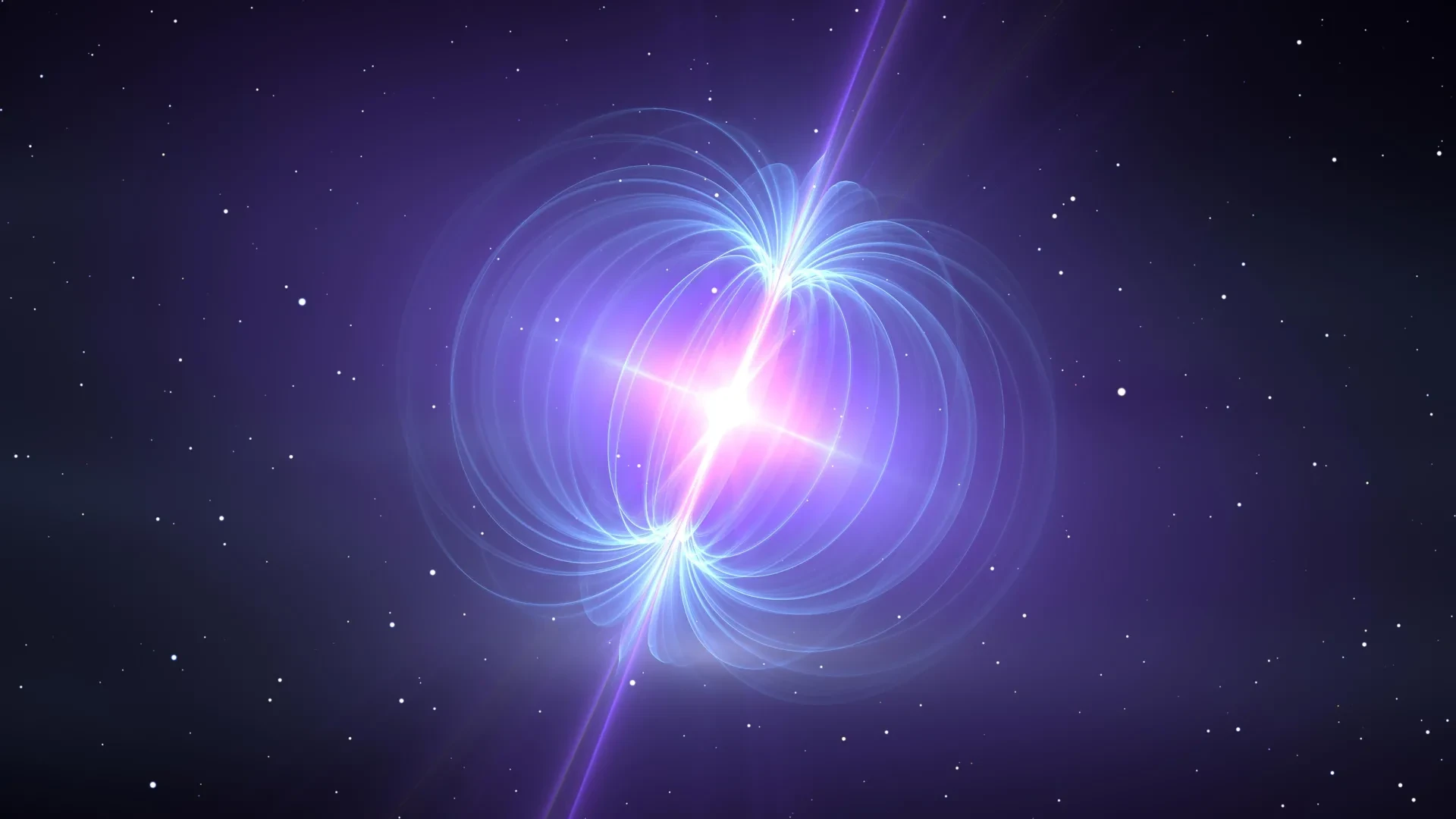
For decades, classical models held that the electromagnetic aftermath of a neutron star merger was dominated by short gamma-ray bursts (lasting under two seconds) powered by accretion disks spiraling into a newly formed black hole. However, theoretical models have long suggested an alternative scenario: if the combined mass of the colliding neutron stars is not too high, the resulting remnant might momentarily—or even permanently—avoid collapse into a black hole, instead forming a magnetar.
"However, if the remnant of the collision is a magnetar, it could keep bursting for longer," explains Professor Eleonora Troja, co-corresponding author of the paper and a key figure in the Einstein Probe European collaboration. "Magnetars are rapidly spinning neutron stars with huge magnetic fields. When they damp their magnetic power into the surroundings, they can make any explosion brighter and longer-lasting. When I saw the X-ray data from this new event, I realized something was up."
A magnetar possesses magnetic fields quadrillions of times stronger than Earth’s magnetic field. As this newborn, ultra-magnetized dynamo spins down rapidly, it unleashes a tremendous reservoir of rotational and magnetic energy into its surrounding ejecta. This sustained energy injection acts as an internal engine, heating the expanding debris and sustaining high-energy X-ray emissions long after the initial gamma-ray flash has faded.
Key Observational Metrics of EP250704a/GRB 250704B
- Discovery Date: July 4, 2025.
- Detecting Satellites: Einstein Probe (EP), SVOM, and Insight-HXMT.
- Gamma-Ray Burst Duration: ~0.5 seconds (classical short GRB profile).
- Prompt X-Ray Flash Duration: ~10 minutes (the longest-lasting prompt X-ray flash ever recorded from a neutron star merger).
- Cosmological Redshift ($z$): 0.6610.
- Light Travel Time: >6 billion years.
- Supernova Counterpart: None detected (effectively ruling out massive star collapse).
Official Statements and Research Collaboration
The success of this study underscores the power of international scientific cooperation, uniting elite institutions across Europe, China, and beyond. The findings represent years of methodical preparation, rapid-response telemetry analysis, and multi-facility coordination.
Reflecting on the emotional and professional gravity of the discovery, graduate student Niccolò Passaleva (University of Rome Tor Vergata), who led the VLT follow-up observations from his laptop on a moving train, noted:
"This is the longest lasting prompt X-ray flash ever observed from a neutron star merger. It is an opportunity to have a front-row seat to the most extreme forces of the Universe and discover more of its secrets."
Professor Eleonora Troja, expanding on the broader implications of the magnetar connection, emphasized how shifting paradigms in X-ray astronomy can reframe unexplained cosmic phenomena:
"Magnetars are rapidly spinning neutron stars with huge magnetic fields. When they damp their magnetic power into the surroundings, they can make any explosion brighter and longer-lasting. When I saw the X-ray data from this new event, I realized something was up."
International Author List and Institutional Contributions
The research paper published in Science Bulletin is the product of a robust global partnership.
- Lead Authors:
- An Li (Beijing Normal University)
- Chen-Wei Wang (Chinese Academy of Sciences)
- Niccolò Passaleva (University of Rome Tor Vergata)
- Jie An (Chinese Academy of Sciences)
- Corresponding Authors:
- Binbin Zhang (Nanjing University)
- Eleonora Troja (University of Rome Tor Vergata)
- Yi-Han Iris Yin (The University of Hong Kong)
- Jing-Wei Hu (Chinese Academy of Sciences)
- Hua-Li Li (Chinese Academy of Sciences)
The ground-based observations that proved pivotal to measuring the event’s redshift and ruling out a supernova counterpart were conducted under the auspices of European Southern Observatory (ESO) large program 114.27LW (Principal Investigator: Eleonora Troja), officially entitled: "QUEENB: a QUEst for Elusive Neutron star and Black hole mergers."
Future Outlook: A New Paradigm in Multi-Messenger Astronomy
The confirmation that neutron star mergers can produce extended, ten-minute X-ray flashes opens an entirely new chapter in observational astrophysics. For years, astronomers searching for electromagnetic counterparts to gravitational-wave events faced a narrow window of opportunity. Short gamma-ray bursts vanish almost instantaneously, making them notoriously difficult to localize with high precision unless space telescopes are pointed in the exact right direction at the exact right microsecond.
By demonstrating that these cataclysmic mergers can also announce themselves via minutes-long X-ray beacons, missions like the Einstein Probe provide a much wider temporal safety net. Wide-field X-ray monitoring allows observatories to catch transients while they are still evolving, signaling ground-based giants like the VLT, the upcoming Extremely Large Telescope (ELT), and radio arrays to slew into position and capture the fading afterglows.
Looking forward, the scientific community is setting its sights on the next generation of gravitational-wave detector runs. If astronomers can routinely pair these newly identified, long-lasting X-ray flashes with direct gravitational-wave detections from the same celestial source, the scientific payoff will be immense.
"Finding more of these X-ray flashes could help reveal how often neutron star mergers create magnetars," concludes Niccolò Passaleva, looking ahead to upcoming technological milestones. "I am really excited for the next run of gravitational wave observations, when we could finally pair one of these X-ray flashes with a burst of gravitational waves from the same source."
As satellite constellations like the Einstein Probe continue scanning the heavens and ground-based telescopes push the boundaries of sensitivity, astrophysics stands on the precipice of a golden age. Every ten-minute X-ray flash decoded brings humanity one step closer to mapping the birth rates of magnetars, understanding the equations of state governing super-dense nuclear matter, and decoding the most violent symphonies of the cosmos.