In the realm of digital product creation, few challenges are as universally acknowledged yet chronically mismanaged as the act of naming. Whether it is an HTML class, a cascading style sheet (CSS) property, a JavaScript function, a design token, a UI component, or an entire product feature, the words we choose profoundly shape our technical infrastructure and cross-functional collaborations.
Language is the foundational substrate of thought. The terms chosen by a product team dictate how they conceptualize interfaces, organize codebases, and converse with users. Yet, despite its critical importance, naming remains a perpetual friction point. Teams frequently grapple with terms that are either too generic—leading to ambiguity and misinterpretation—or too specific, thereby stifling flexibility, scalability, and code reuse.
When terminology fractures across departmental silos, organizations suffer from "dialect fragmentation." Designers speak one dialect, developers another, product managers a third, and users bring an entirely different vernacular altogether. This linguistic disconnect breeds confusion, slows development velocity, and often results in poor feature discovery and low user adoption.
This comprehensive guide explores the multifaceted discipline of naming in design systems and software engineering. By examining industry-proven resources, taxonomic frameworks, and practical strategies from leading design systems, this report provides a definitive roadmap for establishing a unified, scalable, and intuitive lexicon.
Detailed Chronology & The Evolution of Naming Frameworks
The evolution of structured naming in web development and product design has progressed from ad-hoc, developer-driven conventions to highly sophisticated, multi-tiered taxonomies. Understanding this historical progression highlights why structured naming has become a core competency for modern enterprise teams.
Phase 1: The Wild West of Code and Design (Early Web Era)
In the early days of web development and digital design, naming conventions were largely non-existent. Classes were named based on immediate visual appearance (e.g., .blue-button-big or .text-red), and design layers in tools like Photoshop were labeled arbitrarily (e.g., Layer 1, Rectangle copy 4). This approach caused immense technical debt. A simple brand color update required scouring thousands of lines of code to replace hardcoded values, while design files were virtually unhandoffable without verbal context.
Phase 2: Methodologies and Modular Systems (BEM & Atomic Design)
As applications scaled, the industry recognized the need for systemic structure. The introduction of methodologies like BEM (Block, Element, Modifier) brought predictability to CSS class naming. Simultaneously, Atomic Design principles revolutionized UI layout by breaking interfaces down into atoms, molecules, organisms, templates, and pages. However, while these methodologies solved structural organization, teams still struggled with the subjective nature of semantic naming: What do we actually call this specific component?
Phase 3: The Design Token Revolution and Enterprise Scale
Today, the digital landscape is dominated by design systems that serve multi-brand, multi-platform ecosystems. Companies like Intuit, Vodafone, and major tech enterprises have shifted toward abstracting design properties into "design tokens." This evolution requires complex, highly orchestrated taxonomies capable of mapping primitive values all the way through to semantic tokens and page-specific implementations. Naming is no longer just about writing clean code; it is about building a robust cross-functional data structure.
Supporting Context & Metrics: Key Resources and Methodologies
To address the perpetual struggle of naming, the design and engineering communities have developed an array of open-source repositories, interactive guides, and taxonomic frameworks.
1. Breaking Out of the Code Box: General Naming Inspiration
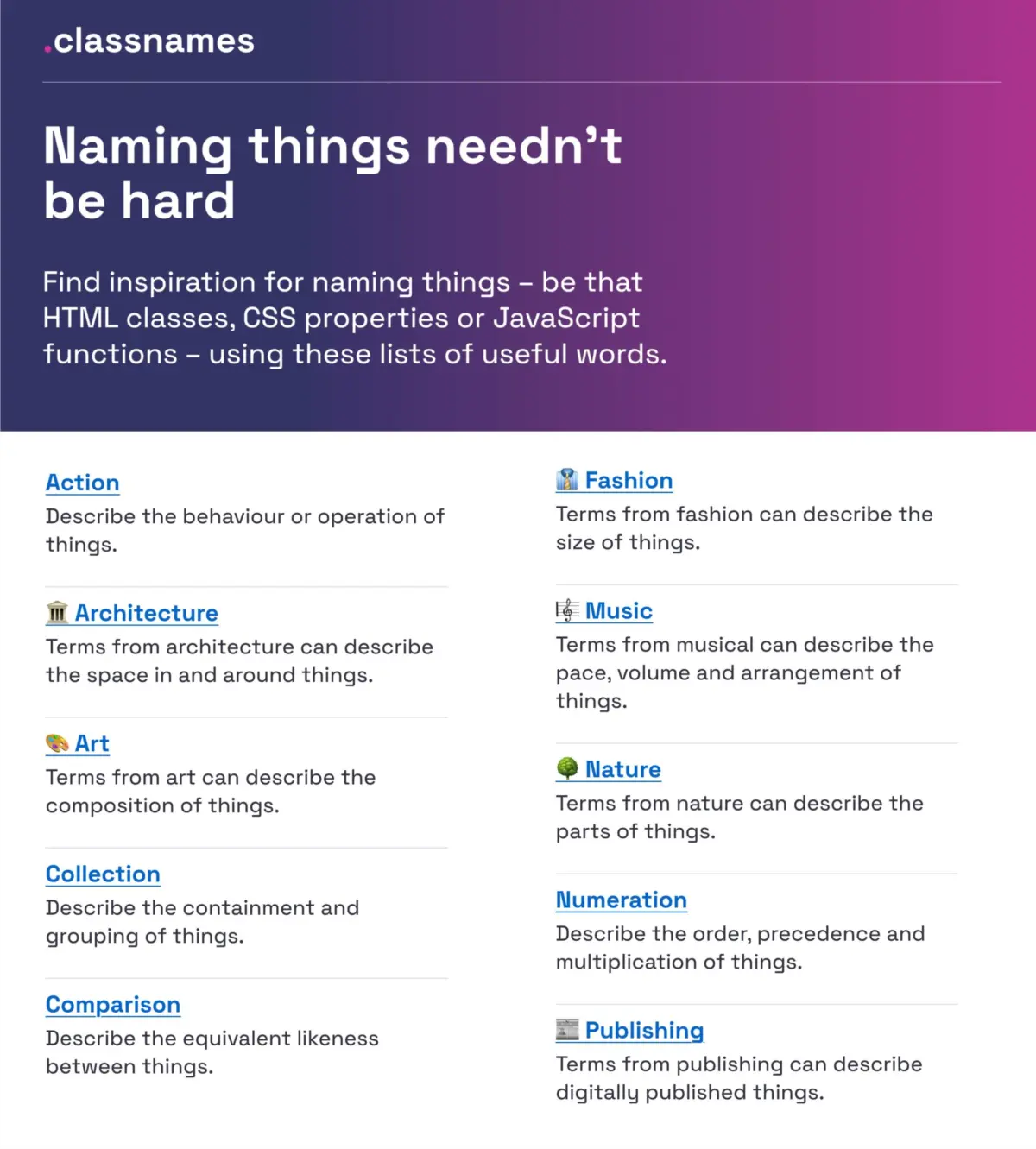
When developers and designers experience mental blocks, looking beyond traditional tech vocabulary is essential. Paul Robert Lloyd’s Classnames resource provides a brilliant antidote to generic naming habits. The platform offers thematically grouped lists of words categorized by behavior, likeness, order, grouping, and association. Furthermore, it introduces unexpected thematic collections drawn from nature, art, theater, music, architecture, fashion, and publishing—inspiring creative yet precise nomenclature for HTML classes and CSS properties.
2. Quantifying Color: The 30,000-Color Challenge
Naming colors has historically been a subjective minefield where developers rely on hexadecimal codes while stakeholders use vague descriptors like "soft coral" or "darkish blue." To bridge this gap, David Aerne maintains a massive repository of color names containing over 30,355 unique, crowdsourced entries. Combined with interactive tools like Color Parrot, teams can query precise color names, ensuring that design tokens and CSS variables share a standardized, human-readable vocabulary.
3. Layer and Group Discipline in Design Tools
Javier Cuello’s guidelines on design naming establish core best practices for structuring layers, groups, and components within design environments like Figma. According to Cuello, an effective name possesses four key attributes:
Logical Structure: Predictable and hierarchical.
Conciseness: Short enough to scan quickly in a layers panel.
Meaningfulness: Communicating intent rather than visual appearance.
Universality: Understood by all members of the product team.
By avoiding visual properties (e.g., naming a layer PrimaryButton rather than BlueRectangleWithShadow), teams ensure their design files remain resilient to future design overhauls.
4. Enterprise Design Token Taxonomies: The Intuit & Vodafone Models
Scaling a design system across diverse product portfolios—such as Intuit’s ecosystem of QuickBooks, Mailchimp, and TurboTax—demands an advanced token taxonomy. Nate Baldwin’s case study on Intuit’s token system highlights how abstracting tokens beyond single brand themes creates foundational stability.
Similarly, the Vodafone UK Design System team released their Variables Taxonomy Map, a comprehensive Figma resource illustrating the anatomy of a design token. Building upon Nathan Curtis’s foundational work on token naming, Vodafone’s map delineates four distinct collections:
Brand & Primitives: Raw values (e.g., color swatches, base spacing units).
For teams seeking hands-on implementation tools, Romina Kavcic’s Design Token Naming Guide + Builder and her Design Token Names Inventory spreadsheet offer structured, multi-level frameworks that allow teams to filter, organize, and expand their token libraries without losing track of dependencies.
5. UI Component Galleries and Visual Dictionaries
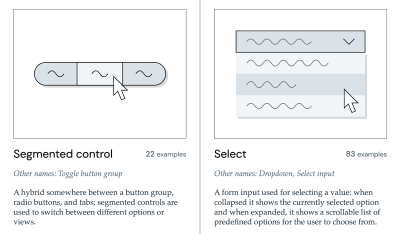
When deciding whether a navigation container should be called a "sidebar," "drawer," or "nav-panel," consulting existing real-world design systems is crucial. Iain Bean’s Component Gallery aggregates examples of over 50 UI components from major design systems, documenting the various aliases each component goes by. Coupled with visual dictionaries like Name That UI, these resources eliminate guesswork when establishing component libraries.
6. Feature Discovery and User-Centric Naming
Poor feature adoption is frequently a symptom of poor discoverability caused by ambiguous naming. As Erin Gannon outlines in her practical guide, features must progress through a lifecycle: discovery, understanding, trial, learning, and integration into existing workflows.
The Golden Rule: Feature names should be driven by user needs, signaling the job-to-be-done or the ultimate outcome.
Actionable Strategy: Ask users to explain a feature in their own words during user testing, and adopt their exact terminology rather than internal corporate jargon.
Official Industry Perspectives and Expert Insights
Industry leaders consistently emphasize that naming is not a superficial task, but a strategic alignment exercise.
"The right name is the one that is well-understood and actively used by both the team and the users. So much time is wasted speaking about the very same thing but in different dialects—the designer’s dialect, the developer’s dialect, the product manager’s dialect, and the user’s dialect. That is what causes friction, frustration, and systemic confusion."
— Vitaly Friedman, UX Consultant and Creator of Design Patterns For AI Interfaces
When cross-functional teams fail to establish a shared vocabulary, technical debt accumulates not just in the codebase, but in product documentation and design files. Leaders advocate for treating naming conventions as living contracts between engineering, product, and design teams.
Future Outlook: The Next Frontier in Semantic Design
As the digital product landscape evolves, the importance of rigorous naming conventions will only accelerate, driven by several emerging technological shifts:
AI-Driven Interfaces and Design Generation: With the rise of AI-generated UI components and automated code translation (as explored in advanced curriculums like Design Patterns For AI Interfaces), machines must parse design token structures and component hierarchies with absolute precision. Ambiguous names break automated code generation and AI reasoning pipelines.
Automated Token Linters: Future design systems will increasingly rely on automated linters that scan Figma files and code repositories for naming compliance, automatically flagging non-standard tokens or generic layer names before code reaches production.
Cross-Platform Design Tokens (W3C Community Group): The standardization of Design Token formats by the W3C will enforce stricter cross-platform naming rules, ensuring tokens transition seamlessly from design tools to iOS, Android, and web frameworks.
Wrapping Up: Actionable Takeaways
To eliminate friction and enhance team collaboration, organizations must take proactive steps regarding their nomenclature:
Audit Your Backlog: If you observe low feature adoption or constant confusion during handoffs, review your naming conventions. Put recurring naming conflicts into a dedicated backlog to resolve systematically.
Adopt User Language: For features and user-facing copy, strip out internal project codenames and use the vocabulary gathered directly from user research.
Leverage Open Resources: Utilize established taxonomies (such as the Component Gallery, Classnames, and Vodafone’s Taxonomy Map) rather than inventing systems from scratch.
By treating language as a critical architectural component of your digital products, you can bridge the gap between disciplines, reduce cognitive overhead, and build truly scalable, intuitive experiences.