

Executive Overview
In the digital product ecosystem, there is an old, universally acknowledged adage: “There are only two hard things in Computer Science: cache invalidation and naming things.” While attributed originally to Phil Karlton, this sentiment resonates just as deeply with UI designers, front-end engineers, product managers, and copywriters alike.
The language we choose does far more than merely decorate our codebases or label our wireframes; it actively shapes the way we think, the mental models we construct, and the collaborative dialogues we maintain across cross-functional teams. When nomenclature fails, confusion reigns. Teams find themselves speaking in fragmented dialects—designers talking in visual metaphors, developers speaking in structural classes, product managers relying on business jargon, and users stumbling through entirely foreign terminology.
This friction leads to bloated design token taxonomies, overly generic HTML classes, inflexible UI components, and ultimately, low feature adoption. Poorly named interfaces create cognitive load, estrange users, and cause internal teams to waste countless hours debating what to call the exact same module.

To bridge this linguistic divide, a wealth of community-driven resources, open-source directories, and industry case studies have emerged. This guide aggregates the definitive frameworks, best practices, and expert tools available today. Whether you are scaling a multi-brand design system across enterprise applications, structuring CSS properties, or seeking a resonant moniker for a brand-new feature, mastering the discipline of nomenclature is your key to building intuitive, cohesive, and scalable digital experiences.
Detailed Chronology: The Evolution of Naming Best Practices in Digital Design
The journey of how our industry approaches naming conventions has evolved rapidly over the past decade, shifting from ad-hoc, siloed decisions to systemic, tokenized, and user-centered taxonomies.
Phase 1: The Wild West of Ad-Hoc Styling (Pre-2015)
In the early days of modern web design and app development, naming was largely an afterthought. Developers wrote CSS classes based on immediate visual appearance (e.g., .blue-button-bold or .float-left-box), while designers named Figma layers arbitrarily like Rectangle 402 or Group Copy 3. This approach worked for isolated, single-page projects, but as applications scaled into massive enterprise products, it collapsed under its own weight. A simple brand color update required hunting down thousands of hardcoded instances, leading to fragmented styling and technical debt.

Phase 2: Methodologies and Modular Systems (2015–2018)
As the industry recognized the unsustainable nature of ad-hoc naming, structured methodologies entered the mainstream. Frameworks like BEM (Block, Element, Modifier) revolutionized CSS architecture by bringing predictability and scoping to class names (e.g., block__element--modifier). Simultaneously, design systems began to formalize. Teams started treating UI components as standardized widgets—accordions, modals, and toolbars—requiring synchronized vocabularies between design tools and code repositories.
Phase 3: The Rise of Design Tokens and Multi-Brand Ecosystems (2018–Present)
Today, design systems have matured into complex, multi-platform, and multi-brand infrastructures. Organizations like Intuit and Vodafone manage diverse product families (such as QuickBooks, Mailchimp, and TurboTax) from unified design token architectures. Naming is no longer just about writing clean CSS; it is an intricate taxonomy challenge. Modern design tokens bridge the gap between design tokens (primitives, semantics, and components) and implementation code, demanding rigorous, scalable, and intuitive nomenclature maps.
Supporting Context & Metrics: Why Naming Directly Impacts User Adoption and Team Velocity
Why does an enterprise invest hundreds of hours refining a design token taxonomy or standardizing component galleries? The answer lies in operational efficiency and user psychology.

The Cost of Siloed Dialects
When design, engineering, and product management speak different naming dialects, the handoff process breaks down. A designer might label a pattern a "Card Carousel," while the developer codes it as a ContentSlider, and the product manager markets it as a "Featured Stream." When bugs are reported or features are updated, communication stalls because team members must continuously translate terms in their heads.
Feature Discoverability and User Psychology
When it comes to customer-facing features, poor naming directly sabotages metrics. Research into product adoption reveals a strict sequential funnel:
- Discovery: The user must notice the feature.
- Understanding: The user must comprehend what the feature does.
- Trial: The user must test the feature within their workflow.
- Integration: The feature must become a habitual part of their routine.
If a feature has an obscure, internal codename or a hyper-clever marketing label that lacks descriptive value, users will never progress past step one. Effective feature names are anchored in the user’s "job-to-be-done." They signal tangible outcomes and leverage the exact vocabulary that users employ when describing their own problems.

Core Frameworks and Essential Resources for Naming Everything
To master the art of digital nomenclature, practitioners can draw upon a curated suite of specialized tools, repositories, and expert guidelines.
1. General Inspiration and Code Vocabulary
When struggling to name HTML classes, CSS properties, or JavaScript functions, looking beyond standard technical dictionaries can spark creativity.
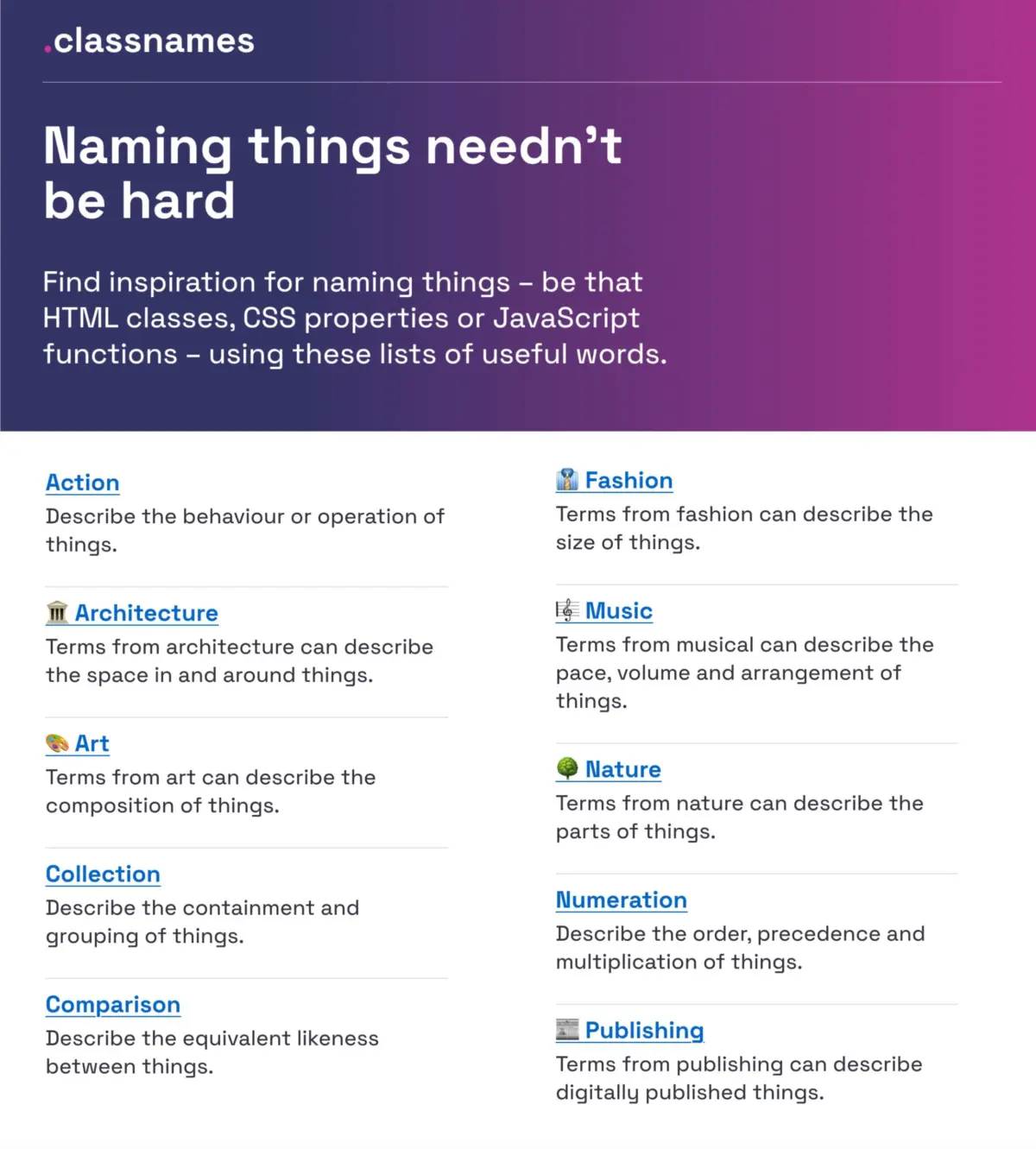
- Classnames (paulrobertlloyd.com/classnames): A brilliant resource packed with thematically grouped lists of words. It offers terms describing behavior, likeness, order, and grouping, alongside unexpected collections drawn from nature, architecture, art, theater, music, fashion, and publishing. It forces teams to think outside the box when standard programming vocabulary falls short.
2. Color System Nomenclature
Naming colors is notoriously subjective. Is a hex code #264653 "Dark Slate," "Ocean Depth," or "Midnight Teal"?

- Color Names Repository (GitHub / meodai): Maintained by David Aerne, this massive repository contains over 30,000 unique color names sourced from user contributions and historical references. Complete with color pickers and name search utilities like Color Parrot, it provides a standardized safety net for semantic color tokenization.
3. Layer and Component Best Practices in Design Tools
Consistency in tools like Figma or Sketch prevents design systems from rotting.
- Design Good Practices (goodpractices.design/guidelines/naming): Javier Cuello outlines definitive guidelines for naming layers, groups, and components. An effective name, according to Cuello, must possess a logical structure, remain concise yet meaningful, be universally understood across the team, and entirely decouple naming from volatile visual properties (e.g., naming a layer
PrimaryActionrather thanBlueRectangle).
4. Design Token Taxonomies
Scaling tokens across global brands requires robust, tiered structures.
- Intuit’s Flexible Design Token Taxonomy: Documented by Nate Baldwin, this case study details how the parent company of QuickBooks and Mailchimp restructured their token taxonomy to serve wildly different brand themes under a single foundational system.
- Vodafone UK Variables Taxonomy Map (Figma Community): A masterclass in multi-brand, multi-themed design system architecture. It maps out the exact four-tier anatomy required to connect brand primitives to semantic tokens and page-level variables, building upon Nathan Curtis’s pioneering work on design token naming.
- Design Token Naming Guide & Builder (namedesigntokens.guide): Created by Romina Kavcic, this interactive tool helps teams configure structured token naming conventions encompassing components, categories, states, and roles, complemented by a handy Design Token Names Inventory spreadsheet.
5. UI Component Gallops and Visual Dictionaries
- The Component Gallery (component.gallery): Curated by Iain Bean, this invaluable directory catalogs real-world design systems, providing examples and alternative nomenclature for over 50 distinct UI components—from accordions to visually hidden utility classes.
- Name That UI (namethatui.com): A quick-reference visual dictionary that clarifies ambiguous interface components.
6. Product and Service Naming Repositories
- Onym (guide.onym.co): An open-source repository gathering brainstorming tools, vetting methodologies, etymology guides, sprint prompts, and cautionary tales to assist teams in naming new digital products and services.
Official Statements and Expert Perspectives
Industry leaders continue to emphasize that naming is an ongoing organizational discipline rather than a one-time setup task.
"The right name is the one that is well-understood and actively used by both the team and the users. So much time is wasted speaking about the very same thing but in different dialects—the designer’s dialect, the developer’s dialect, the product manager’s dialect, and the user’s dialect. That is what constantly causes frustration and confusion."
— Vitaly Friedman, Smashing Magazine
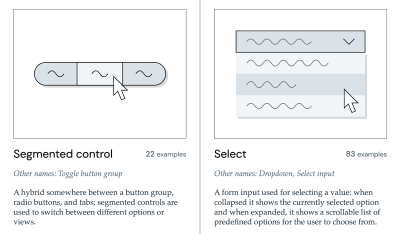
Experts advocate for establishing explicit naming conflict backlogs within agile teams. When a naming ambiguity surfaces—such as an engineer referring to a component as a "Dropdown" while a designer calls it a "Select Menu"—it should not be brushed aside. Documenting and resolving these semantic discrepancies reduces cognitive friction and lays the groundwork for seamless cross-functional collaboration.
Future Outlook: The Next Frontier of Automated and Semantic Nomenclature
As artificial intelligence, automated token generators, and design-to-code pipelines continue to advance, the landscape of nomenclature is poised for transformation.

Looking ahead, we can anticipate several key shifts in how digital creators handle naming:
- AI-Assisted Semantic Validation: Next-generation design system linters will automatically detect when a newly introduced component or design token violates established organizational taxonomies, suggesting context-aware alternatives based on team-specific dictionaries.
- Dynamic Multi-Lingual Token Maps: As global product teams scale, design tokens will increasingly support automated, context-aware translation layers, ensuring that token semantics remain universally aligned across international engineering hubs without fracturing local product dialects.
- Closer Alignment of User Research and Code: Future product workflows will leverage automated transcription and user feedback analysis tools to feed customer phrasing directly into feature-naming repositories, ensuring that marketing labels and UI microcopy reflect true user mental models from day one.
By treating nomenclature as a first-class engineering and design primitive, organizations can eliminate costly miscommunications, accelerate feature adoption, and build resilient digital products that stand the test of time.