

In the digital product ecosystem, a persistent paradox governs workflow efficiency: while teams routinely spend months architecting sophisticated frameworks, designing intricate micro-interactions, and optimizing backend performance, projects frequently stall over a challenge seemingly trivial by comparison—nomenclature. "Naming is hard." This ubiquitous sentiment echoes across engineering stand-ups, design critiques, and product roadmaps. The language employed by cross-functional teams does not merely label features, components, variables, or design tokens; it actively shapes cognitive models and dictates the parameters of collaboration.
When terminology fails, communication fractures. Misalignment surfaces as confusion over colors, icons, user interface (UI) components, and architectural features. Teams find themselves trapped between two problematic extremes: labels that are too generic to convey precise intent, and those that are too specific, stripping systems of the modular flexibility and scalability required for modern product growth.
This comprehensive investigation explores the anatomy of digital naming, charting the essential resources, methodologies, and taxonomies that industry leaders use to conquer nomenclature chaos. From multi-brand design systems at telecom giants to open-source glossaries for color theory, we examine how standardizing language bridges the persistent gap between designers, developers, product managers, and end-users.

Detailed Chronology: The Evolution of Naming Frameworks in Digital Design
The journey toward systematic nomenclature has evolved in tandem with the maturation of design systems, token architecture, and multi-platform digital ecosystems. Understanding this progression illuminates why modern teams face such rigorous naming requirements.
Phase 1: The Wild West of Ad-Hoc Styling (Pre-2015)
In the early days of scalable web design and bespoke application development, naming was largely an afterthought dictated by local context. Developers devised CSS class names based on immediate visual appearance (e.g., .blue-button-large or .text-bold-red), while designers organized Figma or Sketch layers with arbitrary labels like Rectangle 40 or Group Copy 2.
This approach triggered severe technical debt. When brand guidelines shifted or accessibility standards mandated color swaps, updating hard-coded, visually bound names required tedious, error-prone manual overhauls. The vocabulary of design was decoupled from the vocabulary of code, creating an inevitable friction barrier during developer hand-offs.

Phase 2: The Methodology Boom (2015–2019)
As digital products scaled into massive component libraries, the industry recognized an urgent need for structural rigor. Methodology frameworks emerged to govern HTML and CSS class structures. Systems like BEM (Block, Element, Modifier), SMACSS (Scalable and Modular Architecture for CSS), and Atomic Design by Brad Frost introduced hierarchical thinking to nomenclature.
Simultaneously, design tools introduced symbols and nested artboards, forcing designers to adopt structured naming conventions to keep layers parseable. However, silos remained. Designers spoke in spatial terms (cards, grids, containers), while engineers spoke in DOM structures, creating perpetual translation friction across organizational lines.
Phase 3: The Design Token Era and Multi-Brand Complexity (2020–Present)
Today, digital products exist across multi-platform environments—spanning iOS, Android, web, and watch OS—often while supporting multiple white-label brands under a single parent umbrella. This multi-themed reality birthed design tokens: platform-agnostic variables storing design decisions like spacing, typography, and color.

Managing thousands of tokens across global brands rendered manual naming impossible. Organizations like Intuit, Vodafone UK, and enterprise design system teams began treating nomenclature as a dedicated discipline. Naming shifted from descriptive labeling to abstract taxonomy mapping, utilizing token tiers—ranging from primitive values to semantic roles and component-specific states.
Supporting Context & Metrics: Decoding the Taxonomy Crisis
Why do software projects experience friction over naming? The root cause lies in dialect fragmentation. Within a single product organization, distinct stakeholders operate within specialized linguistic frameworks:
- The Designer’s Dialect: Focuses on layout context, visual hierarchy, user journeys, and component behavior (e.g., "Modal Overlay," "Hero Banner").
- The Developer’s Dialect: Focuses on state management, encapsulation, structural hierarchy, and reusability (e.g., "DialogComponent," "Wrapper-Flex").
- The Product Manager’s Dialect: Focuses on business value, feature adoption metrics, user outcomes, and feature discoverability (e.g., "Onboarding Accelerator," "Quick-Pay Feature").
- The User’s Dialect: Focuses on plain-language expectations, task completion, and intuitive mental models (e.g., "Save Money," "Send Message").
When these four dialects clash, teams waste countless hours arguing over identical concepts disguised by conflicting terminology. Research across product teams indicates that up to 15% of daily stand-up and backlog refinement time is lost to semantic disambiguation—clarifying what a specific variable, token, or feature actually controls. Furthermore, low feature adoption rates can frequently be traced back not to poor utility, but to obscure, internal-facing feature names that fail to resonate with user mental models.

Official Strategies and Modern Toolkits for Naming Excellence
Fortunately, the design and engineering communities have rallied to produce sophisticated open-source repositories, guidelines, and interactive builders designed to eradicate guesswork from naming conventions.
1. Expanding Vocabulary with Classnames
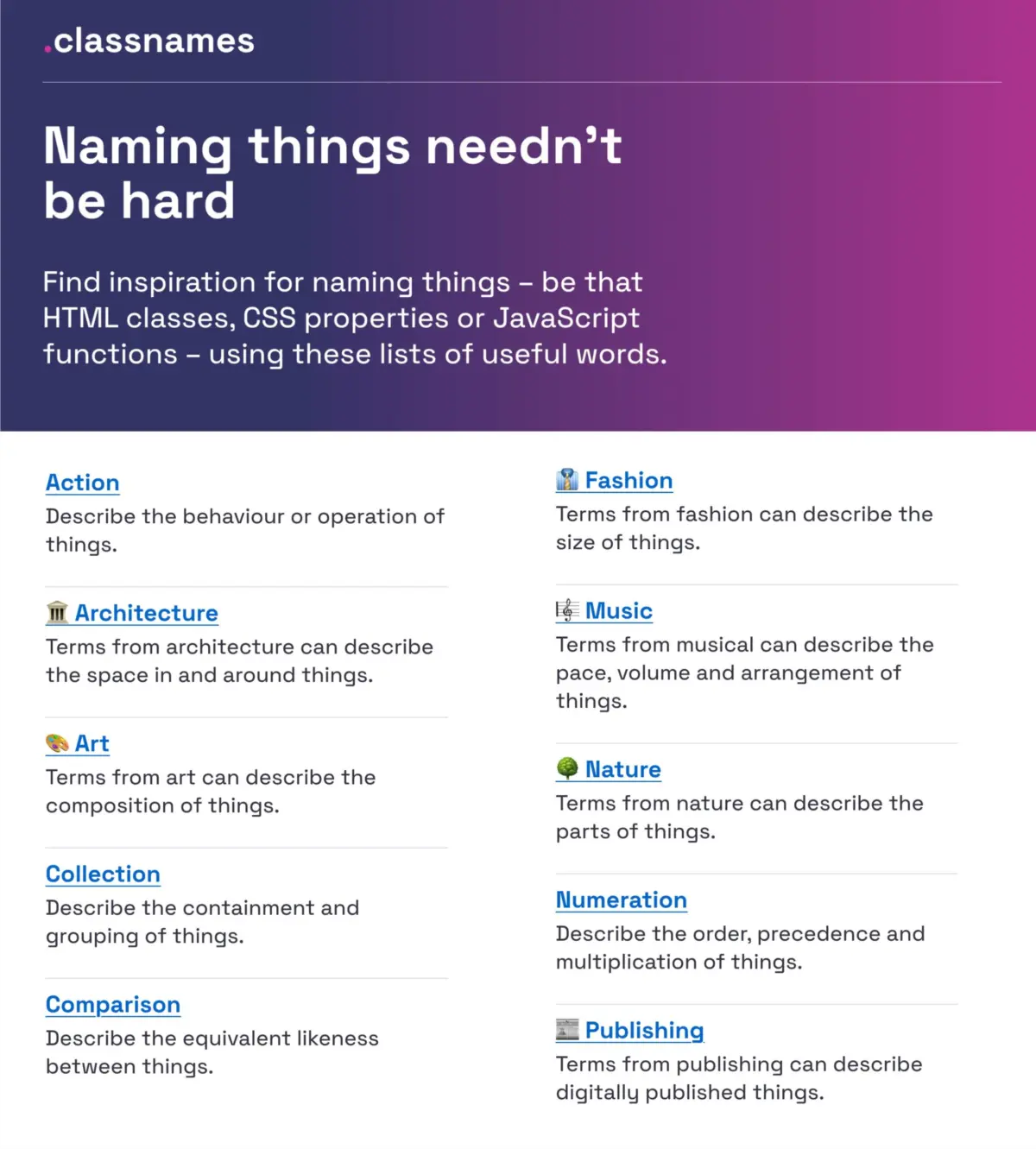
When struggling to name CSS properties, functions, or JavaScript modules, developers often fall into repetitive linguistic loops. Paul Robert Lloyd’s Classnames resource serves as an antidote to unimaginative code, providing thematically grouped lists of words designed to inspire out-of-the-box thinking. Beyond standard programmatic terms describing behavior, grouping, and order, the platform offers curated vocabularies drawn from art, theater, music, architecture, fashion, publishing, and the natural world. Leveraging these thematic collections helps establish memorable, non-generic identifiers that remain distinct within large codebases.
2. Taming Color Semantics via Color-Names
Color nomenclature has historically relied on subjective intuition—leading to team debates over whether a hex code represents "Royal Blue," "Navy," or "Ocean." David Aerne’s color-names repository eliminates this ambiguity by aggregating over 30,355 unique, community-contributed color designations. Supported by interactive utilities like the Color Parrot picker, teams can assign standardized, memorable names to brand and functional palettes, streamlining the synchronization of color tokens between design systems and code repositories.

3. Scalable Layer and Component Best Practices
In design tools like Figma, unorganized files degrade team productivity. Javier Cuello’s comprehensive naming guidelines establish core principles for structural consistency:
- Logical Structure: Names should follow a predictable reading order (e.g.,
Component / State / Variation). - Conciseness: Keep titles short and information-dense.
- Universality: Avoid inside jokes or hyper-local team slang.
- Decoupling from Visuals: Refrain from naming layers after fleeting styles (e.g., avoid
Blue-Box; useCard-Container).
4. Architecting Design Token Taxonomies
Enterprise-grade systems require multi-layered token structures that survive brand shifts. Nate Baldwin’s case study on Intuit’s design token taxonomy highlights the journey of unifying brands like Mailchimp, QuickBooks, TurboTax, and Mint under a resilient foundational system.
Similarly, the Vodafone UK Design System team’s Variables Taxonomy Map in Figma demonstrates how to orchestrate a complex multi-brand, multi-themed system. Building upon Nathan Curtis’s foundational token research, Vodafone’s map illustrates four distinct collections—moving seamlessly from brand primitives to semantic roles and page-level applications. This guarantees that any contributor can instantly identify a token’s origin, scope, and destination simply by reading its identifier.
For teams seeking immediate implementation, Romina Kavcic’s Design Token Naming Guide & Builder provides an interactive web utility to configure custom structures incorporating components, categories, states, and roles. Complemented by her Design Token Names Inventory spreadsheet, teams gain a bird’s-eye matrix to filter, scale, and audit tokens across multiple themes and modes without losing structural integrity.
5. UI Component Benchmarking with The Component Gallery
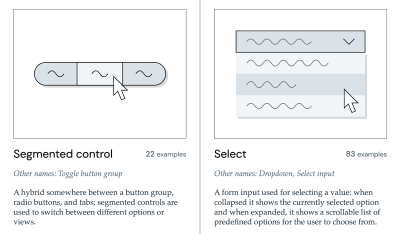
Inventing new names for standard UI patterns is rarely necessary. Iain Bean’s Component Gallery aggregates real-world examples and alternate naming conventions for over 50 distinct interface components—from accordions to visually hidden elements. By cross-referencing industry standards, teams can adopt battle-tested nomenclature that aligns with user expectations and developer conventions alike. This is mirrored in visual dictionaries like Name That UI, which accelerates cross-functional alignment.
6. Crafting Discoverable Feature Names
Naming user-facing features requires a radically different lens than naming code variables. As Erin Gannon outlines in her practical guide “What Do We Call This Thing?”, low feature adoption is frequently a symptom of poor discoverability caused by opaque internal jargon. High-performing feature names must:

- Reflect user needs and solve explicit user problems.
- Signal clear functional value or outcomes (the "job-to-be-done").
- Root themselves strictly in the user’s everyday language rather than corporate marketing speak.
Future Outlook: The Horizon of Automated Semantics
As the digital product landscape continues to expand into AI-assisted design, automated code generation, and multi-modal experiences, the discipline of naming is poised for a profound transformation.
We are rapidly approaching an era where design systems will feature self-healing taxonomies. Artificial intelligence models, trained on comprehensive repositories like the Component Gallery and global color databases, will be capable of auditing team workspaces in real-time, instantly flagging naming conflicts, detecting inaccessible or overly specific component labels, and suggesting universally understood semantic tokens.
However, technology alone cannot replace human consensus. The fundamental challenge of naming remains social: it requires cross-functional empathy. Designers, developers, product managers, and copywriters must consciously step outside their institutional silos to co-create a unified lexicon.

Organizations that invest in robust naming guidelines, maintain living token inventories, and prioritize the end-user’s vocabulary will eliminate the silent tax of semantic friction. By treating nomenclature not as an administrative chore, but as a core architectural pillar of product design, teams can build resilient, scalable, and harmonious digital ecosystems ready for the challenges of tomorrow.