

While high-profile battles over press credentials in the nation’s capital—such as the legal challenges mounted by major networks against White House restrictions—frequently capture national headlines, a quieter, more insidious war on transparency is being waged across statehouses and city halls nationwide.
From the arid political landscapes of Utah and Arizona to the legislative halls of Kansas and the humid municipal chambers of Miami, independent journalists and local newsrooms are increasingly finding themselves locked out of the rooms where the public’s business is conducted. Public officials are leveraging bureaucratic hurdles, strict new media policies, targeted fee increases, and outright denials of press credentials to control the narrative.
This growing hostility toward local and state-level watchdogs is not merely an occupational hazard for reporters; it poses a direct and present danger to the public’s right to know, threatening to erode democratic accountability at its very foundation.
Executive Overview
The erosion of press access across regional and local jurisdictions represents a critical tipping point in American journalism. While the adversarial relationship between the government and the press is a foundational element of American democracy, reporters and media advocates note that the dynamic has shifted significantly over the past decade. What was once a tense yet professional coexistence has devolved into a culture of active antagonism and strategic isolation.
Political leaders at the state and local levels have increasingly realized that they no longer need traditional media organizations to reach their constituents. Armed with social media platforms and digital communication channels, officials can curate their own messaging, bypassing critical scrutiny entirely. When independent watchdogs attempt to hold them accountable, these same officials often respond by restricting physical access, withholding public records, and weaponizing credentialing processes to punish critical coverage.
This systemic restriction of the press has profound downstream consequences. Stories take longer to report, cost more to investigate, and are sometimes abandoned altogether. Ultimately, it is the tax-paying public that bears the cost, left with obscured information about the policies, expenditures, and conduct of the officials who govern them.
Detailed Chronology of Access Restrictions
The nationwide tightening of press access has unfolded across several flashpoints over recent years, marked by escalating friction between local governments and the reporters tracking them.
The Utah Credentialing Battle (2024–Present)
The struggle for access in the Beehive State serves as a prime example of the friction facing independent digital journalists. Bryan Schott, a veteran political reporter and founder of Utah Political Watch, spent years covering state politics with credentials from The Salt Lake Tribune. However, when he applied for credentials for the 2025 legislative session under his own independent banner, his application was rejected.
Utah House and Senate media liaisons Alex Musselman and Aundrea Peterson informed Schott that state Capitol media credentials are not issued to blogs, independent operators, or freelance journalists. The denial followed closely on the heels of text messages from Peterson criticizing Schott’s coverage of a nonprofit alleging campaign finance violations by Senate President J. Stuart Adams.
Schott filed a federal lawsuit in January 2025, alleging viewpoint-based discrimination in violation of the First Amendment. Over the summer, a panel of federal judges revived the lawsuit, sending it back to a lower court—a move Schott notes mirrors the constitutional questions raised in high-profile federal media access cases.
Kansas Statehouse Retaliation (2025)
In Kansas, the statehouse press corps has watched its operational space shrink dramatically under a coordinated series of access restrictions implemented by legislative leadership.
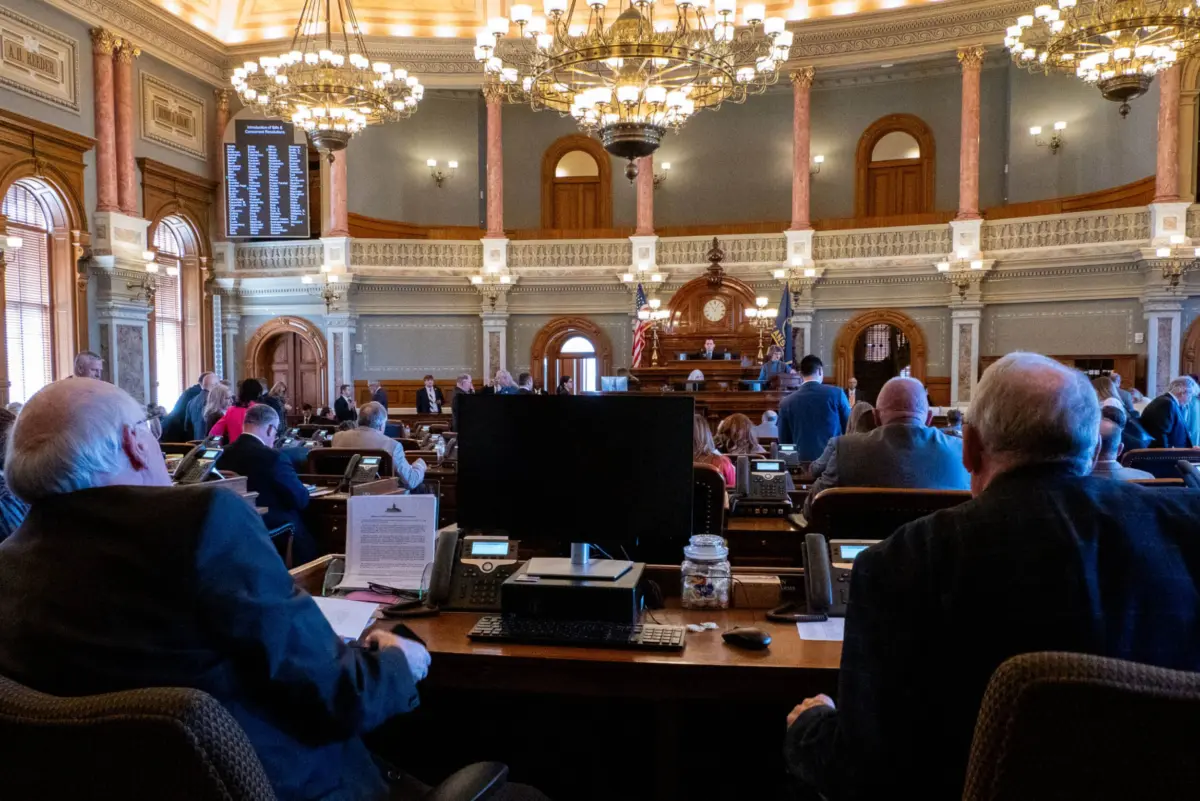
In January 2025, Kansas House Speaker Dan Hawkins eliminated the House’s designated press area on the chamber floor. Journalists were stripped of their workspace and relegated to a distant back wall, where they are permitted to stand, observe, and photograph proceedings, but are explicitly barred from taking notes or approaching lawmakers for impromptu interviews. Shortly thereafter, House Republicans voted to close their caucus meetings to reporters, transforming sessions that were once routinely open into private affairs where legislation is shaped entirely in the dark.
Compounding these physical barriers, state Senator Virgil Peck proposed an aggressive rent hike for the few media outlets maintaining physical offices in the statehouse. Proposing an increase from a flat fee of $100 per year to $1 per square foot per month (and later attempting an even steeper hike), Peck made no secret of his motivations, openly criticizing the press for publishing stories he deemed inaccurate. While targeted outlets avoided the worst financial impacts, the maneuvers highlighted an overt strategy to penalize unfavorable coverage.
Miami’s Bureaucratic Stonewall (2011 Policy, 2024–2026 Litigation)
In South Florida, the newly revitalized Coconut Grove Spotlight encountered an institutional roadblock rooted in an obscure 2011 city policy. As legacy newspapers like The Miami Herald downsized and laid off municipal reporters, the Spotlight stepped into the void, bringing intense investigative scrutiny to Miami City Hall.
In response, city officials began strictly enforcing a long-dormant policy requiring all municipal employees to secure prior approval before speaking with the press. City staff routinely ignored interview requests and routed inquiries into communications black holes. In June, the Miami News Trust (publisher of the Spotlight) filed a federal lawsuit against the city, arguing that the policy violates municipal employees’ First Amendment rights while actively crippling independent newsgathering. The two sides are slated for a court-ordered mediation conference.
Iowa’s Credentialing and Records Hurdles (2019–Present)
Laura Belin, editor and reporter for the independent progressive site Bleeding Heartland, spent five years fighting the Iowa House clerk’s office for basic press credentials. Despite altering her publication’s categorization, adopting formal ethical codes, and even taking on roles with local radio to satisfy arbitrary criteria, Belin was repeatedly rebuffed with the explanation that credentials "are not issued to members of the public."
It was not until Belin filed a federal lawsuit in January 2024 that the House clerk relented, finally granting her credentials. Yet, access remains conditional; Belin continues to find herself excluded from campaign events, denied questions at infrequent gubernatorial press briefings under Gov. Kim Reynolds, and forced to rely on costly, protracted public records litigation to pry loose baseline government data.
Supporting Context & Metrics: The Shrinking Watchdog Ecosystem
The aggressive posture adopted by public officials toward journalists coincides with a catastrophic contraction of the local news ecosystem. The checks and balances traditionally provided by a robust, well-staffed local press corps are rapidly evaporating.
- The 75% Decline: According to a landmark joint study by Muck Rack and Rebuild Local News, the number of full-time local journalists in the United States has plummeted by an astonishing 75% since 2002.
- Shifting Statehouse Demographics: While Pew Research Center studies indicate nominal fluctuations in total statehouse press numbers, the proportion of full-time, experienced reporters dedicated exclusively to watching state governments has steadily declined. Many bureaus have been hollowed out, leaving behind transient, less-experienced reporters who are easily marginalized by entrenched political machines.
- The Economics of Information: Public records requests—the legal lifeblood of investigative reporting—have increasingly been weaponized through prohibitive fees and deliberate, months-long administrative delays. Outlets like the Coconut Grove Spotlight and investigative teams in Iowa have been forced to resort to costly litigation merely to compel compliance with existing public records laws.
This structural decline has left political leaders largely unaccountable to experienced local inquisitors. Without institutional backing from legacy media giants, independent and startup journalists find themselves uniquely vulnerable to administrative isolation, financial penalties, and social ostracization by the very officials they cover.
Official Statements and Institutional Responses
Despite mounting legal challenges and public criticism, the architects of these restrictive policies have largely doubled down or retreated behind legal counsel.
- Kansas Leadership Silence: Neither Kansas House Speaker Dan Hawkins nor state Sen. Virgil Peck responded to requests for comment regarding their legislative restrictions and proposed rent increases. Peck, however, made his underlying philosophy clear during public debates over statehouse office fees, complaining to constituents that taxpayers were subsidizing press spaces for outlets that "frequently are inaccurate."
- Utah Legislative Defense: Staffers Alex Musselman and Aundrea Peterson, targets of Bryan Schott’s First Amendment lawsuit over Capitol credentialing denials, declined to comment on ongoing litigation. Their initial defense—that credentials are unsuited for independent bloggers and freelancers—underscores a persistent bias within legislative bodies against non-traditional digital media formats.
- The Defense of Independent Scrutiny: Independent journalists fighting these battles remain steadfast despite the odds. David Villano of the Coconut Grove Spotlight emphasizes that his outlet’s litigation aims to secure permanent, proactive protections safeguarding municipal employees’ constitutional right to speak with experts and reporters freely. Similarly, Laura Belin notes that while missing out on real-time legislative schedules and floor-level context makes reporting akin to "writing a story with one hand tied behind your back," the fundamental drive to inform the public remains entirely unbowed.
Future Outlook
The legal battles playing out across state courts in Utah, Iowa, and Florida are poised to establish critical legal precedents for the future of American journalism. If federal courts rule that legislative credentialing bodies and municipal communication blackouts constitute unconstitutional viewpoint discrimination under the First Amendment, a vital constitutional guardrail will be reinforced.
However, if these restrictive administrative measures are allowed to stand, the implications for local democracy are severe. As full-time local reporting positions continue to vanish and remaining watchdogs are relegated to the physical and informational peripheries of government, transparency will continue to wither.
Ultimately, as regional journalists frequently emphasize, public officials can erect physical barriers, withhold press releases, and ignore phone calls—but they cannot extinguish the public’s fundamental need for independent oversight. The ongoing legal showdowns are not merely about ID badges or designated workspaces; they are a high-stakes referendum on whether the American public retains the right to look behind closed doors and see how power is truly exercised.