By the Editorial Desk | Published: 2023 Strategy Series
Executive Overview
The modern search engine optimization (SEO) landscape is bloated with software options. Open any browser tab, and you will be immediately bombarded with top-10, top-20, or top-100 tool roundups. For marketers, agency owners, and in-house search managers, this creates an environment of profound paralysis by analysis. The critical question remains: With hundreds of available utilities, what tools do elite digital marketers actually rely on to build profitable campaigns?
To bypass the marketing fluff and get straight to the source, we posed a single, uncompromising question to 139 of the industry’s top search marketing experts:
"If you could only use 3 tools for keyword research, which 3 would you choose?"
The results provide an unvarnished, data-backed leaderboard of the enterprise-grade platforms and scrappy alternative utilities that genuinely move the needle. Rather than relying on theoretical feature lists, this comprehensive analysis examines the real-world operational choices made by professionals managing international brands, enterprise accounts, and high-growth affiliate portfolios.
Detailed Chronology: The Rise of the Big Three
When analyzing the aggregate votes cast by the 139 experts, a clear hierarchy emerges. While niche-specific utilities and foundational metrics platforms received notable nods, the leaderboard is decisively dominated by three main contenders: Semrush, Google Keyword Planner (GKP), and Ahrefs.
1. Semrush (87 Votes): The All-In-One Powerhouse
Securing the top spot with 87 individual endorsements, Semrush established itself as the undisputed favorite among seasoned search professionals. Experts praised its massive global footprint—boasting a keyword database exceeding 23 billion terms spread across 142 international markets.
Key features highlighted by the panel include:
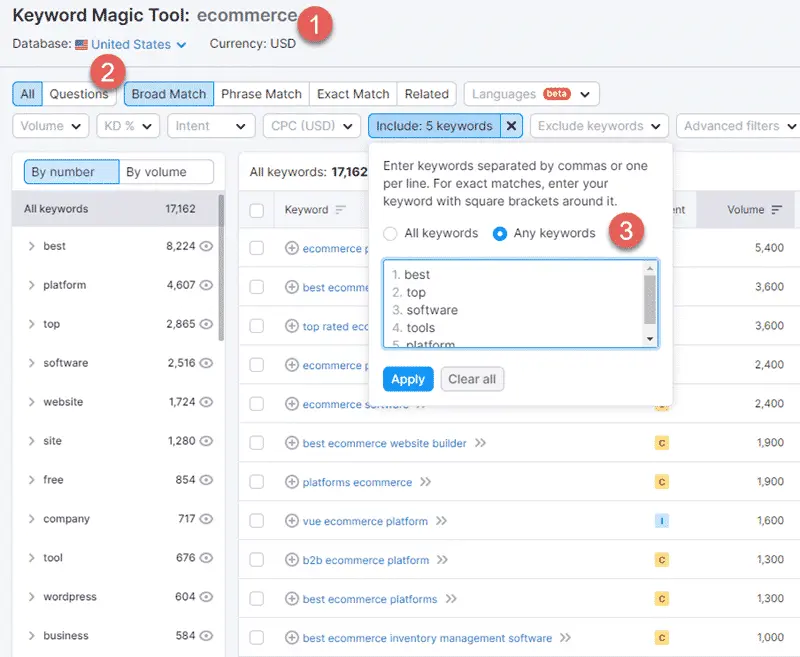
The Keyword Magic Tool: Praised for its ability to effortlessly group search terms by topic, search intent, question type, and SERP features, while feeding lists directly into tracking and PPC toolkits.
The Keyword Gap Tool: A staple for competitive analysis, allowing users to run side-by-side comparisons of up to five competing domains to uncover missed keyword opportunities.
2. Google Keyword Planner (57 Votes): The Source of Truth
Despite facing widespread criticism regarding its shift toward PPC-centric data and blurred search volume ranges for non-advertisers, Google Keyword Planner secured 57 votes. Veterans noted that while it lacks advanced organic filtering, it remains an indispensable baseline for checking raw relative traffic, local market data, and validating ideas straight from the source.
3. Ahrefs Keywords Explorer (55 Votes): The Backlink & SERP Authority
Trailing closely with 55 votes, Ahrefs continues to be a favorite for organic search strategists. Experts highlighted the Keyword Ideas Report for generating thousands of multi-engine opportunities (spanning Google, Bing, YouTube, and Amazon), alongside its powerful SERP overview and historical position tracking features.
Supporting Context & Metrics: Insights from the Trenches
While the top three platforms captured the lion’s share of the votes, the expert panel’s qualitative feedback reveals that modern keyword research extends far beyond traditional volume metrics.
The Shift Toward Search Intent and Semantics
A recurring theme among top-tier practitioners is that raw keyword lists are no longer enough. Brendan Hufford, Growth Content Marketer at ActiveCampaign, noted:
"If I only had 3 keyword research tools, I’d use tools that focus more on topical research and search intent instead of ‘keywords.’ The best content ranks for thousands of keywords… but totally misses the long tail if you don’t match the search intent."
This sentiment was echoed by Suganthan Mohanadasan of Snippet Digital, who advocates for AI-driven clustering tools like Keyword Insights to map out semantic keyword groupings at scale, ensuring content is structured correctly for single-page targeting or multi-page hubs.
The Human Element: Customer Conversations vs. Software
Several seasoned practitioners pushed back against relying solely on software interfaces. Kurt Frankenberg, founder of Shoestring101, shared a refreshing reality check:
"My first, second and third SEO tool is a little off the beaten track: It’s actual human interaction, plus a yellow pad to jot down responses… It’s these actual-paying-customer-generated keywords that have been most useful."
Similarly, Carrie Hill of Sterling Sky emphasized interviewing customer service teams and actual buyers to capture authentic phrasing, slang, and localized intent that automated databases often miss.
Official Expert Statements & Leaderboard Highlights
The contributions from the 139 experts showcase diverse methodological approaches, blending enterprise tools with creative alternatives:
Luke Monaghan (International SEO Manager, lululemon): Relies on Semrush for competitive insight, SISTRIX for historical visibility charts, and Keywordtool.io for long-tail variants.
John Doherty (Founder, Credo): Advocates for Ahrefs for topic research, Semrush for domain-level competitor analysis, and AnswerThePublic for question-based queries.
Paul Shapiro (Technical SEO Lead, Shopify): Goes beyond standard toolsets by recommending KNIME for open-ended semantic analysis, MarketMuse for topic modeling, and Seed Keywords for crowdsourcing human search behavior.
Chris Castillo (Propel Digital Media Solutions): Uses Ahrefs and Keywords Everywhere for aggregation, paired with Keyword Cupid for automated topic and theme clustering.
Jon Morrow (Founder, Smart Blogger): Keeps his toolkit streamlined to Semrush, Ahrefs, and Google Search Console.
Alexandra Tachalova (Founder, Digital Olympus): Balances her research using Semrush, Ahrefs, and Keywordtool.io.
Future Outlook: The Evolution of Keyword Research
As search engines continue to evolve through machine learning, natural language processing (NLP), and zero-click SERP features, the role of keyword research is undergoing a fundamental transformation.
The consensus from 139 of the industry’s sharpest minds points to three primary takeaways for the future:
Consolidation Over Accumulation: Marketers no longer need dozens of disparate tools. Investing in a robust all-in-one suite (like Semrush or Ahrefs) paired with a semantic or intent-mapping utility (such as Surfer SEO, MarketMuse, or Keyword Insights) provides a complete operational stack.
First-Party Data Integration: Tools like Google Search Console and internal site search logs are increasingly vital for uncovering hidden queries, brand variations, and "not provided" terms that third-party scrapers miss.
Intent-First Content Architecture: Knowing a keyword’s search volume is meaningless without understanding why the user is searching. The future belongs to marketers who combine hard data metrics with deep psychological insight into consumer intent.
Disclaimer: This article contains affiliate links. If you purchase a tool through these recommendations, a small commission may be received at no additional cost to you.


![139 Experts Reveal Best Keyword Research Tools [Leaderboard]](https://www.robbierichards.com/wp-content/uploads/2021/01/Best-Keyword-Research-Tools-for-SEO.jpg)
![139 Experts Reveal Best Keyword Research Tools [Leaderboard]](https://www.robbierichards.com/wp-content/uploads/2021/10/Semrush-home-page-screenshot.jpg)
![139 Experts Reveal Best Keyword Research Tools [Leaderboard]](https://www.robbierichards.com/wp-content/uploads/2022/05/image12.png)
![139 Experts Reveal Best Keyword Research Tools [Leaderboard]](https://www.robbierichards.com/wp-content/uploads/2022/06/Keyword-Gap-Tool.jpg)
![139 Experts Reveal Best Keyword Research Tools [Leaderboard]](https://www.robbierichards.com/wp-content/uploads/2018/08/rj-employee_Robbie-color-new.png)
![139 Experts Reveal Best Keyword Research Tools [Leaderboard]](https://www.robbierichards.com/wp-content/uploads/2022/06/Google-Keyword-Planner.jpg)
![139 Experts Reveal Best Keyword Research Tools [Leaderboard]](https://www.robbierichards.com/wp-content/uploads/2022/06/Ahrefs-home-page.jpg)
![139 Experts Reveal Best Keyword Research Tools [Leaderboard]](https://www.robbierichards.com/wp-content/uploads/2021/08/Luke-Monaghan-headshot.jpg)
![139 Experts Reveal Best Keyword Research Tools [Leaderboard]](https://www.robbierichards.com/wp-content/uploads/2021/08/Gael-Breton-headshot.jpg)
![139 Experts Reveal Best Keyword Research Tools [Leaderboard]](https://www.robbierichards.com/wp-content/uploads/2015/04/KW-Expert-Roundup.jpg)
![139 Experts Reveal Best Keyword Research Tools [Leaderboard]](https://www.robbierichards.com/wp-content/uploads/2019/05/John-Doherty-150x150.jpg)
![139 Experts Reveal Best Keyword Research Tools [Leaderboard]](https://www.robbierichards.com/wp-content/uploads/2015/04/ana_hoffman.jpg)
![139 Experts Reveal Best Keyword Research Tools [Leaderboard]](https://www.robbierichards.com/wp-content/uploads/2021/08/Paul-Shapiro-headshot.jpg)
![139 Experts Reveal Best Keyword Research Tools [Leaderboard]](https://www.robbierichards.com/wp-content/uploads/2021/08/Chris-Castillo.jpg)
![139 Experts Reveal Best Keyword Research Tools [Leaderboard]](https://www.robbierichards.com/wp-content/uploads/2021/08/Matthew-Barby-headshot.jpg)
![139 Experts Reveal Best Keyword Research Tools [Leaderboard]](https://www.robbierichards.com/wp-content/uploads/2017/08/Chris-Dreyer-Rankings.io_-150x150.jpg)
![139 Experts Reveal Best Keyword Research Tools [Leaderboard]](https://www.robbierichards.com/wp-content/uploads/2017/06/Adam-Connell-Blogging-Wizard-150x150.jpg)
![139 Experts Reveal Best Keyword Research Tools [Leaderboard]](https://www.robbierichards.com/wp-content/uploads/2021/08/Rich-Missey-headshot.jpg)
![139 Experts Reveal Best Keyword Research Tools [Leaderboard]](https://www.robbierichards.com/wp-content/uploads/2017/08/Charlie-Williams-Screaming-Frog-150x150.jpg)
![139 Experts Reveal Best Keyword Research Tools [Leaderboard]](https://www.robbierichards.com/wp-content/uploads/2015/04/ChristineChurchill-Red-150_400x400.jpg)