

Executive Overview
In the grand pantheon of agricultural journalism, few endeavors match the sheer audacity and sensory dedication required to rigorously review obscure, heirloom, and lesser-known apple cultivars. Following the widespread public reception of the initial exploratory tasting logs, the inquiry continues into the deeper, weirder, and occasionally hostile recesses of the pomological world. Welcome, Apple Snack Gang and casual orchard observers alike, to part two of this exhaustive sensory audit.
This investigation examines a fresh batch of seasonal specimens harvested, inspected, and subjected to the merciless trial of human consumption. From the nutmeg-heavy density of the Kickapoo Spice to the jaw-shattering, gum-flavored fortification of the Graham, this report breaks down the structural integrity, flavor profiles, historical provenance, and subjective ratings of seven unique cultivars.

Apple evaluation is rarely a straightforward metric of sweet versus tart. As this investigation reveals, varieties exist on a chaotic spectrum ranging from fermented cider-makers not meant for human palates to deceptive, sandy-textured frauds. Guided by rigorous tasting notes, historical asides, and unhinged psychological tangents, this installment offers an authoritative look at what is currently happening on the cutting edge of fruit consumption.
Detailed Chronology of the Tasting Log
The second phase of the 2026 apple tasting circuit unfolded over a series of intensive sensory testing sessions. Each cultivar was evaluated under controlled conditions—raw, unpeeled, and immediately following storage assessments. Below is the chronological breakdown of the specimens encountered during this investigative phase.

1. Kickapoo Spice
- Initial Impression: The nomenclature immediately invokes cultural touchstones—specifically the rock opera stylings of Tenacious D, setting a theatrical tone for the tasting. Structurally speaking, this is a dense specimen. It presents as a heavy, compact fruit that behaves less like a delicate snack and more like a botanical anomaly.
- Flavor Profile: The descriptor "spice" is thoroughly validated upon first bite. The cultivar leans heavily into notes of nutmeg, underscored by secondary waves of cinnamon and clove. However, juice content was notably deficient. An unexpected, grassy aftertaste—reminiscent of freshly cut lawn clippings—lingered on the palate, detracting from the overall harmony.
- Maturity & Storage: Horticultural science dictates that apples exist in a perpetual state of flux post-harvest. Some varieties gracefully improve off the tree, while others begin an immediate, irreversible descent toward agricultural mediocrity. The Kickapoo Spice likely sat on the cusp of this timeline, resulting in a complex, if slightly bizarre, eating experience.
- Final Rating: 6.9 out of 10.
2. St. Edmunds Pippin
- Initial Impression: Serving as the maiden voyage into the core of the 2026 proper apple season, the St. Edmunds Pippin immediately established a high benchmark. The exterior skin presented a tactile challenge—rough and coarse, likened colloquially to the sensation of stroking a shark in reverse.
- Flavor Profile: Despite its abrasive exterior, the fruit delivered an intensely satisfying acoustic and physical response: a sharp pop and crunch upon entry. Flavor-wise, the Pippin offered a brilliant juxtaposition of bright, herbal notes reminiscent of fennel pollen, perfectly counterbalanced by a clean, underlying sweetness. It stands as a masterclass in funky, unconventional balance.
- Final Rating: 8.3 out of 10.
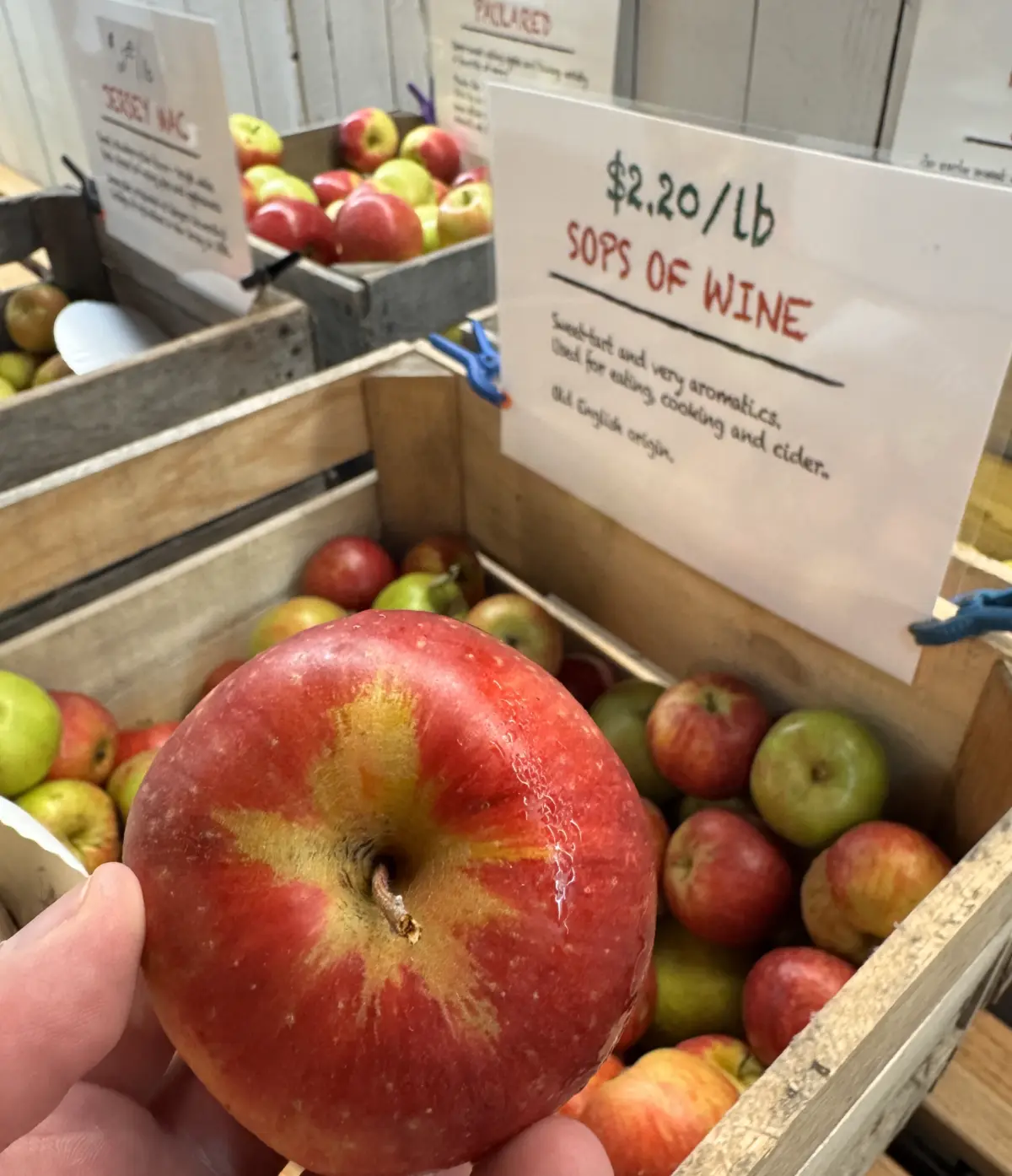
3. Sops of Wine
- Initial Impression: Nomenclature often triggers involuntary neurological associations. In this instance, the mere phrase "Sops of Wine" conjured cinematic visions of Denethor dramatically consuming a tomato in The Lord of the Rings, complete with John Noble’s theatrical vocal cadence echoing through the subconscious.
- Flavor Profile & Texture: While the flavor profile offered pleasant, sub-acid complexity—leaning slightly sweet with distinct undertones of vanilla and warm spice—the structural integrity of the fruit was severely compromised. Suffering from prolonged shelf life post-harvest, the flesh had devolved into a mealy, gritty consistency.
- Taxonomic Confusion: Horticultural literature suggests that "Sops of Wine" may not represent a singular, uniform genetic cultivar, but rather serves an umbrella designation for several disparate historical apple types. Furthermore, while historical texts cite red-fleshed variants or white flesh heavily streaked with crimson, this particular specimen yielded standard coloration, compounding its identity crisis.
- Final Rating: 3.5 out of 10.
4. Fenceline Surprise
- Initial Impression: The primary surprise delivered by the Fenceline Surprise is its absolute lack of culinary merit. While linguistic punnery might suggest a sophisticated French pronunciation rather than a standard "fence line," no amount of phonetic elevation can rescue a fundamentally disappointing fruit.
- Flavor Profile: The interior presented as a bland, pulverized mush. A fleeting, highly transient whisper of pear juice brushed the taste buds before instantly evaporating, leaving behind a dry, abrasive mouthfeel akin to chewing beach sand. Given that point-of-sale signage advertised the cultivar as a "firm apple," the specimen was either the victim of an aggressive batch or had long since crossed the threshold into post-mortem cold storage decay.
- Final Rating: 1 out of 10. (A score of zero was narrowly avoided solely due to its linguistic cleverness and initial aesthetic presentation).
5. Americus Crab
- Initial Impression: The title alone evokes classic pulp fiction tropes—conjuring images of a steampunk inventor named Americus Crab, or alternatively, a delightfully archaic superhero dedicated to maritime justice ("Fear not, citizens, for America’s Crab is on the horizon!").
- Flavor Profile: As a crabapple, the specimen behaves precisely as evolutionary biology intended: aggressively savory, sharply tart, physically resilient, and densely packed with astringent tannins. It is an artifact unsuited for casual, out-of-hand snacking, functioning instead as a provocative experience for those willing to brave the rugged frontiers of high-tannin fruit.
- Final Rating: 2.5 out of 10.
6. Campfield (False?)
- Initial Impression: Labeled enigmatically with the suffix "(False)" in its cataloging, this specimen immediately raised suspicions of pomological deception. The fruit possessed a strange, chewy texture reminiscent of a callused thumb, coupled with a bewildering flavor duality: simultaneously overly sweet and fiercely tannic, creating the uncanny sensation that the apple was consuming the consumer in real-time.
- Contextual Evaluation: As a recognized historic cider apple, its hostility to the unfermented human tongue is standard operating procedure. True appreciation requires biochemical transmutation via the industrious labors of fermentation.
- Final Rating: 4.1 out of 10.
7. Graham
- Initial Impression: The Graham is an absolute physical titan. Possessing a density and structural hardness that actively defied penetration by standard human dentition, this apple appeared sculpted in a gymnasium. Biting into it offered the dramatic acoustic and physical resistance of a calving glacier, practically threatening the consumer with temporomandibular joint (TMJ) dysfunction.
- Flavor Profile: Once successfully breached, however, the reward was staggering. The interior yielded an intensely juicy, flavorful profile that miraculously mirrored the unmistakable taste of classic Juicy Fruit chewing gum. Unrestrained and unreserved, the flavor profile justified the immense physical effort required to breach the fruit’s exterior defense grid.
- Final Rating: 8 out of 10. (Deductions applied exclusively for the jaw-shattering structural resistance).
Supporting Context & Metrics
To contextualize these findings within the broader seasonal harvest, pomological data emphasizes the volatile nature of heirloom and historical apple varieties. Unlike hyper-stabilized commercial monocultures engineered for infinite shelf life and predictable uniformity, heritage apples operate on ancient, unpredictable biological rules.
| Cultivar | Primary Flavor Notes | Texture Rating (1-10) | Flavor Complexity (1-10) | Overall Score |
|---|---|---|---|---|
| Kickapoo Spice | Nutmeg, cinnamon, clove, grass | 6.0 | 7.0 | 6.9 |
| St. Edmunds Pippin | Fennel pollen, bright sweet-tart | 8.5 | 8.0 | 8.3 |
| Sops of Wine | Vanilla, spice, sub-acid | 3.0 | 5.0 | 3.5 |
| Fenceline Surprise | Transient pear essence, sand | 1.0 | 2.0 | 1.0 |
| Americus Crab | Savory, tart, high tannin | 5.0 | 4.0 | 2.5 |
| Campfield (False) | Tannic, overly sweet | 4.0 | 4.5 | 4.1 |
| Graham | Juicy Fruit gum, dense | 9.0 (Hardness) | 9.0 | 8.0 |
Official Historical Aside: The Provenance of Campfield
The investigation into the Campfield apple yields a fascinating historical thread tied to early American colonial history. Archival records trace the lineage of the cultivar back to Matthew Canfield (alternately spelled Campfield), an anti-royalist Puritan who migrated from Harleston, England, during the Great Puritan Migration prior to 1637.

As a founding father of the New Haven Colony, Norwalk, Connecticut, and Newark, New Jersey, Canfield operated within a societal framework where agricultural productivity was legally mandated. Town records from New Haven and Newark outline strict ordinances requiring "freeholders" (those vested with voting rights) to cultivate a minimum of four acres, heavily prioritizing the establishment of commercial orchards for hard cider production.
Historical documentation indicates Canfield invested heavily in local infrastructure, contributing funds toward the construction of a community corn mill and executing transactions for "three barrels of good cider made of winter fruit." Serving as a judge, customs collector, and committee member tasked with assessing damage caused by stray swine and examining boundary fences, Canfield’s legacy is permanently etched into the horticultural bedrock of early American cider culture. Whether the modern iteration sampled in this tasting log represents a direct descendant of those original Puritan orchards or an impostor ("False"), the historical gravity of the name remains undisputed.

Future Outlook
As the autumn harvest cycle progresses, the scope of inquiry expands geographically. Preparations are underway for an extensive expedition into the orchards of New York, New England, and Canada.
This upcoming cross-border deployment promises an influx of fresh regional cultivars, historical anomalies, and wild-harvested specimens. Field investigators and orchard keepers within these target territories are officially advised to prepare their harvests. The pursuit of pomological truth continues, and the Apple Snack Gang remains vigilant in its mission to consume, document, and relentlessly critique the botanical world.