The landscape of content marketing is undergoing its most profound structural disruption since the inception of the commercial web. The rapid proliferation of generative artificial intelligence (AI), coupled with major shifts in search engine algorithms—such as Google’s Search Generative Experience (SGE) and AI Overviews—has altered the economic fundamentals of digital content creation. Strategies that dominated the past decade, primarily focused on high-volume search engine optimization (SEO) blogging and static keyword targeting, are rapidly declining in effectiveness.
Today’s enterprise marketers, agency owners, and independent entrepreneurs face a dual mandate: they must generate measurable revenue rather than vanity metrics (like pageviews or "likes"), and they must adapt to an environment where AI tools can instantly generate basic content. Consequently, traditional video-based digital courses offering static, boilerplate advice are proving insufficient for professionals seeking real-world returns.
       TRADITIONAL PARADIGM                    MODERN REVENUE-DRIVEN PARADIGM
+---------------------------------+        +---------------------------------+
| • Top-of-Funnel Keyword Stuffing|        | • Full-Funnel Lead Conversion   |
| • High Volume / Low Intent      |  --->  | • Omnichannel & Email Ecosystems|
| • Static Video Instruction      |        | • Interactive Mentorship & AI   |
| • Focus on Vanity Impressions   |        | • Direct ROI & Personal Branding|
+---------------------------------+        +---------------------------------+
This comprehensive report evaluates the primary options available for modern content marketing education. By examining eight major programs across a standardized framework—measuring Instructor Credibility, Content Diversity, Advice Recency, Personalized Support, Community Infrastructure, and Pricing Models—this analysis provides marketing leaders with the data required to allocate educational budgets effectively.
Detailed Chronology: The Evolution of Content Marketing Frameworks
To understand the current educational landscape, one must trace how digital marketing instruction has evolved across three distinct eras:
+-----------------------------------------------------------------------------------+
| ERA 1: The Organic Search Boom (2015–2020)                                         |
| Focus: Mass keyword discovery, long-form SEO blogging, foundational backlinks.    |
| Exemplar Curricula: Ahrefs "Blogging for Business", Early HubSpot Certifications. |
+-----------------------------------------------------------------------------------+
                                          |
                                          v
+-----------------------------------------------------------------------------------+
| ERA 2: Conversion-Led Strategies (2021–2022)                                      |
| Focus: Attribution modeling, Pain-Point SEO, middle-to-bottom-funnel conversion.  |
| Exemplar Curricula: Grow & Convert, Semrush Academy (Brian Dean Era).              |
+-----------------------------------------------------------------------------------+
                                          |
                                          v
+-----------------------------------------------------------------------------------+
| ERA 3: The Generative AI & Ecosystem Era (2023–Present)                           |
| Focus: Omnichannel distribution, executive personal branding, live feedback loops. |
| Exemplar Curricula: Copyblogger Academy, Superpath Community, CXL Enterprise.    |
+-----------------------------------------------------------------------------------+
1. The Organic Search Boom (2015–2020)
During this period, organic reach was abundant and algorithm updates were predictable. Educational programs emphasized long-form written articles, mass keyword discovery, and basic backlink acquisition strategies. Programs like Ahrefs’ Blogging for Business and HubSpot’s Content Marketing Certification emerged as dominant industry benchmarks, training a generation of marketers to prioritize high-volume top-of-funnel traffic.
2. The Rise of Conversion-Led Marketing (2021–2022)
As organic search became increasingly saturated, the industry pivoted toward high-intent conversion frameworks. Educational offerings shifted from measuring traffic to tracking bottom-line ROI. Pioneers such as Grow and Convert introduced structured "Pain-Point SEO," arguing that 1,000 highly targeted visitors looking to buy were infinitely more valuable than 100,000 passive readers. Concurrently, platforms like Semrush Academy leveraged recognized experts like Brian Dean to deliver standardized, advanced search strategies.
3. The Generative AI & Ecosystem Era (2023–Present)
The rollout of advanced large language models (LLMs) fundamentally disrupted traditional content creation. Basic blog writing became commoditized almost overnight. In response, effective educational programs transitioned from static video libraries to interactive ecosystems. Platforms like Copyblogger Academy and Superpath introduced live feedback channels, ongoing curriculum updates, executive personal branding instruction (across networks like LinkedIn and X), and direct access to active practitioners navigating algorithmic shifts in real time.
To establish an objective benchmark, we evaluated eight representative content marketing programs against six key criteria critical to modern commercial execution:
Instructor Credibility: Proven track record of building seven-figure businesses or leading growth at scale.
Content Diversity: Coverage extending beyond traditional blogging to include personal branding, email marketing, and conversion copywriting.
Advice Recency: Integration of modern generative AI workflows and contemporary search engine realities.
Feedback & Individual Support: Availability of direct critique on strategic assignments and operational assets.
Community Infrastructure: Dedicated networks for peer collaboration, client networking, and strategic exchange.
Overview: Operates as a hybrid educational course and professional incubator managed by entrepreneurs Tim Stoddart (CEO of Copyblogger and Quantum Leads) and Charles Miller (Personal Branding Expert with 300k+ aggregate social followers).
Curriculum Mechanics: Replaces broad theory with six core execution modules: SEO Content, Copywriting Foundations, Email Marketing, Personal Branding, Client Acquisition, and AI Integration.
       [Tim Stoddart]                       [Charles Miller]
 (SEO, Agency & Monetization)         (Personal Branding, X & LinkedIn)
                                               /
                                              /
                v                             v
           +---------------------------------------+
           |          COPYBLOGGER ACADEMY          |
           | • 6 Core Execution Modules            |
           | • Direct Asset Critique & Feedback    |
           | • Dynamic AI & Trend Updates          |
           +---------------------------------------+
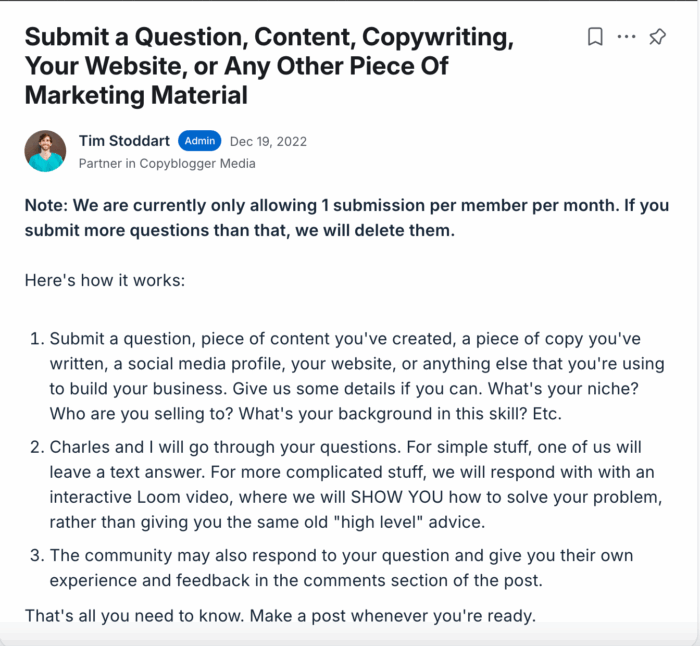
Key Differentiator: Direct feedback channels. Members submit copy, email sequences, or strategic plans directly to Stoddart and Miller for individualized feedback. This structural dynamic ensures participants learn how to implement strategy within current market conditions.
Target Audience: Agency leaders, digital consultants, modern freelancers, and founders looking to turn content channels into direct sales pipelines.
2. HubSpot Content Marketing Course
Overview: An 8.5-hour foundational program designed to introduce inbound marketing principles. Comprising 14 core modules, 54 video lessons, and practical testing benchmarks.
Curriculum Mechanics: Covers foundational inbound methodologies, structural content creation, conceptual storytelling, and corporate guest blogging strategies. Led primarily by Justin Champion (Global Head of Surround Sound Growth at HubSpot) alongside featured experts like Andy Crestodina.
Key Differentiator: Highly standardized, cost-free corporate training tool with a recognized LinkedIn digital certification.
Strategic Limitation: Lacks coverage of emerging growth channels, including executive personal branding, modern outbound social execution, transactional email copywriting, and direct workflow integration for generative AI.
3. Grow and Convert: Customers From Content
Overview: Designed by agency owners Benji Hyam and Devesh Khanal, this training program translates client execution playbooks from B2B and SaaS accounts (including Leadfeeder, Patreon, and CrazyEgg) into a step-by-step framework.
Curriculum Mechanics: Divided into five core modules:
Key Differentiator: Eliminates high-volume vanity traffic targets in favor of bottom-of-the-funnel attribution. Includes continuous updates based on live agency experimentation, access to a private forum, and monthly interactive strategy calls.
4. Superpath
Overview: Founded by former Animalz executive Jimmy Daly, Superpath functions primarily as an active professional network and career accelerator for content leaders, SaaS strategists, and enterprise marketing managers.
Curriculum Mechanics: Offers specialized mini-courses, teardowns, template libraries, and strategic playbooks rather than a linear video curriculum. Focuses heavily on managing complex editorial calendars, scaling content teams, and refining B2B messaging.
Key Differentiator: Peer-to-peer intelligence exchange. High-level discussions occur daily within a network of over 400 active B2B enterprise marketers from companies such as Shopify, Intercom, Podia, and Clearscope.
5. Ahrefs: Blogging for Beginners / Business
Overview: Taught by Ahrefs Chief Marketing Officer Tim Soulo, this classic 5-hour video course covers the fundamentals required to build, scale, and monetize corporate blog properties using organic search tactics.
Curriculum Mechanics: Modules cover search-focused content generation, keyword scoring, technical page optimization, and outreach strategies for backlink acquisition. Includes guest case studies from entrepreneurs like Noah Kagan and Bryan Harris.
Strategic Limitation: Recorded in 2020, the material operates entirely on pre-AI search mechanics. While foundational principles remain sound, it omits current search dynamics, multi-channel distribution, and automated content operations.
6. Semrush Academy: Advanced Content Marketing & Content-Led SEO
Overview: A suite of free digital modules led by Backlinko founder Brian Dean. Focuses on actionable frameworks for organic traffic expansion, backlink generation, and content optimization.
Curriculum Mechanics: Includes 50 aggregate video modules supported by downloadable worksheets, outreach templates, and structured keyword research methodologies.
Strategic Limitation: While Dean’s instruction remains highly clear and actionable, the static materials were recorded in 2022 and do not address recent search algorithm volatility or natural language generation tools.
7. CXL: Content Marketing Research Course
Overview: Taught by Derek Gleason, SEO and Content Lead at Shopify, this executive mini-course focuses on high-level content strategy, audience research, and editorial distribution pipelines.
Curriculum Mechanics: Focuses on tactical content strategy design across six modules, teaching teams how to manage large-scale content libraries, align content with complex buyer journeys, and optimize distribution networks.
Key Differentiator: Exceptional authority for corporate and enterprise strategists managing complex, multi-tiered content engines.
8. Udemy: Content Marketing Masterclass
Overview: A broad overview created by Brad Merrill (CEO of Merrill Media). Spanning 14 sections and nearly four hours of video content, it covers general marketing concepts for beginner entrepreneurs.
Curriculum Mechanics: Introduces fundamental marketing ideas, including the AIDA framework, basic buyer persona development, web layout design principles, and entry-level email setup.
Strategic Limitation: The broad nature of the curriculum limits deep specialization. It lacks practical execution mechanics for advanced practitioners or teams seeking measurable revenue engines in competitive niches.
Official Statements & Industry Methodologies
Understanding the underlying philosophies of prominent industry leaders highlights a clear split in how content marketing education is approached:
Tim Stoddart, CEO of Copyblogger: "The legacy playbook of creating endless generic blog posts to capture top-of-funnel search volume is dead. In the modern AI era, true equity lies in personal authority, owned email distribution lists, and specialized communities. If your content strategy doesn’t directly map to customer acquisition and authentic personal connection, you are essentially wasting capital."
                           INDUSTRY PHILOSOPHY SPLIT

      [TRADITIONAL/FREE CERTIFICATIONS]        [MODERN COHORT & COMMUNITY]
      • Focus: High-volume SEO & reach         • Focus: Bottom-funnel conversions
      • Mode: Passive video consumption        • Mode: Dynamic feedback & mentorship
      • Metric: Traffic & Brand awareness      • Metric: Pipeline Value & ROI
Benji Hyam, Co-Founder of Grow & Convert: "Traffic for the sake of traffic is a vanity metric that ruins content budgets. We deliberately invert the standard content funnel by targeting high-intent, bottom-of-the-funnel queries first. Teaching marketers how to tie every single published asset directly to attributable pipeline conversion is the only way content teams can justify their operational existence today."
Justin Champion, Lead Inbound Instructor: "Creating an overarching content strategy is not just about producing content; it’s about building a sustainable inbound engine. Sustainable growth requires standardized systems, repeatable story frameworks, and consistent distribution across established digital channels."
Strategic Outlook & Implementation Matrix
As digital marketing environments continue to evolve, enterprise teams, business owners, and agency professionals must carefully select educational investments aligned with their specific organizational needs and growth stages.
       +---------------------------------------------------------------+
       |                   DECISION ENGINE MATRIX                      |
       +---------------------------------------------------------------+
                                       |
          +----------------------------+----------------------------+
          |                                                         |
          v                                                         v
  [ENTERPRISE / B2B]                                        [AGENCY / FOUNDER]
  Focus: Process Scaling,                                   Focus: Agility, ROI,
  Governance & Systems.                                     Personal Branding.
  Recommended Paths:                                        Recommended Paths:
   • Superpath                                               • Copyblogger Academy
   • CXL Institute                                           • Grow & Convert
   • HubSpot (Onboarding)
Strategic Recommendations by Target Persona
1. Solo Founders, Freelancers, & Agency Owners
Primary Need: Immediate lead generation, direct business monetization, adaptable personal branding, and live feedback on execution tactics.
Optimal Educational Model: Hybrid learning communities (e.g., Copyblogger Academy). Access to live practitioners and direct material reviews reduces costly mistakes, helping small teams pivot quickly as platforms change.
Primary Need: Operational scale, B2B pipeline optimization, team alignment, and enterprise-grade distribution strategy.
Optimal Educational Model: Executive peer networks and enterprise frameworks (e.g., Superpath Pro or CXL Institute). Engaging with senior peers managing large-scale assets helps solve complex operational challenges.
3. Entry-Level Marketers & Inbound Interns
Primary Need: Mastery of fundamental digital terminology, baseline concepts, and standard inbound structures.
Optimal Educational Model: Comprehensive free certifications (e.g., HubSpot Academy or Semrush Academy). Provides foundational knowledge and globally recognized digital credentials without upfront capital expenditure.
Conclusion
The content marketing industry has moved past the era of passive video courses and static playbooks. As artificial intelligence continues to lower the cost of basic content production, human judgment, personal authority, dynamic strategy, and rapid feedback loops become essential competitive advantages. Marketing leaders who invest in adaptive, community-backed educational ecosystems will build resilient distribution channels that consistently drive bottom-line revenue.