The landscape of search engine optimization (SEO) has evolved beyond recognition. Gone are the days when a digital marketer could rely on a static, manually updated daily spreadsheet to measure organic visibility. Today’s search engine results pages (SERPs) are volatile, hyper-localized, and dominated by dynamic components such as AI Overviews, People Also Ask (PAA) boxes, video carousels, and instant knowledge cards.
To validate SEO campaigns, justify enterprise budgets, and tie ranking fluctuations directly to business revenue, professionals require automated, granular, and lightning-fast tracking systems. Modern SERP tracking tools do more than just report numbers—they aggregate historical performance, evaluate competitor movements across zip codes and devices, and integrate seamlessly with analytics pipelines.
This comprehensive guide investigates the top seven SERP tracking tools for 2025. By evaluating key functionalities—ranging from on-demand updates and SERP feature mapping to cross-device segmentation and white-label reporting—this review aims to help agencies, enterprises, and in-house teams select the ideal platform for their digital marketing stack.
Detailed Chronology: The Evolution of Rank Tracking
To understand why modern SERP software is indispensable, it is helpful to trace how rank tracking has evolved over the past decade:
The Manual Era (Pre-2015): SEO practitioners relied heavily on manual browser searches or rudimentary web-scraping scripts. Data was plagued by personalization biases, cached results, and extreme latency, often leading to skewed performance reviews.
The Rise of Automated Daily Trackers (2015–2020): Dedicated standalone rank-tracking tools emerged to automate daily cron jobs. Marketers gained the ability to monitor keyword sets on a 24-hour cycle across desktop devices, though international and localized tracking remained rudimentary.
The Multi-Feature & API Era (2020–2023): As Google integrated complex SERP features—such as featured snippets and local packs—trackers evolved to map positional data beyond simple blue links. Cloud data warehouses and tools like Google Data Studio (now Looker Studio) began pulling raw tracking metrics into custom executive dashboards.
The AI and Real-Time Era (2024–2025): The introduction of generative search experiences, AI Overviews, and lightning-fast search algorithms necessitated instant, on-demand data refreshes. Modern SERP tracking software now leverages advanced APIs, localized simulation engines, and deep analytics integrations to map keyword positions directly to user conversions, bounce rates, and bottom-line revenue.
Supporting Context & Metrics: Why Invest in SERP Tracking?
Investing in robust SEO tracking software is no longer optional for organizations scaling their organic channel. A granular tracking infrastructure yields several core operational advantages:
Validating ROI to Stakeholders: C-suite executives demand proof of performance. Accurate SERP tracking connects keyword position shifts directly to traffic spikes and conversion milestones.
Uncovering Low-Hanging Fruit: By tracking keywords sitting in positions 4 through 10, teams can deploy tactical content updates to capture high-value featured snippets or AI Overviews without building new pages from scratch.
Cross-Device & Hyper-Localized Insight: Consumer behavior differs drastically between mobile and desktop users, as well as between neighboring zip codes. Advanced trackers let businesses segment campaigns to optimize for local map packs and mobile-first indexing.
Essential Features to Look for in 2025
When evaluating software options, ensure the platform includes these nine core pillars:
On-Demand Ranking Updates: Real-time data refreshes rather than waiting days for scheduled runs (e.g., AccuRanker).
SERP Feature Monitoring: Tracking visibility across AI Overviews, snippets, and video carousels.
Major Search Engine Support: Monitoring performance on Google, Bing, Baidu, Yandex, and YouTube.
Granular Location & Device Filtering: Country, state, city, and zip-code level accuracy, split by desktop and mobile.
Revenue & Analytics Integration: Merging ranking metrics with Google Analytics or Adobe Analytics to calculate true Share of Voice and bottom-line impact.
Historical Performance Tracking: Long-term trend analysis to benchmark against historical competitors.
Competitor Benchmarking: Grouping keywords by performance brackets (e.g., positions 1–3 vs. 11–50) to spot market threats.
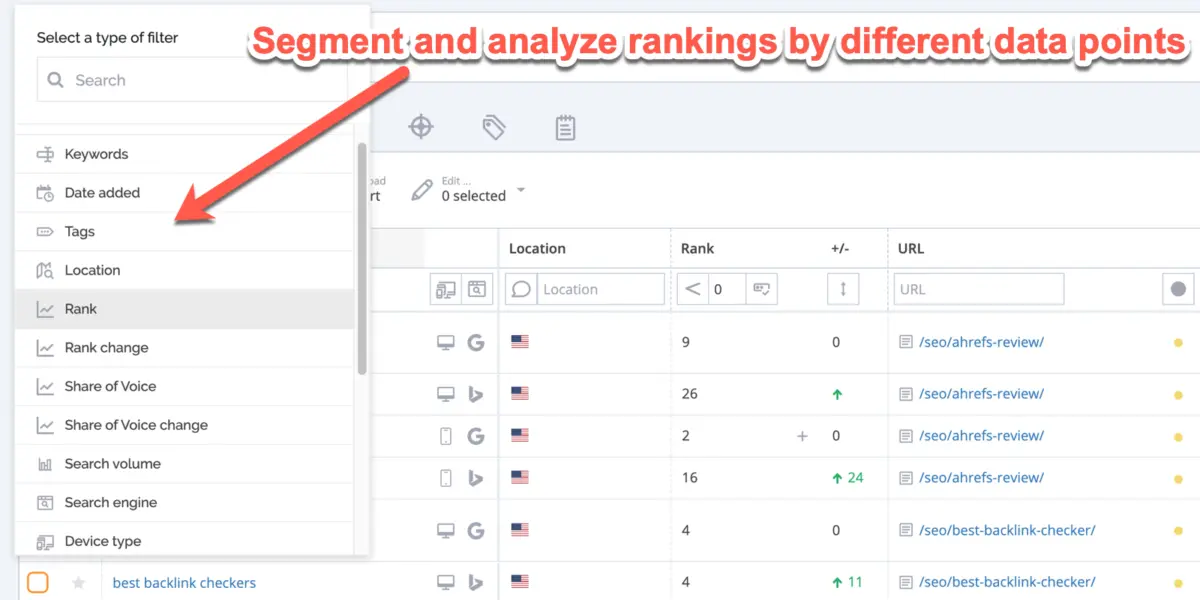
Tagging and Data Segmentation: Organizing assets by funnel stage, topic, or content type.
White-Label & Automated Reporting: Native client-ready report generation and Looker Studio integrations.
The 7 Best SERP Tracking Tools for 2025
The market features both dedicated standalone trackers and comprehensive all-in-one SEO suites. Below is a detailed breakdown of the top seven platforms on the market.
1. AccuRanker
Type: Standalone SERP Tracker
Best For: Agencies, enterprises, and high-volume SEO teams requiring lightning-fast, on-demand data updates.
Overview: Trusted by over 32,000 companies—including HubSpot, IKEA, and Kinsta—AccuRanker is widely regarded as an industry leader in speed and accuracy. It refreshes keyword sets automatically every 24 hours while allowing users to force an on-demand update at the click of a button. Its advanced Landing Pages report integrates with Google Analytics and Adobe Analytics to combine ranking metrics with bounce rates and revenue data.
Pricing: Starts at $116/month for up to 1,000 tracked keywords.
2. Semrush (Position Tracker & SERP Gap Analyzer)
Type: All-in-One SEO Suite Component
Best For: Digital marketing professionals, e-commerce brands, and enterprises looking for a robust suite with industry-leading tracking capabilities.
Overview: Serving over 10 million users globally, Semrush offers a Position Tracker that rivals dedicated standalone platforms. It supports hyper-local tracking down to the zip code level and splits data cleanly across devices. Furthermore, through its App Center, users can leverage the SERP Gap Analyzer, an AI-driven tool that scans search results to uncover under-optimized content and integrates directly with Google Search Console.
Pricing: Platform plans start at $139.95/month.
3. ProRankTracker
Type: Standalone SERP Tracker
Best For: Agencies, international corporations, and video marketers seeking affordable, multi-language global tracking.
Overview: Trusted by over 60,000 users, ProRankTracker provides a cost-effective, highly accurate solution for monitoring rankings across virtually any geographic location, device type, and major search engine, including specialized video platforms.
Pricing: Plans start at $39/month.
4. Advanced Web Ranking (AWR)
Type: Standalone SERP Tracker
Best For: In-house teams, large enterprises, and agencies needing customizable reporting architectures.
Overview: AWR is a veteran standalone rank tracker utilized by enterprise brands like Microsoft. It excels in cloud-based scalability, offering flexible white-label reporting engines and granular tracking across deep international markets and diverse device environments.
Pricing: Starts at $99/month.
5. SERPWatcher (by Mangools)
Type: All-in-One SEO Suite Component
Best For: Startups, small business owners, and freelancers seeking simplicity and value.
Overview: Developed by Mangools, SERPWatcher is celebrated for its intuitive interface and its proprietary Performance Index, which calculates overall organic traffic potential based on keyword search volumes and position changes. It is trusted by major enterprises like Airbnb and Adidas for straightforward tracking without a steep learning curve.
Pricing: Starts at $29.90/month.
6. SE Ranking
Type: All-in-One SEO Suite Component
Best For: Small-to-medium business owners and digital agencies looking for high accuracy at an accessible price point.
Overview: SE Ranking simulates user behavior across precise geographical targets to ensure 100% accurate ranking data. Its Position Tracking tool covers all major search engines and pairs seamlessly with comprehensive auditing, backlinking, and keyword research tools.
Pricing: Starts at $52/month (based on daily updates for 500 keywords).
7. Nightwatch
Type: Standalone SERP Tracker
Best For: Freelancers, SMBs, and agencies scaling their local and global tracking footprints.
Overview: Trusted by brands like Shopify and Coinbase, Nightwatch tracks search engine rankings across more than 100,000 global locations. Its sophisticated dashboard makes it easy to visualize data segmentation, anomaly detection, and competitor positioning.
Pricing: Starts at $32/month for up to 250 keywords, backed by a 14-day free trial.
Official Statements and Industry Insights
Top practitioners in the SEO community emphasize the necessity of integrating rank data directly with visualization pipelines to prove value to clients and stakeholders.
"It’s by far the best keyword ranking tracker in the market and has a ton of great reporting functions. If you want visibility on large volumes of keywords housed within a nice dashboard—this is for you."
— Matthew Howells-Barby, Co-Founder, TrafficThinkTank
Agencies frequently leverage custom data connectors to streamline reporting workflows, ensuring that clients can see the direct correlation between ranking adjustments and business conversions.
"The thing that really got me using them heavily in the last month or two is their Looker Studio connector. Combining the tag feature, as well as the Share of Voice metric… has been a big help in making these reports immediately digestible."
— Ian Howells, Co-Founder, Traffic Think Tank
Future Outlook
As we look deeper into the back half of the decade, the trajectory of SERP tracking points toward hyper-automation, predictive analytics, and conversational search monitoring. With search engines shifting toward AI-generated answers and zero-click environments, traditional rank-tracking metrics are evolving.
Future-proof SERP tracking software will increasingly focus on Share of Voice within AI-driven snippets, immediate visibility drops caused by algorithmic updates, and predictive modeling that estimates traffic recovery timelines. Whether you choose a specialized, high-velocity standalone tool like AccuRanker or a robust, all-in-one enterprise ecosystem like Semrush, investing in a modern, accurate SERP tracker will remain a foundational pillar of any successful digital marketing strategy through 2025 and beyond.