In the fast-paced world of digital marketing, relying on manual spreadsheets to track search engine rankings is a relic of the past. As search algorithms grow increasingly complex, the modern SEO landscape demands real-time data, multi-engine visibility, and granular device-and-location tracking. For digital agencies, enterprise brands, and growing ecommerce stores alike, the ability to accurately measure Search Engine Results Page (SERP) fluctuations is foundational to proving return on investment (ROI) and identifying organic growth opportunities.
Modern SERP tracking software does far more than just log basic keyword positions. Today’s top-tier platforms monitor over 50 distinct SERP features—including AI Overviews, featured snippets, People Also Ask (PAA) boxes, and video carousels—while seamlessly connecting rank movements directly to downstream traffic, conversions, and revenue.
This comprehensive market review analyzes the absolute best SERP tracking tools for 2025. By evaluating nine essential criteria—ranging from on-demand data updates and historical performance analytics to advanced competitor benchmarking and white-label reporting—we separate the market leaders from the pack. Whether you are seeking a dedicated, hyper-specialized standalone tracking application or a robust feature within an all-in-one SEO suite, this guide provides the authoritative insights necessary to make an informed investment decision.
Detailed Chronology: The Evolution of Rank Tracking
To truly understand the sophistication of today’s SERP tracking software, one must look at how the technology has evolved over the past decade.
The Early Era (Manual & Weekly Data): Historically, SEO professionals relied on weekly or monthly data scrapes. Spreadsheets were manually updated, and tracking local or mobile rankings required tedious proxy setups. Data was frequently delayed, and capturing sudden algorithmic volatility was nearly impossible.
The Rise of Automated Daily Trackers (Mid-2010s): As search engines accelerated their core update cycles, the industry shifted toward automated, cloud-based rank trackers. Platforms introduced scheduled 24-hour updates, allowing marketers to spot broad ranking drops shortly after a Google core update rolled out.
The Real-Time and SERP Feature Era (Late 2010s to 2020s): The SERP evolved rapidly from simple blue links to a dynamic ecosystem dominated by Knowledge Graphs, Local Packs, and Featured Snippets. Trackers had to adapt by parsing complex layout structures and introducing features like "Share of Voice" calculations.
The AI and Omnichannel Landscape (2025 and Beyond): Today, with the integration of AI Overviews, conversational search mechanics, and global multi-engine monitoring (including Baidu, Yandex, Bing, and YouTube), rank trackers must function as real-time intelligence engines. Modern tools not only tell you where you rank, but why you rank, who is capturing your traffic, and how to plug critical content gaps instantly.
Supporting Context & Metrics: Why SERP Tracking is Mission-Critical
Investing in professional SERP tracking software is no longer a luxury; it is a fundamental pillar of any data-driven marketing operation. Without precise metrics, justifying SEO budgets to stakeholders becomes an uphill battle.
The Business Impact of Granular Data
When evaluating performance, modern SEOs look beyond vanity metrics. Correlating higher rankings with actual business outcomes requires a deep integration between rank trackers and web analytics platforms like Google Analytics or Adobe Analytics. Advanced tracking software allows organizations to:
Validate SEO Investments: Tie specific keyword position gains directly to organic traffic lifts, conversion rates, and revenue generation.
Mitigate Algorithmic Risk: Instantly detect sudden drops caused by algorithmic shifts or competitor maneuvers, enabling rapid remediation.
Optimize Content ROI: Identify "low-hanging fruit" keywords—terms sitting comfortably in positions 4 through 10—and execute targeted optimization to capture high-value Position #0 or AI-driven features.
9 Essential Features to Look for in SERP Tracking Software
When auditing potential software solutions, ensure the platform delivers on these nine crucial capabilities:
Access Accurate On-Demand Ranking Updates: Avoid waiting days for scheduled refreshes. Real-time, on-demand data triggers give you immediate visibility following content updates.
Monitor Performance Across SERP Features: Track whether your URLs are securing AI Overviews, featured snippets, local packs, or video carousels.
Track SERP Movement Across All Major Search Engines: Look beyond Google to include Bing, Baidu, Yandex, and YouTube, depending on your geographic target audience.
Granular Tracking (Location and Device): Filter performance down to the country, state, city, or even zip-code level, while separating desktop from mobile metrics.
Map SERP Movements to Traffic and Revenue: Integrate cleanly with analytics suites to build unified reports that showcase bottom-line business impact.
View Historical Rank Performance: Analyze long-term trends rather than isolated point-in-time data snapshots.
Run Competitor Comparisons: Group keywords into brackets (e.g., positions 1–3, 4–10, 11–50) to measure your visibility against market rivals.
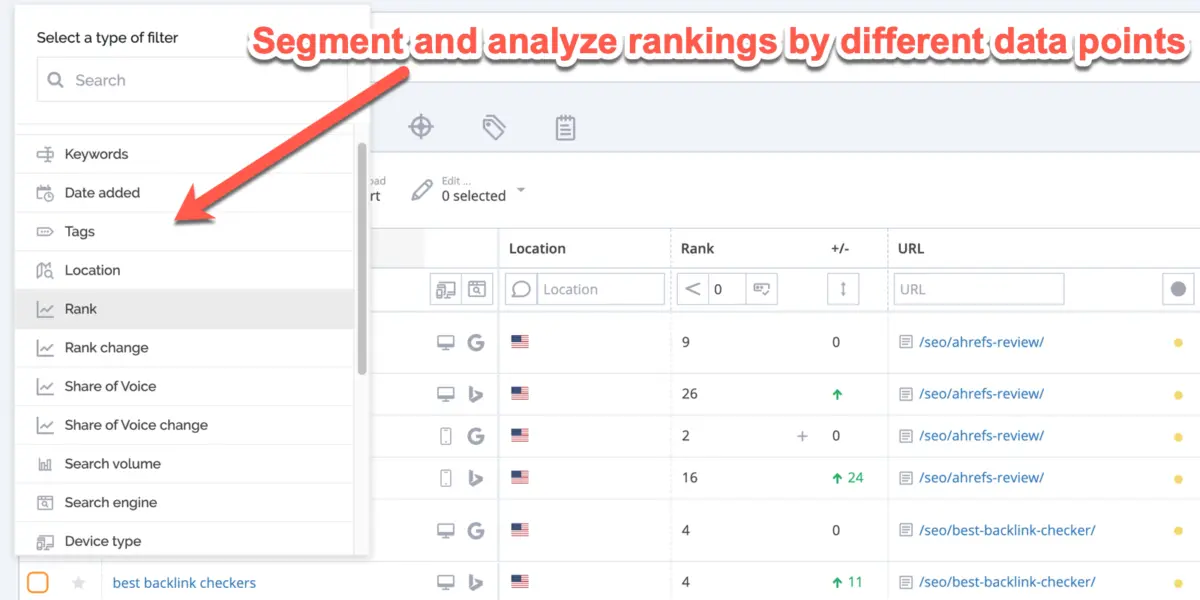
Tag and Segment Rankings Data: Organize keywords by topic, customer journey funnel stage, content asset type, or custom tags.
Generate White-Label Reports: Deliver polished, professional, automated reports natively or via integrations with tools like Google Looker Studio (formerly Data Studio) and Databox.
The 7 Best SERP Tracking Tools for 2025
The market features countless options, but our research highlights the top seven platforms that combine accuracy, scalability, and deep analytical power. We divide these into two categories: Dedicated Standalone Trackers and All-in-One SEO Platforms.
Category 1: Dedicated Standalone SERP Trackers
1. AccuRanker
Overview: AccuRanker is widely regarded as the gold standard for dedicated, high-speed rank tracking. Trusted by over 32,000 companies—including enterprise giants like HubSpot, IKEA, and Kinsta—it is built for agencies and brands that demand ultra-fast, accurate data.
Standout Features: Automatic daily updates coupled with an on-demand refresh button; comprehensive SERP feature tracking across 50+ layout types; advanced Landing Pages reports that merge keyword data with Google Analytics/Adobe Analytics metrics; and deep Looker Studio integrations.
Best For: Agencies, enterprises, and SEO professionals requiring lightning-fast, on-demand data and robust API access.
Pricing: Subscription plans scale based on tracked keywords, starting at $116/month for up to 1,000 keywords.
2. ProRankTracker
Overview: ProRankTracker is a robust, cost-effective standalone solution utilized by over 60,000 users worldwide. It offers extensive multi-device and multi-language capabilities.
Standout Features: Highly accurate global and local rank tracking, deep video rank tracking for YouTube campaigns, and comprehensive multi-format reporting tools.
Best For: Digital marketing agencies, ecommerce brands, and video marketers seeking scalable tracking without enterprise-level pricing.
Pricing: Plans begin at an accessible $39/month.
3. Advanced Web Ranking (AWR)
Overview: Advanced Web Ranking is a veteran enterprise-grade tracker utilized by major tech brands like Microsoft. Known for its robust data security and white-label customization, AWR handles massive keyword portfolios with ease.
Standout Features: Flexible data sharing, exceptional multi-location hierarchy mapping, and fully customizable automated report generation.
Best For: In-house marketing teams and large agencies managing complex enterprise portfolios.
Pricing: Subscription tiers begin at $99/month.
4. Nightwatch
Overview: Nightwatch stands out as one of the most precise daily SERP trackers available, trusted by industry leaders such as Shopify, Scotiabank, and Coinbase. It aggregates data from over 100,000 granular global locations.
Standout Features: Advanced site auditing integration, intuitive custom dashboards, and flexible segmentation features.
Best For: Freelancers, small-to-medium businesses (SMBs), and agencies looking for hyper-local accuracy and clean user interfaces.
Pricing: Offers a 14-day free trial, with paid plans starting at $32/month for up to 250 keywords.
Category 2: All-in-One SEO Platforms with Powerful Trackers
5. Semrush (Position Tracker & SERP Gap Analyzer)
Overview: Semrush is a premier all-in-one digital marketing suite utilized by over 10 million users, including global brands like Samsung, Vodafone, and Booking.com. Its Position Tracker is frequently nominated by SEO experts as a top-tier rank tracking solution.
Standout Features: Unrivaled tracking accuracy down to the local map-pack level; seamless desktop/mobile comparisons; and the innovative SERP Gap Analyzer app found in the Semrush App Center, which scans Google SERPs to find under-optimized content and integrates directly with Google Search Console.
Best For: Digital marketing professionals and enterprises seeking an all-inclusive marketing suite that does not compromise on tracking precision.
Pricing: Standard platform plans begin at $139.95/month.
6. SERPWatcher (by Mangools)
Overview: Developed by Mangools, SERPWatcher is designed for users who prioritize simplicity and aesthetic design without sacrificing core tracking integrity. It is trusted by household names like Airbnb and Adidas.
Standout Features: The proprietary Performance Index, which calculates organic traffic potential based on current keyword positions and search volumes; clean, easy-to-read graphical trend charts.
Best For: Small business owners, startups, and agencies looking for a user-friendly, visually intuitive tracking tool.
Pricing: Bundled Mangools plans start at $29.90/month.
7. SE Ranking
Overview: SE Ranking is a versatile all-in-one SEO platform equipped with a powerful Position Tracking module that simulates real user behavior to collect 100% accurate ranking data across major search engines.
Standout Features: Precise local and regional tracking, professional competitor visibility graphs, and comprehensive white-label reporting suites.
Best For: SMBs and digital agencies seeking an affordable, feature-rich alternative to legacy platforms.
Pricing: Plans start at $52/month for daily updates on 500 keywords.
Official Statements & Industry Expert Perspectives
Industry leaders continue to emphasize the vital role that sophisticated rank tracking and data integration play in modern marketing strategies:
"It’s by far the best keyword ranking tracker in the market and has a ton of great reporting functions. If you want visibility on large volumes of keywords housed within a nice dashboard—this is for you."
— Matthew Howells-Barby, Co-Founder, TrafficThinkTank (referencing AccuRanker)
"The thing that really got me using them heavily in the last month or two is their Looker Studio connector. Combining the tag feature, as well as the Share of Voice metric… has been a big help in making these reports immediately digestible."
— Ian Howells, Co-Founder, Traffic Think Tank
Future Outlook: What Lies Ahead for SERP Tracking
As we look deeper into the back half of the decade, the SERP tracking industry will continue to experience rapid transformation. Key developments to watch include:
AI Integration and Semantic Search: With search engines increasingly prioritizing conversational AI summaries and Zero-Click searches, traditional rank trackers are pivoting to monitor how brands are cited within AI-generated answers.
Hyper-Personalization and Dynamic Geolocation: As local search intent becomes more granular, tracking tools will lean heavily into hyper-local coordinate mapping to reflect true user experiences.
Unified Business Intelligence: The boundary between SEO tools and broader business intelligence dashboards (like Looker Studio and Databox) will continue to blur, making automated, cross-channel revenue attribution standard practice for all digital campaigns.
Conclusion: Which Tool Should You Choose?
Selecting the right SERP tracking software ultimately depends on your organization’s specific scale, budget, and operational structure:
If your primary requirement is standalone, lightning-fast, on-demand data with unmatched agency reporting capabilities, AccuRanker remains the definitive market choice.
If you need a comprehensive all-in-one digital marketing suite that pairs world-class rank tracking with advanced content optimization apps like the SERP Gap Analyzer, Semrush is the optimal investment.
Evaluate your portfolio size, reporting needs, and geographic targets today, and equip your team with the precision data required to dominate the 20th-century digital landscape.