

Executive Overview
The landscape of search engine optimization has evolved far beyond the basic, static spreadsheets of the past. As modern search engine results pages (SERPs) become increasingly dynamic—dominated by AI Overviews, localized map packs, instant answers, video carousels, and dozens of other specialized visual elements—relying on manual updates or infrequent, batch-processed weekly data is no longer viable for competitive digital strategies.

For modern marketers, agencies, and enterprise brands managing hundreds or thousands of keywords across multiple devices, locations, and search engines, SERP tracking software has transformed from a luxury into an absolute operational necessity. These advanced platforms allow digital marketers to monitor keyword positions with pinpoint accuracy, capture nuanced shifts in SERP features, analyze competitor movements, and connect visibility directly to business outcomes like organic traffic, conversions, and revenue.

In this deep-dive review, we examine the fundamental characteristics that define top-tier ranking software, explore the critical metrics modern SEOs must demand from their tech stacks, and evaluate a curated shortlist of the seven best SERP tracking tools for 2025. Whether you require a specialized standalone rank tracker or a robust all-in-one marketing suite, this guide will help you navigate your options and select the ideal tool to future-proof your SEO strategy.

Detailed Chronology & Industry Evolution: From Spreadsheets to Real-Time Intelligence
To understand where SERP tracking stands in 2025, it is helpful to review how the industry arrived here.

- The Early Era (Late 2000s): SEO professionals relied heavily on manual spot-checks or rudimentary desktop-installed scraping tools. These programs were notorious for triggering CAPTCHAs, getting IP-blocked by search engines, and providing erratic, unverified data.
- The Rise of Cloud-Based Trackers (2010s): The emergence of cloud infrastructure allowed companies to build dedicated web applications capable of tracking thousands of keywords asynchronously. This era introduced automated daily ranking updates and basic international tracking capabilities.
- The Complexity Explosion (2020–2023): Search engines aggressively diversified the SERP. Standard blue links were pushed down by rich snippets, "People Also Ask" (PAA) boxes, knowledge graphs, and local map packs. Rank tracking tools had to evolve past simple integer positioning (e.g., "Rank #4") to tracking spatial dominance across rich features.
- The Modern Era (2024–2025): Today, the integration of generative artificial intelligence—epitomized by Google’s AI Overviews and conversational search integrations—has made SERP volatility unprecedented. Modern rank tracking platforms must capture real-time updates on-demand, integrate seamlessly with business intelligence dashboards, and map rank fluctuations straight to bottom-line revenue.
Supporting Context & Core Metrics: 9 Essential Features of Modern SERP Trackers
When evaluating software to manage your organic search visibility, not all tools are created equal. Enterprise-grade tracking requires a comprehensive feature set designed to deliver granular insights without sacrificing speed or accuracy. Below are the nine critical components to look for when choosing a SERP tracker.

1. Access Accurate On-Demand Ranking Updates
Search engine rankings fluctuate by the minute due to algorithmic refreshes, local personalization, and real-time query adjustments. Waiting days for a batch update creates blind spots in your campaign management. Leading platforms provide automated 24-hour refreshes alongside on-demand manual update buttons, enabling SEOs to instantly check the impact of a newly published page or content optimization.

2. Monitor Performance Across Diverse SERP Features
Securing a traditional organic position is only half the battle. Capturing "Position #0"—such as featured snippets, knowledge cards, video carousels, and AI Overviews—can dramatically increase click-through rates. The best trackers allow you to monitor dozens of distinct SERP features in a single view, identifying which keywords trigger them and highlighting content gaps where minor adjustments can steal features from competitors.

3. Track Movement Across All Major Search Engines
While Google commands the lion’s share of global search volume, regional and vertical-specific optimization requires broader coverage. A robust tracking tool must support major alternative search engines—such as Bing, Baidu, Yandex, and YouTube—ensuring comprehensive visibility regardless of your target geographic market or audience behavior.

4. Granular Tracking by Location and Device
Global rankings are largely irrelevant for localized businesses or multi-regional enterprises. Advanced SERP trackers allow for hyper-local monitoring down to the city, state, or zip code level. Furthermore, because mobile and desktop user intent and layout structures differ radically, the software must provide separate, clear comparative metrics for mobile versus desktop performance.

5. Map SERP Movements to Traffic and Revenue
Rankings alone do not pay the bills. The gold standard for modern SEO reporting involves connecting position changes directly to business KPIs. Top-tier tools integrate natively with analytics platforms like Google Analytics or Adobe Analytics, combining keyword data with organic sessions, bounce rates, conversion goals, and load times to provide a holistic view of financial return on investment.

6. Comprehensive Historical Performance Analysis
Point-in-time ranking checks offer a narrow window into performance. To accurately evaluate seasonal trends, algorithmic penalty recoveries, or long-term content decay, software must provide deep historical tracking data. This allows marketers to view multi-year trending patterns and benchmark their growth directly against market rivals.

7. Rigorous Competitor Comparisons
In a zero-sum search environment, your gains are often another competitor’s losses. Effective rank tracking solutions group keywords into logical brackets (e.g., Positions 1–3, 4–10, 11–50) to let you easily visualize how your keyword distribution stacks up against competing domains over time, rapidly spotting emerging market threats.

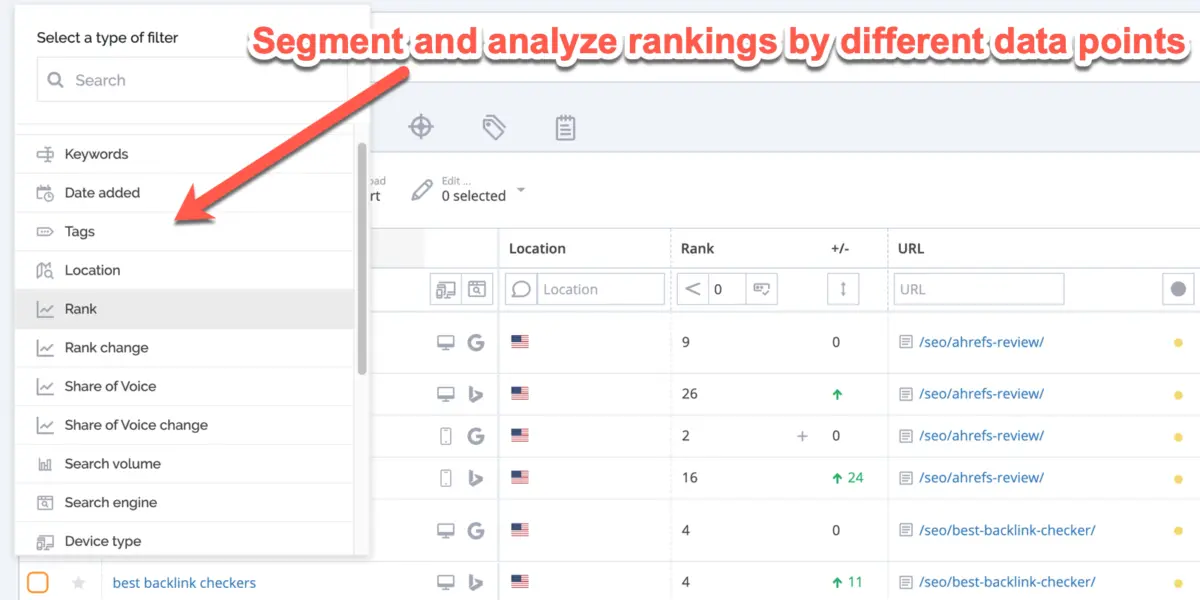
8. Tag and Segment Rankings Data
As keyword portfolios scale into the thousands, unstructured data becomes unactionable. Advanced tagging systems allow users to categorize keywords by content type, marketing funnel stage, product category, or topical cluster. This segmentation empowers teams to analyze Share of Voice and ranking shifts across specific business units or content initiatives.

9. Generate White-Label and Automated Reports
For agencies and in-house teams reporting to executive boards, professional presentation is vital. The ideal tracker offers native white-label reporting capabilities or seamless integrations with visualization suites (such as Google Looker Studio and Databox), enabling automated delivery of clean, digestible progress reports to stakeholders.

The 7 Best SERP Tracking Tools for 2025
The software market features countless options, split primarily between dedicated standalone trackers and comprehensive all-in-one SEO platforms. Below is our shortlist of the top seven tools available today.

1. AccuRanker
- Type: Standalone SERP Tracker
- Starting Price: $116/month (up to 1,000 keywords)
- Overview: Widely considered the gold standard for dedicated rank tracking, AccuRanker is trusted by over 32,000 companies, including global brands like HubSpot, IKEA, and Kinsta. It delivers blazing-fast, accurate data with automated daily updates and instant on-demand refreshing.
- Standout Strengths: Unmatched data update speed, deep Share of Voice analytics, comprehensive SERP feature tracking (50+ features), and robust integrations with Google Analytics and Looker Studio.
2. Semrush (Position Tracker & SERP Gap Analyzer)
- Type: All-in-One SEO Platform Suite
- Starting Price: $139.95/month
- Overview: Serving over 10 million users from enterprise giants like Samsung and Vodafone, Semrush offers an exceptional Position Tracking tool that rivals the accuracy of any standalone software on the market, backed by its massive all-in-one marketing toolkit.
- Standout Strengths: Highly accurate localized and device-split tracking, competitive distribution matrixes, and access to the innovative SERP Gap Analyzer app, which automatically scans SERPs to uncover under-optimized content and low-hanging fruit opportunities.
3. ProRankTracker
- Type: Standalone SERP Tracker
- Starting Price: $39/month
- Overview: ProRankTracker is a cost-effective, highly scalable tracking and reporting engine serving over 60,000 users worldwide. It is particularly well-regarded for its extensive multi-language capabilities and versatile reporting structures.
- Standout Strengths: Excellent affordability, comprehensive video rank tracking (YouTube), and highly customizable client reporting.
4. Advanced Web Ranking (AWR)
- Type: Standalone SERP Tracker
- Starting Price: $99/month
- Overview: A veteran in the SEO software space, AWR is utilized by major enterprises and agencies (including Microsoft) for reliable, long-term SERP monitoring across complex geographic and device architectures.
- Standout Strengths: Enterprise-grade security, flexible cloud or on-premise execution models, and deep historical data access.
5. SERPWatcher (by Mangools)
- Type: All-in-One Suite Component
- Starting Price: $29.90/month (Mangools bundle)
- Overview: Designed with simplicity and ease of use in mind, SERPWatcher is the tracking component of the Mangools platform, trusted by massive brands like Airbnb and Adidas. Its proprietary Performance Index calculates organic traffic potential at a glance.
- Standout Strengths: Exceptionally clean user interface, highly intuitive data visualization, and budget-friendly pricing ideal for smaller teams and startups.
6. SE Ranking
- Type: All-in-One SEO Platform
- Starting Price: $52/month
- Overview: SE Ranking has carved out a stellar reputation for delivering feature-rich, highly accurate position tracking by simulating user behavior across precisely targeted geographic locations and devices.
- Standout Strengths: Comprehensive professional toolset at a mid-market price point, strong competitor research utilities, and reliable white-label reporting.
7. Nightwatch
- Type: Standalone SERP Tracker
- Starting Price: $32/month (250 keywords)
- Overview: Trusted by enterprise brands like Shopify and Coinbase, Nightwatch stands out for its unique data-fetching architecture that allows accurate rank tracking across more than 107,000 global locations.
- Standout Strengths: Incredible geographic depth, sophisticated segmentation capabilities, and modern, dashboard-driven reporting interfaces.
Future Outlook: What Lies Ahead for SERP Tracking?
As we look toward the remainder of the decade, the evolution of search engine technology shows no signs of slowing down. Several forward-looking trends are reshaping the requirements for SERP monitoring tools:
- Generative Engine Optimization (GEO): With AI-driven search experiences fundamentally altering how users discover information, traditional blue-link positioning metrics will continue to give way to visibility metrics inside conversational AI answers and synthesized summaries.
- Hyper-Personalization and Dynamic Local Intent: As search engines increasingly tailor results based on user history and hyper-local spatial data, tracking platforms must leverage advanced simulation algorithms to reflect true user experiences across micro-locations.
- Deeper BI Integration: The barrier between SEO data and general business intelligence will continue to dissolve. Future-proof tools will increasingly rely on seamless APIs to feed rank, traffic, and revenue data straight into corporate data warehouses (such as Snowflake and BigQuery).
Choosing the right SERP tracking software ultimately depends on your organization’s specific scale, budget, and operational needs. For teams demanding dedicated, lightning-fast standalone tracking, AccuRanker remains the premier choice. For those seeking an expansive, all-in-one marketing powerhouse equipped with advanced content gap analysis, Semrush is difficult to surpass. Evaluate your key metrics, leverage trial periods, and equip your team with the data clarity needed to dominate the modern search landscape.