In the grand tradition of agricultural journalism and unhinged sensory exploration, the annual apple assessment has returned. Welcome, Apple Snack Gang and casual orchard observers alike, to the continuation of the definitive 2026 fruit audit. Following the initial wave of field testing, this second installment delves deeper into the esoteric, the over-spiced, the potentially fraudulent, and the genuinely jaw-shattering specimens currently dominating the pomological landscape.
Apples are, by nature, a volatile agricultural commodity. Some varieties improve gracefully in cold storage, maturing into complex flavor profiles, while others begin an immediate, irreversible descent into "crap-town" the moment they sever ties with the branch. This report examines seven distinct varieties—ranging from high-spice oddities and historical New Jersey cider staples to literal dental hazards tasting of nostalgic chewing gum. Utilizing rigorous empirical tasting notes, historical triangulation, and an unyielding commitment to rating apples on a numerical scale, this investigation provides a complete breakdown of the latest batch to cross the tasting table.
Detailed Chronology of the Tasting Circuit
The evaluation of the current harvest follows a strict, randomized sampling methodology, though exterior factors—such as unexpected pop-culture hallucinations and structural jaw integrity—inevitably influence the data collection process. Below is the chronological record of the specimens analyzed during this phase of the trial.
1. Kickapoo Spice
Score: 6.9 / 10 ("Nice.")
Profile: High spice component, heavy on nutmeg, cinnamon, and clove. Non-juicy, featuring an idiosyncratic cut-grass aftertaste.
Evoking immediate mental associations with classic rock anthems, the Kickapoo Spice presents itself as a dense, eccentric specimen. Structurally, it is a heavy-set fruit with zero regard for traditional hydration levels; it lacks juiciness entirely. Instead, it compensates with an aggressive aromatic spice profile dominated by nutmeg, underpinned by subtle notes of cinnamon and clove.
The primary drawback in the tasting chronology was a lingering aftertaste reminiscent of freshly cut lawn clippings—a distinct indicator that the fruit may have required either a prolonged or truncated storage duration. Apples remain an unpredictable agricultural wildcard, and while the Kickapoo Spice falls short of perfection, its bold, herbal weirdness secures it a respectable 6.9 rating.
As the inaugural "proper" apple of the seasonal rotation, the St Edmunds Pippin set a remarkably high baseline for subsequent contenders. Though its exterior texture presents a tactile challenge—frequently likened to stroking a shark in reverse—the interior delivery is nothing short of triumphant.
Upon piercing the skin, the fruit responds with an explosive, high-decibel pop-and-crunch combination that satisfies primal instincts. Flavor-wise, it leans into a bright, herbal complexity, offering distinct notes of fennel pollen harmonized by a measured, refined sweetness. It serves as the gold standard for how a slightly unconventional, funky apple can achieve absolute harmony between tartness and sugar.
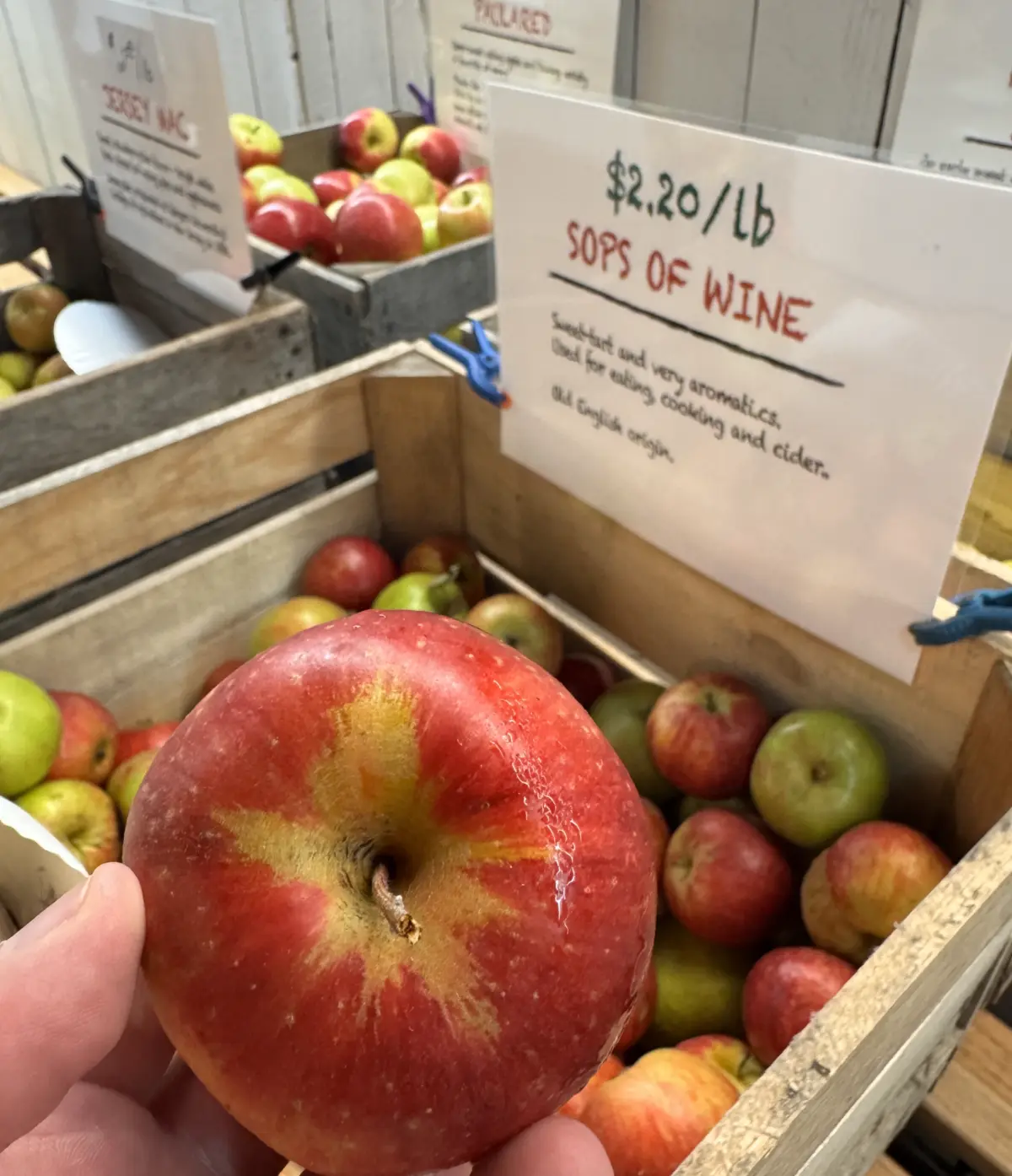
3. Sops of Wine
Score: 3.5 / 10
Profile: Subacid, vanilla and spice notes, compromised by a mealy, gritty texture.
Entering the evaluation phase with historical baggage, the Sops of Wine triggered immediate psychological phenomena, specifically compelling the taster to involuntarily channel The Lord of the Rings character Denethor consuming a tomato while muttering its namesake in a hollow skull-resonance.
Despite its storied nomenclature and promising aromatic profile—featuring subtle hints of vanilla and spice—the physical execution was deeply disappointing. Suffering from an advanced state of post-harvest degradation, the texture was excessively mealy and gritty. Compounding this was taxonomic confusion: while classical literature suggests true Sops of Wine should feature red-stained flesh or represent a collective umbrella term for various heritage types, this particular specimen offered neither redemption nor structural integrity.
4. Fenceline Surprise
Score: 1.0 / 10
Profile: Bland, mealy mush with a fleeting hint of pear juice, terminating in a texture akin to beach sand.
The Fenceline Surprise lived up to its moniker, though the "surprise" was exclusively negative. Despite an intriguing name that begs to be pronounced with an affected French cadence, the interior reality was a tragic exercise in disappointment.
The flesh yielded a bland, structural mush. A ghost-like trace of pear juice flavor flickered across the palate during the initial millisecond of contact, only to vanish instantly, leaving behind the distinct sensation of chewing coastal beach sand. Marketed officially as a "firm apple," this specimen clearly suffered from catastrophic supply chain aging or pre-harvest morbidity. Were it not for its aesthetically pleasing exterior and clever nomenclature, it would have cleanly bottomed out at zero.
Sounding suspiciously like a steampunk inventor or a silver-age comic book hero tasked with defeating the nefarious "Brine Man," the Americus Crab is an unapologetic outlier. As a true crabapple, it refuses to conform to standard dessert apple expectations.
It is profoundly savory, overwhelmingly tart, physically tough, and surging with structural tannins. It is decidedly not an item meant for casual, out-of-hand snacking. However, for those rare demographic segments who actively seek out culinary punishment, it provides a fascinating, if punishing, sensory experience.
6. Campfield (False?)
Score: 4.1 / 10
Profile: Chewy, tannin-heavy cider apple designed for fermentation rather than raw human consumption.
Labeled intriguingly with the modifier "(false)," this specimen behaved less like a fruit and more like a tactical obstacle. It offered a chewy, callused resistance, swinging wildly between excessive sweetness and a tannin payload so intense it felt as though the apple was actively consuming the taster in return.
Given its classification as a dedicated cider apple, such aggressive defense mechanisms are standard procedure; these are fruits waiting for biochemical mutation via industrial fermentation before facing the human tongue.
7. Graham
Score: 8.0 / 10
Profile: Glacial fracture density, leading to an astonishing, unadulterated flavor profile of Juicy Fruit chewing gum.
The final contender of the rotation, the Graham, is an absolute physical titan. It is so densely fortified that it poses an immediate liability to human dental work, boasting structural integrity capable of deflecting low-gauge ammunition. Biting into a Graham requires rigorous preparation, breaking open with the dramatic force of a calving glacier.
However, those who survive the initial structural assault are rewarded with one of the most astonishing flavor anomalies in modern pomology: an unreserved, crystal-clear taste profile matching Juicy Fruit chewing gum down to the molecule. While the physical effort required to breach its defenses prevents a higher numerical score, the flavor profile alone secures its place among the elite.
Supporting Context & Metrics
Evaluating heritage and specialty apples requires acknowledging the broader ecological and agricultural framework. The table below outlines the core metrics tracked across the current testing phase:
Variety Name
Primary Flavor Notes
Structural Integrity
Tannin / Acid Balance
Final Score (/10)
Kickapoo Spice
Nutmeg, cinnamon, cut grass
Dense, non-juicy
Moderate spice / low acid
6.9
St Edmunds Pippin
Fennel pollen, crisp sugar
High-pop, razor-crunch
Balanced sharp-sweet
8.3
Sops of Wine
Vanilla, subtle spice
Mealy, gritty
Subacid
3.5
Fenceline Surprise
Ghost pear, sand
Mushy, degraded
Flat
1.0
Americus Crab
Savory, extreme tart
Tough, woody
Maximum tannins
2.5
Campfield (False)
Tannic wood, heavy sweet
Chewy, resistant
Extreme tannins
4.1
Graham
Juicy Fruit gum
Glacial, gym-hardened
Sweet / high density
8.0
Official Statements and Historical Interludes
The agricultural lineage of these fruits often stretches back centuries, intertwined with the foundation of modern governance and local history. Notably, the historical pedigree attached to the Campfield variety highlights the deep roots of American pomology. According to archival genealogical accounts tracing back to early New Jersey and Connecticut settlements:
"Matthew Canfield, an anti-royalist Puritan arriving from Harleston, England prior to 1637, established foundational agricultural footprints across the New Haven Colony, Norwalk, and Newark. Town records mandate that freeholders cultivate specific acreage in fruit trees to support local cider production. Canfield’s historical legacy—rooted in town court records, corn mills, and winter fruit cultivation—serves as a reminder that many of today’s esoteric apple varieties were originally engineered to fuel the colonial landscape."
While modern consumers may struggle with the intense tannin loads of heritage cider apples like the Campfield, their historical utility as the bedrock of early American agrarian enterprise remains undisputed.
Future Outlook
As the 2026 apple testing circuit transitions into its next phase, field operations are expanding northward. With upcoming expeditions scheduled across New York, New England, and the Canadian provinces, the search for extraordinary pomological anomalies accelerates.
Orchardists, agricultural historians, and local apple enthusiasts are strongly encouraged to come forward with regional variations, rare heritage drops, and experimental harvests. The pursuit of the ultimate apple continues—teeth permitting.