

By Mitchell Parton
Senior Commerce Reporter
Executive Overview
The retail landscape is undergoing a foundational shift as artificial intelligence transitions from a passive tool for product discovery into an active participant in consumer transactions. In a major strategic divergence from its chief retail rival, retail giant Walmart has announced a sweeping rollout of new features designed to support "agentic shopping"—a paradigm where autonomous AI agents browse, compare, and purchase goods directly on behalf of human consumers.
This move positions Walmart as an early champion of open commerce architecture in the age of generative AI. By introducing a dedicated integration portal for external AI agents and rolling out consumer-facing governance tools like spending caps and purchase approvals, Walmart is leaning into an interconnected ecosystem.
The timing of Walmart’s announcement is particularly striking. It comes just a month after Amazon erected digital barriers, locking out Meta’s Muse AI assistant from executing transactions on its platform. While Amazon appears intent on defending its walled garden and controlling the entire consumer funnel, Walmart is opening its doors to third-party AI agents. This strategy signals a calculated bet that embracing autonomous shopping assistants will drive higher transaction volumes and capture forward-thinking, tech-native consumers—even if it means ceding some traditional interface control to automated software.
Detailed Chronology: The Rise of Agentic Commerce and Walmart’s Pivot
To understand the weight of Walmart’s recent announcement, one must trace the rapid evolution of artificial intelligence in retail over the past several years. What began as simple chatbots answering basic customer service inquiries has rapidly metastasized into sophisticated, multimodal AI architectures capable of executing complex multi-step workflows.
Phase 1: From Conversational Search to Autonomous Execution
For years, digital commerce was defined by keyword searches, filters, and manual cart additions. Even early implementations of generative AI in retail were largely confined to conversational search engines—tools that could recommend a blender or suggest an outfit but still required the human user to click "Checkout."
By late 2024 and 2025, foundational model advancements enabled "agentic workflows." These systems possess agency: they can be given an open-ended goal (e.g., "Find organic gluten-free snacks under $50 for a family of four, ensure they arrive by Friday, and complete the order"), break that goal down into actionable steps, and execute transactions securely without constant human hand-holding.
Phase 2: The E-Commerce Standoff (Late 2025 – Early 2026)
As external tech platforms—ranging from social media giants like Meta to nimble AI startups—began developing autonomous shopping assistants, traditional retail platforms faced a strategic crossroads. How should massive e-commerce ecosystems interact with third-party software attempting to bypass their proprietary apps and websites?
The industry fracture became glaringly apparent just weeks prior to Walmart’s announcement, when Amazon took aggressive steps to block Meta’s Muse AI assistant from accessing its ecosystem for automated purchasing. Amazon’s defensive posture underscored a traditional retail fear: losing the direct relationship with the consumer, missing out on first-party data harvesting, and ceding monetization levers (such as sponsored product ads) to third-party AI intermediaries.
Phase 3: Walmart’s Open-Door Policy
Rather than locking out external AI agents, Walmart has chosen a collaborative, infrastructure-first approach. Recognizing that consumers will increasingly rely on their preferred AI assistants—whether built into their smartphones, operating systems, or specialized apps—Walmart decided to facilitate rather than frustrate this shift.
The retailer is deploying a two-pronged strategy:
- The Developer & Agent Portal: A dedicated integration framework that allows external AI agents to securely connect with Walmart’s e-commerce backend, streamlining product data retrieval, inventory checks, and checkout APIs.
- Consumer Guardrails: Recognizing that handing purchasing power over to an AI agent introduces friction, anxiety, and risk regarding unauthorized spending, Walmart is introducing granular control mechanisms directly into customer accounts.
Supporting Context & Metrics: The Mechanics of Walmart’s New AI Infrastructure
Walmart’s announcement is not merely a philosophical statement about open ecosystems; it is backed by concrete technical features rolling out across its digital properties over the coming weeks.
Agent Profiles: Granular Control and Separation of Concerns
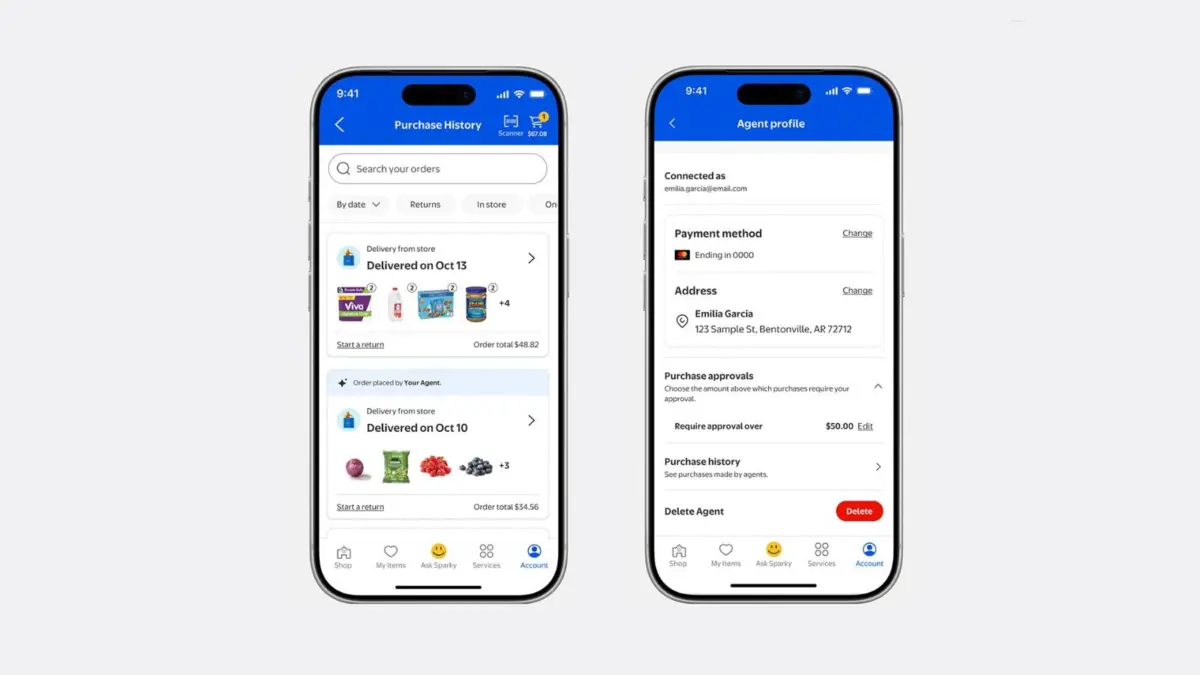
Set to launch within the next month, Agent Profiles represent a novel approach to account management in the age of automated commerce. Historically, shared household accounts or automated recurring orders often muddied purchase histories and spending visibility.

With Agent Profiles, Walmart is introducing a dedicated structural container within individual user accounts. Key elements of this feature include:
- Dedicated Authorization: Shoppers can explicitly authorize specific AI agents (e.g., a household management AI, a fitness tracker’s nutrition shopper, or a third-party personal assistant) to operate within their Walmart account.
- Segmented Purchase Histories: All transactions executed by an AI agent are logged separately from the user’s manual shopping history. This allows consumers to audit what their agents are buying, evaluate the accuracy of the AI’s purchasing decisions, and maintain a clear paper trail.
- Spending Limits and Approval Workflows: Consumers retain absolute sovereign control via customizable governance parameters. Users can set hard spending caps per transaction, daily limits, or configure a "human-in-the-loop" requirement where any cart exceeding a specific dollar threshold triggers a push notification requiring explicit human approval before the order is processed.
The Broader Retail and Media Landscape
The stakes for mastering agentic commerce are extraordinarily high. According to recent retail tech analyses, digital commerce executives expect automated agents to account for a double-digit percentage of all routine e-commerce replenishment orders by the end of the decade.
For a mass-merchant giant like Walmart—whose core value proposition heavily relies on household staples, grocery replenishment, and everyday low prices—routine purchases are prime territory for automation. If a consumer’s AI assistant can automatically reorder milk, paper towels, and laundry detergent the moment supplies run low, whoever owns the frictionless integration wins the recurring revenue stream.
By providing a dedicated portal for agents, Walmart is positioning itself as the most "agent-friendly" destination in retail. This could siphon off significant market share from platforms that attempt to restrict external AI integration.
Official Statements and Industry Implications
While formal press releases from Walmart executives emphasize a consumer-first philosophy centered on convenience and choice, retail analysts are reading between the lines to understand the broader strategic maneuver.
"Walmart is making it easier for agents to connect with its ecommerce platform via a dedicated portal, signaling a pragmatic acknowledgment that the future of retail search and discovery will happen outside traditional apps and websites." — Industry Trade Analysis
The contrast between Walmart’s open portal and Amazon’s blocking of Meta’s Muse highlights two competing philosophies in modern retail:
- The Walled Garden (Amazon’s Approach): Protect the ecosystem, force users to stay within proprietary apps, protect advertising revenue models, and restrict third-party software from intermediating the customer relationship.
- The Open Utility (Walmart’s Approach): Meet the customer wherever their preferred AI lives, reduce friction for automated transactions, build trust through rigorous governance tools (Agent Profiles), and capture transaction volume regardless of the originating interface.
Tech sector commentators have noted that Walmart’s strategy carries inherent risks. Opening backend infrastructure to external AI agents requires robust security protocols to prevent malicious bot activity, scraping anomalies, or erroneous bulk purchasing loops. However, by pairing developer access with strict consumer-side guardrails like spending limits and approval walls, Walmart is attempting to mitigate these vulnerabilities while capturing first-mover advantage in the agentic commerce race.
Future Outlook: What Agentic Shopping Means for the Next Decade of Retail
As Walmart rolls out Agent Profiles and its dedicated agent integration portal over the coming weeks, the ripple effects across the digital commerce ecosystem will be profound.
1. The Death of Traditional Keyword SEO?
As AI agents—rather than human shoppers staring at glowing screens—drive a growing share of product discovery and selection, traditional search engine optimization (SEO) must evolve into Algorithmic/Agentic Optimization (AIO). Agents do not care about flashy banner ads or emotional copywriting; they care about structured data, precise inventory feeds, transparent pricing, guaranteed fulfillment timelines, and API reliability. Walmart’s developer portal is an early indicator that retail infrastructure must be built for machine-to-machine communication just as much as human-to-machine interfaces.
2. Advertising and Monetization Shifts
For decades, retail media networks (RMNs) have thrived on sponsored search placements, where brands pay top dollar to have their products appear at the top of a search results page. In an agentic shopping future, if a consumer instructs an AI agent to "buy the best-value olive oil with these specific health parameters," the agent evaluates the data objectively rather than being swayed by a visual banner ad. This existential shift will force brands and retailers to rethink how digital advertising budgets are allocated in an era where software makes the final purchasing decision.
3. The Battle Lines Are Drawn
The divergence between Walmart and Amazon sets the stage for a fascinating industry showdown. Will consumers migrate toward platforms that integrate seamlessly with their preferred multi-purpose AI assistants, or will they tolerate the friction of walled gardens in exchange for closed ecosystem benefits?
One thing is certain: by opening the door to agentic shopping and giving consumers the governance tools to manage it safely, Walmart has fired a powerful opening salvo in the next great era of digital commerce.