

Executive Overview
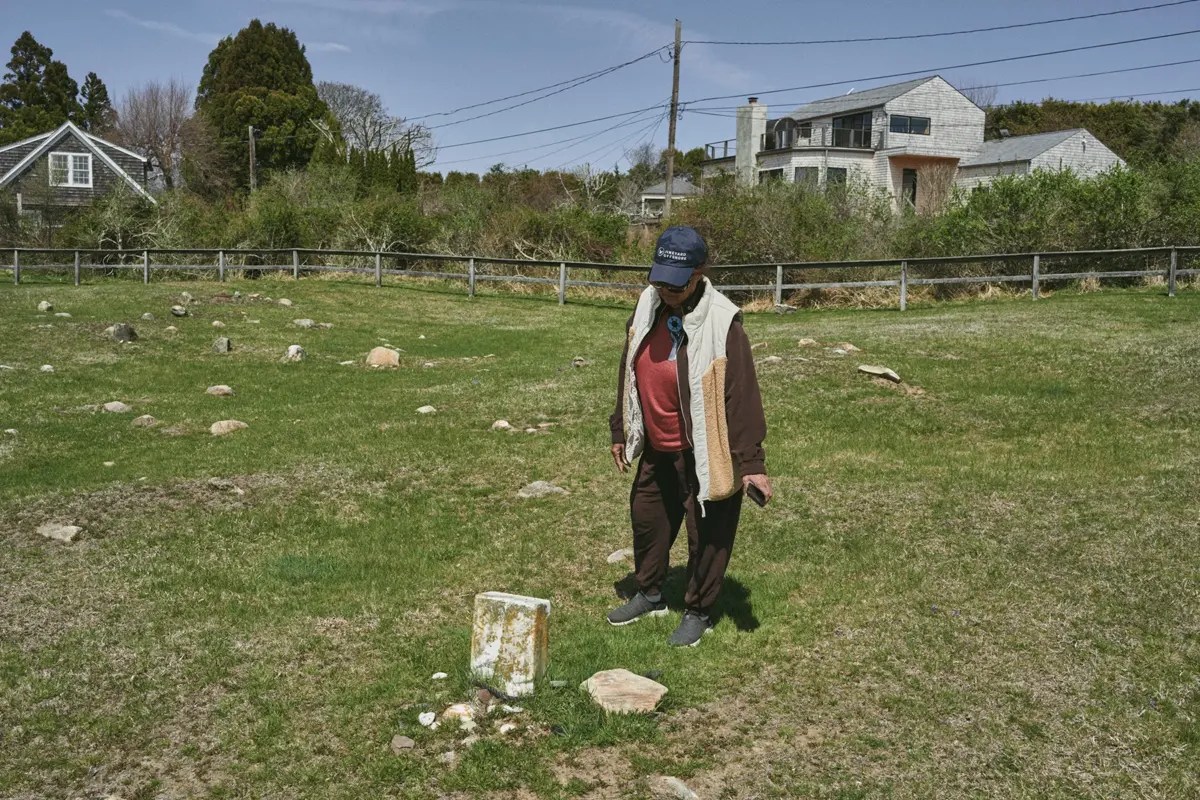
Sandwiched between two rows of suburban Long Island homes, a fenced-off tract of grass looks like any nondescript construction lot. Yet, walk past the chain-link barrier, and the ground yields the unmistakable, faint outlines of ancient rock slabs—gravestones belonging to a centuries-old Indigenous family cemetery long obscured by time, neglect, and systemic erasure.
"When we started working here seven years ago, it was nothing but trees and trash—there were couches buried here, you name it," says Sandi Brewster-walker, an octogenarian historian, tribal activist, and guide to the site. She stoops to pick up a discarded beer bottle tossed over the fence from an adjacent property. "People in the houses throw stuff over here, so it’s been a project."
For Brewster-walker, this plot is hallowed ground: the final resting place of at least 80 members of her tribe, the Montaukett. Since stepping into her role as executive director a decade ago, uncovering lost history and setting the historical record straight has become her life’s obsession. Her tireless efforts—digging through public archives, tracing lineages, and petitioning local officials—have compelled the Town of Babylon to install a remembrance plaque and maintain the grounds.
Yet, this small, local victory stands in stark contrast to a much larger, state-sponsored tragedy. The Montaukett are a once-flourishing people who were systematically dispossessed of their ancestral lands in the Hamptons and subsequently stripped of their official existence—a brazen case of legal erasure that remains a permanent stain on New York State jurisprudence. Despite repeated unanimous, bipartisan votes in the State Assembly and Senate to restore their official state recognition, the legislation has met a brick wall in the executive chamber, repeatedly vetoed by successive Democratic governors.

The tribe is asking for no territory or financial restitution. They simply demand what is rightfully theirs: historical vindication, legal existence, and protection against the permanent erasure of their culture.
Detailed Chronology: From 10,000 Years of Ancestry to Courtroom "Extinction"
Long before the expressway traffic snarls, the roaring engines of Maseratis, and the sprawling waterfront estates of the ultra-wealthy, the Montaukett ruled the easternmost reaches of Long Island.
Deep Roots and Early Contact
Archaeological evidence confirms that the Algonquian-speaking ancestors of the Montaukett arrived on the eastern tip of Long Island roughly 10,000 years ago. The surrounding seas provided an abundance of fish, oysters, and marine life, while the dense woodlands brimmed with wild game. These natural resources furnished the materials for their wigwams, longhouses, and dugout canoes, which facilitated extensive trade networks and military alliances stretching deep into southern New England.
When European settlers arrived in the early 17th century, the native population was estimated at upwards of 10,000. Within decades, European-introduced diseases and intertribal warfare decimated their numbers to approximately 500.

The Mechanism of Dispossession
As British settlers established dominance, they utilized predatory land purchases, restrictive edicts, and forced displacement to shrink Montaukett territory. In his definitive historical study, The Montaukett Indians of Eastern Long Island, historian John A. Strong debunks the persistent myth that the tribe simply "vanished," demonstrating that the narrative was manufactured to clear the path for commercial expansion.
While English legal traditions enforced deeds as permanent, absolute property transfers, the Montauketts understood them as reciprocal agreements for shared land use and resource rights. Settlers routinely bypassed local tribal bands, elevating a single compliant sachem to sign away vast tracts of land under duress. As disease and intensified raids by rival tribes left the Montauketts increasingly dependent on English protection, they were systematically compelled to concede more territory to pay off manufactured debts.
"The Montauketts," Strong writes, "were to be drawn gradually into the web of an economic and political system where they would have less and less control over their own affairs."
The 1910 Judicial Execution
By the late 19th century, land speculator Arthur W. Benson began acquiring massive tracts of the Hamptons to build a summer resort, forcing out families who refused to sell and razing properties. In 1896, Montaukett Chief Wyandanch Pharaoh filed a lawsuit to reclaim tribal territory.

At the time, federal and state policy was explicitly premised on the idea that Native Americans would be "better off if they abandoned their traditional identity." State courts actively weaponized prevailing racial and pseudoscientific stereotypes against the tribe.
In the infamous 1910 trial Pharaoh v. Benson, Montaukett leaders and 75 tribal members sat in a state Supreme Court courtroom as Judge Abel Blackmar declared the tribe legally "extinct." The judge ruled that because the Montauketts had culturally assimilated, intermarried with freed Black residents, and labored on whaling ships out of Sag Harbor, their blood had "become so mixed that in many of them Indian traits were obliterated."
In a single stroke of a pen, the Montauketts lost their legal status, their sovereignty, and their right to compensation, paving the way for unchecked real estate development. An appellate court upheld the ruling, even as the U.S. Department of the Interior continued to officially count the Montaukett population until 1930.
Supporting Context & Metrics: Eugenics, Real Estate, and Systemic Marginalization
Long Island was the epicenter of the American eugenics movement—a pseudoscientific campaign aimed at "improving" the genetic quality of the population that heavily influenced Nazi Germany’s racial policies. In 1910, the exact year of the Pharaoh v. Benson ruling, the Eugenics Record Office was founded in Cold Spring Harbor with the stated goal of purging the country of the "unfit" and "degenerate."

By the 1920s, an estimated one out of seven Long Islanders belonged to the Ku Klux Klan. Federal agencies drew explicit red lines around minority neighborhoods, denying mortgages, while master builder Robert Moses engineered parkways and overpasses with low clearances explicitly designed to block public-transit access for minority and lower-income residents to beaches and recreational areas.
With all opposition legally neutralized, state authorities and developers laid the groundwork for the East Hampton-Montauk corridor to become one of the wealthiest enclaves in America:
- The Miami Beach of the North: In 1925, Carl G. Fisher purchased 10,000 acres of former Montaukett land for $2.5 million, blasting channels to connect freshwater Lake Montauk to the port and erecting luxury hotels.
- Modern Wealth: Today, the region stands as an exclusive summer playground where the average home lists for nearly $3 million.
- The Cost of Recognition: Despite the immense value of their ancestral territory, the Montaukett have made zero land claims and seek no financial restitution. Chief Robert Pharaoh emphasizes: "I don’t want to throw anybody out of their houses, and I’m not looking for any big pieces of land. The only thing I want is a property big enough that I can put a museum or cultural research center on, and maybe put up a natural Indian village outside."
Official Statements: Broken Promises in Albany
To date, eight distinct bills to reinstate the Montaukett Nation have passed both the New York State Assembly and Senate with overwhelming, veto-proof bipartisan majorities. Yet, every single one has been struck down by executive vetoes under Democratic Governors Andrew Cuomo (three times) and Kathy Hochul (four times and counting).
The Veto Cycle
Year after year, Brewster-walker and tribal leaders have worked in good faith with the Governor’s Office, meeting and exceeding every administrative request for supporting materials, historical lineages, and genealogical clarifications. Yet, invariably around the Christmas holiday, a phone call arrives from an Albany area code delivering the news that the governor has quietly issued a veto—a calculated timing strategy that ensures the legislature is out of session and unable to override it.

Fred W. Thiele Jr., a former Democratic state assemblyman who sponsored multiple reinstatement bills, calls the ongoing political charade "the New York state version" of the U.S. Supreme Court’s infamous Dred Scott decision and Plessy v. Ferguson. "It’s one of the most racist court decisions in the history of New York state jurisprudence," Thiele says. "There’s a wrong that needs to be corrected, and we shouldn’t be making them go back to square one to prove something that we already know is true."
The Executive Defense
In statements provided to media outlets, Ken Lovett, a spokesman for Governor Kathy Hochul, defended the administration’s stance:
"Gov. Hochul is committed to supporting and strengthening relationships with Indigenous peoples and Nations across New York state… She has worked hard to right some of the horrific wrongs inflicted in the past on Indigenous peoples and takes seriously the responsibility of determining whether to recognize a Native American tribe, which would be a sovereign nation. That includes ensuring any claims of tribal leadership can be substantiated."
Following Hochul’s November 2023 veto during Native American Heritage Month—issued despite assurances from staffers that an agreement had been reached—the disconnect between rhetoric and action became glaring. Eight months later, Hochul hosted a major Native American summit in Albany to discuss removing offensive artwork from the State Capitol. The Montauketts were not invited.

Future Outlook: Persistence Overcomes Resistance
The primary motivation behind Albany’s stubborn resistance appears to be raw economic anxiety. Observers and insiders note that despite the tribe’s explicit renunciation of land claims, the executive branch fears that state recognition could open legal floodgates, unsettling the ultra-lucrative Hamptons real estate market and threatening the massive gaming revenues projected from newly authorized downstate mega-casinos.
The contemporary struggles of their landed cousins, the Shinnecock Indian Nation, offer a sobering precedent. Sixteen years after securing federal recognition, the Shinnecock have faced relentless state and local opposition to nearly every economic venture, resulting in millions of dollars spent defending their sovereignty in court against targeted state crackdowns on commercial billboards, gas stations, and fisheries.
Yet, the Montaukett refuse to yield.
"They think I’ll give up sooner or later. Well, I’m not giving up—and I’m preparing other people behind me," Brewster-walker says with an unyielding smile. "Every time we get vetoed, we get stronger. This is a matter of justice, of right and wrong, and we’re not going to be erased."

As the state legislature prepares to advance yet another iteration of the recognition bill, Brewster-walker and her allies are already drafting alternative legislative strategies—including sweeping statutory overhauls designed to strip the governor of unilateral veto power over Indigenous sovereignty. Backed by an unshakeable sense of historical duty, the Montaukett Nation is writing its own future, ensuring that the next generation inherits not just the buried gravestones of their ancestors, but the full, legal restoration of their rightful place in American history.