

Executive Overview
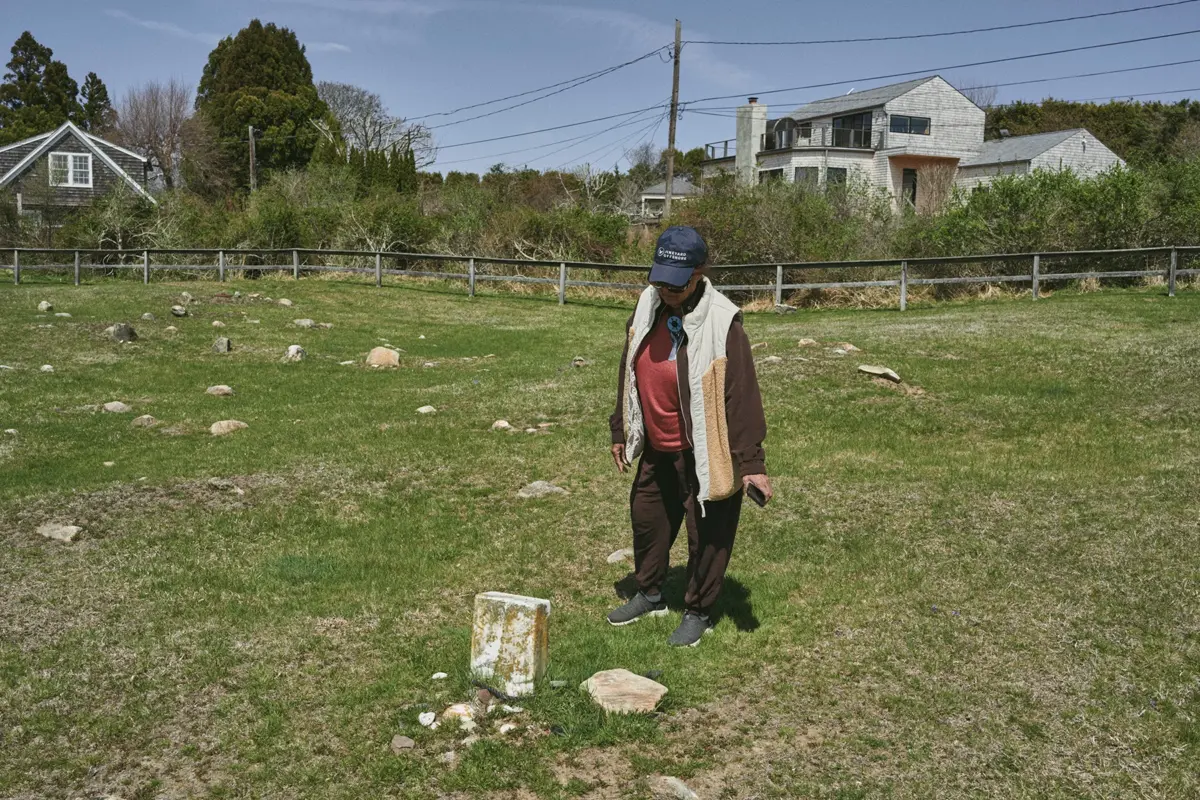
Sandwiched between two rows of suburban Long Island homes, a fenced-off tract of grass looks like any nondescript lot awaiting construction. But step inside, and the ground tells a vastly different story. The soil is laden with faint slabs of rock and weathered gravestones—a centuries-old Indigenous family cemetery long obscured by time, overgrowth, and official neglect.
"When we started working here seven years ago, it was nothing but trees and trash—there were couches buried here, you name it," says Sandi Brewster-walker, an octogenarian historian and executive director of the Montaukett Nation. Bending over to pick up a discarded beer bottle tossed over the fence by a neighboring homeowner, she remarks, "It’s been a project."
For Brewster-walker and her community, this neglected plot is sacred ground. It is the final resting place of at least 80 members of the Montaukett tribe. Yet, this rehabilitation project is merely a microcosm of a much larger, systemic struggle. For decades, the Montauketts have waged an exhausting, uphill battle not just to preserve their physical history, but to reclaim their legal existence.
Despite overwhelming, bipartisan legislative victories—including eight separate bills passed by the New York State Assembly and Senate—the Montaukett Nation remains officially unrecognized by the state. Year after year, these measures have met the governor’s veto pen, perpetuating a century-old act of judicial erasure that civil rights advocates compare to the darkest stains of American jurisprudence.

Detailed Chronology: From Ancestral Stewards to Judicial "Extinction"
Long before the espresso-traffic snarls, Maseratis, and sprawling waterfront estates of the Hamptons, the Montauketts were the undisputed stewards of Long Island’s easternmost reaches. Archeological records show their Algonquian-speaking ancestors arrived in the region approximately 10,000 years ago. The surrounding seas teemed with fish and oysters, while the woodlands brimmed with wild game and timber, providing the materials needed to build wigwams, longhouses, and dugout canoes. These watercraft enabled the tribe to establish extensive trade routes and military alliances stretching into southern New England.
When better-armed English settlers arrived in the early 17th century, the native population was estimated at upwards of 10,000. Within decades, intertribal warfare and imported European diseases devastated the community, reducing its numbers to about 500.
As English colonization expanded, the Montauketts faced predatory land purchases, restrictive edicts, and forced displacement. In his definitive study, The Montaukett Indians of Eastern Long Island, historian John A. Strong debunks the myth that the tribe simply "vanished," asserting instead that the narrative was manufactured to clear the path for commercial real estate development.
Among other tactics, colonial authorities enforced deeds as permanent property transfers, whereas the Montauketts viewed them as reciprocal agreements for shared land use and resource rights. Settlers routinely bypassed local tribal bands, elevating a single compliant Montaukett sachem to sign away vast tracts of land. As disease and intensified raids left the tribe increasingly dependent on English protection, they were compelled to cede more territory to pay off manufactured debts.

The 1910 Pharaoh v. Benson Ruling
By the late 19th century, land speculators targeted the far-eastern tip of Long Island for summer resorts. When plans were announced for a Long Island Rail Road extension to Montauk, a developer named Arthur W. Benson began buying up vast tracts of land, bypassing tribal consent and forcibly relocating families who refused to leave.
In 1896, Montaukett Chief Wyandanch Pharaoh filed a landmark lawsuit to reclaim tribal territory. However, state policies of the era operated on the premise that Native Americans would be "better off if they abandoned their traditional identity." State courts weaponized prevailing racial stereotypes against the tribe.
In the devastating 1910 Pharaoh v. Benson trial, state Supreme Court Judge Abel Blackmar ruled that because the Montauketts had culturally assimilated, intermarried, and labored alongside other minority groups, their blood had "become so mixed that in many of them Indian traits were obliterated." In an instant, the Montauketts were legally declared "extinct," stripping them of their land, their sovereignty, and their right to compensation. An appellate court upheld the verdict, though the U.S. Department of the Interior continued to officially count the Montaukett population until 1930.
Supporting Context & Metrics: Eugenics, Real Estate, and the Hamptons Boom
The judicial erasure of the Montauketts coincided with a dark chapter in American social history. Long Island served as an epicenter for the American eugenics movement—a pseudoscientific campaign aimed at "improving" the genetic quality of the population, which later heavily influenced Nazi ideology in Germany. In 1910, the Eugenics Record Office was founded in Cold Spring Harbor with the stated goal of purging the country of the "unfit" and "degenerate."

By the 1920s, an estimated one out of seven Long Islanders belonged to the Ku Klux Klan. Federal agencies drew explicit red lines around minority neighborhoods, while public works engineered by Robert Moses systematically limited minority and lower-income access to regional beaches and recreational spaces.
With the legal obstacles cleared, state authorities and developers transformed the East Hampton-Montauk corridor into one of the wealthiest enclaves in America. In 1925, Carl G. Fisher purchased 10,000 acres of former Montaukett land for $2.5 million to create "the Miami Beach of the North." Today, the region stands as an exclusive summer playground where the average home lists for nearly $3 million.
Yet, despite sitting on some of the most valuable real estate in the country, the Montauketts have made no sweeping land claims or demands for financial restitution.
"I don’t want to throw anybody out of their houses, and I’m not looking for any big pieces of land," says Robert Pharaoh, hereditary chief of the Montaukett Indian Nation. "The only thing I want is a piece of property big enough that I can put a museum or cultural research center on, and maybe put up a natural Indian village outside. That’s all."

Official Statements and Political Gridlock
To date, eight separate bills to recognize the Montaukett tribe have passed both the New York State Assembly and Senate with overwhelming bipartisan support. Yet, every single measure has been vetoed—three times by Democratic Governor Andrew Cuomo, and four times (and counting) by current Governor Kathy Hochul.
Former state Assemblyman Fred W. Thiele Jr., a Democrat who sponsored multiple bills to reinstate the tribe, calls the 1910 ruling "one of the most racist court decisions in the history of New York state jurisprudence," likening it to the U.S. Supreme Court’s infamous Dred Scott and Plessy v. Ferguson decisions.
"There’s a wrong that needs to be corrected, and we shouldn’t be making them go back to square one to prove something that we already know is true," Thiele argues.
Year after year, Brewster-walker and tribal leaders have worked in good faith with the Governor’s Office, submitting thousands of pages of historical documentation and answering detailed inquiries. Yet, the legislation routinely stalls or faces late-December vetoes—timing that prevents lawmakers from mounting an override.

The State’s Position
In statements to the press, Ken Lovett, a spokesman for Governor Hochul, emphasized the administration’s commitment to Indigenous nations:
"Gov. Hochul is committed to supporting and strengthening relationships with Indigenous peoples and Nations across New York state… [She] takes seriously the responsibility of determining whether to recognize a Native American tribe, which would be a sovereign nation. That includes ensuring any claims of tribal leadership can be substantiated."
When Hochul issued a veto in November 2023 during Native American Heritage Month, she stated she did not find sufficient evidence to overturn the 1910 precedent. Subsequent vetoes have echoed similar concerns regarding "traditional criteria" for recognition, leaving tribal leaders bewildered by the shifting goalposts.
The Shinnecock Parallel
Observers point to the protracted struggles of the neighboring Shinnecock Indian Nation as indicative of the state’s approach to tribal sovereignty. Sixteen years after securing federal recognition, the Southampton-based Shinnecock have faced continuous state opposition to economic development initiatives, resulting in millions of dollars spent on legal battles over commercial ventures, digital billboards, and land use.

"They want to put a stranglehold on any economic development that the tribe has," says Lance Gumbs, vice chairman of the Shinnecock Council of Trustees. "There’s been this concerted effort by the town and the state to keep us subservient."
Future Outlook: "Persistence Overcomes Resistance"
Despite decades of setbacks, the Montaukett leadership refuses to yield. The strategy moving forward involves continued legislative pressure paired with potential legal action. If current bills fail, Brewster-walker plans to introduce sweeping legislation designed to establish a formal New York State Indian law that removes tribal recognition decisions from the unilateral control of the governor. Furthermore, the tribe is actively preparing to launch the formal federal recognition process.
Back at the rehabilitated burial ground in Babylon, surrounded by suburban lawns, Brewster-walker reflects on the journey.
"They think I’ll give up sooner or later. Well, I’m not giving up—and I’m preparing other people behind me," she says with a resolute smile. "Every time we get vetoed, we get stronger. This is a matter of justice, of right and wrong, and we’re not going to be erased."

Reporting for this story was supported with a grant from IllumiNative.