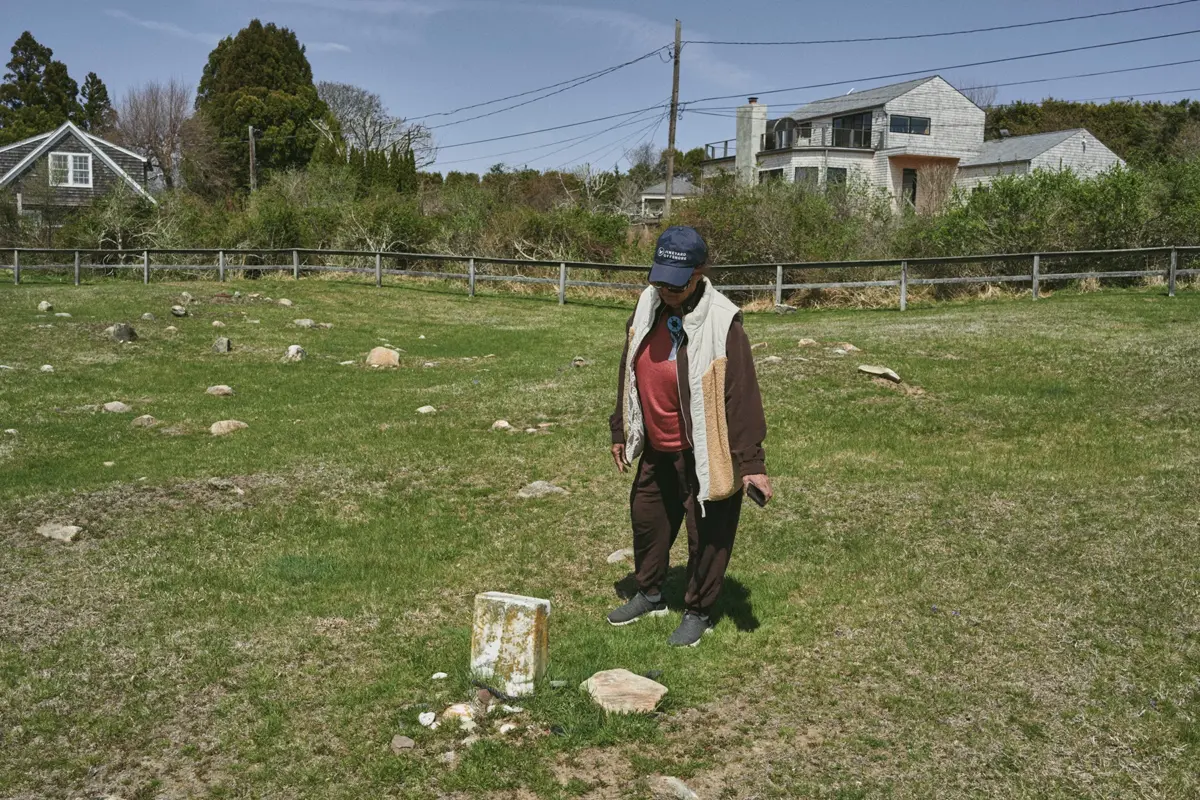
Sandwiched between two rows of suburban Long Island homes, a fenced-off tract of grass looks like any nondescript lot cleared for construction. But a step inside reveals a ground laden with faint slabs of rock—gravestones from a centuries-old Indigenous family cemetery obscured by the passage of time and neglect.
"When we started working here seven years ago, it was nothing but trees and trash—there were couches buried here, you name it," says Sandi Brewster-walker, an octogenarian guide to the site, as she bends over to pick up a discarded beer bottle. "People in the houses throw stuff over the fence, so it’s been a project."
For Brewster-walker, this place is sacred ground: the resting place of at least 80 members of her tribe, the Montaukett. Serving as executive director for a decade, uncovering lost history and setting the records straight has become an obsession for Brewster-walker, whose caramel complexion is framed by warm hazel eyes and a beaded light-blue necklace. She points to the rear of the tract, where authorities are still removing brush concealing some 50 additional graves. "It’s probably more than that," she says. "I have all the names."
Thanks to Brewster-walker’s tireless efforts digging up public records, tracing lineages, and petitioning officials, the town of Babylon will install a remembrance plaque and mow the grass here several times a year, mirroring other rehabilitated Montaukett burial grounds. It is a small but meaningful gesture for a once-flourishing tribe that was gradually dispossessed of ancestral lands and then stripped of its official existence—a brazen case of legal erasure that continues to stain the annals of New York State government.
To date, eight bills to recognize the tribe have passed both the State Assembly and Senate with overwhelming bipartisan support, only to be repeatedly vetoed by Democratic Governors Andrew Cuomo (three times) and Kathy Hochul (four times and counting). Year after year, Brewster-walker says, she and tribal leaders have worked in good faith with the Governor’s Office, meeting and exceeding every request for supporting materials and clarifications. Yet, sometime around the Christmas holiday, a phone call with an Albany area code inevitably arrives, informing them that the bill failed to pass the governor’s desk—a cruel charade that, according to former State Assemblyman Fred W. Thiele Jr., "compounds the original sin."
Detailed Chronology of an Historic Injustice
1. Pre-Colonial Flourishing and Early Contact
Long before the expressway traffic snarls, Maseratis, and sprawling waterfront estates of the Hamptons, there were the Montauketts. Archaeological records show their Algonquian-speaking ancestors arrived in the easternmost reaches of what is now Long Island approximately 10,000 years ago. Surrounding seas offered abundant fish and oysters, while woodlands brimmed with wild game and furnished the raw materials used to construct wigwams, longhouses, and dugout canoes. These watercraft enabled the tribe to establish expansive trade routes and military alliances stretching into southern New England, including partnerships with better-armed English settlers who arrived in the early 17th century. At the time, the native population was estimated to be upward of 10,000. Within decades, intertribal warfare and imported European diseases reduced that number to about 500.
2. Predatory Dispossession and Legal Subterfuge
In the decades that followed, predatory land purchases, restrictive edicts, and forced displacement further diminished Montaukett ranks. In his definitive study, The Montaukett Indians of Eastern Long Island, Long Island University historian John A. Strong debunks the myth that the tribe simply "vanished," asserting that the narrative was manufactured to clear the way for commercial expansion.
Among other tactics, English settlers enforced deeds as permanent property transfers, whereas the Montauketts understood them as reciprocal agreements for shared land use and resource rights. Settlers bypassed local tribal bands and elevated a single Montaukett sachem to sign away vast tracts of land. As disease and intensified raids by rival tribes left the Montauketts dependent on English protection, they were compelled to concede more territory to pay off debts. As Strong writes, "The Montauketts were to be drawn gradually into the web of an economic and political system where they would have less and less control over their own affairs."
3. The 1910 Judicial Extinction
As Montaukett territorial holdings thinned, many members intermarried with freed Black residents and other minorities. Bereft of land and traditional fishing rights, they increasingly labored on behalf of powerful business interests, earning a reputation as hardy seamen on Atlantic whaling ships sailing out of Sag Harbor in the 19th century. When plans were announced for a Long Island Rail Road extension to Montauk, a developer named Arthur W. Benson began buying up vast tracts of land to create a summer resort, bypassing tribal consent. Families that refused to leave were forcibly relocated, and some saw their properties razed.
In 1896, Montaukett Chief Wyandanch Pharaoh filed a lawsuit to reclaim tribal territory. According to Strong, government policy at the time was based on the premise that Native Americans would be "better off if they abandoned their traditional identity." State courts weaponized prevailing racial stereotypes against the tribe. In the devastating 1910 Pharaoh v. Benson trial, State Supreme Court Judge Abel Blackmar ruled that because the Montauketts had culturally assimilated and intermarried, their blood had "become so mixed that in many of them Indian traits were obliterated."
In an instant, the Montauketts lost their legal status and right to compensation. An appellate court upheld the ruling, even though the U.S. Department of the Interior continued to officially count the Montaukett population until 1930.
Supporting Context & Metrics: Eugenics, Real Estate, and the Hamptons
Long Island was the epicenter of the American eugenics movement, a pseudoscientific campaign aimed at "improving" the genetic quality of the population—an ideology that later heavily influenced the policies of the Nazi regime in Germany. In 1910, the same year as the ruling that wiped away Montaukett tribal rights, the Eugenics Record Office was founded in Cold Spring Harbor with the stated goal of maintaining an American hereditary ideal by purging the country of the "unfit" and "degenerate."
By the 1920s, it was estimated that one out of seven Long Islanders belonged to the Ku Klux Klan. Federal agencies drew explicit red lines around minority neighborhoods, labeling them hazardous and refusing to back mortgages, while parkways and overpasses engineered by autocratic urban planner Robert Moses limited minority and lower-income public-transit access to recreational areas and beaches.
With nothing left in their way, state authorities and developers laid the groundwork that made the East Hampton-Montauk corridor one of the wealthiest regions in America. In 1925, Carl G. Fisher purchased 10,000 acres of former Montaukett land for $2.5 million, envisioning "the Miami Beach of the North." He blasted connections between freshwater Lake Montauk and the local port, built golf courses and luxury hotels, and erected a six-story office building nicknamed the "White Elephant." During the post-World War II construction boom, old-money dynasties were joined by affluent New Yorkers, transforming the region into an exclusive summer playground where the average home now lists for nearly $3 million.
Official Statements and Political Obstruction
Fred W. Thiele Jr., a Democratic former state assemblyman who sponsored multiple bills to reinstate the tribe, calls the 1910 verdict "one of the most racist court decisions in the history of New York State jurisprudence." He asserts that the egregious case of judicial overreach is the "New York State version" of the U.S. Supreme Court’s shameful Dred Scott decision and Plessy v. Ferguson: "There’s a wrong that needs to be corrected, and we shouldn’t be making them go back to square one to prove something that we already know is true—we should just be correcting that wrong."
Despite unanimous bipartisan support in the legislature, governors continue to slam the door. In a statement to Rolling Stone, Ken Lovett, a spokesperson for Governor Kathy Hochul, defended the administration’s stance:
"Gov. Hochul is committed to supporting and strengthening relationships with Indigenous peoples and Nations across New York State… [She] has worked hard to right some of the horrific wrongs inflicted in the past on Indigenous peoples and takes seriously the responsibility of determining whether to recognize a Native American tribe, which would be a sovereign nation. That includes ensuring any claims of tribal leadership can be substantiated."
Contrast this with the perspective of Robert Pharaoh, hereditary chief of the Montaukett Indian Nation, who affirms that the tribe harbors no ambitions for massive financial restitution or displacement:
"I don’t want to throw anybody out of their houses, and I’m not looking for any big pieces of land. The only thing I want is a piece of property big enough that I can put a museum or cultural research center on, and maybe put up a natural Indian village outside. That’s all."
Furthermore, Lance Gumbs, vice chairman of the Shinnecock Nation’s Council of Trustees, highlights the frustrating cycle of empty political promises:
"‘We’ll work with you, we’ll work with you.’ You know how many years we’ve heard that. That never happens. It never comes to fruition."
Future Outlook: Resilience and the Path Forward
The gnawing question remains: why does Albany resist? In an era where bipartisan cooperation is rare, Montaukett recognition appears to be a legislative layup. While the tribe’s ancestral territory includes the Hamptons—some of the most valuable real estate in the country—the Montauketts have not made land claims or requests for compensation. They insist that regaining state recognition is foremostly about correcting a historical error and preventing their heritage from sliding into oblivion.
Real estate power dynamics and casino interests in New York City are widely believed to heavily influence the state’s hesitation. Re-recognizing tribes introduces the complex specter of land claims and sovereign competition in a lucrative market where state officials prefer absolute predictability.
Yet, the Montauketts remain resolute. Comparing their struggle to the Shinnecock Nation’s 32-year battle for federal recognition, leaders like Brewster-walker and Chief Pharaoh are preparing for the long haul. If the current iteration of the recognition bill faces another gubernatorial veto, advocates are prepared to introduce comprehensive legislation that strips individual governors of absolute veto power over tribal sovereignty, while opening the door to federal recognition pathways.
"They think I’ll give up sooner or later," Brewster-walker says with a confident smile. "Well, I’m not giving up—and I’m preparing other people behind me. Every time we get vetoed, we get stronger. This is a matter of justice, of right and wrong, and we’re not going to be erased."
Reporting for this story was supported with a grant from IllumiNative.