

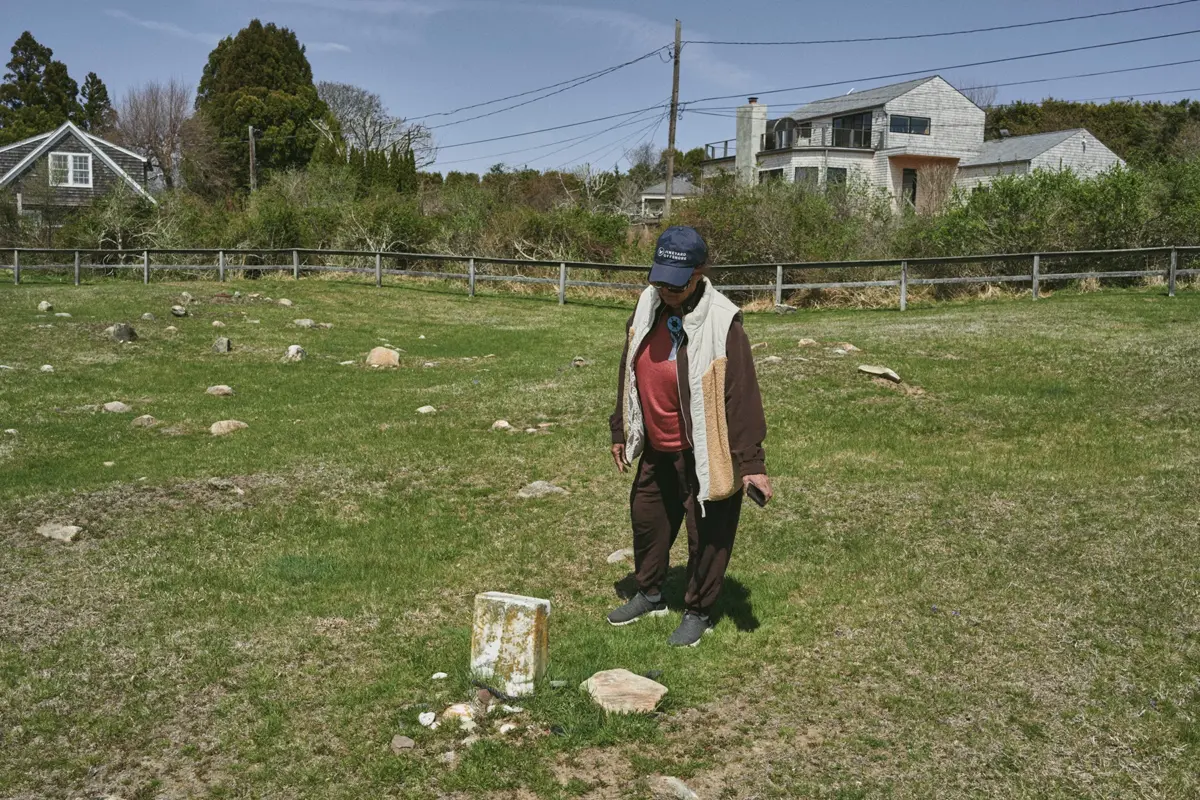
Tucked between modern suburban Long Island homes, a fenced, unassuming plot of grass appears ready for ordinary residential construction. Yet, a step beyond the perimeter reveals an entirely different reality: weathered, low-slaping slabs of stone, half-obscured by decades of leaf litter and systemic neglect, mark a centuries-old Indigenous family cemetery.
"When we started working here seven years ago, it was nothing but trees and trash — there were couches buried here, you name it," says Sandi Brewster-walker, an octogenarian Montaukett tribal historian who serves as the project’s tireless steward. As she walks the grounds, she bends down to retrieve a discarded beer bottle tossed over a residential fence. "People in the houses throw stuff over here, so it’s been quite a project."
For Brewster-walker, this lot is sacred ground. It is the final resting place of at least 80 members of her tribe, the Montaukett. Over the past decade, as executive director of the tribal revitalization efforts, she has made uncovering lost history and setting historical records straight a consuming obsession. Pointing toward the rear of the tract, she notes where authorities have gradually cleared dense brush to expose roughly 50 additional graves. "It’s probably more than that," she says with quiet authority. "I have all the names."
Through exhaustive public record searches, genealogical mapping, and relentless municipal lobbying, Brewster-walker has successfully convinced the town of Babylon to install remembrance plaques and maintain the grounds—actions already taken at other rehabilitated Montaukett burial sites.

While these local measures bring a measure of dignity, they represent only tiny steps toward redressing a massive, historic injustice. More than a century ago, the State of New York orchestrated a deliberate legal erasure of the Montauketts, systematically stripping them of ancestral lands and official existence. Despite continuous, overwhelming bipartisan support from the state legislature, consecutive governors have repeatedly blocked efforts to reinstate the tribe, prioritizing real estate and political convenience over fundamental human rights.
Detailed Chronology: A Century of Erasure and Resistance
From Flourishing Algonquian Nation to Dispossession
Long before Long Island was defined by expressway traffic, luxury estates, and high-end coastal tourism, it belonged entirely to the Algonquian-speaking Montauketts. Archaeological records show their ancestors arrived in the easternmost reaches of the region approximately 10,000 years ago. The surrounding seas provided an abundant supply of fish, shellfish, and marine life, while dense woodlands yielded wild game, materials for longhouses and wigwams, and timber for dugout canoes. These watercraft allowed the tribe to establish expansive trade networks and military alliances stretching deep into southern New England.
When European settlers arrived in the early 17th century, the Indigenous population was estimated at roughly 10,000. Within decades, however, introduced European diseases and intensified intertribal conflicts reduced that number to around 500.
As English settlers expanded their footprint, they relied on predatory land purchases and restrictive legal edicts. In his definitive historical study, The Montaukett Indians of Eastern Long Island, historian John A. Strong debunks the persistent myth that the tribe simply "vanished," revealing instead that the narrative was intentionally manufactured to clear the way for commercial expansion. While the Montauketts understood land deeds as reciprocal agreements for shared resource use, the English enforced them as permanent, absolute property transfers. By systematically bypassing local bands and coercing individual sachems to sign away massive tracts, settlers trapped the tribe in an inescapable web of debt and dependency.

The 1910 Legal Annihilation: Pharaoh v. Benson
As territorial holdings dwindled, surviving Montauketts frequently intermarried with freed Black residents and other marginalized groups. Deprived of traditional hunting and fishing rights, many found work as hardy mariners on Atlantic whaling ships sailing out of Sag Harbor.
When plans emerged to extend the Long Island Rail Road to the island’s eastern tip, a developer named Arthur W. Benson began snapping up massive tracts of land without tribal consent to build an exclusive summer resort. Families who refused to leave were forcibly relocated, and their homes were razed.
In 1896, Montaukett Chief Wyandanch Pharaoh filed a landmark lawsuit to reclaim tribal territory. However, the American legal system of the era was steeped in the philosophy that Native Americans would be "better off if they abandoned their traditional identity." State courts weaponized prevailing racial and eugenic stereotypes.
In the devastating 1910 ruling of Pharaoh v. Benson, New York State Supreme Court Judge Abel Blackmar declared that because the Montauketts had culturally assimilated and intermarried, their blood had "become so mixed that in many of them Indian traits were obliterated." In a single judicial stroke, the tribe was declared "extinct," stripping them of legal status, land rights, and eligibility for compensation. An appellate court upheld the verdict, even though the U.S. Department of the Interior continued to officially count the Montauketts in federal censuses until 1930.

The Eugenics Epicenter and the Rise of the Hamptons
The timing of the 1910 decision was no coincidence. Long Island served as the American epicenter of the eugenics movement—a pseudoscientific campaign aimed at "improving" genetic stock that would later heavily influence Nazi racial policies in Germany. That same year, the Eugenics Record Office was established in Cold Spring Harbor with the explicit goal of purifying the American hereditary ideal.
With the legal obstacles removed, state authorities and developers built the foundation for the East Hampton–Montauk corridor to become one of the wealthiest enclaves in the United States. In 1925, investor Carl G. Fisher purchased 10,000 acres of former Montaukett land for $2.5 million, envisioning "the Miami Beach of the North." He blasted channels to connect Lake Montauk to the sea, built luxury hotels, and laid the groundwork for a post-World War II boom that transformed the region into a playground where average home values now hover near $3 million.
Supporting Context & Metrics: The Modern Legislative Deadlock
Despite the clear historical record of dispossession, the modern struggle for state recognition has met an unyielding wall of executive resistance. To date, eight distinct bills aimed at officially recognizing the Montaukett Nation have passed both the New York State Assembly and Senate with overwhelming, veto-proof bipartisan majorities. Yet, every single measure has been struck down by Democratic governors: three times by Andrew Cuomo, and four times (and counting) by Kathy Hochul.
| Governor | Veto Count | Legislative Status | Stated Rationale |
|---|---|---|---|
| Andrew Cuomo | 3 Vetoes | Passed both houses unanimously | Administrative review / delaying tactics |
| Kathy Hochul | 4+ Vetoes | Passed both houses unanimously | "Outstanding questions" on traditional criteria & lineage |
Former Democratic state assemblyman Fred W. Thiele Jr., who sponsored multiple reinstatement bills during his tenure, does not mince words regarding the pattern of executive vetoes. He categorizes the 1910 judicial decision as "one of the most racist court decisions in the history of New York State jurisprudence," comparing it directly to federal shames like Dred Scott and Plessy v. Ferguson.

"There’s a wrong that needs to be corrected," Thiele argues, "and we shouldn’t be making them go back to square one to prove something that we already know is true—we should just be correcting that wrong."
The "Busy Work" Charade
The procedural indignity surrounding the vetoes has only compounded the historical trauma. Tribal leaders report working in exhaustive good faith with successive governors’ offices, supplying thousands of pages of genealogical records, historical analyses, and answers to exhaustive questionnaires. Yet, year after year, the pattern repeats: just around the winter holidays, when the legislative session is out of reach and lawmakers are unavailable to override a veto, an Albany phone call delivers the rejection.
"I was constantly told that the governor wanted to do it," Brewster-walker recalls of the November 2023 veto by Gov. Hochul, which was announced pointedly during Native American Heritage Month. "I thought we had come to some agreement, that we were gonna be recognized."
When another bipartisan bill reached the governor’s desk, Hochul’s team claimed in an email that they could not locate any of the extensive historical documentation submitted between 2017 and 2025, demanding a frantic resubmission just days before the signing window expired.

Underlying Motives: Land, Casinos, and Real Estate
Political observers and tribal advocates point to several underlying factors driving Albany’s reluctance:
- The Land Claims Fear: Although tribal leaders—including hereditary Chief Robert Pharaoh—have explicitly stated they have no intention of seizing private homes or filing disruptive land claims, state officials remain privately terrified that recognition could cloud real estate titles in the hyper-lucrative Hamptons market. "I don’t want to throw anybody out of their houses, and I’m not looking for any big pieces of land," Chief Pharaoh affirms. "The only thing I want is a piece of property big enough that I can put a museum or cultural research center on."
- The Casino and Gaming Market: With the state approving a lucrative quota of downstate commercial casinos (including major ventures in the Bronx and Queens) designed to generate billions in tax revenue for the Metropolitan Transportation Authority (MTA) and public education, powerful economic stakeholders are reportedly averse to introducing potential sovereign tribal gaming competition into the region.
- The Shinnecock Precedent: The ongoing struggles of the federally recognized Shinnecock Indian Nation—landed cousins of the Montauketts in eastern Long Island—serve as a stark warning. Despite federal recognition secured after a grueling 32-year battle, the Shinnecock have faced continuous state and local lawsuits, multi-million-dollar legal fees, and aggressive municipal blocks against commercial development, economic ventures, and highway digital billboards.
Official Statements and Institutional Responses
In response to inquiries regarding the repeated vetoes, representatives for the executive branch maintain that their decisions are guided by strict adherence to legal standards.
-
Ken Lovett, Spokesperson for Gov. Kathy Hochul:
"Gov. Hochul is committed to supporting and strengthening relationships with Indigenous peoples and Nations across New York State… She has worked hard to right some of the horrific wrongs inflicted in the past on Indigenous peoples and takes seriously the responsibility of determining whether to recognize a Native American tribe, which would be a sovereign nation. That includes ensuring any claims of tribal leadership can be substantiated."

Regarding the broader relationship with Long Island tribes, Lovett emphasized that the governor’s office takes the "economic development and other policy concerns of the Shinnecock Nation" seriously, adding that state actions are "guided by long-standing legal frameworks and the responsibility to apply the law fairly and consistently and with diligence and great care."
-
Fred W. Thiele Jr., Former State Assemblyman:
"It’s a wrong that needs to be corrected, and we shouldn’t be making them go back to square one to prove something that we already know is true."
-
Lance Gumbs, Vice Chairman of the Shinnecock Nation Council of Trustees:

"’We’ll work with you, we’ll work with you.’ You know how many years we’ve heard that? That never happens. It never comes to fruition… There has been this concerted effort by the town and the state to keep us subservient."
Future Outlook: Unbroken Persistence
Despite continuous political roadblocks, the Montaukett Nation refuses to fade into oblivion. Sandi Brewster-walker and tribal leaders are already preparing the next phases of their multi-pronged strategy.
If the current legislative package fails to secure executive approval, tribal advocates plan to introduce two aggressive legislative measures in the upcoming session: one for direct statutory reinstatement, and a second sweeping bill designed to strip absolute veto power from the governor’s office by establishing a formalized New York State Indian law framework that mandates legislative recognition of historically documented tribes. Furthermore, the tribe is actively preparing documentation to initiate the rigorous federal recognition process.
For Brewster-walker, who divides her time between exhaustive archival research, diner-booth planning sessions, and guiding visitors across sacred ancestral sites, the fight is much larger than politics—it is an existential defense of truth and identity.

"They think I’ll give up sooner or later," Brewster-walker says with a resilient smile. "Well, I’m not giving up—and I’m preparing other people behind me. Every time we get vetoed, we get stronger. This is a matter of justice, of right and wrong, and we’re not going to be erased."