In the fast-evolving landscape of modern agriculture and artisanal food culture, few phenomena rival the quiet, fervent renaissance of rare and heirloom fruit tasting. While mainstream commercial supermarkets remain dominated by a hyper-standardized duopoly of uniform, shelf-stable cultivars, a dedicated vanguard of pomologists, foragers, and adventurous snackers are plunging deep into the idiosyncratic world of non-standard apples. This burgeoning subculture—affectionately championed by the "Apple Snack Gang"—relies not on corporate metrics of uniformity and extended cold-storage longevity, but on an uncompromising, highly subjective exploration of flavor profiles, structural integrity, historical lineage, and sheer culinary audacity.
Following an initial wave of evaluations earlier in the season, our ongoing investigation into the current regional harvest reveals a chaotic, fascinating, and frequently unpredictable spectrum of pomological experiences. From high-spice oddities that evoke distant memories of traditional liqueurs to rock-hard, jaw-testing specimens tasting inexplicably of nostalgic chewing gum, the 2026 harvest offers a profound reminder that nature refuses to be neatly cataloged.
This report delivers a comprehensive, rigorous examination of seven distinct, eccentric apple varieties evaluated during this season’s harvest cycle. By analyzing structural texture, chemical composition, flavor complexity, and historical context, we aim to shed light on what makes these esoteric cultivars triumphs of agricultural heritage—or, in several unfortunate cases, cautionary tales of fruit left too long off the branch.
Detailed Chronology of the 2026 Harvest Evaluations
The systematic evaluation of this seasonal batch took place across multiple testing sessions, utilizing standardized human sensory assessment protocols (taste, tactile bite resistance, olfactory analysis, and post-consumption aftertaste tracking). Below is the granular breakdown of the varieties scrutinized during this phase of the investigation.
1. Kickapoo Spice
Initial Impression & Nomenclature: Evoking immediate cultural touchstones ranging from classic rock ballads to regional Americana, the Kickapoo Spice presents itself as a visually dense, unorthodox specimen.
Sensory Profile: Upon initial division, the apple revealed a heavy aromatic concentration of spice elements—specifically dominating notes of nutmeg, warm cinnamon, and sharp clove. Contrary to what its robust exterior might suggest, the flesh lacked optimal juiciness, presenting instead a somewhat dry, fibrous landscape.
Aftertaste & Ripening Dynamics: A lingering aftertaste reminiscent of freshly cut grass detracted slightly from the experience, suggesting a delicate window of post-harvest maturation that may have been missed.
Investigative Verdict: Apples remain notoriously fickle organisms; some improve gracefully in cold storage, while others begin an unceremonious descent into degradation the moment they sever from the branch. The Kickapoo Spice lands comfortably as an intriguing, complex mid-tier contender, earning a 6.9 out of 10.
2. St Edmunds Pippin
The Season’s Opening Salvo: Serving as the lead-in proper for the harvest season, the St Edmunds Pippin immediately established a high threshold for quality.
Tactile and Auditory Metrics: Featuring a skin texture reminiscent of a shark’s hide when stroked in reverse, the fruit compensated with an exceptionally satisfying acoustic and physical response upon biting—delivering a sharp, clean pop and crunch.
Flavor Complexity: Far from one-dimensional sweetness, the Pippin delivered a vibrant, herbal profile punctuated by distinct fennel pollen undertones, harmoniously balanced against a crisp, juicy, and sharp-breaking acidity.
Investigative Verdict: A masterclass in how a slightly unconventional, funky heirloom cultivar can achieve absolute culinary satisfaction through a superior tart-sugar equilibrium. Final score: 8.3 out of 10.
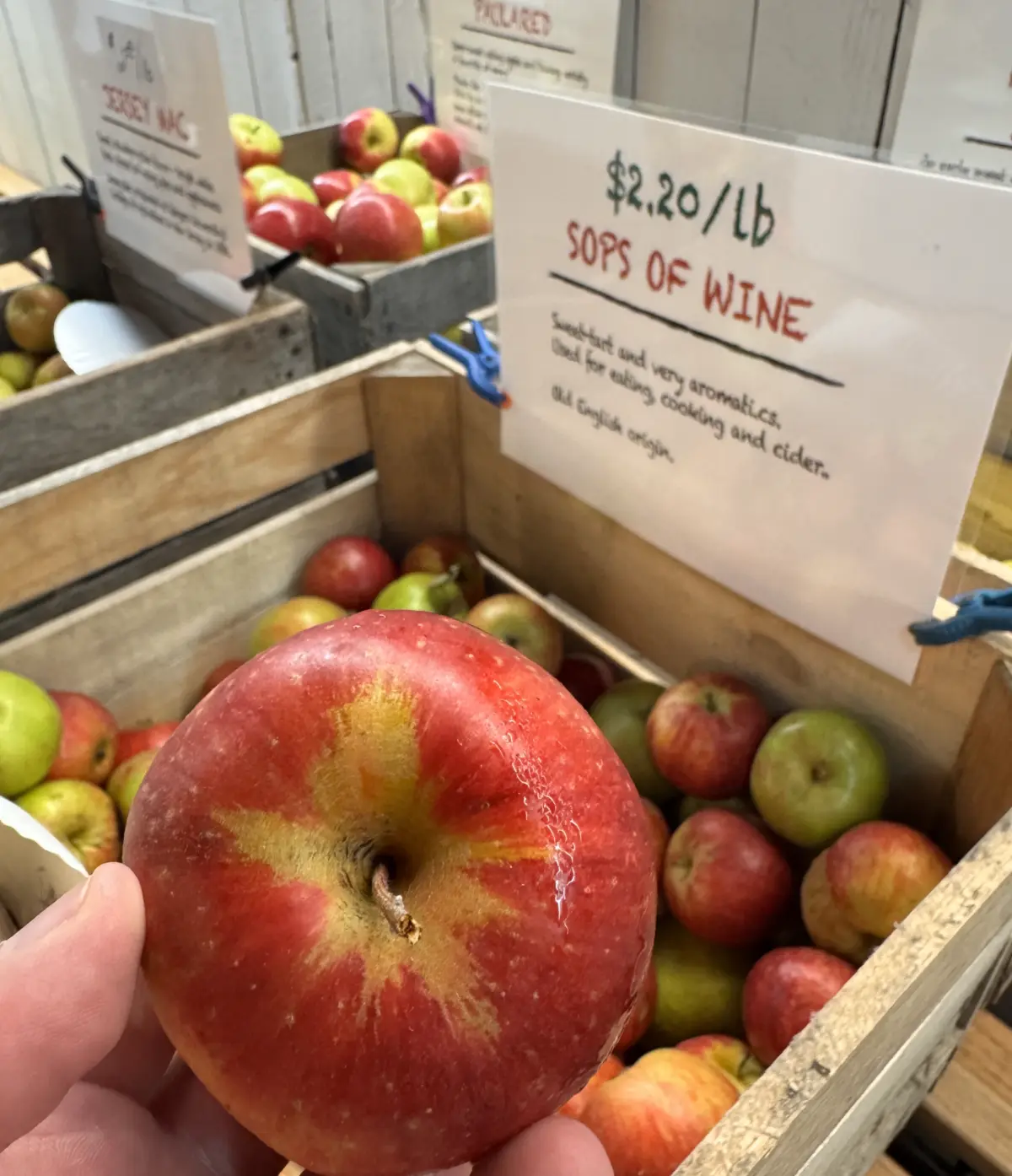
3. Sops of Wine
Subconscious Associations: Naming conventions within pomology often trigger vivid psychological responses. For the Sops of Wine, evaluators reported immediate, involuntary cognitive leaps toward cinematic antiquity—specifically, the rich baritone cadence of classical literary adaptations echoing "SOPS OF WINE" through the corridors of memory.
Texture vs. Flavor Disconnect: While the aromatic and flavor profiles offered pleasant, funky notes leaning gently toward subacid sweetness with subtle vanilla and spice undertones, the physical structure was severely compromised. The texture registered as distinctly mealy and gritty, indicating over-maturity or extended post-harvest shelf life.
Taxonomic Confusion: Pomological literature often describes true Sops of Wine as possessing red-fleshed interiors or white flesh laced with crimson streaks; however, the tested sample displayed no such chromatic anomalies. Furthermore, historical ambiguity surrounds whether "Sops of Wine" represents a single stable cultivar or an umbrella designation for a collection of archaic British and American apples.
Investigative Verdict: Plagued by poor textural integrity and identity crisis, this specimen struggled to justify its historic name, securing a disappointing 3.5 out of 10.
4. Fenceline Surprise
The Linguistic and Gustatory Irony: Pronounced with a faux-French cadence or straightforward agrarian dialect, the name promised intrigue; the reality, however, delivered profound disappointment.
Textural Failure: Described uniformly as a "bland mush," the fruit offered a fleeting, ghostly whisper of pear juice before collapsing entirely into a sensation akin to chewing beach sand.
Agrarian Forensics: Despite orchard signage classifying the cultivar as a "firm apple," the specimen exhibited all the biological markers of an overripe casualty—or a fruit left to rot slowly in cold storage long before reaching the consumer.
Investigative Verdict: A near-total structural failure rescued from a score of absolute zero solely by its pleasant nomenclature and initially deceptive visual presentation. Final score: 1.0 out of 10.
5. Americus Crab
Industrial and Heroic Imagery: Nominally evocative of a steampunk inventor or a silver-age comic book defender of the oceans ("America’s Crab"), this cultivar immediately commands attention in terms of branding.
Culinary Utility: As a true crabapple, the Americus Crab defies conventional out-of-hand consumption. It presents an aggressive matrix of high tannins, formidable structural toughness, and a confusing synthesis of savory and tart notes.
Investigative Verdict: Strictly designated for the adventurous hedonist willing to consume botanical anomalies unsuited for standard palates. Fun, but punishing. Score: 2.5 out of 10.
6. Campfield (False?)
Anomalous Labeling: Labeled ambiguously with the modifier "(false)," this cultivar provoked playful speculation regarding pomological deception before revealing its true utilitarian nature as a dedicated cider apple.
Physical Resistance: The flesh offered a chewy, callused resistance, releasing an overwhelming wave of tannins that created a sensory illusion of the apple consuming the consumer in real-time. Unsuited for the unmodified human tongue prior to industrial or artisanal fermentation.
Investigative Verdict: A middling direct-consumption score of 4.1 out of 10, though its historical pedigree carries immense weight.
7. Graham
Structural Fortitude: So dense and impenetrable that evaluators questioned its botanical classification, the Graham required extreme mastication effort, breaking apart with the catastrophic abruptness of a calving glacier.
The Flavor Miracle: Despite the structural hazards—and potential threats to jaw alignment—breaching the exterior unlocked an explosion of flavor defying all logical expectation: unmistakable, unadulterated, mainstream Juicy Fruit chewing gum.
Investigative Verdict: An astonishing sensory pivot that nearly overcomes the immense physical exertion required to consume it. Final score: 8.0 out of 10.
Supporting Context & Historical Metrics
Apples are not merely agricultural commodities; they are living testaments to human migration, colonial history, and botanical serendipity. The evaluation of heritage varieties requires looking backward through centuries of arboriculture.
Take, for instance, the historical lineage tied to the Campfield apple. Archival records trace its roots directly to Matthew Canfield (alternately spelled Campfield), an anti-royalist Puritan who fled Harleston, England, during the Great Puritan Migration prior to 1637. Serving as a founding father of New Haven, Norwalk, and Newark—where he is entombed beneath City Hall—Canfield’s legacy is inextricably bound to the legal requirements placed on early American "freeholders." To secure voting rights and municipal land allocations, colonial law mandated the cultivation of four-acre tracts, three of which were frequently dedicated to fruit orchards destined for hard cider production.
Variety Name
Primary Flavor Profile
Texture Rating (1-10)
Historical / Cultural Note
Overall Score
Kickapoo Spice
Nutmeg, Cinnamon, Cut Grass
5.5
High spice component; requires precise storage.
6.9
St Edmunds Pippin
Fennel Pollen, Herbal, Sweet-Tart
8.5
Premier opening-season fruit with exceptional crunch.
8.3
Sops of Wine
Vanilla, Subacid, Mealy
3.0
Evokes cinematic literary memories; high identity confusion.
3.5
Fenceline Surprise
Faint Pear, Sandy Mush
1.0
Misleadingly labeled as "firm"; severe textural collapse.
Linked to 17th-century Puritan settler Matthew Canfield.
4.1
Graham
Unmistakable Juicy Fruit Gum
9.0
Extreme structural density yielding bizarrely nostalgic flavor.
8.0
Official Statements and Expert Perspectives
The methodology employed by contemporary independent pomological reviewers stresses that the evaluation of heirloom fruit cannot be standardized by industrial metrics. Industry bodies and agricultural historians increasingly recognize that consumer perception of fruit quality has been artificially narrowed by decades of grocery store consolidation.
"Apples are weird like that," notes lead investigative field taster and commentator. "Some improve off the tree, while others begin their descent to crap-town the moment they drop. You cannot judge a wild, historical, or foraged heirloom by the metrics you apply to a mass-produced Red Delicious."
Historians specializing in New England and Mid-Atlantic colonial agriculture emphasize that varieties like the Campfield were never intended for fresh market snacking. Their high tannin concentrations and structural astringency were evolutionary and agricultural adaptations designed specifically to optimize the chemistry of colonial cider presses—the primary potable hydration source of early American settlements.
Future Outlook
As the 2026 harvest cycle progresses, the investigative focus of the pomological community pivots northward and eastward. With upcoming expeditions scheduled across New York, New England, and the Canadian provinces, the hunt for undiscovered heirloom specimens intensifies.
Regional orchards in these historic fruit-growing corridors are expected to yield further anomalies as cooler autumn temperatures alter sugar-to-acid ratios in late-season hanging fruit. Consumers, foragers, and Apple Snack Gang affiliates are advised to monitor regional appearance schedules, audit local heritage orchards, and prepare their jaws for the structural rigors of the next generation of eccentric pomological discoveries. The unmapped frontier of apple tasting remains wide open—and remarkably crunchy.