In the realm of modern front-end engineering, when developers are tasked with crafting an interface that feels physically responsive, bouncy, or malleable, the default industry instinct is almost invariably to reach for a physics engine. Frameworks such as Matter.js, Cannon.js, or complex custom WebGL integrations have long stood as the gold standard for breathing simulated life into digital canvases. These tools offer robust, mathematically sound approximations of real-world physics, allowing objects to gravity-drop, bounce, and collide based on mass, velocity, and friction.
However, a fundamental tension often arises between algorithmic simulation and high-end art direction: physics engines produce plausible motion, whereas animators produce intentional motion.
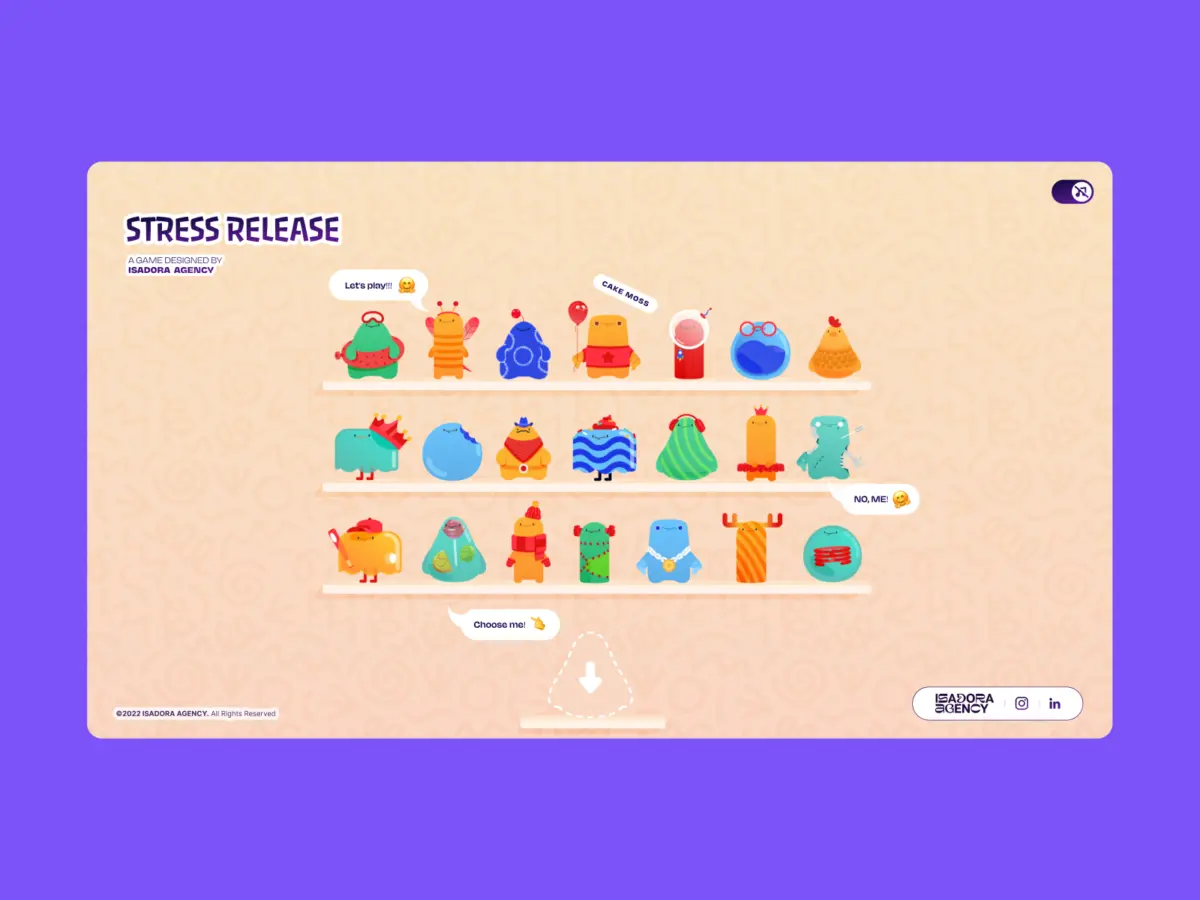
When the creative team at Isadora Agency set out to develop Stress Release—a browser-based digital stress-relief toy designed to let burnt-out professionals smash, stretch, and distort animated UI characters—they initially walked down the conventional physics route. The core objective was clear: construct a deeply tactile environment where every click yields a satisfying, squishy reaction. Yet, as prototyping commenced, the engineering team realized that standard physics engines were actively working against the meticulous design language created by their animators.
Rather than allowing characters to behave like unpredictable rubber balls bouncing haphazardly across a coordinate plane, the project demanded absolute, deterministic control over frame-by-frame sequences. To solve this, Isadora Agency discarded physics engines entirely. Instead, they relied on an elegant synthesis of programmatic Lottie state controls, native DOM manipulation, and distance-based mathematics. This architectural choice ensured that the engineering layer acted as a precise, faithful servant to the art direction, preserving every nuance of the designers’ intended motion without a single line of WebGL or Matter.js.
Detailed Chronology: From Physics Simulation to Intentional Motion
The development of Stress Release progressed through distinct technical phases, marked by a critical paradigm shift in how the engineering team approached interactivity and animation state management.
Phase 1: The Fallacy of Automated Physics
At the onset of the project, the development roadmap assumed a standard gamified web stack. The team mapped out user interactions relying on rigid-body simulations to handle character deformation. The logic seemed sound: if a user clicks a character, calculate a force vector, apply an impulse, and let the physics engine determine the visual aftermath.
However, this approach immediately collided with the creative requirements of the design team. The animators had meticulously crafted bespoke vector assets using JSON-based Lottie files, featuring complex, hand-drawn squash-and-stretch frames. For instance, a signature "mega squeeze" reaction required a precise 181-frame build-up phase characterized by specific aesthetic tension, followed by an exact release sequence. Algorithmic physics frameworks could not guarantee this level of deterministic frame-by-frame precision; they approximated collisions dynamically, often overriding the carefully timed keyframes that gave the characters their distinct personalities.
Phase 2: Scraping the Engine and Rethinking the DOM
Recognizing that simulation was diluting artistic intent, the team made the bold decision to strip out external physics libraries entirely. They pivoted toward a DOM-centric architecture powered by Lottie’s native runtime API. By rendering Lottie animations as internal SVGs directly within the Document Object Model, the engineers gained the ability to target elements via standard CSS classes and IDs.
This pivot shifted the burden of interaction from heavy computational physics calculations to lightweight, mathematically precise event mapping. Instead of asking a physics engine where an object should deform, the team decided to calculate the exact distance of a user’s click relative to a character’s center point, using that single metric to drive scoring systems, visual feedback intensity, and procedural particle positioning.
Phase 3: Implementing Radial Input Mapping
To achieve the tactile sensation of physically striking a character, Isadora Agency engineered a radial input mapping system. When a user clicks or taps the interface, the application translates page coordinates into the character’s local coordinate space.
By measuring the straight-line distance from the center point of the character using the Pythagorean theorem (Math.hypot), the system establishes a concentric zone framework—resembling a traditional dartboard. This distance metric single-handedly dictates three critical gameplay elements:
The Score: Bullseyes yield maximum points, while peripheral clicks scale down reward values.
Feedback Intensity: The severity of the visual reaction matches the proximity of the impact.
Explosion Placement: A secondary Lottie animation representing a visual impact effect is dynamically repositioned via CSS margins to the exact (x, y) coordinates of the click.
Phase 4: Programmatic State Management and Animation Segments
With spatial interaction resolved, the team needed a way to control the character’s narrative states without breaking the animation timeline. Rather than letting animations loop indefinitely or trigger arbitrarily, the characters were mapped into structured frame ranges representing idle states, light reactions, medium reactions, and heavy reactions.
When a user interacts with a character, the application halts the current animation segment immediately (playChar.stop()), disables looping, and forces the Lottie runtime to jump directly to the target frame range corresponding to the current game state (playChar.playSegments(playNow, true)). Once the segment completes, an onComplete callback gracefully returns the character to its looping idle state. This handshake between DOM events and Lottie timelines ensures zero visual stutter and absolute fidelity to the original design assets.
Supporting Context & Metrics: Performance, Responsiveness, and Optimization
While abandoning heavy physics engines drastically simplified interaction logic, it introduced a new engineering hurdle: asset payload and runtime performance.
The Lottie Performance Equation
Lottie JSON files, while unparalleled for vector fidelity, can quickly become bloated when scaled across multiple concurrent assets. Stress Release features 21 distinct character animations, alongside various explosion overlays and UI indicators. Rendering multiple complex vector animations simultaneously on mobile devices poses severe thread-blocking risks.
To combat this, Isadora Agency deployed aggressive optimization strategies depending on the active application view:
The Shelf View (Multi-Asset Optimization): When displaying all 21 characters simultaneously on the selection screen, the team instantiated Lottie players with reduced rendering quality (lottie.setQuality(0.5)) to cut down heavy interpolation calculations. Furthermore, animation speeds were slightly throttled (shelf.setSpeed(0.6)) to minimize the number of frame calculations required per second.
The Play View (Single-Asset Focus): Once a user selects a character and enters the primary interaction screen, all background noise is stripped away. The active character is loaded at full fidelity (lottie.setQuality(1)), ensuring buttery-smooth 60fps vector manipulation during high-intensity clicking sprees.
Seamless Responsiveness via CSS Custom Properties
Another major advantage of bypassing WebGL canvas renderers in favor of standard DOM elements was native responsive handling. Scaling bounding boxes and custom collision vectors across fragmented mobile and desktop viewports is notoriously painful in canvas-based environments.
By anchoring the experience within the DOM, the team utilized dynamic CSS custom properties (--doc-height and --doc-width) calculated via JavaScript on viewport resize events. As the screen dimensions shift, the layout naturally adjusts via CSS, allowing the Lottie SVGs to scale fluidly inside their containers without losing their spatial states or breaking alignment with hit-detection zones.
Official Statements & Industry Perspective
Reflecting on the philosophical underpinnings of the project, front-end architects at Isadora Agency emphasize that technological choices must always flow downstream from design requirements rather than dictating them.
"When tasked with building a highly interactive, tactile web experience, the architecture must serve the art direction," notes lead developer Alexey Kopytin. "By mapping Lottie’s native timeline capabilities directly to the DOM, developers can deliver incredibly rich, tactile user experiences while maintaining absolute, uncompromised control over the artistic vision."
In an industry increasingly oversaturated with out-of-the-box physics libraries and generic WebGL boilerplates, the Stress Release project serves as a timely reminder that simpler, math-driven DOM solutions often yield superior results when artistic intentionality is paramount. When every keyframe matters, algorithmic approximations take a backseat to precise programmatic control.
Future Outlook: The Evolution of Tactile Web Experiences
As web technologies continue to mature, the boundary between passive viewing and active, tactile digital engagement grows increasingly blurred. Projects like Stress Release point toward a sophisticated future for UI/UX design—one where digital interfaces cease to feel like flat sheets of glass and instead mimic the responsive, satisfying feedback loops of physical objects.
Looking ahead, the methodologies pioneered by Isadora Agency open up exciting possibilities for gamified marketing, mental health applications, and interactive storytelling on the web. By proving that developers do not need heavy physics simulations to evoke physical sensation, this architectural blueprint empowers future engineering teams to collaborate more closely with animators.
As browser performance improves and vector rendering engines become even more optimized, the combination of lightweight DOM manipulation, precise coordinate math, and programmatic animation state control will undoubtedly become a premier design pattern for immersive, art-driven web applications.