

Executive Overview
KABUL, Afghanistan — In the pre-dawn stillness of a Sunday morning in March 2012, the remote farming district of Panjwai in Kandahar province—long recognized as the ideological birthplace of the Taliban—became the site of an unspeakable tragedy. While families slept inside their mud-brick homes, believing they had finally found a measure of safety in a war-torn land, a rogue U.S. service member slipped away from his forward operating base. Armed and acting alone, according to military investigators, the infantry soldier embarked on a pre-dawn rampage that left 16 Afghan civilians dead, including nine children and three women. Many of the victims were found in their beds, bearing close-range bullet wounds; others had been dragged or mutilated, their bodies later gathered in heartbreaking clusters in the backs of flatbed pickup trucks.
The massacre sent immediate shockwaves through the local community, the Afghan government, and the highest corridors of Washington, D.C. It instantly ignited simmering anti-American sentiments, severely strained the fragile bilateral partnership between the international coalition and the Kabul administration, and raised profound questions about the psychological toll of prolonged counterinsurgency warfare. While the Taliban vowed swift and bloody revenge, the immediate response from the grief-stricken villagers of Panjwai was a mix of paralyzed disbelief and searing rage.
As investigators picked through blood-spattered walls and gathered spent shell casings, new and troubling details emerged regarding the suspect: a decorated Army staff sergeant with a history of multiple combat tours in Iraq and a documented traumatic brain injury (TBI). Despite official assertions by the International Security Assistance Force (ISAF) that the shooter acted entirely alone, local residents remained deeply skeptical, convinced that such devastation could not have been wrought by a single man. The incident ultimately triggered intense diplomatic friction over jurisdiction and accountability, highlighting the deep chasm between foreign military protocols and the desperate thirst for localized justice among the Afghan people.
Detailed Chronology: The Horrors of Panjwai
The sequence of events unfolded in the dark hours before dawn on Sunday, cutting deep into the heart of two neighboring villages in the Panjwai district. Months prior, many of these families had returned to their ancestral lands after assurances from nearby U.S. military personnel that the area had been sufficiently cleared of insurgents and was safe for resettlement. Residents recalled being told by coalition forces that they could come home, reclaim their property, and live unmolested.
That fragile illusion of security was shattered violently. According to surviving family members and local accounts, a U.S. soldier departed his base in western Kandahar under the cover of darkness, bypassed security perimeters, and entered civilian residential compounds.
The carnage was methodical and devastating. In one home, a mother recounted the terror of the intrusion: “One guy came in and pulled a boy from his sleep and he shot him in this doorway. Then they came back inside the room and put a gun in the mouth of one child and stomped on another child.”
By the time the sun began to rise, 16 human lives had been extinguished. The dead included infants and toddlers whose tiny bodies bore the horrific signatures of close-range violence. In the back of a local pickup truck, a dead toddler with a bloodstained face rested between two fallen men. In an adjacent vehicle, a pulled-back blanket revealed the charred legs and feet of additional victims—members of a single extended family that local religious leaders confirmed had lost 11 souls in a matter of hours.
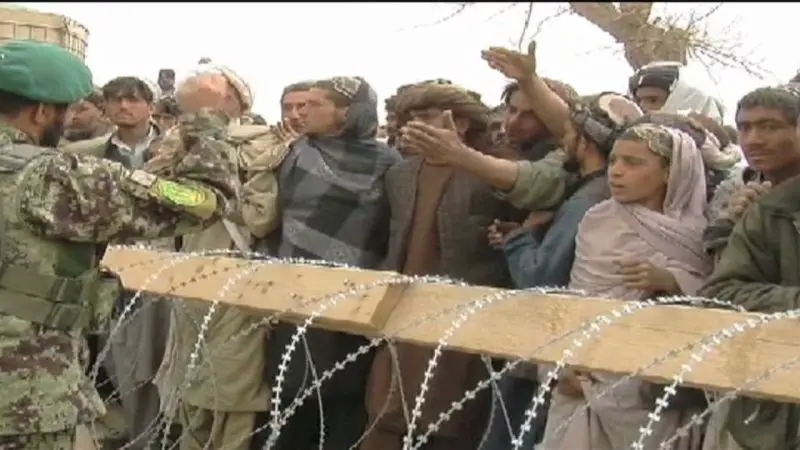
As morning broke, the villages transformed from quiet farming hamlets into scenes of profound mourning and forensic investigation. Grieving men sat against tree trunks with their heads buried in their knees, weeping openly. Women voiced their heartbreak and fury to visiting journalists, holding up the tiny victims to challenge the narrative of the war. “Four girls and four boys. They are 2-year-olds. Are these Talibs?” one mother demanded, her voice cutting through the despair of the crowd.
By midday, while investigators meticulously combed through blood-stained floors and collected spent cartridge casings, the grieving families turned their focus to the grim task of burying their dead, even as the shadow of insurgent threats loomed overhead.
Supporting Context & Metrics: The Profile of the Accused and the Anatomy of a War
As the international community grappled with the scale of the massacre, attention quickly shifted to the perpetrator and the institutional frameworks that allowed him to slip into the dark.
On Monday, Department of Defense officials revealed critical background information concerning the suspect, identified as an Army staff sergeant assigned to a base in Kandahar province. Military records indicated that the soldier was a highly trained infantry sniper, qualified to deliver lethal fire at distances of up to 800 meters. However, it was his combat history that drew immediate scrutiny from mental health experts and military analysts alike.
The sergeant was serving his fourth combat deployment—having completed three grueling tours of duty in Iraq prior to his deployment to Afghanistan. During his time in Iraq in 2010, he had suffered a traumatic brain injury (TBI) resulting from a severe vehicle accident. TBI, often referred to as the "signature wound" of the post-9/11 wars, is widely known to cause cognitive deficits, impulse control issues, emotional instability, and behavioral changes. Following medical treatment and subsequent evaluation, the soldier had been cleared by military medical boards to return to active duty status, leading to his eventual assignment in Afghanistan.
The incident also exposed the profound vulnerability of the local population in Panjwai. While the district had historically served as a primary stronghold and the spiritual birthplace of the Taliban, local residents emphasized that they had experienced a period of relative calm. One female resident testified that she had not encountered a single Taliban fighter in the five months leading up to the attack. Families had trusted the explicit safety guarantees provided by the U.S. military base, only to find themselves defenseless against a threat that originated not from the hills, but from the very coalition forces stationed to protect them.
Official Statements and Diplomatic Fallout
The immediate aftermath of the Panjwai massacre triggered an intense diplomatic crisis, forcing senior political and military leadership into immediate damage-control mode.
President Barack Obama and other high-ranking U.S. officials swiftly issued formal statements expressing deep sorrow, shock, and condolences to the families of the victims and the Afghan nation. President Obama characterized the incident as tragic and appalling, emphasizing that it did not reflect the core values of the United States military or the dedication of the hundreds of thousands of service members who had served honorably in the region.
However, these diplomatic reassurances carried little weight on the ground in Kandahar, where grieving relatives and community elders struggled to comprehend the scale of the atrocity. The anger was further exacerbated by conflicting accounts of how the operation was conducted. While distraught villagers insisted that multiple shooters must have been involved to inflict such widespread casualties across different homes, the International Security Assistance Force (ISAF) firmly maintained its operational assessment: the killings were the result of a single, lone actor who had walked away from his outpost unobserved.
The tension soon escalated into a fierce jurisdictional battle. Infuriated Afghan lawmakers and tribal leaders demanded that the accused soldier face a public, transparent trial on Afghan soil, administered through the local judicial system. This demand struck at the heart of longstanding sovereignty disputes regarding foreign military operations within Afghanistan.
The Pentagon, however, moved quickly to shut down any prospect of local prosecution. Pentagon Press Secretary George Little explicitly stated that the soldier had never been in the custody of Afghan security forces and would not face trial under Afghan law.
“The soldier was never in the custody of Afghan forces and will not face punishment under the Afghan justice system,” Little declared during a press briefing. “The U.S. military has strong means to address wrongdoing. There is an agreement in place with the government of Afghanistan, so that the investigation—and when appropriate, prosecution—will be done through U.S. military channels.”
This assertion of exclusive U.S. jurisdiction deepened the alienation felt by local leaders, who argued that accountability could not be truly served behind closed military courtroom doors thousands of miles away from the villages where the blood had been spilled.
Future Outlook: The Long-Term Impact on the War and Alliance
The Panjwai massacre stands as a profound watershed moment in the history of the post-9/11 war in Afghanistan, casting a long and darkening shadow over the remainder of the international military mission. Beyond the immediate human toll—the destruction of families, the orphaned children, and the desecration of peaceful homes—the incident fundamentally altered the psychological and political landscape of the coalition’s presence.
For the Afghan public, the shooting eroded the remaining reservoirs of trust in foreign forces, transforming perceptions of the mission from one of liberation and security to one of unpredictable peril. Although the Taliban capitalized on the tragedy by issuing vociferous threats of revenge, the more immediate threat to the coalition lay in the sudden spike of "green-on-blue" insider attacks and generalized hostility that would plague the remaining years of the NATO campaign.
For the U.S. military establishment, the tragedy forced an agonizing internal reckoning regarding force readiness, mental health screening protocols, and the cumulative psychological strain placed on combat veterans deployed across multiple consecutive tours. The failure to detect the severe mental degradation of a sniper trained in lethal combat before he turned his weapon on sleeping children exposed critical vulnerabilities in military medical and command oversight.
Ultimately, the events of that March morning in Panjwai accelerated plans for the eventual drawdown of international combat forces. It served as a grim reminder of the high human costs of a protracted insurgency—costs borne most heavily by innocent civilians caught between the machinery of modern war and the enduring grief of broken homes.