

Executive Overview
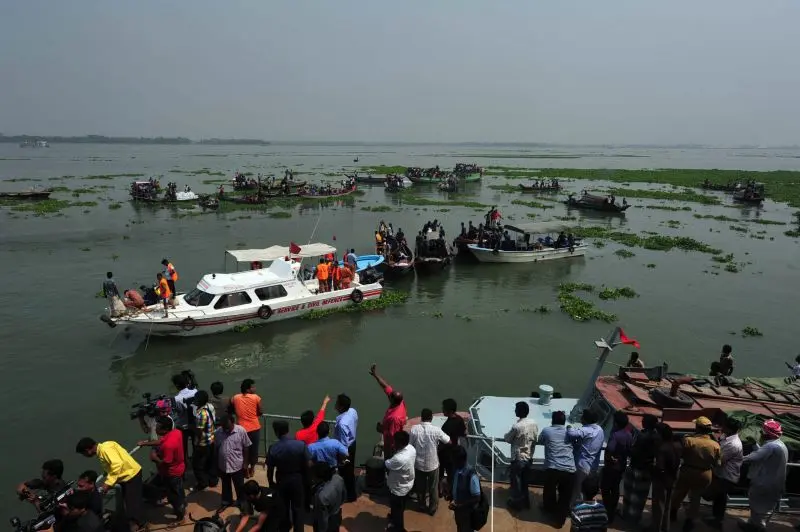
DHAKA, Bangladesh — In the murky, turbulent depths of the Meghna River, rescue divers and emergency personnel pressed forward with harrowing recovery operations Tuesday, following one of the deadliest maritime disasters to strike South Asia in recent years. The passenger ferry MV Shariatpur-1, carrying an estimated 250 passengers, went down in the dead of night after a violent collision with a cargo vessel in Bangladesh’s central Munshiganj district.
With the official death toll climbing to at least 32 and more than 60 individuals still unaccounted for, grief-stricken families have converged on riverbanks, desperately hoping for news of their loved ones. Local authorities warn that the casualty numbers are likely to rise as specialized dive teams attempt to breach the wreckage—located more than 20 meters (70 feet) beneath the surface—where numerous bodies are believed to be trapped.
The disaster has once again thrust the perilous state of domestic water transport in Bangladesh into the global spotlight. Despite dense river networks serving as the lifeblood of the nation’s economy, lax enforcement of safety regulations, chronic vessel overcrowding, and poor navigational protocols continue to transform routine commutes into horrific loss-of-life events.
Detailed Chronology of the Disaster
The catastrophe unfolded in the pre-dawn hours of Tuesday, catching hundreds of passengers fast asleep in their cabins and on open decks. The MV Shariatpur-1 was making its regular overnight transit from the southern Shariatpur district toward the bustling capital city of Dhaka.
Roughly 40 kilometers (25 miles) south of Dhaka, in the murky waters of the Meghna River within the Munshiganj district, the passenger liner crossed paths with an oncoming cargo ferry. According to preliminary police findings and survivor testimonies, visibility was low, and the collision occurred with devastating impact. The heavy cargo vessel tore into the side of the passenger ferry, breaching its hull and causing the vessel to capsize rapidly.
Mohammad Dulal Dewan, a 55-year-old survivor who was traveling in a shared cabin with seven family members, recounted the terrifying speed with which the disaster struck.
"We were seven in a cabin in the ferry, and six of my family members are still missing," Dewan told CNN, fighting back tears. "Everything happened before I could understand anything."
Disoriented and thrust into the dark, frigid waters as the cabin flooded, Dewan managed to break free and swim to the surface.
"I jumped into the river and was rescued by people in another passing ferry," he recalled.
Dewan’s harrowing journey was meant to be a joyous family occasion. He and his relatives were traveling to Dhaka to see his brother-in-law, Shamim Fakir, off on an international flight to the United States, which had been scheduled for early Wednesday morning. By Tuesday evening, Fakir remained missing, exemplifying the agonizing limbo facing dozens of families along the riverbanks.
Emergency Response and Recovery Operations
As day broke, local villagers and fishermen were first on the scene, pulling approximately 30 survivors from the water before formal emergency services could arrive. By mid-morning, a multi-agency state response was mobilized, involving the Bangladesh Navy, the Fire Service and Civil Defence, local police units, and the Bangladesh Inland Water Transport Authority (BIWTA).
Khandker Shamsuddoha Khandaker, chairman of the BIWTA, confirmed to reporters that sonar and tracking equipment had successfully located the sunken hull of the MV Shariatpur-1 resting on the riverbed at a depth of 70 feet.
Munshiganj Police Chief Shahabuddin Khan detailed the complex nature of the ongoing salvage operation, emphasizing the severe challenges posed by river currents and zero visibility at depth.
"We believe many bodies are still trapped inside the sunken ferry, and the rescue operation is still on," Khan stated.
Families of the missing have set up an informal registry station along the shore, working alongside civil administrators. Mohammad Azizul Alam, the administrative chief of Munshiganj district, reported that officials had compiled a preliminary roster of 61 missing persons based on accounts provided by frantic relatives. Because passenger manifests on these rural routes are rarely accurate or kept up to date, authorities fear the true number of missing and dead may significantly exceed official estimates.
Supporting Context & Metrics: A History of Tragedy
The sinking of the MV Shariatpur-1 is far from an isolated incident. Bangladesh is a delta nation crisscrossed by hundreds of rivers, making water transport essential for millions of citizens who rely on ferries to travel between rural districts and urban centers like Dhaka. However, this heavy reliance on riverine transit is counterbalanced by a devastating safety record.
Historical data paints a grim picture of maritime safety in the region:
- High Annual Toll: Hundreds of people perish in Bangladeshi ferry accidents every year.
- Historical Loss of Life: Industry estimates suggest that nearly 4,000 individuals have lost their lives in domestic ferry mishaps since 1977.
- Systemic Failures: Investigations into past disasters consistently point to systemic negligence, including chronic overloading, operations during severe weather or low-visibility conditions, a lack of basic safety gear such as life jackets, and a widespread disregard for maritime traffic rules by commercial operators.
Critics and safety advocates argue that despite repeated promises of regulatory reform from successive governments, enforcement remains notoriously lax. Unregistered vessels, uncertified modifications, and rampant corruption within licensing bodies continue to place profit above human lives.
Official Statements and Accountability
In the wake of the disaster, public outrage has mounted, prompting calls for strict accountability and systemic overhauls of the nation’s transport sector.
Transport ministry officials have announced that an independent investigative committee will be formed to determine the exact sequence of events that led to the collision, specifically examining whether the cargo vessel was operating without proper navigational lights or if speed and operator negligence played a role on the part of either ship.
Prime Minister and senior government ministers have expressed deep condolences to the families of the victims, promising financial assistance for the families of the deceased and comprehensive support for ongoing search operations. However, for families like that of Mohammad Dulal Dewan—who spent Tuesday evening scanning the grey waters of the Meghna River in search of six family members—official statements offer little immediate comfort.
Future Outlook: Can Bangladesh Make Its Waters Safe?
As the immediate recovery phase transitions into identification and mourning, the broader conversation in Bangladesh must pivot toward preventative reform. International maritime safety experts have long urged Dhaka to implement stringent modernization policies for its domestic fleet. Key recommendations include:
- Mandatory Passenger Ticketing: Enforcing digital or physical ticketing systems to ensure accurate manifests are maintained for every voyage.
- Vessel Modernization: Phasing out antiquated, top-heavy wooden and steel-plate ferries in favor of stable, compartmented designs that resist rapid capsizing.
- Rigorous Licensing and Penalties: Implementing zero-tolerance policies for operators who overload vessels, sail without proper radar or lighting equipment, or employ untrained crews.
- Radar and Traffic Separation: Establishing designated shipping lanes and active radar monitoring on high-density river junctions to prevent collisions between large cargo carriers and passenger ferries.
Until such structural reforms are rigorously enforced, the rivers of Bangladesh will remain shadowed by the constant threat of disaster. For now, the nation watches the murky currents of the Meghna River, mourning the lives lost in the dark and praying for closure for the families left behind.