

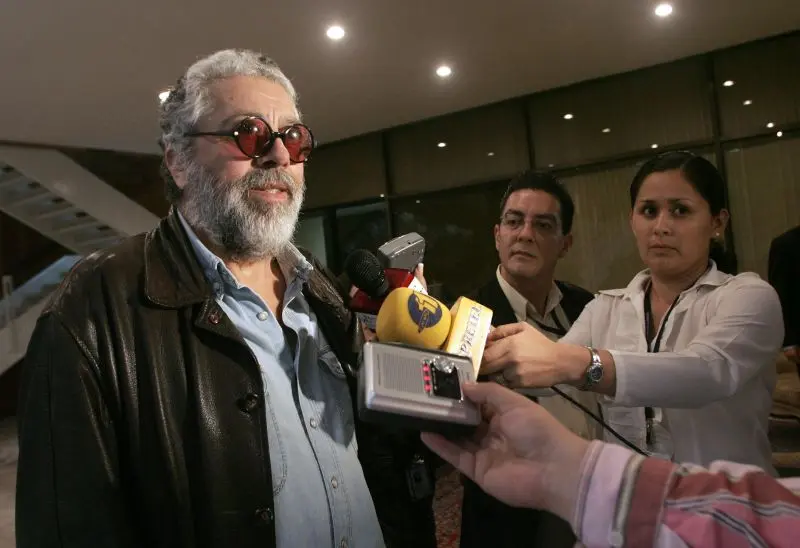
International law enforcement has achieved a major breakthrough in one of Latin America’s most high-profile modern criminal investigations. Colombian authorities successfully apprehended Alejandro Jimenez, alias "Palidejo," a fugitive accused of masterminding the brazen July 2011 assassination of beloved Argentine folk singer Facundo Cabral. Jimenez was captured while attempting to enter Colombia aboard a maritime vessel, marking a decisive victory for cross-border police cooperation.
Cabral, a revered troubadour widely celebrated across the Spanish-speaking world as a "messenger of peace," was killed in a hail of gunfire when armed assailants ambushed his vehicle in Guatemala City. Investigators believe that Cabral was merely an innocent casualty caught in the crossfire—a tragic case of being in the wrong place at the wrong time. The intended target of the assassination plot was reportedly Nicaraguan concert promoter Henry Fariñas, who was traveling with Cabral at the time of the attack.
The arrest of Jimenez has triggered a complex web of legal, diplomatic, and logistical maneuvers across multiple nations. Following his apprehension in Colombia, an extradition flight transporting Jimenez toward Guatemala was abruptly forced to turn back mid-journey. The reversal occurred after Costa Rican authorities intervened, seeking firm diplomatic guarantees that the suspect would be spared the death penalty. As extradition disputes and jurisdictional battles play out, Jimenez remains in the custody of Colombian law enforcement, bringing renewed focus to the intricate criminal networks operating across Central and South America.
Detailed Chronology: From Tragic Ambush to International Manhunt
The Fatal Morning in Guatemala City (July 2011)
The sequence of events that shocked the Latin American cultural landscape began on a fateful morning in July 2011 in Guatemala City. Facundo Cabral, then 74 years old, had just concluded a series of performances in Guatemala and was heading to the La Aurora International Airport. He was riding in a vehicle driven by Nicaraguan promoter Henry Fariñas, accompanied by local security personnel.
As they traveled along the Boulevard Liberación, a major thoroughfare in the Guatemalan capital, a convoy of armed vehicles intercepted them. The gunmen unleashed a barrage of high-caliber rounds into the car, instantly killing Cabral. Fariñas sustained severe injuries but survived the attack.
The murder immediately reverberated across the globe. Governments throughout the region condemned the violence, and both Argentina and Guatemala declared three days of national mourning to honor a man whose music and philosophy had touched millions of lives.
The Investigation and the Identification of "Palidejo"
In the wake of the shooting, Guatemalan investigators, working in tandem with international agencies including Interpol, launched an exhaustive probe. Piecing together ballistic evidence, eyewitness testimonies, and communications intercepts, authorities quickly realized that the attack was meticulously planned.
Investigators concluded that the assassination was not a random act of street crime, but rather a targeted hit orchestrated by organized crime elements. Focus zeroed in on Alejandro Jimenez, a Costa Rican businessman and alleged drug trafficking operative. Authorities alleged that Jimenez bore a personal and financial grievance against Henry Fariñas, stemming from a dispute over business dealings and regional narcotics trafficking operations.
As the net tightened around Jimenez, he fled Costa Rica, sparking a multi-country international manhunt. For months, intelligence agencies tracked his digital footprint and shadowy movements across Central and South America, as he utilized false identities and trusted associates to evade capture.
The Maritime Capture and Extradition Turbulence
The months-long evasion came to an abrupt halt when Colombian authorities received intelligence regarding Jimenez’s movements. Operating along the nation’s coastal waters, law enforcement intercepted and boarded a vessel, positively identifying and arresting the fugitive.
Costa Rican Attorney General Jorge Chavarría publicly lauded the operation during an interview with Radio Reloj, emphasizing the efficacy of multinational policing. "We are very pleased with the news, because it confirms that international cooperation delivers results," Chavarría stated.
However, the path to justice quickly encountered diplomatic hurdles. Following his capture, arrangements were made to place Jimenez on an aircraft bound for Guatemala, where he faced outstanding murder warrants. Drama unfolded mid-operation when Costa Rican officials raised concerns regarding capital punishment. Because Costa Rica’s constitution and legal framework strictly prohibit the death penalty, authorities sought explicit diplomatic assurances that Jimenez would not face capital charges if tried in Guatemala.
As a direct result of these diplomatic interventions, the aircraft transporting Jimenez was ordered to turn back mid-flight, returning the high-value prisoner to Colombian soil. As of late Tuesday night, Jimenez was securely held in Colombian police custody while diplomats and legal teams negotiated the terms of his ultimate transfer.
Supporting Context & Metrics: The Life and Legacy of Facundo Cabral
To fully understand the gravity of Jimenez’s arrest, one must comprehend the immense cultural footprint left by Facundo Cabral. Born in La Plata, Argentina, in 1937, Cabral endured a profoundly impoverished and tumultuous childhood before finding salvation in literature and music.
A Troubadour of Peace
Influenced by the teachings of Mahatma Gandhi, Jesus Christ, and mystic writers, Cabral developed a unique artistic style that blended folk melodies with profound philosophical monologues. His songs were hymns of freedom, non-violence, and spiritual awakening. During the 1970s military dictatorship in Argentina, Cabral’s anti-authoritarian message and calls for human rights made him a target for the regime, forcing him into a prolonged exile that spanned several continents.
Throughout his legendary career, Cabral performed in over 160 countries, communicating in multiple languages and captivating audiences from Buenos Aires to Madrid, and Tokyo to New York. He famously referred to himself not merely as a singer, but as a wanderer sharing lessons of inner peace.
Preserving a Legacy
In an interview with CNN en Español in September 2009—just two years before his tragic death—Cabral reflected on his mortality with characteristic grace and serenity. He noted that he had lived a "great life" and expressed deep gratitude for the opportunity to travel the globe.
"When people leave my concerts, they’re better human beings than they were when they arrived, but not because of me… not because of me," Cabral remarked during the 2009 interview. "It’s because the main character of my concerts is life, and life is exciting."
He added that he was prepared to depart the world whenever his time came, confident that he would die a "happy man." His tragic assassination abruptly cut short that journey, but his recorded performances, books, and timeless philosophies continue to inspire subsequent generations of Latin Americans.
Official Statements and Diplomatic Friction
The capture of Alejandro Jimenez has thrust regional legal systems into the spotlight, exposing the complexities of international extradition law when multiple sovereign nations hold competing legal claims against a single suspect.
Competing Jurisdictions
Jimenez faces a dense thicket of legal challenges across borders:
- Guatemala: Wants Jimenez extradited to face formal charges of murder and conspiracy regarding the July 2011 attack on Boulevard Liberación.
- Costa Rica: Seeking his extradition on separate, domestic charges relating to international drug trafficking, organized crime, and money laundering operations.
- Colombia: The site of his physical apprehension, currently acting as the holding state managing his provisional detention while diplomatic channels resolve the extradition destination.
The Death Penalty Stumbling Block
The sudden turnaround of the extradition aircraft on Tuesday night underscored the sensitivity surrounding human rights protections in cross-border criminal renditions. A spokesman for the Guatemalan interior ministry confirmed that the flight was recalled after Costa Rican authorities formally requested guarantees that Jimenez would be immune from capital punishment.
International human rights norms frequently bar countries from extraditing suspects to jurisdictions where they might face the death penalty, unless assurances are secured from the receiving state capping the maximum potential sentence at life imprisonment or a specific term of years. Guatemalan and Colombian legal officials are currently working to formalize these guarantees to clear the legal runway for the resumption of transfer proceedings.
Future Outlook: Accountability and Regional Security
The arrest and impending extradition of Alejandro Jimenez represent a critical litmus test for the rule of law and transnational police cooperation in Latin America.
The Path to Trial
As Jimenez remains detained under heavy guard by Colombian police, legal analysts anticipate prolonged pre-trial maneuvers. Defense attorneys are expected to challenge the validity of the extradition warrants and test the procedural compliance of the multi-nation operation. Whether Jimenez is ultimately transferred first to Costa Rica to answer for narcotics and money-laundering charges, or directly to Guatemala to face murder indictments, remains a central question for regional prosecutors.
Broader Implications for Organized Crime
Beyond the specific tragedy of Facundo Cabral’s death, the case shines a harsh light on the insidious reach of regional cartels and corruption networks operating across Central and South America. The targeting of Henry Fariñas—and the collateral assassination of a beloved cultural icon—demonstrates how deeply entrenched international trafficking syndicates have become in local economies and urban centers.
For the millions of fans who mourned the loss of the "messenger of peace," Jimenez’s capture offers a glimmer of long-awaited accountability. While no legal verdict can restore the life of an artistic legend, the dismantling of the alleged mastermind’s freedom signals that international borders will no longer serve as an absolute shield for those who orchestrate violence against innocence.