

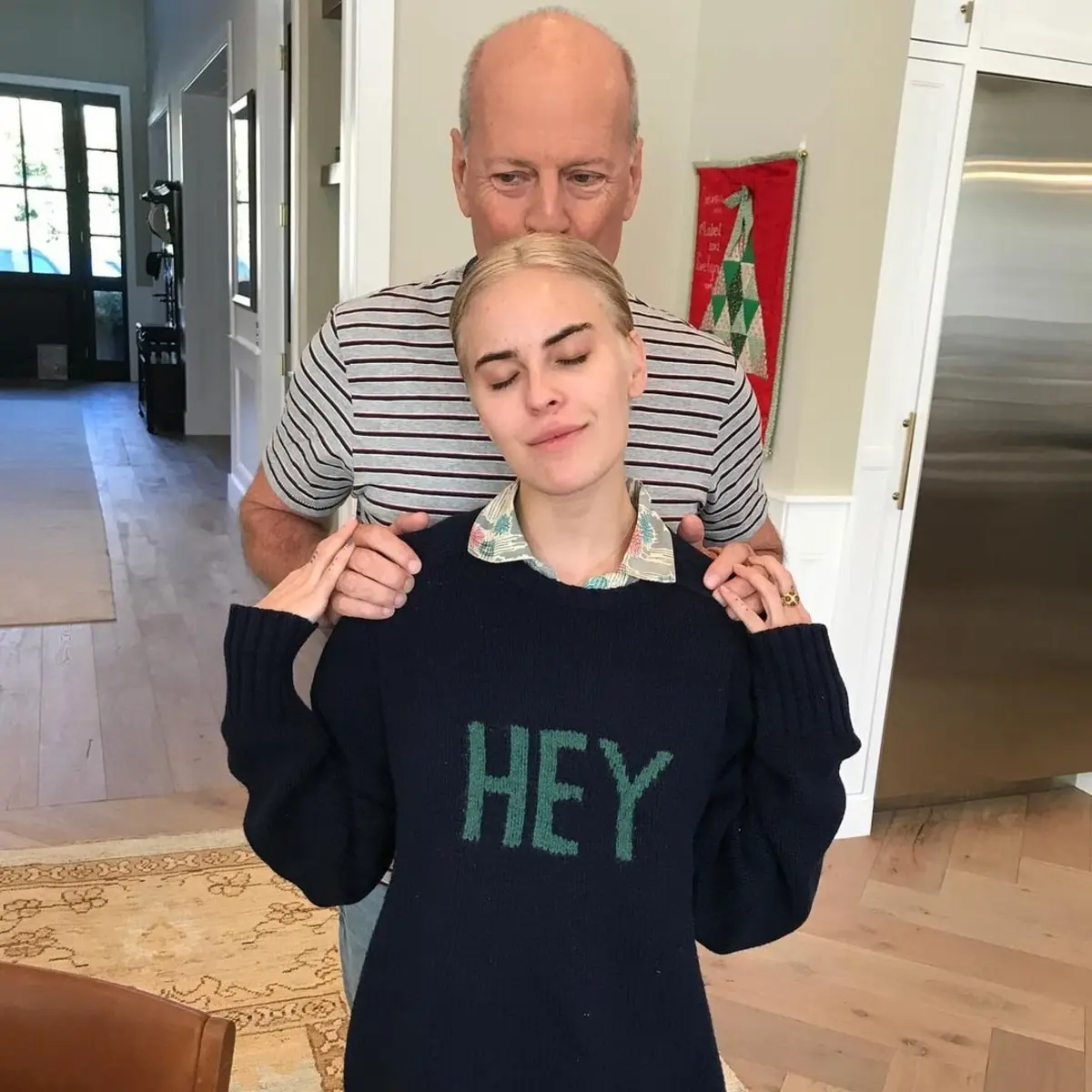
In an era where digital oversharing has become the default rhythm of celebrity culture, moments of public vulnerability carry a unique weight. For Tallulah Willis, navigating the complexities of her father Bruce Willis’s public-facing life amid his devastating health decline requires a delicate balance between public connection and deeply personal preservation. Recently, Tallulah made headlines not for posting a celebratory throwback or a milestone family portrait, but for a deliberate act of retraction: she deleted a candid, highly intimate photograph of herself and her legendary father.
The photograph, shared to Instagram on November 21, captured a quiet afternoon on an outdoor porch swing. In the snapshot, Tallulah sat beside the Die Hard and The Sixth Sense star, holding his hand as they watched a video of Frankie Valli singing. While the image radiated warmth—with Tallulah in a red sweater and sunglasses wrapping an arm around her father, and Bruce dressed in a gray cardigan and pale pink shirt—Tallulah quickly realized that the tender exchange crossed a line into a private sphere that deserved protection.
By the following day, the 32-year-old had removed the post, replacing it with a candid reflection on the boundaries of public documentation when dealing with degenerative illness. "I was very excited by the sweetness of the moment that I didn’t think farther ahead that this was possibly too intimate a photo to show," she wrote on November 22. "I can acknowledge that and vow to do better."
This poignant episode casts a spotlight on the broader reality of the Willis family’s journey since Bruce’s frontotemporal dementia (FTD) diagnosis became public in 2023. As his wife, Emma Heming Willis, and his ex-wife, Demi Moore, alongside his five daughters—Rumer, Scout, Tallulah, Mabel, and Evelyn—continue to share updates, the family walks a tightrope. They seek to honor the immense affection global fans hold for the iconic action hero while fiercely safeguarding his dignity during an intensely vulnerable chapter of his life.
Detailed Chronology
To understand the weight of Tallulah’s recent decision, it is essential to trace the timeline of Bruce Willis’s diagnosis and the unprecedented transparency demonstrated by his blended family.
The Shift in Public Awareness (2022–2023)
For decades, Bruce Willis was Hollywood’s quintessential indestructible hero, commanding the screen in high-octane blockbusters and gritty dramas. However, rumors regarding his cognitive health began circulating within the industry and among fans during his final years of active filmmaking.
In March 2022, the Willis family released a joint statement announcing that Bruce was stepping away from his illustrious acting career after being diagnosed with aphasia, a language disorder that impacts cognitive communication. This announcement marked the first major turning point, shifting public perception from speculation to collective concern.
Nearly a year later, in February 2023, the family provided a heartbreaking update. Through statements issued via the Association for Frontotemporal Degeneration (AFTD) and personal channels, they revealed that Bruce’s condition had progressed to frontotemporal dementia (FTD). This specific diagnosis provided clarity on the underlying cause of his aphasia while framing the immense challenges ahead for his loved ones.
The Blended Family’s Unified Front
Following the diagnosis, Bruce’s family—led dynamically by his wife Emma Heming Willis and his former wife Demi Moore—cultivated a profoundly supportive ecosystem. Rather than retreating entirely from the public eye, the family committed to sharing select moments of joy, gratitude, and familial solidarity.
- November 2023: The family celebrated their first Thanksgiving since the FTD announcement. Emma shared archival photos of Bruce surrounded by his loved ones, noting the deep well of gratitude they shared despite the new reality.
- March 2024 & 2025: Milestone birthdays brought out deeply emotional tributes from his daughters. Rumer shared a touching reflection on being "loved by you," while Demi Moore posted celebratory snapshots for his 70th birthday, emphasizing the enduring love pouring in from around the world.
- September 2025: Emma Heming Willis offered a deeply raw interview with Hello! magazine, detailing the ongoing emotional toll of FTD and the constant state of grief experienced by caregivers.
The November 2025 Porch Swing Incident
The events culminating in Tallulah’s recent retraction unfolded across two days in late November 2025.
- November 21: Tallulah posted a photo to Instagram capturing an afternoon visit with her father. Seated on a porch swing, the father-daughter duo held hands while watching archival footage of Frankie Valli.
- November 22: Recognizing the deeply personal nature of the snapshot—particularly regarding her father’s altered physical and cognitive state—Tallulah proactively deleted the image. She replaced the post with an acknowledgment of her oversight, writing, "I know you all love him. I love him. My family loves him. And he’s still always the absolute hero we know him to be." Her caption simply stated: "I can do better."
Supporting Context & Metrics: Understanding Frontotemporal Dementia (FTD)
To fully comprehend why an image can cross the threshold from sweet to "too intimate," one must understand the medical reality of frontotemporal dementia.
What is FTD?
According to the Mayo Clinic, frontotemporal dementia is an umbrella term for a group of brain disorders primarily affecting the frontal and temporal lobes of the brain. These regions are uniquely responsible for:
- Personality and behavioral regulation
- Language comprehension and expression
- Executive functioning and decision-making
Unlike Alzheimer’s disease, which typically presents first with memory loss, FTD frequently manifests early through dramatic shifts in behavior, empathy, judgment, and communication skills. For an individual who spent decades cultivating a public persona defined by sharp wit, physical presence, and verbal agility, the degenerative nature of FTD strips away these traits gradually.
The Caregiver’s Burden: Metrics and Realities
The psychological weight borne by families dealing with FTD is immense. According to data from the Association for Frontotemporal Degeneration (AFTD):
- Diagnosis Delays: On average, individuals suffering from FTD experience a delay of 3.6 years between the onset of initial symptoms and an accurate clinical diagnosis, largely due to initial misdiagnoses such as psychiatric conditions, depression, or Alzheimer’s.
- Age of Onset: Unlike other dementias that primarily affect individuals over the universe of 80, FTD frequently strikes younger, with the majority of diagnoses occurring between the ages of 45 and 64.
- Caregiver Stress: Studies highlighted by caregiving coalitions indicate that FTD caregivers experience higher rates of psychological distress, burnout, and depression compared to caregivers of Alzheimer’s patients, largely driven by the profound behavioral and personality changes inherent to the disease.
Emma Heming Willis captured this exact weight in her September 2025 interview, describing FTD as a disease that "steals things from you very slowly" and forces families into "a constant state of grief."
Official Statements & Public Reflections
The discourse surrounding Tallulah Willis’s deleted post underscores a broader conversation about dignity, public legacy, and familial protection in the digital age.
Tallulah Willis’s Apology and Reflection
Tallulah’s transparency regarding her mistake has been widely praised by mental health advocates and fan communities alike. By publicly addressing why she removed the photograph, she set a healthy boundary for what constitutes respectful documentation of a neurodegenerative illness:
"I posted a photo of my dad yesterday because we were having a BEAUTIFUL visit… I had someone take a super sweet photo of a shared moment between us watching a video of Frankie Valli singing.
I was very excited by the sweetness of the moment that I didn’t think farther ahead that this was possibly too intimate a photo to show. I can acknowledge that and vow to do better."
Her statement recognizes that while fans view Bruce Willis through the lens of his legendary cinematic career, his family experiences him through an intimate, evolving human relationship that requires shielding from excessive public exposure.
Emma Heming Willis on Collective Resilience
Emma Heming Willis has consistently served as an authoritative voice on the family’s shared journey, balancing the public’s desire for updates with the strict necessity of protecting Bruce’s dignity. Speaking on the unity of the Willis-Moore household, Emma noted:
"What has been truly beautiful to see throughout this process is how we all pour our hearts into supporting him—how deeply we love him, while completely respecting the way each person chooses to express that love.
I think the balance we’ve found is simply a reflection of who Bruce is at his core; it’s the result of all the love and support he planted over the years coming right back to him now."
This sentiment highlights a unique modern dynamic: a blended family operating with absolute synchronization to champion a patriarch who can no longer advocate for himself in the public sphere.
Future Outlook
As Bruce Willis continues his journey with frontotemporal dementia, the landscape of how his family interacts with the public will undoubtedly continue to evolve. Tallulah’s self-correction serves as a modern watershed moment for celebrity transparency, demonstrating that even well-intentioned posts must be filtered through the lens of a patient’s evolving dignity.
Key Trajectories to Watch:
- Redefining Celebrity Advocacy: The Willis family has transformed a private medical tragedy into a masterclass in public health awareness. By continually drawing attention to FTD through organizations like the AFTD, they have helped demystify a rare and often misunderstood condition.
- The Evolution of Digital Boundaries: As younger generations of celebrity families—such as Bruce and Demi’s daughters—grow up documenting their lives online, incidents like Tallulah’s porch swing photo provide a vital blueprint for establishing respectful boundaries around cognitive decline and elder care.
- Continued Support Systems: The resilience of the blended Willis-Moore-Heming family unit remains a beacon for blended families facing similar health crises. Their ability to maintain open communication, shared celebrations, and mutual respect sets a high standard for collaborative caregiving.
Ultimately, Bruce Willis remains, as Tallulah aptly put it, "the absolute hero we know him to be." Whether on screen in Die Hard, surrounded by his five daughters at a holiday gathering, or quietly listening to Frankie Valli on a sunny porch swing, his legacy transcends his illness—bolstered by a family dedicated to protecting his honor every step of the way.
