

Executive Overview
Paleoanthropology has long relied on the fragmented arithmetic of fossilized bones—isolated teeth, shattered crania, and incomplete pelvic fragments—to reconstruct the epic sweep of human evolution. However, bones tell a story of accumulation, a palimpsest of lifetimes compressed into geological strata over millennia. Footprints, by contrast, offer something vanishingly rare: an unedited, instantaneous frame of a single day 1.4 million years ago.
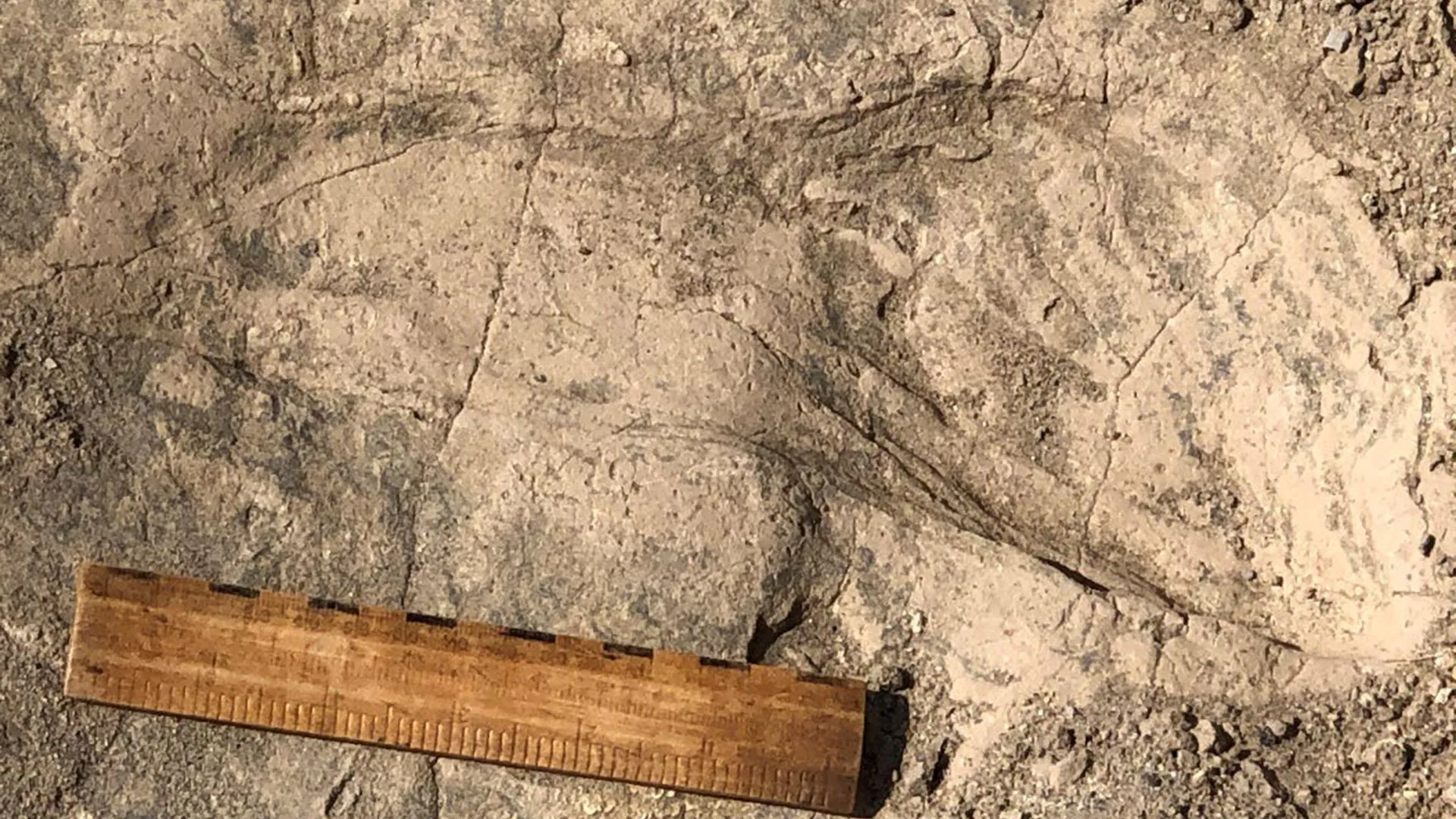
In a landmark discovery along the ancient, sun-baked lakeshores of northern Kenya, an international team of researchers has unearthed a remarkable set of fossilized footprints. Preserved near the cradle of Lake Turkana, these tracks provide an intimate, unprecedented glimpse into the biology, locomotion, and social behavior of Paranthropus boisei, an enigmatic and robust hominin species that once walked alongside early human ancestors before vanishing from the evolutionary stage.
Using sophisticated analytical techniques developed as recently as 2024, the research team—a collaborative coalition of scientists from the United States and Kenya—identified the tracks as belonging to eight distinct Paranthropus boisei individuals. Far from being a passive record of ancient ambulation, this fossilized snapshot challenges foundational assumptions about the species’ anatomy and social structures. Most shockingly, the size of the footprints reveals individuals that reached human-like statures of up to 1.8 meters (nearly six feet) and weighed roughly 75 kilograms (165 pounds). This shatters long-held academic consensus that Paranthropus boisei was substantially smaller than Homo erectus, its contemporaneous evolutionary cousin.
Furthermore, the clustering of the trackmakers—all eight appearing to be adult males traveling without females or children—hints at complex social dynamics. It suggests a society where males may have banded together for mutual protection in a lethal Pleistocene landscape, tolerating one another while navigating the hyper-resourceful yet perilous margins of an East African lake. As researchers continue to build what they describe as a "photo album" of the Early Pleistocene, these discoveries elevate the Lake Turkana basin not merely as a graveyard of ancient bones, but as a dynamic theater of prehistoric behavior.
Detailed Chronology and Discovery Context
The story of the Lake Turkana footprints unfolds across decades of meticulous fieldwork, geological detective work, and the gradual evolution of analytical methodologies. The East Turkana region has long been revered as a Mecca for paleoanthropologists, yielding landmark discoveries that helped chart the course of human origins. Yet, while cranial remains of Paranthropus boisei—characterized by their hyper-robust jaws, massive sagittal crests, and colossal, flat molars adapted for grinding tough vegetation—have been heavily documented since the mid-20th century, post-cranial fossils (skeletal elements below the neck) have remained agonizingly scarce.
For generations, this anatomical bias forced scientists to model the body size and locomotion of Paranthropus boisei from limited and frequently ambiguous evidence. Many researchers assumed the species was notably diminutive, especially when compared to the tall, slender, and long-limbed Homo erectus, which strode across the same East African landscapes during the same window of time.
The paradigm shifted when researchers began systematically analyzing ancient lakeshore surfaces across multiple sites in northern Kenya. Unlike terrestrial soils that quickly erode or scatter biological debris, ancient lakeshore margins offer unique geological conditions. Fluctuating water levels expose fine-grained muds and silts that, when capped rapidly by gentle layers of volcanic ash or fine sediment, can preserve fragile impressions with astonishing fidelity.
In this recent campaign, the international team encountered preserved walking surfaces distributed across sites separated by roughly 40 kilometers in the East Turkana region. Utilizing cutting-edge 3D morphological analysis and biomechanical frameworks established by the research group in 2024, scientists scrutinized the subtle contours of the footprints. They analyzed the depth of the heel strikes, the push-off mechanics of the toes, and the arch structures. These anatomical signatures decisively pointed away from the genus Homo and directly toward Paranthropus boisei.
The implications of the tracks were immediate and startling. The physical dimensions of the impressions did not match the small-bodied baseline traditionally assigned to the species. Instead, the stride lengths and footprint surface areas mapped onto modern human body parameters: heights reaching 1.8 meters and weights approximating 75 kilograms. By capturing these individuals in motion, the researchers effectively bridged the gap between isolated teeth and full-body mechanics, proving that Paranthropus boisei was far more robust and dimensionally comparable to its Homo contemporaries than previously imagined.
Supporting Context and Metrics
To fully appreciate the gravity of the Lake Turkana discovery, one must examine the broader ecological and behavioral context of the Early Pleistocene, roughly 1.4 million years ago. This era was characterized by dramatic climatic shifts, expansive grasslands, and fluctuating lake systems that acted as magnets for a wide array of megafauna and hominins alike.
The Anatomy of a Trace Fossil
Trace fossils—or ichnofossils—comprise tracks, burrows, and impressions rather than preserved body parts. While bones provide statistical averages of a species’ morphology over evolutionary epochs, trace fossils capture singular, transient events.
- Temporal Resolution: A set of footprints is typically laid down over hours, minutes, or even seconds. It records a specific behavioral event: a group walking from point A to point B.
- Biomechanical Data: Footprints reveal gait, velocity, stride width, and foot-pressure distribution. The Turkana tracks demonstrate modern-like bipedal walking mechanics, confirming that despite its unusual cranial adaptations, Paranthropus boisei was a fully committed biped.
- Body Mass Estimation Formulas: By applying mathematically validated regressions that correlate footprint surface area and depth with live body weight and stature, the team calculated that these eight individuals possessed robust, heavy-set physiques previously unrecognized in the fossil record for this lineage.
A Portrait of Pleistocene Society
Perhaps the most provocative dimension of the find is the demographic profile of the trackmakers. Out of the eight individuals recorded moving across the lakeshore surface together, all appear to be fully grown adults, with morphological indicators strongly favoring an all-male cohort.
In modern mammalian ecology—particularly among primates—all-male bands or coalitions are indicative of specific social structures. They often occur in species where males band together to defend territory, patrol home ranges, or secure resources against rival groups, while simultaneously managing internal competition for mates. The absence of females and juveniles in this specific migratory snapshot suggests that Paranthropus boisei may have practiced complex social grouping strategies. Rather than living in small, isolated family units, they may have operated within larger, fluid communities where individuals occasionally segregated by age and sex for specific ecological tasks, such as foraging or traveling across exposed, predator-dense landscapes.
The Lakeshore Magnet
The geological mapping associated with the discovery reveals a compelling behavioral pattern: hominins returned to these specific lakeshore environments repeatedly over a timespan exceeding 100,000 years. The margins of ancient Lake Turkana offered a rich convergence of critical survival resources. Freshwater, high-density aquatic and semi-aquatic plant foods, high-protein resources, and raw materials for stone tool use were all concentrated at the water’s edge. However, these zones were also perilous, serving as watering holes for ambush predators such as sabertooth cats, early crocodiles, and large carnivores. The willingness of Paranthropus boisei to repeatedly visit these high-risk, high-reward corridors underscores a sophisticated spatial memory and an adaptive survival strategy that sustained the species for over a million years before its eventual extinction.
Official Statements and Expert Perspectives
The profound implications of the discovery have drawn commentary from leading paleoanthropologists across the globe, emphasizing both the methodological breakthrough and the rewriting of hominin evolutionary history.
"The sizes of the footprints indicate human-like body sizes—up to 1.8 meters tall and around 75 kilograms."
— Dr. Kevin Hatala, Lead Author, Chatham University and Associated Researcher at the Department of Human Origins, Max Planck Institute for Evolutionary Anthropology.
Dr. Hatala emphasized the unique nature of the research, noting how combining advanced analytical metrics with pristine geological preservation allows science to reconstruct moments in deep time that bones alone cannot elucidate.
"The fact that eight, mostly adult male, Paranthropus boisei individuals seemingly traveled together as a group, without females or children, hints at a complex social structure in this species. They may have lived in large groups, where males competed for mates, but also tolerated each other at times for safety in a dangerous environment."
— Dr. Neil Roach, Co-author, Harvard University.
Dr. Roach’s insights open new avenues for comparative behavioral ecology, forcing researchers to reevaluate how extinct hominins navigated social pressures, resource competition, and cooperative defense long before the dominance of modern humans.
The environmental and geological foundations of the discovery were underscored by long-term researchers of the East African rift system:
"To me, it is amazing that we have the same kind of lake margin deposits in two areas of East Turkana that are 40 kilometers apart, at about the same age. If we can understand what geological conditions allowed these tracks to be preserved, we should know more about why hominins continued to return to the lakeshore environment over more than 100,000 years."
— Dr. Kay Behrensmeyer, Co-author, Smithsonian Institution.
From a regional and national stewardship perspective, the findings cement Kenya’s peerless status in the global landscape of evolutionary research:
"The discovery of these fossil footprints along the margins of Lake Turkana reinforces the region’s global importance in understanding human evolution, preserving remarkable evidence of how our ancient relatives lived 1.4 million years ago. It further strengthens Kenya’s position as one of the world’s leading paleoanthropological landscapes and highlights our responsibility to protect this irreplaceable heritage."
— Dr. Purity Kiura, Co-author, National Museums of Kenya.
Future Outlook and Ongoing Research
As the ink dries on this initial publication, the international research collaborative is already preparing for the next phase of fieldwork. Later this year, the team plans to return to the remote badlands of northern Kenya to expand excavations, scour adjacent stratigraphic layers, and search for additional footprint surfaces.
The overarching goal is twofold: expand the empirical database and refine our understanding of Early Pleistocene ecosystems. By systematically documenting every exposed footprint surface, the researchers are assembling a metaphorical photo album of the past. Each new site acts as a distinct window, capturing varied ecological conditions, fluctuating climate cycles, and different facets of hominin behavior that are entirely absent from the traditional fossil record.
Furthermore, geologists and paleoecologists within the team are intensifying their work on the sedimentology of the Lake Turkana basin. Unlocking the precise taphonomic processes—the exact sequence of mud deposition, moisture retention, and rapid ash-capping—that allowed these fragile impressions to survive for 1.4 million years will serve as a predictive model. If scientists can decode the micro-environmental conditions responsible for exceptional preservation, they can target prospective zones across East Africa with surgical precision, potentially uncovering entirely new chapters of hominin history.
Ultimately, the footprints of Paranthropus boisei remind the scientific community that human evolution was not a solitary, linear march toward modernity, but a rich, complex bush of diverse experiments in bipedalism, body size, and social life. As these ancient tracks continue to speak across the millennia, they challenge our assumptions, deepen our understanding of our extinct relatives, and reaffirm the boundless capacity of the Earth to preserve the fleeting echoes of deep time.