

Published: November 3, 2026 | Location: Atlanta, Georgia
Author: Political Desk / Investigative Reporting Unit
Executive Overview
In a seismic political realignment that reverberated across the American South and the nation at large, Democrat Keisha Lance Bottoms secured a historic victory in Georgia’s 2026 gubernatorial election on Tuesday night. Defeating Republican billionaire health care executive Rick Jackson, the former Atlanta mayor and presidential adviser achieved a monumental milestone: she has been elected as the first Black female governor in the history of the United States.
Bottoms’ decisive win shatters a 24-year Republican monopoly on the Georgia governor’s mansion, marking the first time a Democrat has claimed the state’s highest executive office since Roy Barnes won election in 1998. The victory serves as the crowning achievement of a hyper-competitive, multimillion-dollar contest that captured the national spotlight, underscoring Georgia’s ongoing transformation into one of the country’s most fiercely contested and unpredictable political battlegrounds.
The race pitted two starkly contrasting visions for the state’s future. Bottoms championed a platform centered on economic equity, accessible health care, public education reform, and cost-of-living relief. Jackson, leaning heavily on his background as a political newcomer and corporate titan, waged a massive self-funded campaign—pouring upwards of $200 million of his own wealth into the race—to advocate for sweeping tax cuts, deregulation, and private-sector management principles in state government.
Despite Jackson’s staggering financial advantage, Bottoms capitalized on her deep grassroots roots, widespread name recognition from her tenure leading Georgia’s capital city, and a surging progressive-moderate coalition. Coupled with the successful reelection of Democratic Senator Jon Ossoff on the same ballot, Bottoms’ victory cements Georgia’s status as a premier multi-racial, fiercely competitive purple state.
Detailed Chronology of a Historic Campaign
The path to the governor’s mansion in November 2026 was forged over years of shifting demographics, high-stakes political maneuvering, and an intense general election cycle.
The Open Seat and Primary Season
The foundational shift in the race occurred when two-term Republican Governor Brian Kemp reached his term limit, opening up the state’s executive office for the first time in eight years. Kemp’s departure triggered a scramble within both parties.
For the Democrats, Keisha Lance Bottoms emerged as a unifying figure early on. Following her high-profile tenure as the Mayor of Atlanta during a period of intense social reckoning and pandemic recovery, and her subsequent service as a senior adviser to President Joe Biden, Bottoms possessed the national profile, administrative experience, and cross-demographic appeal required to unite the Democratic base.
On the Republican side, the primary field gave way to Rick Jackson, a political newcomer and wealthy health care executive who promised to run state government like a business. Jackson outmaneuvered traditional party politicians by blanketing the airwaves early, presenting himself as a political outsider untethered to establishment politics.
The General Election Sprint: David vs. Goliath
Once the matchups were set, the Georgia gubernatorial race rapidly evolved into a historic financial clash. Rick Jackson shattered state fundraising norms—and rivaled historical national spending records—by pumping more than $200 million of his personal fortune into the campaign. The endless barrage of television commercials, digital ads, and mailers saturated every corner of the Peach State, attempting to paint Jackson as a benevolent corporate savior who would slash taxes and fuel job growth.
Bottoms, meanwhile, leveraged a robust small-dollar donor network, national party backing, and an aggressive retail-politics strategy. Rather than attempting to match Jackson dollar-for-dollar in television ad buys, Bottoms focused her campaign on direct voter contact. She traveled extensively through rural, suburban, and urban communities alike—from Morrow, Georgia, where she rallied supporters in the final stretch, to traditional Republican strongholds in the outer Atlanta rings.
Her message directly targeted the pocketbook concerns of everyday Georgians: the soaring cost of housing, rising inflation, the expansion of Medicaid to protect rural hospitals, and increased investments in public education. By framing the election as a choice between prioritizing working families or protecting the interests of an unchecked billionaire, Bottoms steadily consolidated her support among suburban moderates, women, and Black voters.
Supporting Context & Metrics: Financial Might vs. Demographic Shifts
To fully understand the gravity of Keisha Lance Bottoms’ victory, one must analyze the unique intersection of unprecedented campaign finance dynamics and Georgia’s evolving electoral map.
The $200 Million Question
Rick Jackson’s decision to self-fund his campaign to the tune of over $200 million places his bid among the most expensive self-financed gubernatorial campaigns in U.S. history. This astronomical investment forced political analysts to test a longstanding hypothesis: Can infinite wealth buy an electorate?
While Jackson’s spending saturated the media landscape and elevated his profile from political unknown to formidable contender, it ultimately hit a ceiling. Analysts note that his vast financial reserves could not fully insulate him from tough scrutiny regarding his corporate record and vague policy proposals on complex social issues. In an era of heightened political polarization, personal wealth could not entirely overwrite party identification and grassroots mobilization.
A State in Political Transition
Georgia’s political identity over the past decade has been defined by its transition from a reliable "Red State" into the nation’s most prominent battleground.
- 2020: Georgia narrowly voted for Democrat Joe Biden in the presidential election, stunning political pundits.
- 2021: Democrats Raphael Warnock and Jon Ossoff won historic U.S. Senate runoffs, shifting the balance of power in Washington.
- 2022: While Republican Brian Kemp won a comfortable reelection victory for governor and Raphael Warnock secured a full Senate term, the margins demonstrated a shifting suburban electorate.
- 2024: The state briefly swung back to Donald Trump in the presidential cycle.
- 2026: The pendulum swung back decisively for Democrats. Keisha Lance Bottoms captured the governor’s office, and Senator Jon Ossoff coasted to a convincing reelection victory on the same ballot.
This oscillating voting behavior underscores an electorate driven less by rigid party loyalty and more by candidate quality, economic conditions, and specific platform planks—most notably health care access and reproductive rights.
A Historic Milestone
Bottoms’ victory is historic on multiple fronts:
- She is the first Black woman elected governor in the history of the United States.
- She is the first Black governor ever elected in the state of Georgia.
- She is the first female governor to hold Georgia’s highest executive office.
- She breaks a 24-year Republican lock on the state capitol, ending an era that began when Sonny Perdue took office in January 2003 following Roy Barnes’ defeat in 2002.
Official Statements and Reactions
The historic nature of the election prompted an outpouring of statements from political leaders, civil rights organizations, and the candidates themselves.
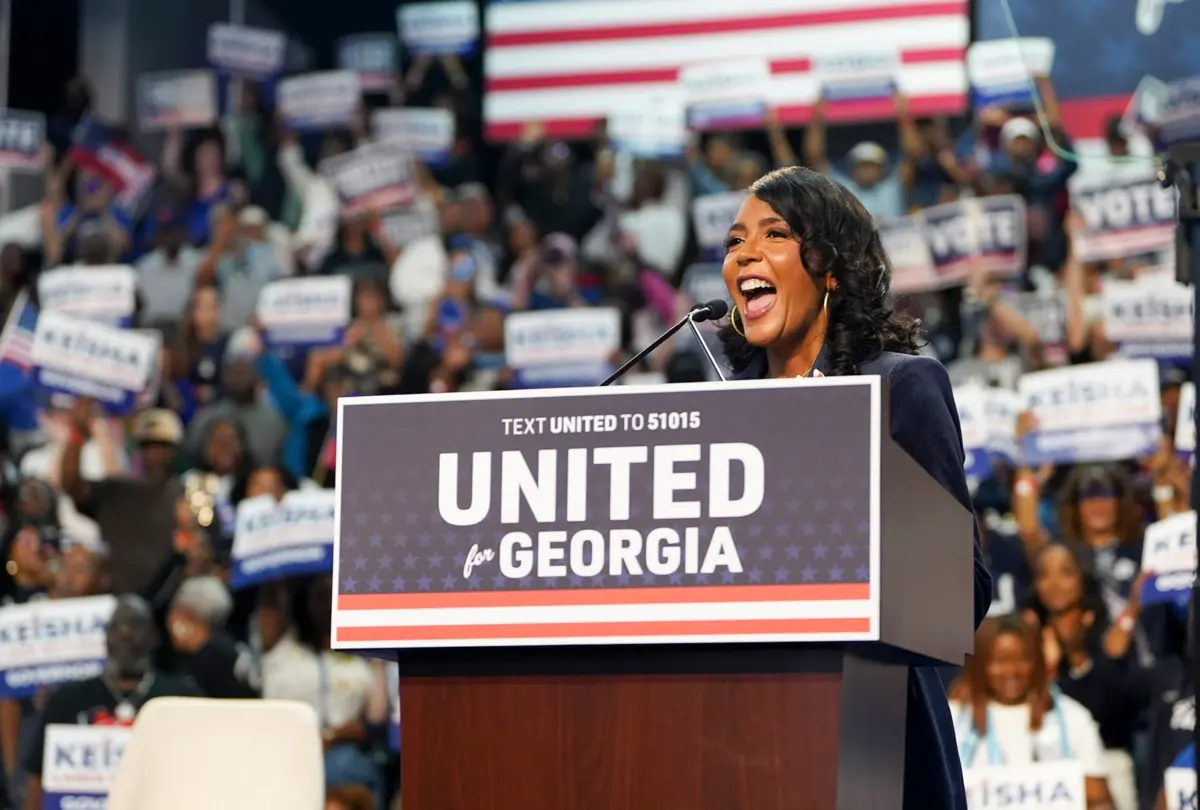
Addressing a jubilant crowd of supporters in Atlanta late Tuesday night, Governor-elect Keisha Lance Bottoms emphasized the unity and resilience required to achieve the milestone.
"Tonight, the people of Georgia have sent a resounding message to the nation," Bottoms declared to thunderous applause. "We have proven that progress is possible, that glass ceilings are meant to be shattered, and that our government belongs to everyone—not just the privileged few who can self-fund a multi-million-dollar ticket. To every young girl, to every person of color, and to every Georgian who has ever wondered if your voice matters: let this night be proof that in America, your dreams are within reach. Now, the real work begins—building an economy that lifts every family, securing health care for our most vulnerable, and moving Georgia forward together."
Conceding the race late Tuesday evening, Rick Jackson thanked his supporters and defended his unorthodox campaign trajectory:
"While the final outcome is not what we hoped for, I am deeply proud of the race we ran and the conversations we sparked about fiscal responsibility and economic growth," Jackson said in a statement. "Georgia remains a great state full of promise, and I wish Governor-elect Bottoms wisdom and success as she takes the helm."
National figures also weighed in quickly. Outgoing Governor Brian Kemp released a formal statement pledging a smooth transition of power, noting the historic nature of the office while emphasizing the importance of institutional stability. Meanwhile, congressional leaders and civil rights icons praised Bottoms for crossing a historic threshold that had remained stubbornly closed since the founding of the republic.
Future Outlook: What Bottoms’ Victory Means for Georgia
As Keisha Lance Bottoms prepares to take the oath of office in January 2027, her administration will face immediate structural, political, and legislative challenges.
Legislative Hurdles
While Bottoms secured a historic personal victory, the makeup of the Georgia General Assembly remains a vital question. Navigating a potentially divided or narrowly divided state legislature will require seasoned political negotiation. Bottoms’ background as a municipal leader and her experience dealing with diverse city councils will be put to the test as she attempts to advance her legislative priorities.
Core Policy Priorities
- Health Care Expansion: Bottoms has long advocated for closing coverage gaps and expanding Medicaid access in Georgia—a policy fiercely debated during the Kemp administration. In a state with numerous rural hospitals facing financial strain, addressing health care infrastructure will be an urgent Day One priority.
- Economic Development & Cost of Living: With inflation and housing affordability weighing heavily on working-class families, the incoming administration is expected to focus on targeted tax relief for middle- and lower-income households, alongside workforce training initiatives tied to Georgia’s booming green energy and tech sectors.
- Public Education: Enhancing teacher compensation, modernizing classroom technology, and increasing per-pupil funding will anchor her domestic policy agenda.
National Implications
Bottoms’ ascension to the governorship instantly vaults her into the upper echelon of national Democratic leadership. As the first Black female governor in American history, her administration will be watched closely by political analysts nationwide. Her governance style—balancing progressive social values with pragmatic, urban-tested management—could serve as a blueprint for Democrats seeking to win and govern in transitioning Southern and Sunbelt states.
For Georgia, Tuesday, November 3, 2026, will be recorded in the history books as the day the political landscape fundamentally shifted. For Keisha Lance Bottoms, it marks the beginning of an unprecedented chapter in state and national governance.
