In the fast-paced world of modern search engine optimization (SEO), relying on manual spreadsheets or infrequent, batch-processed ranking updates is a recipe for strategic failure. As search engine results pages (SERPs) become increasingly volatile—influenced by rapid algorithmic shifts, localized hyper-targeting, and the expansive integration of generative AI features like Google’s AI Overviews—digital marketers, agencies, and enterprise brands require real-time, highly granular data.
SERP tracking software has evolved far beyond simple keyword position logs. Today’s premier tracking platforms serve as comprehensive intelligence hubs, correlating rank movements with traffic acquisition, conversion rates, and revenue generation. They provide deep analytical visibility into more than 50 distinct SERP features, ranging from traditional featured snippets and People Also Ask (PAA) boxes to rich media carousels and knowledge graphs.
This in-depth review evaluates the market landscape for 2025, breaking down the essential features to look for in SERP tracking software and examining a curated shortlist of the seven best tools available today. Whether you are looking for a dedicated, standalone tracker or a robust component of an all-in-one SEO suite, this guide will help you align your software investment with your organization’s core business objectives.
Detailed Chronology: The Evolution of Rank Tracking
To understand the current state of SERP tracking tools in 2025, it is vital to trace how the technology has matured alongside search engine architectures over the past decade.
The Early Era (Pre-2015): Marketers relied heavily on localized desktop scraping tools or rudimentary web-based checkers that fetched data once a week. These systems were prone to IP blocks, cap limits, and high margins of error due to personalization and lack of device segmentation.
The Cloud & Daily Updates Shift (2015–2019): Cloud-based infrastructure allowed platforms to scale data collection. Daily automated ranking updates became the gold standard. Tools began incorporating basic SERP feature tracking, such as identifying when a site secured a traditional "Position #0" featured snippet.
The Granularity & Multi-Engine Era (2020–2023): As local search exploded and mobile-first indexing took total precedence, trackers introduced zip-code level accuracy and distinct mobile versus desktop segmentation. Integrations with business intelligence platforms (such as Google Data Studio/Looker Studio and Databox) allowed SEOs to tie rankings directly to Google Analytics revenue data.
The Generative AI & Real-Time Intelligence Era (2024–2025): With search engines fundamentally altered by artificial intelligence, modern SERP tracking tools must account for dynamic, non-traditional search features like AI Overviews. On-demand data refreshes, instant API data delivery, and automated gap analyses have replaced static historical logs as the essential requirements for enterprise-grade SEO stacks.
Supporting Context & Metrics: Why Invest in Advanced SERP Tracking?
Demonstrating the return on investment (ROI) of SEO campaigns has historically been challenging due to the fluid nature of search engines. However, modern SERP tracking software bridges the gap between technical optimization and boardroom metrics.
By utilizing advanced tracking platforms, digital marketing teams can operationalize data across several core vectors:
Validation of SEO Efforts: Stakeholders want proof of progress. Granular SERP tracking validates tactical execution, proving that specific content optimizations directly correlate with upward shifts in visibility.
Share of Voice (SoV) Calculations: Rather than staring at isolated keyword fluctuations, advanced trackers compute your brand’s overall market share in the SERP for specific thematic clusters against your fiercest competitors.
Risk Mitigation: Sudden algorithmic updates can wipe out organic traffic overnight. Real-time monitoring allows teams to identify drops instantly, diagnose technical or content-related causes, and deploy corrective measures before quarterly revenue is severely impacted.
Resource Allocation: By identifying keywords sitting on the cusp of the top three positions or hovering just below a lucrative SERP feature, teams can focus their editorial resources on high-probability "low-hanging fruit" rather than blindly creating new content.
9 Essential Features to Look for in SERP Tracking Software
When evaluating solutions for your marketing stack, ensure the platform delivers on these nine critical feature sets:
1. Access Accurate On-Demand Ranking Updates
Search engine results shift rapidly throughout the day. Waiting days for a batch update is no longer acceptable. Leading tools like AccuRanker automate daily checks while offering on-demand data refreshes at the click of a button, ensuring you always work with fresh intelligence.
2. Monitor Performance Across SERP Features
Securing a traditional ranking is only half the battle. Your software must track whether your URLs trigger AI Overviews, featured snippets, knowledge cards, or video carousels. Platforms offering comprehensive SERP analysis help you spot feature opportunities and steal them from competitors.
3. Track SERP Movement Across All Major Search Engines
While Google commands the lion’s share of global search traffic, international campaigns or specific regional markets require multi-engine tracking. Top-tier tools allow seamless monitoring across Bing, Baidu, Yandex, and YouTube alongside Google.
4. Granular Tracking (Location and Device)
Hyper-local SEO requires precision down to the city, state, or zip code level. Furthermore, mobile-first indexing demands the ability to decouple and compare desktop versus mobile rankings independently.
5. Map SERP Movements to Traffic and Revenue
The ultimate goal of SEO is business growth. Integrations with analytics platforms (such as Google Analytics or Adobe Analytics) combine keyword positions, search volume, and Share of Voice with bounce rates, load times, and conversion revenue into unified landing page reports.
6. View Historical Rank Performance
Point-in-time snapshots are insufficient for trend analysis. Robust tracking solutions maintain deep historical databases, allowing SEOs to view long-term performance trajectories and benchmark them against industry competitors.
7. Run Competitor Comparisons
Understanding your relative position in the market requires dynamic competitor grouping (e.g., segmenting keywords into buckets like positions 1–3, 4–10, and 11–50). This visibility highlights emerging threats and fading rivals.
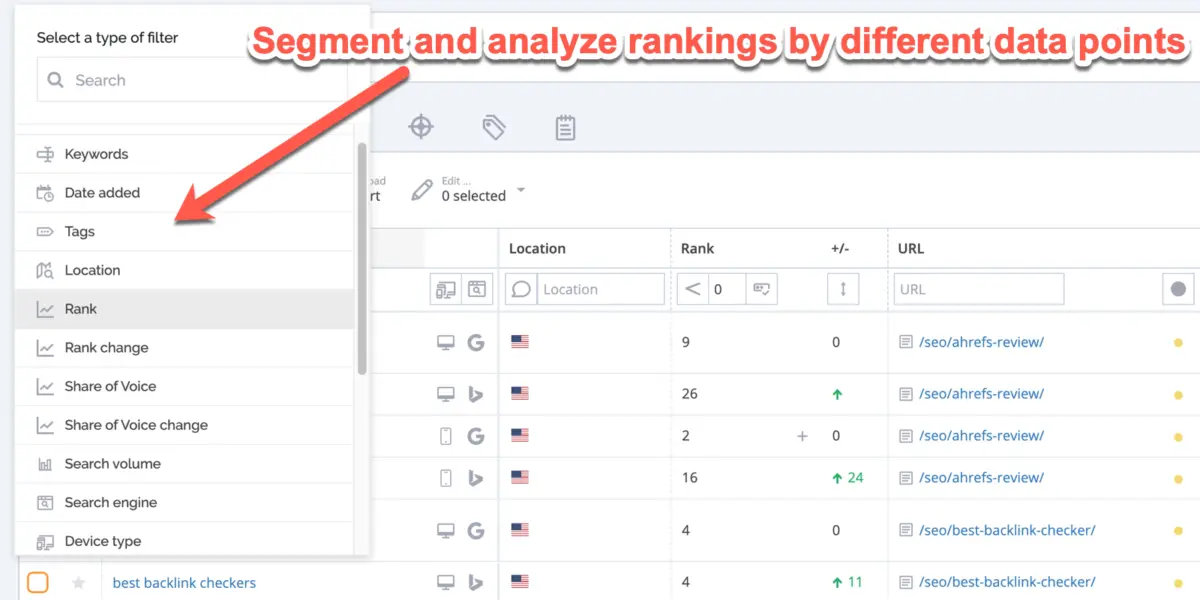
8. Tag and Segment Rankings Data
Not all keywords hold equal business value. Advanced tagging functionality enables you to filter and analyze data by topic, funnel stage, asset type, device, and geographical location.
9. Generate White-Label Reports
For agencies and enterprise consultants, client reporting must be seamless. Native white-label reporting engines—supplemented by robust connectors for Looker Studio or Databox—allow teams to deliver beautifully formatted, digestible progress reports automatically.
Official Statements & Industry Perspectives
Industry leaders continue to emphasize the shift toward integrated, data-driven reporting frameworks. Ian Howells, Co-Founder of Traffic Think Tank, notes:
"The thing that really got me using them heavily in the last month or two is their Looker Studio connector. Combining the tag feature, as well as the Share of Voice metric… has been a big help in making these reports immediately digestible."
Similarly, Matthew Howells-Barby, Co-Founder of TrafficThinkTank and prominent digital marketer, asserts:
"It’s by far the best keyword ranking tracker in the market and has a ton of great reporting functions. If you want visibility on large volumes of keywords housed within a nice dashboard—this is for you."
The 7 Best SERP Tracking Tools for 2025
The market features countless options, but our research isolates the top performers—split between dedicated standalone trackers and comprehensive all-in-one SEO platforms.
1. AccuRanker (Best Dedicated SERP Tracker)
Trusted by over 32,000 companies including HubSpot, IKEA, and Kinsta, AccuRanker is widely regarded as the premier standalone ranking tracker on the market. It delivers lightning-fast, on-demand data updates, robust SERP feature analysis across 50+ features, and deep integrations with Google Analytics and Looker Studio.
Best For: Agencies, enterprise brands, and professionals demanding real-time data and flawless API access.
Pricing: Starts at $116/month for up to 1,000 tracked keywords.
2. Semrush Position Tracker and SERP Gap Analyzer (Best All-in-One Solution)
As part of a massive digital marketing suite used by over 10 million users (including Samsung and Vodafone), the Semrush Position Tracker rivals dedicated tools in sheer accuracy. Beyond standard rank tracking, Semrush offers the SERP Gap Analyzer app in its App Center, which scans Google SERPs to find under-optimized content, saves hours of manual research, and integrates directly with Google Search Console.
Best For: Digital marketing professionals, e-commerce brands, and enterprises wanting an all-in-one suite with elite tracking capabilities.
Serving over 60,000 customers, ProRankTracker is a powerful standalone tool tailored for international agencies, e-commerce operations, and video marketers who require precise multi-device, multi-language tracking.
Best For: Users seeking robust, highly scalable rank tracking across multiple global markets on a budget.
Pricing: Starts at $39/month.
4. Advanced Web Ranking – AWR (Best for Enterprise & Custom Reporting)
Used by thousands of in-house teams and global enterprises like Microsoft, Advanced Web Ranking specializes in flexible data architecture, deep device/location breakdowns, and fully customized white-label reporting.
Best For: Enterprise organizations requiring granular data segmentation and tailored reporting interfaces.
Pricing: Starts at $99/month.
5. SERPWatcher by Mangools (Best for Simplicity & Value)
SERPWatcher is the dedicated rank tracking component of the Mangools SEO platform. Trusted by brands like Airbnb and Adidas, it introduces the unique Performance Index, which calculates organic traffic potential based on current rankings and search volumes.
Best For: Startups, small business owners, and freelancers looking for an easy-to-use, aesthetically polished tracking solution.
Pricing: Starts at $29.90/month.
6. SE Ranking (Best Feature-Rich Mid-Market Suite)
SE Ranking is a comprehensive all-in-one SEO toolset featuring an advanced Position Tracking module. By simulating real user behavior within precise geographical targets, it claims exceptional data accuracy across all major search engines.
Best For: Small-to-medium agencies and growing businesses seeking an affordable, balanced SEO platform.
Pricing: Starts at $52/month (based on daily updates for 500 keywords).
7. Nightwatch (Best for Hyper-Localized & Global Scale)
Nightwatch stands out as an ultra-accurate daily SERP tracker trusted by Shopify, Coinbase, and Scotiabank. It enables precise ranking discovery across an astonishing 107,296 distinct global locations.
Best For: Organizations managing complex international campaigns or hyper-local multi-location businesses.
Pricing: Starts at $32/month for up to 250 keywords.
Future Outlook
As we look deeper into 2025 and beyond, the boundary between keyword tracking and AI-driven content optimization will continue to blur. Search engines are no longer simple lists of blue links; they are complex, dynamic ecosystems where visual assets, localized map packs, and generative summaries dictate user acquisition.
Future-proofing your SEO strategy requires moving away from static spreadsheets and investing in sophisticated SERP tracking platforms that offer real-time data freshness, deep analytics integration, and actionable visibility into emerging SERP features. Whether you choose the blistering speed and precision of a standalone tool like AccuRanker or the comprehensive marketing power of an all-in-one suite like Semrush, equipping your team with the right intelligence tool is no longer optional—it is the core engine of modern digital growth.


![7 Best SERP Tracking Tools for 2022 [In-Depth Review]](https://www.robbierichards.com/wp-content/uploads/2020/05/Best-SERP-Trackers.jpg)
![7 Best SERP Tracking Tools for 2022 [In-Depth Review]](https://www.robbierichards.com/wp-content/uploads/2020/04/image16-2.png)
![7 Best SERP Tracking Tools for 2022 [In-Depth Review]](https://www.robbierichards.com/wp-content/uploads/2020/04/image2-3.png)
![7 Best SERP Tracking Tools for 2022 [In-Depth Review]](https://www.robbierichards.com/wp-content/uploads/2020/04/image6-2.png)
![7 Best SERP Tracking Tools for 2022 [In-Depth Review]](https://www.robbierichards.com/wp-content/uploads/2020/04/image15.jpg)
![7 Best SERP Tracking Tools for 2022 [In-Depth Review]](https://www.robbierichards.com/wp-content/uploads/2020/04/image12-1.png)
![7 Best SERP Tracking Tools for 2022 [In-Depth Review]](https://www.robbierichards.com/wp-content/uploads/2020/04/image13-2.png)
![7 Best SERP Tracking Tools for 2022 [In-Depth Review]](https://www.robbierichards.com/wp-content/uploads/2020/04/image3.jpg)
![7 Best SERP Tracking Tools for 2022 [In-Depth Review]](https://www.robbierichards.com/wp-content/uploads/2018/08/rj-employee_Robbie-color-new.png)
![7 Best SERP Tracking Tools for 2022 [In-Depth Review]](https://www.robbierichards.com/wp-content/uploads/2020/05/Databox-SEO-dashboard-1.jpg)
![7 Best SERP Tracking Tools for 2022 [In-Depth Review]](https://www.robbierichards.com/wp-content/uploads/2020/04/image4-2.png)
![7 Best SERP Tracking Tools for 2022 [In-Depth Review]](https://www.robbierichards.com/wp-content/uploads/2020/04/image5.jpg)
![7 Best SERP Tracking Tools for 2022 [In-Depth Review]](https://www.robbierichards.com/wp-content/uploads/2020/05/AccuRanker-Google-Data-Studio-integration.jpg)
![7 Best SERP Tracking Tools for 2022 [In-Depth Review]](https://www.robbierichards.com/wp-content/uploads/2018/11/Ian-Howells2.png)