

Executive Overview
As early voting gathers momentum across the United States for the 2026 midterm elections, a familiar and disruptive narrative has resurfaced across social media platforms: claims that electronic voting machines are altering, swapping, or "flipping" citizens’ candidate selections. Amplified by partisan groups, viral videos, and widespread digital sharing, these allegations have surfaced in multiple states, notably including Texas, Tennessee, Florida, and Ohio.
The digital discourse alleges a systematic, malicious effort by voting systems to favor one political party over another—most prominently circulating dual claims from opposing political viewpoints that machines are actively resisting Democratic votes or, conversely, locking out Republican choices. However, an in-depth investigation by election administrators, voting equipment manufacturers, and independent fact-checkers reveals a starkly different reality.
There is no credible evidence that voting machines are deliberately engineered with vote-flipping flaws, nor is there any indication that such issues are occurring on a widespread, systemic scale. Instead, thorough reviews of the incidents reported during the 2026 early voting window point to standard technological friction points: user error, touch-screen sensitivity, screen calibration issues, and inadvertent selections made by voters unfamiliar with specific hardware interfaces. Furthermore, the modern voting apparatus—relying heavily on paper-auditable systems and rigorous pre-election testing—provides multiple safety nets, enabling voters to review and correct their ballots long before their votes are officially cast and tabulated.
Compounding the spread of misinformation during this early voting window is the recirculation of outdated, decontextualized video footage from past election cycles—some dating back nearly a decade—being deliberately or mistakenly repurposed to stoke fears of contemporary electoral malfeasance. This report offers a comprehensive examination of the 2026 early voting machine claims, analyzing specific state-level incidents, assessing the technological mechanics of modern touch-screen voting, and providing clear guidance on how election officials are addressing public anxieties.
Detailed Chronology of the 2026 Early Voting Incidents
The trajectory of the 2026 vote-flipping claims began to accelerate shortly after early voting windows opened in mid-October. Across various digital ecosystems, isolated reports quickly compounded into sweeping, generalized narratives of systemic failure.
The Spark on Social Media
On October 21, 2026, the liberal advocacy group "The Other 98%" published a widely shared Facebook post warning of a "very disturbing trend" in early voting. The post asserted that multiple states—specifically naming Texas, Florida, Tennessee, and Ohio—were experiencing widespread difficulties getting machines to accept Democratic votes, claiming the systems allegedly defaulted selections back to Republican candidates unless voters pressed repeatedly.
Simultaneously, alternative narratives materialized on platforms like X (formerly Twitter) and TikTok. Conservative and independent accounts posted parallel claims alleging that machines were actively blocking votes for conservative candidates. These competing, contradictory viral claims underscored how pre-existing political polarization immediately frames administrative or mechanical anomalies as intentional partisan sabotage.
State-Specific Reports: Tennessee and Texas
While the digital sphere buzzed with broad generalizations, tangible reports on the ground were heavily localized and quickly addressed by local election authorities.
Tennessee (Davidson, Williamson, and Madison Counties)
In Nashville, high-profile reports drew immediate media attention. On October 21, Stella Parton—sister of iconic entertainer Dolly Parton—posted on Facebook detailing her experience at the Hermitage Library polling location. She claimed her ballot "kept flipping to the wrong candidate," asserting she had to correct her vote three times because the interface repeatedly defaulted to incumbent U.S. Senator Marsha Blackburn.
Concurrently, local broadcaster WSMV-TV reported that several voters in Williamson County (encompassing Franklin, Spring Hill, and Nolensville) experienced moments where tapping a specific candidate resulted in an adjacent or different name highlighting on screen. Similar isolated complaints emerged in Madison County.
Response from Tennessee officials was swift. State Coordinator of Elections Mark Goins informed local media that the anomalies "appeared to be a voter error," likely caused by unintended secondary touches or angled finger pressure on sensitive capacitive touch screens. Highlighting that all equipment undergoes rigorous pre-election logic-and-accuracy testing, election offices noted that styluses were made available upon request to assist voters with touch-screen precision. Notably, the Tennessee Secretary of State’s office reported that out of approximately 400,000 early ballots cast across the state at that juncture, only a single formal complaint of that specific nature had been logged.
Texas (Bexar and Kendall Counties)
In the Lone Star State, KSAT-TV reported that three voters in Bexar County alleged touch screens changed or removed their choices during the early voting process. However, all three voters successfully identified the discrepancy during the mandatory review screen phase, corrected their ballots, and cast their final votes without incident.
In Kendall County, a social media post went viral claiming a voter’s elderly mother experienced repeated switches from Democratic to Republican selections. However, Alicia Pierce, the Texas Assistant Secretary of State’s Communications Director, confirmed that her office had received no official reports substantiating these specific claims. Pierce further emphasized a crucial structural safeguard unique to Texas voting procedures: the counties reporting these issues do not utilize machines that store raw voting selections in computer memory. Instead, they deploy hardware explicitly designed to generate a human-readable paper ballot, ensuring that the physical printout—not internal digital storage—serves as the definitive record of the vote.
Supporting Context, Metrics, and Technological Realities
To understand why touch screens occasionally register inputs incorrectly, one must examine the specific hardware deployed across the jurisdictions where these incidents occurred and evaluate the mechanics of modern voting technology.
The Hardware: ES&S ExpressVote Systems
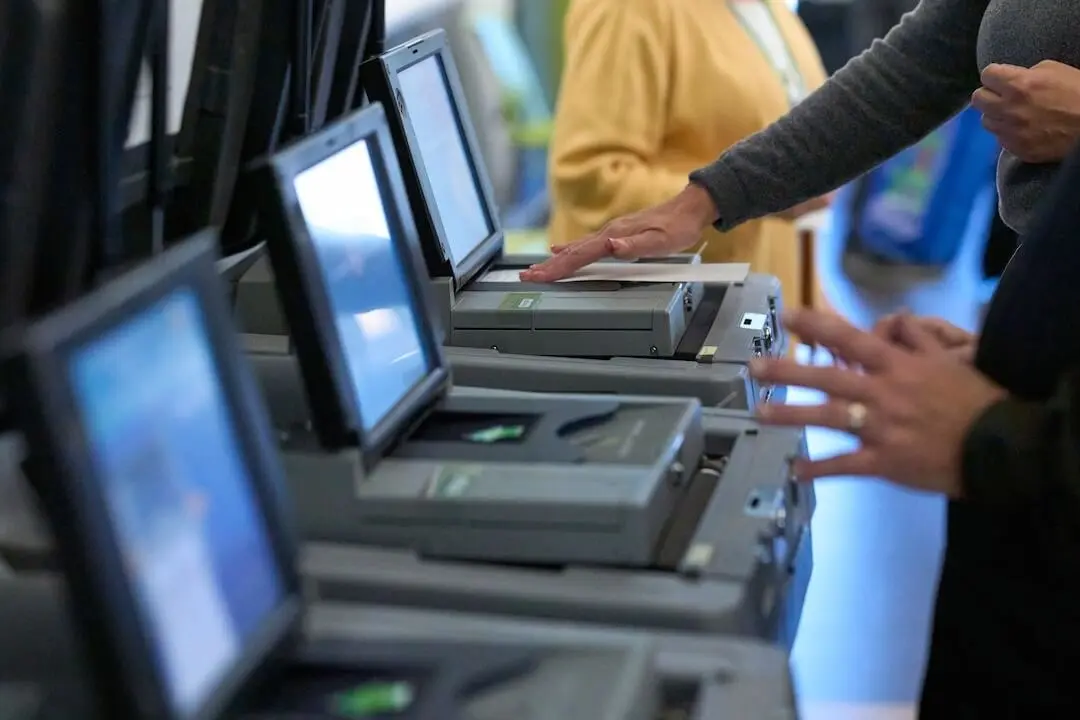
The counties central to these 2026 early voting reports—including Williamson, Davidson, and Madison in Tennessee, and Bexar and Kendall in Texas—utilize the ExpressVote system, manufactured by Election Systems & Software (ES&S).
The ExpressVote is a ballot-marking device rather than a direct-recording electronic (DRE) voting machine that tallies votes internally. It assists voters in making their selections, prints a paper record of those choices, and requires the voter to review that paper record before inserting it into a tabulator.
Katina Granger, a spokesperson for ES&S, addressed the mechanical realities of these systems in statements to election monitors and fact-checkers. Granger clarified that the company had not received widespread or systemic reports of technological failure from election administrators.
"Most commonly, reported instances stem from a voter not touching the text box in the correct place," Granger explained. "They can touch anywhere inside the large box containing the candidate’s name, but users unaccustomed to industrial-grade touch screens sometimes graze boundaries or apply oblique pressure."
Screen Sensitivity and Calibration
Kristin Miles, president of the Texas Association of County Election Officials, reinforced this technical explanation in an official statement:
"Statewide and local officials have both repeatedly affirmed that nearly every case comes back to the screen calibration on older touchscreen machines, or user interface familiarity, not a change to anyone’s vote."
Modern commercial smartphones utilize capacitive touch screens that respond to the minutest electrical charges from human skin. In contrast, secure voting hardware—subject to strict federal certifications, offline air-gapping requirements, and heavy-duty protective casings—often relies on robust touch interfaces designed to withstand millions of touches across extreme temperature variations. Consequently, these screens require a deliberate, flat, and firm tap directly over the designated selection area. If a voter taps near the edge of a bounding box, or removes their finger while a scroll or selection animation is processing, the system may register the input differently than intended.
The Resurgence of Digital Archival Misinformation
A recurring vector for election misinformation is the cyclical resurrection of digital media from past election cycles. During the 2026 early voting window, fact-checkers identified multiple viral videos purportedly showing contemporary vote-flipping events that were, in reality, years or decades old.
- The 2019 Mississippi Primary Video: An X post shared on October 23, 2026, featured a video of a voter tapping a box next to a candidate, only for the screen to highlight the candidate directly above. The caption warned of a "national emergency" regarding electronic voting manipulation. Investigative reviews revealed this exact video originated during the August 2019 Republican primary gubernatorial runoff in Mississippi between Tate Reeves and Bill Waller Jr.—an incident thoroughly debunked and explained by election authorities seven years prior.
- The 2018 Indiana General Election Video: Another widely circulated clip posted on October 22, 2026, claimed to show a modern voting machine malfunctioning by failing to register a voter’s intended selection. Digital forensics proved this video dated back to November 2018, capturing an isolated calibration anomaly involving U.S. House candidates Jim Baird and Tobi Beck in Indiana.
The recycling of these archival clips underscores a coordinated effort by bad actors—or an uncritical amplification network among hyper-partisan social media users—to manufacture a persistent narrative of systemic electoral decay by stitching together disconnected fragments of historical anomalies.
Official Statements and Administrative Responses
Election authorities across the nation have adopted a posture of proactive transparency, emphasizing that administrative protocols are specifically engineered to catch and correct human or mechanical errors before a vote is finalized.
Securing the Process
Election administrators continuously reiterate fundamental security and accuracy safeguards:
- Air-Gapped Systems: Voting machines and tabulators are strictly prohibited from connecting to the internet or external local area networks, rendering them entirely immune to remote cyberattacks or digital manipulation.
- Pre-Election Testing: Prior to the opening of any polling place, bipartisan boards of election officials conduct exhaustive "logic and accuracy" tests, running test ballots through every individual machine to verify that selections register precisely where intended.
- The Multi-Tiered Review Process: Officials emphasize that voting is not a single-click event. Voters are granted multiple distinct opportunities to verify their choices:
- The interactive visual summary displayed on the voting machine touch screen at the end of the candidate selection session.
- The physical paper ballot or ballot card generated by marking devices, which explicitly prints out the voter’s selections in human-readable text.
- The final review opportunity before the voter physically feeds the paper ballot into a secure tabulation scanner or drops it into a secure ballot box.
Michele Carew, Bexar County Elections Administrator, addressed voters directly in a press release:
"Reports of mismatched selections are almost always due to user touchscreen sensitivity, not machine malfunction. Touchscreens require a firm, direct tap, and poll workers are trained to assist as needed. We encourage all voters to utilize every review step available to them."
Future Outlook and Guidance for Voters
As the 2026 midterm elections approach their conclusion, election security experts predict that viral claims regarding machine manipulation will likely peak during Election Day itself and the subsequent tabulation window. Because public trust in democratic institutions remains a primary target for domestic and foreign disinformation campaigns, voter education has become the most effective countermeasure.
Best Practices for Voters in the 2026 Midterms
Election officials, civil rights organizations, and nonpartisan watchdogs recommend the following steps for all participating citizens to ensure a seamless voting experience:
- Take Your Time: Touch-screen interfaces in polling places may differ from personal consumer tablets or smartphones. Approach the screen with deliberate, flat finger taps directly within the candidate selection box.
- Utilize Available Aids: Do not hesitate to ask trained poll workers for assistance. If you have physical tremors, visual impairments, or difficulty navigating the touch screen, request a stylus or assistance from bipartisan election judges, who are legally authorized to help.
- Rigorously Check Your Review Screen: Read through the final summary screen before advancing to the printing stage. Ensure every contest reflects your actual intent.
- Inspect Your Paper Ballot: If your voting system generates a paper record (such as an ExpressVote printout), take the time to read every line of text on that physical document before casting it into the tabulator.
- Report Discrepancies Immediately: If a paper ballot or touch screen does not match your selections, do not cast the ballot. Notify a poll worker immediately. Under federal and state laws, election workers are required to spoil the incorrect ballot, issue a fresh one, and document the technical anomaly, ensuring that every voter leaves the polling place completely confident that their voice has been accurately recorded.
Through a combination of transparent administrative protocols, robust paper-backed verification systems, and heightened public vigilance, election officials remain fully equipped to handle isolated technical frictions while safeguarding the integrity of the 2026 midterm elections.