

Executive Overview
In the rapidly evolving landscape of modern commerce, artificial intelligence has fundamentally altered the mechanics of enterprise execution. Tasks that once required weeks of manual analysis, creative iteration, and logistical deployment can now be synthesized in seconds. Yet, as automation democratizes output, it introduces a profound existential crisis for modern enterprises: When everyone can produce infinite content and hyper-targeted campaigns instantaneously, what makes a brand actually matter?
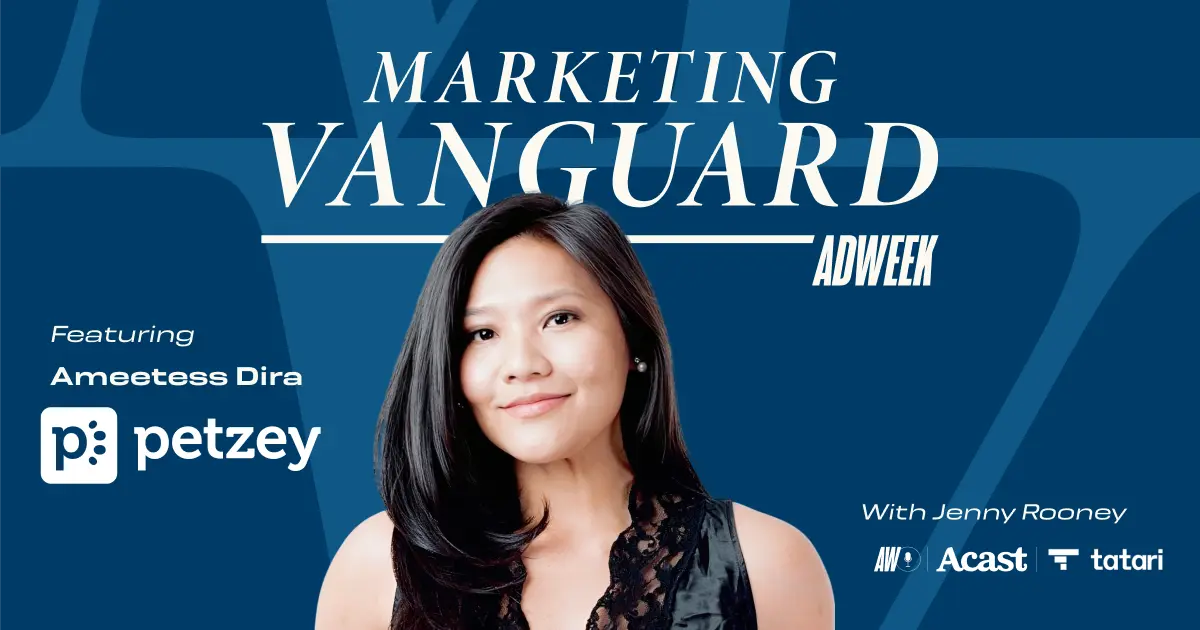
This foundational tension took center stage at Brandweek 2026. Broadcasting live from the prestigious Marketing Vanguard stage, Adweek’s Jenny Rooney sat down with Ameetess Dira, Chief Marketing Officer of Petzey, for an uncompromising exploration of modern leadership. Their conversation sliced through the superficial metrics of the digital age to address the hard choices that define durable brands.
Dira—a seasoned executive whose career spans traditional broadcasting, print, radio, agency leadership, and global technology scaling across Asia and the United States—argues that marketing’s greatest threat is not technological displacement, but internal irrelevance. According to Dira, as automated tools commoditize execution, the true differentiator for a CMO shifts from tactical output to strategic integration.
This special live-recorded vidcast, presented in partnership with Tatari, captures a masterclass in modern brand stewardship. Dira’s philosophy rejects the passive marketing models of the past. Instead, she advocates for a proactive, purpose-aligned, and cross-functional framework where marketing acts as a primary catalyst for product development, financial strategy, and crisis response.
This article explores the core themes of their conversation, breaking down Dira’s framework for purpose-driven alignment, cultural observation, cross-departmental influence, and ethical decision-making that defies short-term spreadsheet logic.
Detailed Chronology: From Personal Loss to Executive Purpose
To understand Ameetess Dira’s approach to marketing, one must examine the personal crucible that shaped her executive philosophy. Her journey into the pet health sector was not calculated purely on market opportunity or total addressable market (TAM) projections; it was catalyzed by a profound personal milestone: the loss of her senior dog.
The Catalyst for Change
Navigating the twilight years and subsequent passing of an aging pet exposes systemic friction within veterinary care: the emotional toll, the financial strain, and the systemic lack of accessible, real-time guidance. For Dira, this experience rewired her professional compass. Having spent decades scaling technology companies and navigating complex international markets across the U.S. and Asia, she reached an inflection point familiar to many senior leaders: the desire to deploy hard-earned skills toward a mission of undeniable consequence.
When the opportunity at Petzey arose, it met her strict personal criteria. Petzey is an on-demand pet telehealth application bridging the gap between pet parents and a robust network of more than 1,000 licensed veterinary professionals across the United States. For Dira, the platform offered a rare intersection: high-growth technology meeting a deeply human (and animal) need.
Operationalizing Empathy
This personal motivation quickly translated into operational strategy. Dira did not view her role as simply packaging a telemedicine app for digital consumption. Instead, she recognized that in a crowded health-tech landscape, trust is the ultimate currency.
During her live conversation at Brandweek 2026, Dira walked the audience through how this founding motivation dictates every subsequent business decision:
- Filtering Partnerships: Evaluating potential brand alliances not purely on audience overlap, but on shared values.
- Navigating Crises: Establishing protocols that prioritize community welfare over immediate monetization during natural disasters.
- Shaping Culture: Positioning the brand to advocate for marginalized pet populations—such as senior animals—that traditional marketers routinely bypass.
By anchoring her strategic framework in genuine utility, Dira transformed Petzey’s marketing from an acquisition engine into a trust-building mechanism.
Supporting Context & Metrics: The Petzey Ecosystem and the Telehealth Revolution
To contextualize Dira’s strategies, one must examine the market dynamics driving the pet care industry. The post-pandemic landscape has witnessed an unprecedented humanization of pets. Households increasingly view companion animals as full family members, driving exponential demand for accessible, high-quality veterinary care.
The Telehealth Imperative
Traditional veterinary clinics face severe labor shortages, burnout, and scheduling backlogs. Pet parents frequently find themselves waiting weeks for routine check-ups or facing exorbitant emergency clinic fees for minor concerns. This friction created a ripe environment for telehealth innovation.
- Network Scale: Petzey has mobilized a nationwide network exceeding 1,000 veterinary professionals, offering real-time, on-demand medical guidance directly to consumers’ mobile devices.
- The Accessibility Gap: The addressable market is vast, yet underserved segments—ranging from low-income pet owners to rural communities and caregivers of aging pets—frequently fall through the cracks of traditional veterinary business models.
- The AI Disruption Factor: As AI-driven diagnostic tools and automated customer service chat-bots flood the pet-tech space, companies risk homogenization. Dira’s leadership emphasizes that while technology can optimize the delivery of care, the underlying brand trust must be fiercely protected by human empathy.
Official Insights & Core Takeaways from the Vanguard Stage
The conversation between Jenny Rooney and Ameetess Dira generated four foundational pillars for modern marketing leadership. These takeaways serve as a blueprint for executives navigating the AI era.
1. Purpose Alignment Is Not a Nice-to-Have
In many corporate structures, "purpose" is treated as a late-stage veneer—a creative campaign slapped onto an existing product to appeal to socially conscious consumers. Dira categorically rejects this model.
"For Ameetess, belief in the company and its leadership is a non-requirement that is non-negotiable. She wants to work with people she trusts enough to do difficult things with because the work serves something bigger than the individuals involved."
Dira makes a vital distinction: purpose is not a marketing layer; it is an executive filter. If an enterprise lacks authentic alignment between its leadership, its product, and a genuine societal contribution, no amount of marketing wizardry can sustain it. For Dira, purpose dictates whether she takes the job in the first place, ensuring that her professional energy is expended on initiatives with intrinsic, durable value.
2. Look Where Everyone Else Says "That’s Too Small"
Modern marketing data encourages herd behavior. Algorithms point brands toward the largest, most obvious audience segments, leading to derivative messaging and diminishing returns. Dira advocates for the exact opposite approach.
- The Senior Dog Paradigm: Senior dog adoption is notoriously difficult, emotionally taxing, and financially demanding. Most brands ignore this demographic because the immediate ROI spreadsheets label it "too small" or "too niche."
- Cultural Observation: Dira actively looks at how culture is changing where people remain underserved. By focusing on overlooked intersections—such as the unique challenges faced by owners of aging pets—Petzey contributes something genuinely useful rather than fighting for the same saturated segments as every other competitor.
- Unconventional Partnerships: This philosophy explains why some of Dira’s most successful brand partnerships looked completely irrational on paper. By refusing to follow the conventional playbook, she identifies white-space opportunities that build fierce, loyal brand communities.
3. Marketing Has No Business Staying in Marketing
One of the most provocative arguments Dira advanced on the Brandweek stage was her critique of insular marketing departments. Too many CMOs restrict their domain to campaigns, creative assets, and lead-generation metrics, effectively isolating themselves from core business operations.
+-------------------------------------------------------+
                THE EXECUTIVE TABLE
+-------------------------------------------------------+
|  [Finance]  <--->  [Product]  <--->  [Technology]     |
|         ^              ^              ^               |
|         |              |              |               |
|         +--------------+--------------+               |
|                        |                              |
|                        v                              |
|             [Ameetess Dira (CMO)]                     |
|    "The executive team is my primary team."           |
+-------------------------------------------------------+
Dira deliberately inserts marketing into product development, technological roadmapping, and financial planning discussions. Her rationale is refreshingly pragmatic:
- The Executive Team as the Primary Team: A CMO’s true allegiance must be to the overall health of the business, not just the marketing department.
- Breaking Down Silos: By participating in product and tech discussions, Dira ensures that customer insights gathered on the front lines directly influence software updates and service offerings.
- Preserving Influence: The modern marketing leader who stays confined to communications and campaigns voluntarily abdicates their influence before major enterprise decisions are made.
4. Sometimes the Right Decision Is the One the Spreadsheet Hates
Perhaps the most powerful moment of the session involved a real-world test of corporate values during a catastrophic crisis.
When destructive wildfires struck Los Angeles, displacing families and putting immense pressure on local infrastructure, the short-term financial logic for a commercial telehealth platform pointed toward capturing surging demand. Emergencies create spikes in anxiety, which traditional business models often view as prime monetization opportunities.
Dira did the exact opposite.
She immediately opened Petzey’s platform to provide free wellness checks for anyone affected by the crisis—extending the service to displaced residents, first responders, teachers, local businesses, and animal shelters.
- Defying Short-Term Metrics: The immediate financial spreadsheet hated this decision. It represented direct operational costs with zero top-line revenue generation.
- Proving Brand Integrity: Dira argued that moments of crisis strip away marketing doublespeak. When a brand steps up to serve its community without a transaction attached, it proves what it actually stands for.
- Durable Equity: While the short-term ledger took a hit, the long-term brand equity, community trust, and human goodwill generated by that single decision yielded immeasurable, lasting value.
Future Outlook: The Role of the CMO in the Age of AI
As we look toward the remainder of the decade, the insights shared by Ameetess Dira at Brandweek 2026 offer a clear directional beacon for the marketing industry.
The Commoditization of Content vs. The Elevation of Strategy
As generative AI automates the production of text, imagery, and programmatic media buying, execution will become a commodity. Brands that rely solely on clever copywriting and high-frequency ad delivery will find themselves locked in a race to the bottom, easily replicated by competitors utilizing superior algorithms.
Dira’s blueprint demonstrates that the future belongs to the integrated executive leader. To thrive, modern CMOs must:
- Embrace Radical Empathy: Build brands rooted in authentic solutions to real human and animal needs, moving far beyond surface-level purpose-washing.
- Operate Cross-Functionally: Sit comfortably at the intersection of finance, product design, and technology engineering, ensuring that brand promise and product delivery are indistinguishable.
- Have the Courage to Defy the Spreadsheet: Recognize that in moments of cultural friction or crisis, ethical integrity and community service outweigh immediate quarterly returns.
Conclusion
Ameetess Dira’s conversation with Jenny Rooney serves as a vital reminder for an industry intoxicated by technological speed. While AI can automate how we reach an audience, it cannot answer the foundational question that every consumer ultimately asks: “Why should anyone choose you?”
For Dira and Petzey, the answer is found not in automated efficiency, but in relentless purpose alignment, unapologetic advocacy for the underserved, and the courage to make decisions that prioritize humanity over margins. That is the standard to which modern marketing must evolve.