

Executive Overview
In the modern marketing landscape, the mandate to "be bold" is often tossed around like a silver bullet. Yet, true creative bravery is a razor-thin tightrope walk. On one side lies stagnant irrelevance; on the other, chaotic brand dilution that leaves consumers bewildered.
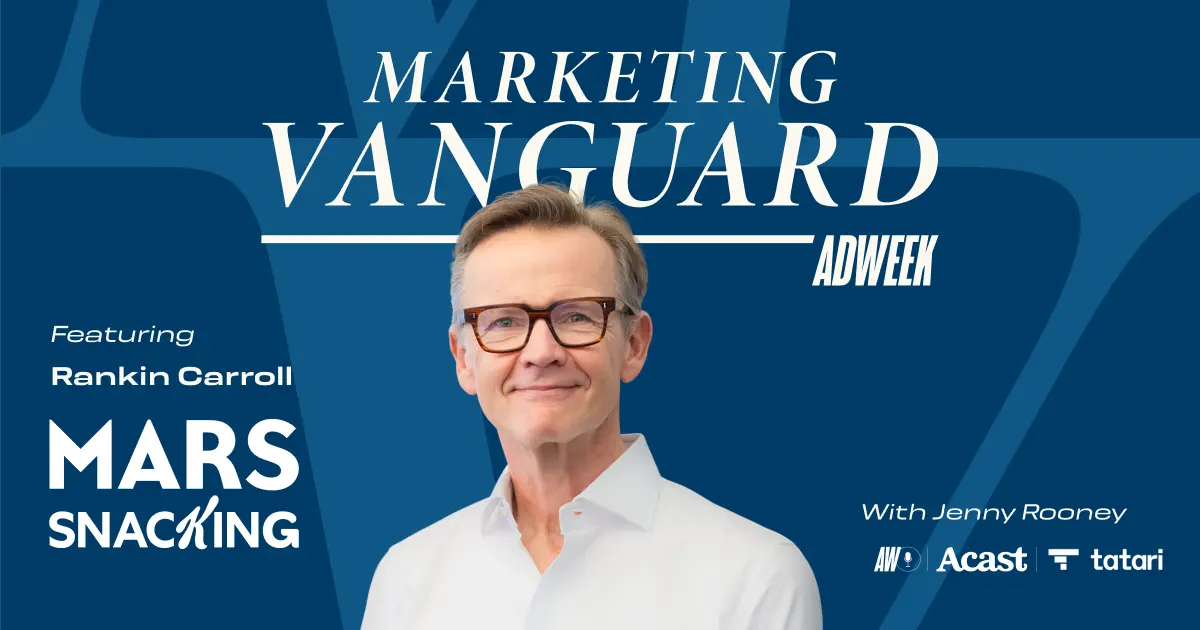
Taking the stage live from the Marketing Vanguard at Brandweek 2026, Jenny Rooney, editor, sat down with Rankin Carroll, Chief Brand Officer of Mars Snacking, for a masterclass in how some of the world’s most iconic consumer packaged goods (CPG)—including M&M’s, Snickers, and Skittles—maintain aggressive cultural relevance without losing their anchoring identity.
Presented in partnership with Tatari as part of a special Brandweek 2026 vidcast series, the conversation moved past standard corporate platitudes. Instead, Carroll delivered a transparent, analytical assessment of modern brand stewardship. He unpacked the terrifying logistics behind the 2023 Snickers artificial intelligence experiment, evaluated the rigorous gatekeeping required to protect long-term equity, confronted the uncomfortable realities of workforce disruption driven by AI, and issued a stern warning against "pilot purgatory."
For brand leaders operating in an era of algorithmic noise, Carroll’s message was unequivocal: The best creative risks should make you slightly nervous, but they should never force you to justify why your brand is taking them in the first place.
Detailed Chronology: Inside Mars Snacking’s Modern Playbook
1. The 2023 Snickers AI Bet: Engineering "Calculated Crazy"
At the Brandweek 2026 session, Carroll pulled back the curtain on one of the most high-stakes digital experiments in Mars’ recent history: an agentic creative experience launched with Snickers in 2023. At the time, generative and agentic AI tools were largely viewed by enterprise legal and security teams as corporate liabilities waiting to happen.
The undertaking was, by Carroll’s own admission, "potentially crazy." Deploying dynamic, AI-driven content at scale meant navigating a minefield of unpredictable outputs, real-time brand safety concerns, and reputational hazards that far outpaced the digital risk models of the day.
"The takeaway is much bigger than ‘take more risk,’" Carroll explained during the live session. "It’s that ambitious experimentation becomes possible when the organization commits to solving the risk together."
The operational reality of the 2023 pilot was staggering. Bringing the concept to life required an integrated coalition of approximately ten specialized tech partners, direct alignment from legal and cybersecurity leadership, and the compilation of a massive blacklist containing 8,000 blocked words.
Rather than letting tech enthusiasts run wild, Mars approached the experiment as a collective exercise in risk mitigation. The success of the campaign did not stem from reckless abandon; it was born from a rigorous, cross-functional refusal to let fear paralyze innovation. By locking arms with legal and technical leads before launch, Mars transformed a potential PR disaster into a masterclass in controlled technological disruption.
2. Earning the Right to Play: The Filter of Brand Authenticity
As brands scramble to capitalize on cultural moments, Carroll drew a sharp distinction between calculated cultural risk and performative, trend-chasing behavior.
He highlighted Skittles’ steadfast relationship with the LGBTQ+ community, noting that the brand was able to weather volatile political and social backdrops simply because it had spent years—and in some cases decades—earning authentic credibility within those spaces. In Carroll’s eyes, trust is not a faucet you can turn on during Pride Month; it is a long-term capital investment that must be meticulously preserved.
To prevent creative teams from falling into the trap of hollow performative activism or trend-hopping, Carroll applies a strict, non-negotiable filter to every major marketing swing:
- Why us?
- Why this brand?
If a marketing team cannot formulate a strategically convincing, authentic answer to those two questions, the idea is immediately scrapped—no matter how viral its potential might seem. Brand equity, Carroll argued, is too fragile to be squandered on ideas that belong to someone else’s narrative.
Supporting Context & Metrics: The Philosophy of Brand Stewardship
To understand Rankin Carroll’s approach to modern marketing, one must examine his extensive tenure within the CPG ecosystem. Having spent more than 20 years at Mars, Carroll’s career has traversed continents (from Toronto to the United Kingdom) and operational verticals, including managing a sprawling ice cream business.
Today, his overarching remit as Chief Brand Officer of Mars Snacking centers on what he defines as the stewardship of distinctive, iconic brands. According to Carroll, true brand stewardship requires balancing three competing imperatives:
- Protect: Safeguard the core equities and emotional resonances that make the brand uniquely valuable to consumers.
- Elevate: Leave the brand stronger, more resilient, and more economically viable than it was when you inherited it.
- Provoke: Introduce enough healthy creative tension to ensure the brand remains culturally relevant to successive generations of consumers.
+-------------------------------------------------------------+
|               THE MARS BRAND STEWARDSHIP MODEL              |
+-------------------------------------------------------------+
|  [ PROTECT ] ---> Safeguard core emotional equities         |
|  [ ELEVATE ] ---> Leave the asset stronger than before      |
|  [ PROVOKE ] ---> Introduce healthy creative tension        |
+-------------------------------------------------------------+
This philosophy directly counters the short-termist metrics plaguing modern digital marketing. While performance marketing often prioritizes immediate click-through rates and algorithmic optimization, Carroll’s framework insists that long-term cultural saliency cannot be bought via cheap impressions. It requires structural integrity, patience, and uncompromising creative standards.
Official Statements & Insights from Brandweek 2026
During the live Brandweek 2026 interview, Carroll addressed several systemic challenges facing contemporary marketing leadership, offering candid assessments on talent development and organizational efficiency.
On Workforce Disruption: Preparing the Next Generation
One of the most sobering moments of the session arrived when Carroll shifted focus away from technology and toward human capital. He raised a critical, uncomfortable question that many industry leaders actively avoid: What happens to junior marketers when the profession is fundamentally reshaped by artificial intelligence?
Carroll openly admitted that the foundational tasks traditionally assigned to entry-level marketers—such as data aggregation, basic copy drafting, asset tagging, and baseline competitive analysis—are precisely the workflows being automated away.
- The Timeline: Carroll projects that the day-to-day practice of marketing will look entirely unrecognizable within three years.
- The Leadership Gap: With refreshing candor, he noted that he does not yet have a fully satisfying answer for how universities or corporate onboarding programs should train the next wave of talent.
- The Verdict: Carroll asserted that talent development can no longer be outsourced to an HR afterthought. It is an urgent, operational leadership responsibility that CMOs must tackle head-on.
On Organizational Chaos: "A Thousand Pilots and No Progress"
Turning to corporate digital transformation, Carroll delivered a stinging critique of decentralized, undisciplined tech adoption. He warned that leaving AI experimentation to disconnected enthusiasts scattered across various departments is a guaranteed recipe for operational chaos.
"A thousand pilots and no progress," Carroll cautioned the Brandweek audience.
His prescription for enterprise leadership is decisive: Chief Marketing Officers must personally own the AI agenda in lockstep with Chief Technology Officers and information security teams. This requires top-down clarity regarding capital investment, technological priorities, and a strict operational framework dictating whether the company should build, buy, rent, or borrow specific capabilities.
His closing warning on the matter served as an industry-wide reality check: Just because technology gives you the capability to deploy AI somewhere in your marketing architecture does not mean you actually should.
Future Outlook: The Horizon for Iconic Brands
As the marketing industry charges deeper into an automated, algorithmically driven future, the lessons from Rankin Carroll’s Brandweek 2026 appearance offer a vital roadmap for enterprise brands.
The future does not belong to the brands that take the most risks; it belongs to the organizations disciplined enough to align their internal structures before stepping onto the cultural stage. By treating AI integration as a collective cross-functional effort rather than a wild-west experiment, and by treating entry-level talent as an endangered asset requiring active re-skilling, Mars Snacking is setting a high benchmark for CPG leadership.
Ultimately, Carroll’s philosophy reminds us that while tools and technologies will inevitably shift from year to year, the core tenets of marketing remain unchanged. Iconic brands do not endure by chasing every fleeting digital trend. They endure because their custodians possess the courage to ask the hard questions—starting with Why us?—long before the cameras roll and the campaigns go live.
