

Executive Overview
Picture the European wilderness of 100,000—or even one million—years ago, and a distinct, evocative image likely comes to mind. It is a world of deep, brooding green: an endless expanse of towering, ancient trees with interlocking canopies that block out the sun, casting the forest floor in permanent shadow. For generations, this "closed-forest paradigm" has served as the bedrock of European conservation, framing dense, unbroken woodlands as the continent’s pristine, untouched baseline before human hands altered the landscape.
According to a sweeping, comprehensive new study published in Biological Conservation, that familiar vision is fundamentally incorrect.
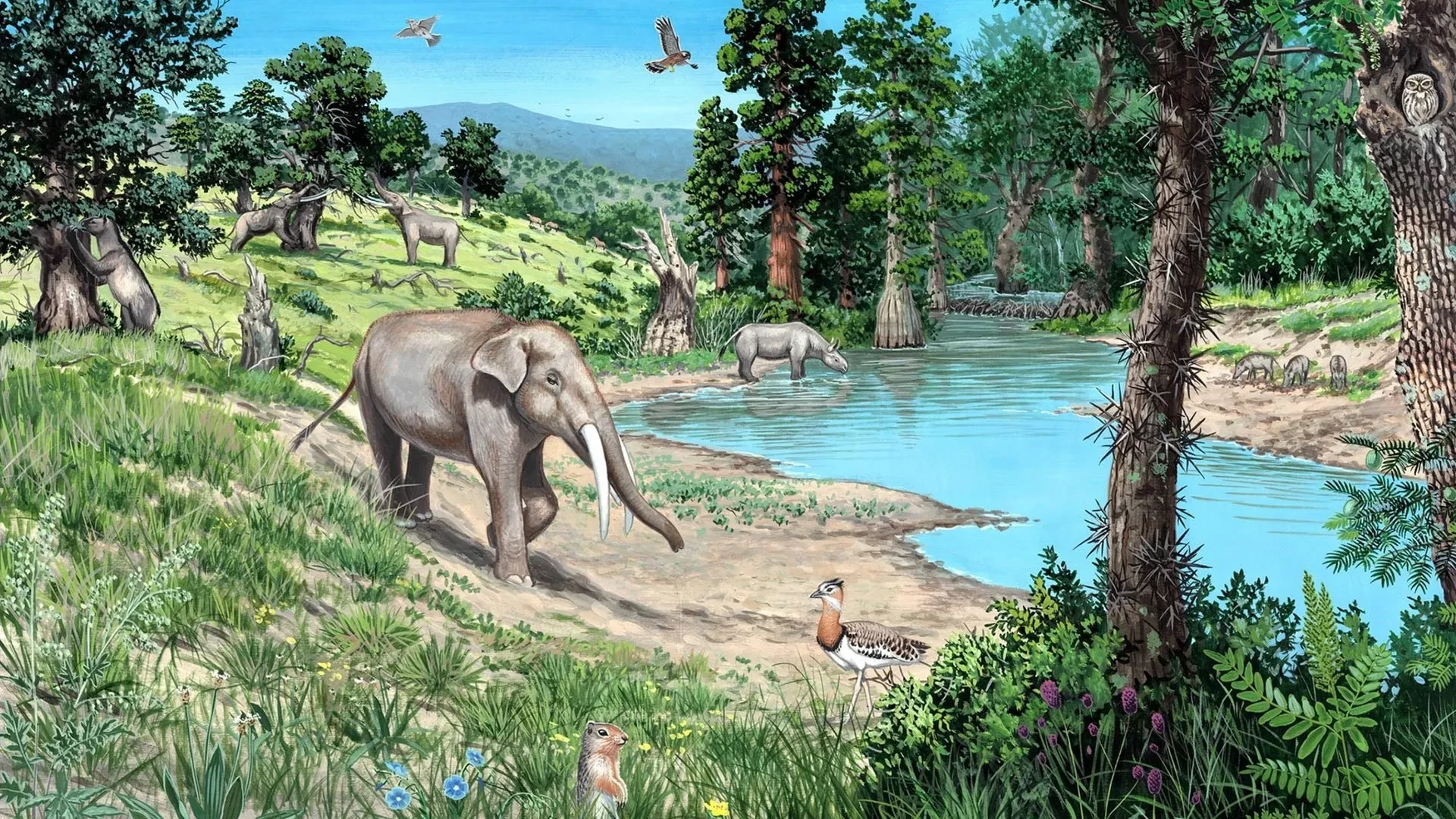
Spearheaded by an interdisciplinary team of researchers at Aarhus University, the research reveals that for more than 20 million years, Europe was not a dark, monotonous sea of trees. Instead, it was a dynamic, sunlit tapestry of scattered woodlands, grassy clearings, shrublands, and vibrant wildflower meadows. This heterogenous landscape was continuously sculpted and maintained by megafauna—massive grazing and browsing animals such as ancient elephants, rhinoceroses, aurochs, and bison—whose movements and appetites prevented trees from monopolizing the terrain.
These findings do more than rewrite prehistoric ecology; they present a direct challenge to modern conservation policy. Across Europe, current reforestation initiatives rely heavily on planting dense blocks of timber to absorb carbon and bolster biodiversity. Yet, this new scientific evidence indicates that these well-intentioned programs may actually be harming the very ecosystems they seek to protect. By forcing open, mosaic landscapes into closed-canopy forests, modern practices are violating millions of years of evolutionary history, threatening species that evolved specifically to thrive in the bright, open spaces of Pleistocene and Miocene Europe.
Detailed Chronology and Methodological Rigor
To overturn a paradigm as deeply entrenched as the closed-forest model, researchers had to look far beyond the historical and archaeological records typically relied upon by conservationists. Led by Szymon Czyzewski, a PhD student at Aarhus University’s Center for Ecological Dynamics in a Novel Biosphere (ECONOVO), the research team constructed an unprecedented paleoecological timeline spanning more than 23 million years.
Reconstructing the Miocene to the Pre-Industrial Era
While previous ecological investigations have often focused on the late Pleistocene or Holocene—periods heavily impacted by early human activity—this study extended deep into the past. It captured data stretching from the Miocene epoch through the pre-industrial era, providing a multi-million-year baseline of European ecosystem dynamics.
To achieve this, the researchers integrated multiple independent, high-resolution scientific methods. Because no single proxy can fully reconstruct a prehistoric environment, the team cross-referenced several lines of empirical data:
- Fossilized Pollen and Macrofossils: Plant remains and pollen grains preserved in lake beds and peat bogs offered a continuous record of the dominant flora shifting over millennia.
- Charcoal Records: Sedimentary layers preserved charcoal deposits left by ancient wildfires, indicating the frequency of fires and the dryness of the terrain.
- Stable Isotope Analysis: Chemical signatures extracted from the fossilized teeth and bones of ancient herbivores revealed dietary preferences, confirming whether animals fed on closed-canopy browse or open-country grasses.
- Fossil Insects and Mammals: Assemblages of micro- and macro-fauna provided clues regarding the openness of the canopy and microclimate conditions.
- Sedimentary Ancient DNA (sDNA): Genetic material shed by plants and animals into their environments was extracted from ancient soil and sediment layers, identifying species present long after their physical remains had decayed.
By synthesizing these diverse datasets across deep time, the research team tracked long-term vegetation shifts with unprecedented confidence. The results revealed a striking consistency: across millions of years, under vastly different climatic regimes—including both warm interglacials and cold glacials—Europe’s landscapes stubbornly resisted transitioning into continuous closed forests. Instead, they maintained a shifting, open mosaic.
Supporting Context & Metrics: The Architecture of Ancient Europe
The portrait of prehistoric Europe painted by the Aarhus University study forces a complete recalibration of how scientists view biodiversity, evolution, and land management.
The Megafaunal Engineers
Central to this open-woodland paradigm is the role of large wild herbivores. In the modern imagination, animals like elephants and rhinos are confined to African savannas or tropical jungles. Yet, until relatively recently in geological terms, Europe was home to an extraordinary roster of megafauna.
Forest elephants (Palaeoloxodon), massive forest rhinoceroses, wild aurochs, and ancestral bison roamed the continent in staggering numbers. These animals were not passive inhabitants of their environment; they were active landscape engineers. By consuming massive quantities of saplings, stripping bark, trampling undergrowth, and creating wallows, megafauna systematically suppressed the unchecked advance of trees. Their physical disturbances opened up niches for light-loving species, ensuring that grasses, shrubs, and wildflowers could flourish alongside pockets of mature timber.
Evolutionary Misalignments
The study’s findings shed light on the evolutionary history of numerous species currently mischaracterized as "man-made" or agricultural interlopers.
- Avian and Mammalian Lineages: Birds such as larks and jackdaws, along with mammals like the European hamster, are frequently categorized as species adapted to human-managed farmland. The new research demonstrates that their evolutionary roots sink much deeper, having developed in the natural, open woodland environments that existed long before the dawn of agriculture.
- Flora and Fauna Connections: Even familiar wildflowers—such as wild poppies, commonly seen blanketing modern agricultural fields—are ancient inhabitants of these disturbed, sunlit woodland ecosystems, where megafauna once churned the earth.
The sharp modern dichotomy between "forest" and "open habitat" is revealed to be an artifact of recent history, accelerated by the eradication of large herbivores and the intensification of human land-use over the last century.
Official Statements and Expert Analysis
The implications of the Biological Conservation paper extend far beyond academic circles, offering a direct critique of current European environmental policy.
Professor Jens-Christian Svenning, senior author of the study and head of ECONOVO at Aarhus University, did not mince words regarding the shortcomings of current conservation frameworks:
"The study shows that current reforestation practices are on the wrong track—both here in Denmark, where subsidies are only granted for planting dense forests, and elsewhere in Europe," Svenning stated. "This will not only be harmful for biodiversity; it will be in direct contradiction to the type of ecosystems that Europe’s species have evolved in over millions of years."
Szymon Czyzewski, the study’s lead author, emphasized the profound ecological rupture caused by the loss of large herbivores over the past century:
"The ecosystems we see in Europe today lack the large wild herbivores that not only shaped landscapes but also sustained its biodiversity for millions of years," Czyzewski explained. "The most dramatic shift has largely taken place within the last hundred years, when traditional extensive grazing disappeared from large parts of the landscape."
This abrupt cessation of traditional grazing and browsing pressure has triggered ecological succession, allowing shade-tolerant trees to choke out the diverse mosaic habitats that once characterized the continent. Without active intervention to restore natural disturbance regimes, Europe’s biodiversity continues to suffer from a homogenized landscape.
Future Outlook: Reimagining Conservation for the 21st Century
As European nations ramp up green initiatives to meet ambitious climate targets, the debate over land use has never been more urgent. Planting trees is frequently promoted as a silver bullet for carbon sequestration and biodiversity loss. However, this study issues a clear warning: counting stems without considering ecological context can backfire.
Beyond the "Plant More Trees" Mantra
If continuous, closed-canopy forests are not Europe’s natural baseline, then treating reforestation as a universal ecological remedy is flawed. Converting heterogeneous shrublands, heaths, and meadows into dense timber plantations risks destroying specialized habitats for countless species of insects, birds, and plants that depend on sunlight and open space.
Instead, the researchers advocate for a paradigm shift in European rewilding and conservation strategies:
- Mosaic Management: Conservation planning must prioritize the creation and maintenance of dynamic mosaics—interlocking patches of open grassland, scrub, wetland, and scattered woodland.
- Megafauna Restoration: Reintroducing or functionally mimicking the role of large herbivores is essential. While bringing back straight-tusked elephants is impossible, programs that reintroduce European bison, semi-wild cattle, and horses can help restore natural grazing and browsing pressures.
- Process-Oriented Conservation: Rather than micro-managing specific flora, future initiatives must focus on restoring the ecological processes—such as natural fire regimes, soil disturbance, and herbivory—that naturally maintain biodiversity.
Conclusion
The familiar image of Europe as an unbroken, dark primeval forest is deeply ingrained in cultural and scientific lore. Yet, backed by 23 million years of empirical evidence, science is telling a richer, brighter story. To successfully protect Europe’s biodiversity in the face of modern environmental crises, conservationists must look backward to move forward—embracing a wilder, more open vision of nature where trees, meadows, and large animals exist in a delicate, ancient balance.
