

Executive Overview
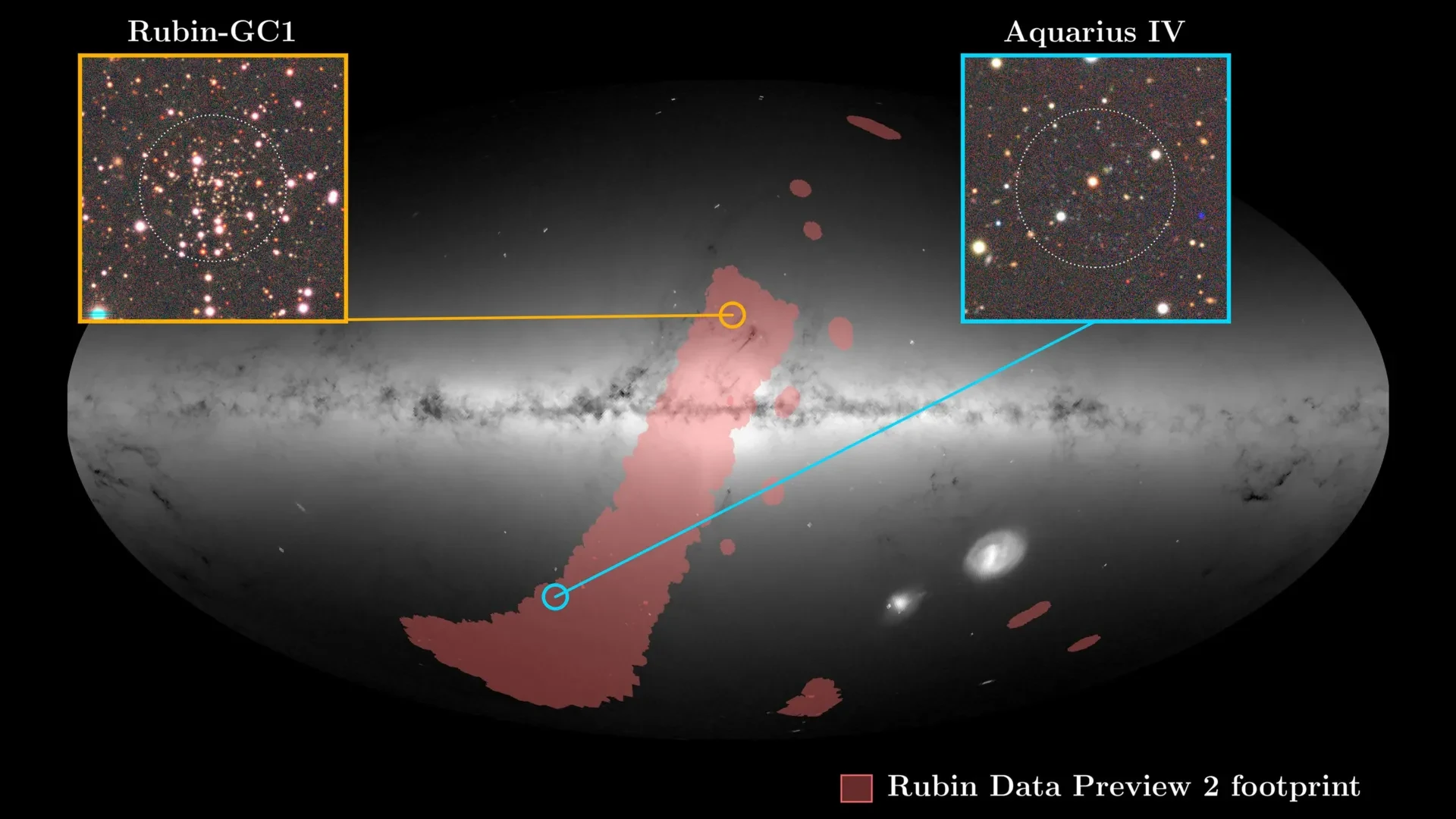
The cosmic dawn of a new era in observational astronomy has officially arrived from the high-altitude peaks of the Chilean Andes. The newly completed National Science Foundation-Department of Energy (NSF-DOE) Vera C. Rubin Observatory has made its maiden scientific breakthrough, uncovering two previously unknown companions lurking in the cosmic shadows of our Milky Way. These early discoveries—unearthed during the analysis of limited "preview" data covering a mere 7% of the night sky—not only expand our local galactic census but signal an imminent deluge of astronomical discoveries.
For decades, theoretical models have predicted the existence of hundreds of faint, ultra-diffuse satellite galaxies and stellar clusters orbiting the Milky Way, hidden from the view of even the most powerful historical telescopes due to their extreme dimness and obscuring cosmic dust. The Rubin Observatory, armed with the largest digital camera ever constructed and an 8.4-meter survey telescope, has now proven its capability to penetrate these cosmic veils.
Spearheaded by an international collaboration of researchers—including prominent teams from Yale University and the University of Chicago—these initial findings offer a breathtaking preview of the facility’s ambitious 10-year Legacy Survey of Space and Time (LSST). Beyond simply adding to the tally of galactic neighbors, these ultra-faint stellar systems provide invaluable astrophysical laboratories. They hold the key to decoding the elusive nature of dark matter, reconstructing the chaotic assembly history of our home galaxy, and refining our understanding of how the universe’s smallest structures form and survive.
Detailed Chronology: From Preview Data to Galactic Breakthroughs
The path toward these groundbreaking discoveries began well before the Rubin Observatory officially commenced its full-scale 10-year survey in June. Situated high atop Cerro Pachón in Chile, the facility entered an intensive phase of testing and calibration, gathering early-stage preview data between April 2025 and January 2026.
Astronomers poured over these preliminary observations, searching for overdensities of stars that might indicate the presence of long-hidden satellite systems. This methodical search bore fruit with the identification of two distinct, highly elusive objects:
1. Aquarius IV: The Distant Outlier
The first discovery, designated Aquarius IV, is an ultra-faint dwarf galaxy residing in the distant, sparse outskirts of the Milky Way. Located approximately 355,000 light-years from Earth, Aquarius IV is a pristine relic of the early universe. Dwarf galaxies like this contain only a minuscule fraction of the stars found in major galaxies, making their detection akin to finding a single candle lit across an ocean. Yet, its discovery in early-stage data underscores the unprecedented sensitivity of Rubin’s imaging systems.
2. Rubin-GC1: The Dusty Infiltrator
The second discovery, named Rubin-GC1, is a dense star cluster located on the opposite side of our galaxy. Unlike Aquarius IV, which sits in the relative clarity of the outer halo, Rubin-GC1 was hidden within a region plagued by thick, obscuring clouds of galactic dust. Starlight passing through these regions is heavily dimmed and reddened, creating a nearly impenetrable barrier for conventional optical telescopes. Rubin’s wide-field vision and exceptional light-gathering power allowed researchers to peer through this interstellar fog and bring the cluster into focus.
Academic Publications and Leadership
The findings were quickly documented in two separate, peer-reviewed studies. The discovery of Aquarius IV was led by William Cerny, an astronomy graduate student in Yale’s Graduate School of Arts and Sciences, and published in Research Notes of the AAS. Cerny also served as a co-author on the companion study detailing Rubin-GC1, which has been accepted for publication in The Astrophysical Journal Letters and was led by Aashay Pai of the University of Chicago.
Reflecting on the pace of these discoveries, Cerny noted that finding systems of this caliber using only a fraction of the observatory’s total projected lifespan guarantees that the full 10-year survey will revolutionize our census of the local universe.
Supporting Context & Metrics: The Engineering Marvel Behind the Discoveries
To fully grasp the significance of finding Aquarius IV and Rubin-GC1, one must examine the staggering scale and engineering prowess of the Vera C. Rubin Observatory.
The Simonyi Survey Telescope and 3.2-Gigapixel Camera
At the heart of the observatory is the 8.4-meter Simonyi Survey Telescope, paired with a custom-built digital camera measuring the size of a small car and boasting an astonishing resolution of 3.2 gigapixels. This massive sensor allows the telescope to capture vast swaths of the southern sky in unprecedented detail, recording light from objects millions of times fainter than what the naked eye can perceive.
The Scope of the LSST
The observatory’s primary engine of discovery is the Legacy Survey of Space and Time (LSST), a decade-long project designed to systematically image the entire available southern sky every few nights. By repeatedly photographing the same regions, Rubin creates a continuous time-lapse record of the dynamic cosmos. This capability not only helps astronomers track transient phenomena—such as exploding supernovae and near-Earth asteroids—but also allows them to stack exposures, effectively deepening the image to reveal objects previously lost in the cosmic noise.
Mapping the Milky Way’s Halo
A primary scientific mandate of the LSST is to map the Milky Way’s "halo." This vast, spheroidal envelope surrounds the galaxy’s bright spiral disk and contains ancient stars, diffuse gas, dark matter, and a swarm of orbiting satellite galaxies and globular clusters. Because the halo preserves the archaeological record of how the Milky Way grew by cannibalizing smaller systems over billions of years, discovering its missing satellites is vital for reconstructing our galaxy’s evolutionary timeline.
A Global Collaboration
The success of these initial studies highlights the collaborative nature of modern astrophysics. The research mobilized a formidable coalition of international academic and scientific institutions. Alongside Yale University and the University of Chicago, contributing organizations included:
- University of Virginia
- University of Washington
- Dartmouth College
- University of Tampa
- NSF NOIRLab
- Duke University
- University of Toronto
- Instituto de Astrofísica de Andalucía (Spain)
- University-of Colorado Boulder
- Lund University (Sweden)
Official Statements and Expert Perspectives
The astronomical community has greeted these early results with a mixture of profound awe and validation, viewing them as the opening salvo of a golden age in galactic archaeology.
Marla Geha, a professor of astronomy and physics in Yale’s Faculty of Arts and Sciences and co-author on both studies, shared her perspective on watching decades of theoretical work materialize into observational reality.
"Finding new Milky Way satellites in Rubin Observatory data has been an exciting future prospect for most of my career," Geha remarked. "It is remarkable this is now a reality."
Geha emphasized that the discovery of Aquarius IV and Rubin-GC1—achieved using data covering just 7% of the night sky—provides a statistically robust indicator that hundreds more dwarf galaxies and star clusters are waiting to be unmasked.
"These discoveries are incredibly promising," Geha added. "Continued discoveries will allow us to complete the census of satellite galaxies around the Milky Way, which is a key to understanding how the faintest galaxies form and survive in the harsh gravitational tides of a giant galaxy."
William Cerny echoed these sentiments, pointing directly to the broader implications for fundamental physics.
"These new satellites will give us new opportunities to test models of galaxy formation, trace the assembly history of the Milky Way, and investigate the nature of dark matter," Cerny stated.
Future Outlook: Decoding Dark Matter and the Missing Satellites
As the Vera C. Rubin Observatory pushes further into its inaugural year of the LSST, the scientific horizon has never looked broader or more promising. The implications of finding these ultra-faint systems extend far beyond stellar cartography, striking at the very heart of modern cosmology.
The Dark Matter Enigma
Perhaps the most profound application of these discoveries lies in the study of dark matter. Comprising an estimated 85% of all matter in the universe, dark matter neither emits, absorbs, nor reflects light, rendering it entirely invisible to standard electromagnetic detectors. Its presence is inferred solely through its gravitational scaffolding, which dictates the rotation of galaxies and the large-scale structure of the cosmos.
Ultra-faint dwarf galaxies like Aquarius IV represent the ultimate cosmological laboratories for testing dark matter theories. While luminous stars make up only a tiny fraction of their total composition, these systems are overwhelmingly dominated by dark matter. By measuring the velocities and velocity dispersions of the few stars residing within them, astrophysicists can map the distribution of dark matter on small scales. This helps researchers distinguish between competing theories, such as Cold Dark Matter (CDM) versus alternative models like Warm Dark Matter or Self-Interacting Dark Matter.
Completing the Galactic Census
Current astronomical models predict that a healthy spiral galaxy like the Milky Way should be orbited by hundreds of satellite systems. However, observed counts historically fell short of these theoretical predictions—a discrepancy known in astrophysical literature as the "Missing Satellites Problem."
With the Rubin Observatory now operational and proving its aptitude for sniffing out the dimmest galactic fragments, astronomers are poised to determine whether this discrepancy was simply an observational artifact—meaning the satellites were always there, just too faint to see—or if our theoretical models of galaxy formation require revision.
A Transforming Landscape
Over the next decade, the deluge of data streaming from Cerro Pachón will fundamentally rewrite our textbooks. As the Rubin Observatory maps the southern sky night after night, it will not only complete the census of our galactic backyard but also cast its gaze deeper into the universe, tracking billions of galaxies and probing the mysteries of dark energy and cosmic expansion.
For now, the quiet discovery of two faint companions—one in the distant expanse, the other buried in cosmic dust—stands as a triumphant proof of concept. The twilight of the unknown is receding, and the universe is finally stepping fully into the light of the Vera C. Rubin Observatory.
