

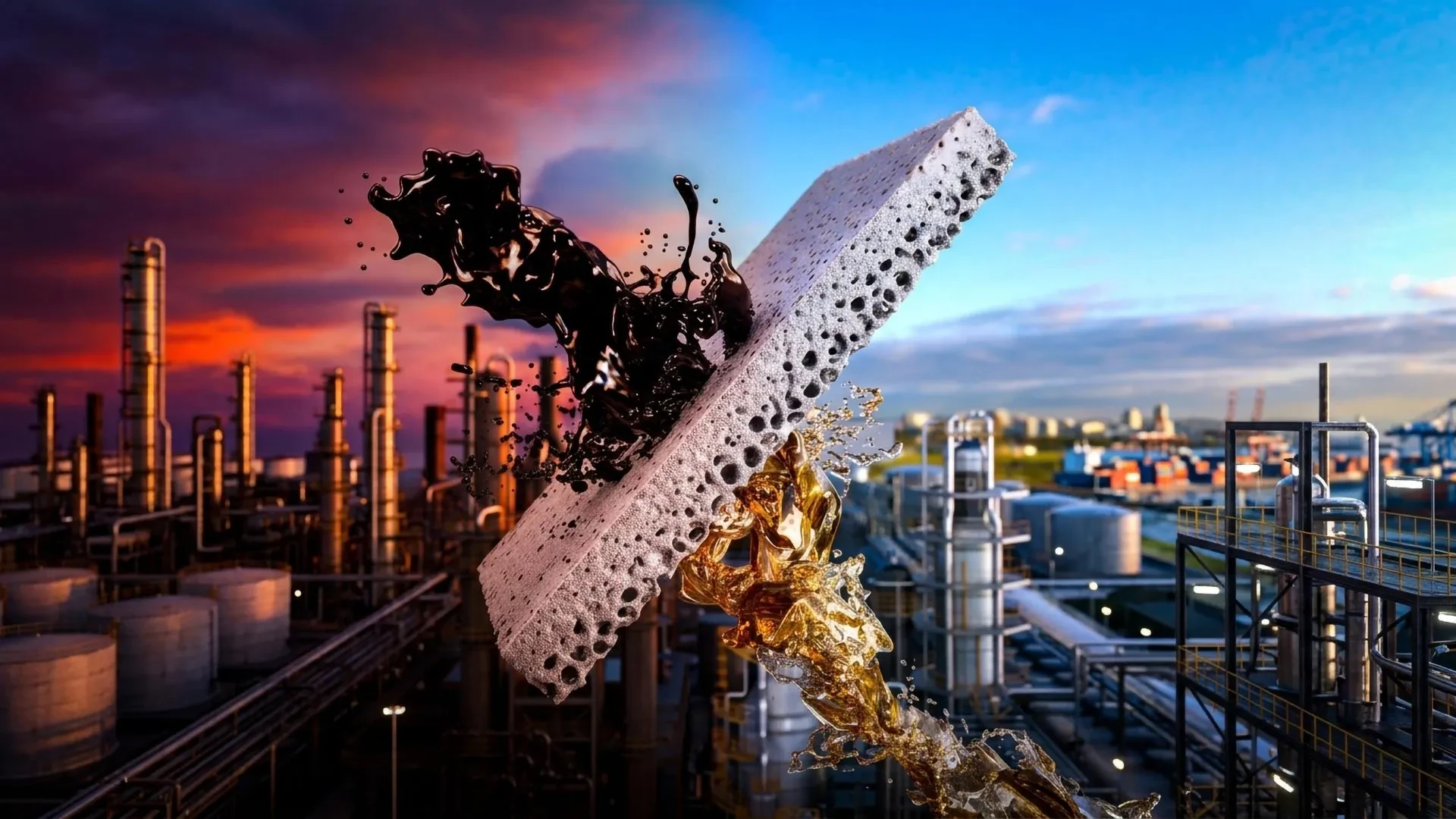
Executive Overview
For over a century, the global petrochemical industry has operated under a single, highly energy-intensive paradigm: if you want to separate crude oil into its valuable components, you have to boil it. This thermal distillation process—relying on massive furnaces that heat hydrocarbons to upwards of 350°C (662°F)—is a foundational pillar of modern civilization. It yields not only the gasoline, diesel, and jet fuel powering global transit, but also the fundamental feedstocks required to manufacture plastics, synthetic clothing, advanced packaging, and pharmaceuticals.
However, this reliance comes at a staggering environmental and financial cost. Globally, crude oil distillation consumes approximately 1,100 terawatt-hours (TWh) of energy every year—an astronomical figure roughly equivalent to the continuous energy output of 130 large-scale nuclear power plants. This insatiable appetite for heat makes the refining sector one of the world’s most potent drivers of greenhouse gas emissions.
Now, an international team of researchers from the Korea Advanced Institute of Science and Technology (KAIST) and the Georgia Institute of Technology has upended a century of chemical engineering dogma. In a breakthrough published in the prestigious journal Nature, the research collective demonstrated a radically simple, room-temperature method for separating crude oil using an inexpensive, uncoated polymer membrane.
By turning a traditional industrial failure—membrane "fouling" or clogging—into a clever operational advantage, the team achieved fluid permeation rates roughly 23 times higher than previous state-of-the-art separation membranes. Computer simulations suggest that retrofitting existing refineries with these modular filters could slash refining energy consumption by 31.6%, cut carbon dioxide emissions by 37.6%, and reduce operating costs by over a third. As global industries scramble for pathways to net-zero emissions, this humble filter may represent one of the most consequential material science breakthroughs of the decade.
Detailed Chronology of the Breakthrough
The path to room-temperature crude oil separation was not paved by developing increasingly complex, ultra-thin molecular coatings, but rather by stepping back and rethinking the fundamentals of membrane science.
The Traditional Membrane Roadblock
For decades, chemical engineers recognized that membranes offered an alluring alternative to thermal distillation. In theory, if a filter could selectively allow certain hydrocarbon molecules to pass while blocking others based on size or chemical affinity, refineries could bypass the energy-draining phase-change cycle of turning liquids into vapors and back into liquids.
Yet, practical application stalled due to severe manufacturing hurdles. Conventional wisdom dictated that high-precision molecular separation required membranes covered with extraordinarily thin, highly specialized active layers. While these coatings offered the necessary selectivity, they were prohibitively expensive to synthesize, exceptionally difficult to scale up without defects, and notoriously fragile when exposed to harsh industrial chemicals. Consequently, the petrochemical industry remained wedded to thermal distillation.
Flipping the Script on Membrane "Fouling"
Led by Professor Dong-Yeun Koh at KAIST and working in close collaboration with Professor Ryan Lively’s research group at Georgia Tech, the international team decided to abandon complex coatings altogether. Instead, they tested a bare, commercially available ultrafiltration membrane constructed from porous polyacrylonitrile (PAN)—an inexpensive, chemically stable polymer routinely used as a rudimentary support backing in standard industrial filtration setups.
When raw, unrefined crude oil—supplied directly by industrial partner HD Hyundai Oilbank to ensure real-world validity—was passed through the uncoated PAN membrane at room temperature, an unexpected phenomenon occurred.
As the complex hydrocarbon mixture flowed through the microscopic pores of the PAN material, heavier, long-chain hydrocarbon molecules naturally accumulated and adhered along the inner walls of the pathways. Rather than instantly ruining the filter, this accumulation created a self-regulating constriction. The deposition of heavier molecules gradually narrowed the pore openings down to sub-nanometer channels measuring less than 2 nanometers across.
In essence, the crude oil engineered its own molecular sieves in situ.
A Self-Assembled Separation Engine
This spontaneously formed network of ultra-narrow channels acted with remarkable precision. Lighter, more mobile fractions of the crude oil—including valuable high-demand components like naphtha, gasoline, and kerosene—rushed through the membrane with unprecedented ease. Meanwhile, the bulkier, heavier hydrocarbon fractions were successfully turned away.
In membrane science, the accumulation of matter inside pores is traditionally classified as "fouling"—an enemy of efficiency that degrades performance, chokes fluid flow, and necessitates frequent chemical cleaning or membrane replacement. By harnessing fouling as a constructive mechanism rather than a destructive impediment, the KAIST and Georgia Tech researchers transformed a catastrophic failure mode into a high-performance separation engine.
The resulting uncoated PAN membranes achieved crude oil permeation rates roughly 23 times higher than any previously documented crude oil separation membranes. Crucially, the system demonstrated robust industrial durability, maintaining stable performance and separation capability over 28 consecutive days of continuous operation.
Supporting Context & Metrics: The Scale of Impact
To understand the transformative potential of the KAIST-Georgia Tech membrane, one must examine the staggering scale of contemporary petrochemical operations and the specific metrics governing refinery economics.
The Thermal Burden of Distillation
Atmospheric and vacuum distillation columns are the beating hearts of modern oil refineries. Operating 24 hours a day, 365 days a year, these towering steel columns heat crude oil past 350°C to vaporize its constituent fractions, allowing them to condense at varying heights within the column based on their boiling points.
The annual energy footprint of this global distillation process—1,100 TWh—carries profound economic and environmental consequences. It requires burning massive quantities of refinery fuel gas or natural gas, pumping colossal volumes of cooling water to condense vapors, and emitting hundreds of millions of tonnes of carbon dioxide into the atmosphere.
Projected Efficiency and Economic Gains
Because the new PAN membrane operates entirely at room temperature and requires no phase change (liquid-to-vapor-to-liquid), it sidesteps the primary thermodynamic penalties of traditional refining. Process simulations modeling the integration of these membranes as a pre-treatment stage—installed upstream to process crude oil before it enters conventional thermal units—yielded extraordinary projections:
- Energy Consumption Reduction: 31.6% decrease in total energy usage.
- Carbon Emissions Mitigation: 37.6% reduction in carbon dioxide ($CO_2$) emissions.
- Cooling Water Conservation: 20.7% drop in cooling water requirements.
- Operating Cost Savings: 36.0% reduction in overall operating expenditures.
To put these figures into a national perspective, researchers calculated the potential impact of deploying the technology across South Korea’s domestic refining and petrochemical sectors alone. The transition could eliminate approximately 10 million tonnes of greenhouse gas emissions annually—an environmental offset equivalent to taking roughly 4 million internal combustion engine vehicles off the road every year.
Infrastructure Compatibility
One of the most significant barriers to adopting green technology in heavy industry is the capital expenditure required to overhaul existing plants. Refineries represent multi-billion-dollar investments designed to operate for decades.
The KAIST-Georgia Tech innovation solves this adoption hurdle through modularity. The membrane units can be dropped into existing facilities as a modular pretreatment filtration step. By partially separating lighter fractions upstream, the membranes reduce the thermal load on legacy distillation towers, allowing refineries to decarbonize and cut operating costs without tearing down or rebuilding their core infrastructure.
Official Statements and Academic Insights
The collaborative nature of the research brought together leading minds in polymer science, chemical engineering, and industrial application. The project’s principal investigators and key contributors emphasized both the fundamental scientific breakthrough and the pragmatic path toward commercialization.
Reflecting on the productivity bottlenecks that historically plagued membrane research, Professor Ryan Lively of Georgia Tech noted:
"One of the key challenges facing membrane systems for crude oil separation was the low productivities of the membrane units—the PAN membranes with their surprising separation mechanism dramatically increase the productivity of the membrane unit, to the point where industry should seriously consider adopting the technology."
Detailing the mechanics of the discovery, Professor Dong-Yeun Koh of KAIST highlighted the importance of real-world testing:
"This study reveals a new scientific principle in which a membrane interacts with a complex mixture and spontaneously forms its own separation channels. Working with real crude oil supplied by HD Hyundai Oilbank allowed us to validate the technology under conditions relevant to industrial operation."
Addressing the roadmap for future industrial deployment, Professor Jae W. Lee of KAIST, a co-corresponding author of the study, emphasized scalability:
"By advancing large-area membrane modularization and long-term operational reliability, we hope to broaden the adoption of membrane-based processes throughout the refining and petrochemical industries."
The study’s co-first authors, Dr. Jihoon Choi and Dr. Hyeokjun Seo of KAIST, outlined the broader vision for the platform technology:
"Our goal is to precisely control this spontaneous pore-constriction phenomenon and develop it into a membrane platform applicable to the entire refining process. We also aim to expand the technology to plastic recycling, biofuel purification, and other sustainable chemical processes that support carbon neutrality."
The research was made possible through foundational backing from the South Korean government, receiving critical support from the Ministry of Science and ICT via the Basic Research Program for Outstanding Early-Career Researchers and the Engineering Research Center (ERC) Program.
Future Outlook: Beyond Crude Oil Refining
While the immediate application of this self-assembling membrane technology targets the petroleum refining sector, its underlying chemical principles open doors across multiple green-tech and industrial domains.
Plastic Recycling and Pyrolysis Oil
As the global economy transitions toward a circular model for plastics, chemical recycling has emerged as a vital tool. When waste plastics are thermally broken down via pyrolysis, they yield a complex liquid mixture known as pyrolysis oil. Just like crude oil, pyrolysis oil is a dense, multi-component hydrocarbon soup that requires separation before its fractions can be reused as pristine chemical feedstocks. The KAIST-Georgia Tech membrane platform could revolutionize pyrolysis oil upgrading, making chemical recycling significantly more energy-efficient and economically viable.
Pharmaceutical Purification and Battery Manufacturing
Beyond heavy hydrocarbons, the spontaneous pore-constriction mechanism could find a home in precision chemical manufacturing. The technology holds immense promise for recovering valuable organic solvents used in lithium-ion battery manufacturing, purifying delicate pharmaceutical compounds, and streamlining the production of advanced biofuels.
In each of these scenarios, the core innovation remains the same: abandoning the pursuit of expensive, flawless surface coatings and instead allowing complex liquid streams to dynamically sculpt their own micro-channels through controlled, predictable fouling.
Path to Commercialization
Despite the groundbreaking nature of the Nature publication, significant work remains before these membranes appear in commercial refineries worldwide. The research team is actively focused on scaling up membrane production to large industrial formats and verifying long-term operational reliability under punishing, multi-year industrial conditions.
If these scaling efforts succeed, the petrochemical industry may soon witness a quiet revolution—one where the century-old roar of roaring distillation furnaces is tempered by the silent, efficient flow of self-engineered polymer filters, steering heavy industry toward a cleaner, more sustainable horizon.