

Executive Overview
For generations, Princeton University has projected an image of academic prestige, institutional philanthropy, and enlightened leadership. As the top-ranked institution in the United States, according to prominent higher education indices, it boasts a campus anchored by historic architecture, world-renowned special collections, and a towering legacy of shaping American politics and global thought. However, beneath the manicured lawns, neo-Gothic spires, and hallowed research archives lies a sobering historical entanglement: a deeply woven connection to the transatlantic slave trade, the American colonization movement, and the corporate extraction of West African resources.
This investigative report explores how Princeton—frequently dubbed the "Southern Ivy" due to its historical alignment with southern political interests and racial paradigms—played an instrumental role in the founding and exploitation of the Republic of Liberia. Through figures such as University President John Witherspoon, early abolitionist-disguised deportation advocates of the American Colonization Society (ACS), and the twentieth-century expansion of the Firestone Tire and Rubber Company, the university’s institutional infrastructure, financial endowments, and intellectual cachet were built, in part, on the subjugation of indigenous African populations and the systemic displacement of freed Black Americans.

As contemporary institutions navigate the turbulent waters of post-affirmative action admissions drops, targeted federal investigations into diversity, equity, and inclusion (DEI) initiatives, and campus activism, the reckoning with Liberia exposes a profound structural amnesia. By tracing this history from the colonial ports of the nineteenth century to the high-security academic offices of modern-day scholars, this piece illuminates the enduring cost of historical erasure and the urgent necessity of collective remembrance.
Detailed Chronology
1. The Antebellum Era and the American Colonization Society (1768–1868)
Princeton’s structural connection to the African continent began long before the scramble for African territory in the late nineteenth century.

- The Witherspoon Legacy (1768–1794): John Witherspoon, president of Princeton (then the College of New Jersey) from 1768 to 1794 and a signer of the Declaration of Independence, was a slaveholder who actively resisted the immediate emancipation of enslaved people, maintaining that freed Black populations would be "free to their own ruin." Despite student protests and public scrutiny regarding his ideological legacy, university trustees defended his central commemorative footprint on campus.
- Architects of Displacement (Early 19th Century): Princeton alumni served as the intellectual and administrative masterminds behind the American Colonization Society (ACS), founded between 1821 and 1822. Charles Mercer (Class of 1797), Elias Caldwell (Class of 1796), and Reverend Robert Finley (Class of 1787) championed the relocation of free Black Americans to West Africa. Masked in the language of progressive benevolence, the movement operated on a two-fold premise of racial exclusion: that integrated American social life could not function with free Black citizens, and that relocated individuals could "civilize" indigenous African populations.
- The Seizure of Cape Mesurado: In 1821, U.S. naval officer Robert F. Stockton—tied to a prominent Princeton family and acting on behalf of colonial interests—used gunpoint diplomacy, holding a pistol to the head of indigenous Dei leader "King Peter," to secure the land that would become Monrovia and the nucleus of Liberia.
- The Doughface Presidency: John Maclean Jr., Princeton’s president from 1854 to 1868, served as a prominent president of the New Jersey Colonization Society (NJCS). Known as a "doughface"—a northern politician sympathetic to southern slaveholding interests—Maclean fostered an academic environment accommodating to southern students up to and through the American Civil War.
2. The Firestone Era and Twentieth-Century Extraction (1926–1947)
The structural relationship between Princeton and Liberia evolved from ideological deportation to industrial extraction in the twentieth century.
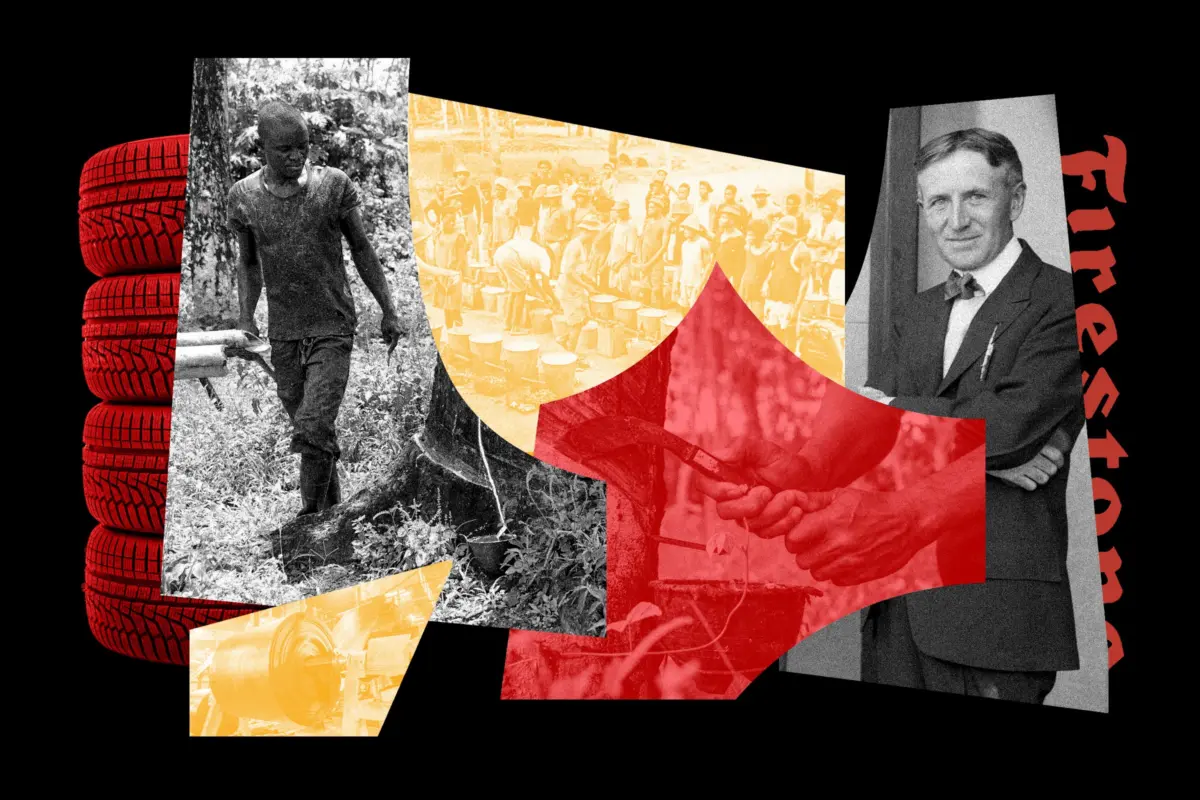
- The 1926 Concession: The Firestone Tire and Rubber Company secured a one-million-acre lease of continuous forest land in Harbel, Liberia, for a nominal fee of six cents per acre and a one percent royalty on rubber exports. According to historian Walter Rodney, this arrangement propelled Firestone into the upper echelon of American corporate giants while treating Liberia as an effective de facto American colony.
- Labor Exploitation: Indigenous laborers on the Harbel plantation—the largest contiguous rubber farm in the world—faced draconian conditions. Forced displacement, single-room housing devoid of basic amenities, and suppressed wages (often mediated through chiefs who withheld payment) formed the bedrock of production.
- Financing the Ivory Tower: The vast corporate wealth generated by the Firestone plantation directly underwrote the construction of Princeton’s Firestone Library, completed in 1947. Named in honor of Harvey Firestone Sr., the library’s capital accumulation directly funded the expansion of the university’s legendary manuscript collections and research infrastructure, interlinking late-night undergraduate study sessions with the grueling physical labor of rubber tappers whose shoulders were permanently scarred from carrying latex buckets.
3. Modern Reckonings and the Struggle for Historical Memory (1990s–Present)
- The Civil War and Charles Taylor: In the 1990s, the brutal Liberian civil wars—characterized by the use of child soldiers and orchestrated by warlord Charles Taylor—devastated the nation, driving thousands of families, including those of future Princeton students and visiting scholars, into exile. Despite severe international war crimes convictions, corporate links between western entities and the region’s resources frequently persisted.
- The Post-Affirmative Action Landscape: Following the 2023 Supreme Court ruling in Students for Fair Admissions v. Harvard, elite institutions across the United States experienced precipitous declines in minority enrollment. Princeton’s Black undergraduate admissions plummeted from approximately nine percent in 2023 to 5.4 percent by the 2024–2025 academic year, coinciding with intense federal political pressure against diversity initiatives.
Supporting Context & Metrics
To fully comprehend the operational scale of these historical entanglements, several key metrics and structural realities must be examined:

- Land Concession Scale: Firestone’s acquisition of 1,000,000 acres in Harbel represented roughly four percent of Liberia’s total land area, transforming the nation into a mono-crop economy heavily dependent on foreign industrial directives.
- Wage Disparities: Throughout the mid-twentieth century, indigenous rubber tappers earned a fraction of American wages—historically fluctuating around 18 cents per day—while generating multi-million-dollar revenues that fueled industrial expansion during World War II and supported Ivy League capital campaigns.
- Demographic Shifts in Higher Education: The collapse of race-conscious admissions has created a compounding crisis for historic equity initiatives. The reduction of Black student enrollment at Princeton to 5.4 percent marks the lowest baseline since 1968, underscoring a broader retrenchment in institutional accountability and access.
- Archival Dominance: Firestone Library houses over 70 miles of stacks and millions of manuscripts. Yet, the foundational capital that erected its physical infrastructure remains largely disconnected, in public discourse, from the manual labor performed by families like those of Dr. Artemus Gaye on the Harbel plantation.
Official Statements & Scholarly Perspectives
Institutional leadership and prominent faculty members have increasingly been forced to address the friction between historical foundations and modern ethical frameworks.
- Dr. Artemus Gaye, Liberian Scholar and Activist: Reflecting on his family’s generational labor on the Firestone plantation and his campus tour alongside Princeton undergraduates, Dr. Gaye emphasizes the necessity of oral tradition and familial remembrance. Serving as his family’s griot—the designated keeper of history and oral records—Gaye points out that the physical structures of elite American universities were constructed on the extraction of West African land and labor.
- Dr. Eddie Glaude Jr., James S. McDonnell Distinguished University Professor of African American Studies: In interviews reflecting on Princeton’s institutional identity, Dr. Glaude characterized the university as operating within "a moment of disremembering." Referencing the work of Toni Morrison and James Baldwin—specifically the maxim “If one cannot use the past, one cannot function in the present, and so one can never be free”—Glaude has frequently critiqued the university’s historical role in reproducing racist ideologies, citing institutional delays in admitting Black students, historical resistance to integration, and the lingering legacies of figures like Woodrow Wilson and John Witherspoon.
- University Institutional Stance: While official historical projects, such as the Princeton and Slavery Project, have meticulously documented the university’s historical ties to slavery and the colonization movement, formal institutional reconciliation or material reparations specifically addressing Liberia, the ACS, and the Firestone enterprise remain absent from official university policy mandates.
Future Outlook
The convergence of historical investigation, modern geopolitical awareness, and shifting higher education policies points toward a critical inflection point for institutions like Princeton University. As student researchers, faculty members, and international scholars continue to uncover the threads connecting nineteenth-century deportation schemes to twentieth-century corporate extraction, the demand for transparent institutional self-reflection grows louder.
- Curricular Integration: There is an ongoing push to embed transnational histories—specifically the deep ties between American philanthropic institutions and post-colonial nations like Liberia—into core academic curriculums, ensuring that students understand the global supply chains of intellectual privilege.
- Archival Transparency and Restorative Engagement: Future accountability will likely require more than digital disclaimers on institutional websites. Scholars and activists argue for active partnerships with Liberian educational and cultural institutions, creating reciprocal pathways for research, resource sharing, and acknowledgment of historical debts.
- The Imperative of Remembrance: As noted by scholars working within the Department of African American Studies, the danger lies not merely in what was done, but in the willful active forgetting of how modern comforts were financed. True institutional progress requires confronting the disremembering head-on—ensuring that the voices of families from Harbel and Monrovia are no longer treated as footnotes in the grand narrative of the Ivy League, but as central pillars of an interconnected global history.