

Executive Overview
The strategic architecture of American global military dominance is undergoing a profound and potentially irreversible transformation. Driven by the protracted demands of a costly military campaign against Iran, the United States is withdrawing critical power projection assets from the Indo-Pacific to shore up beleaguered forces in the Middle East.
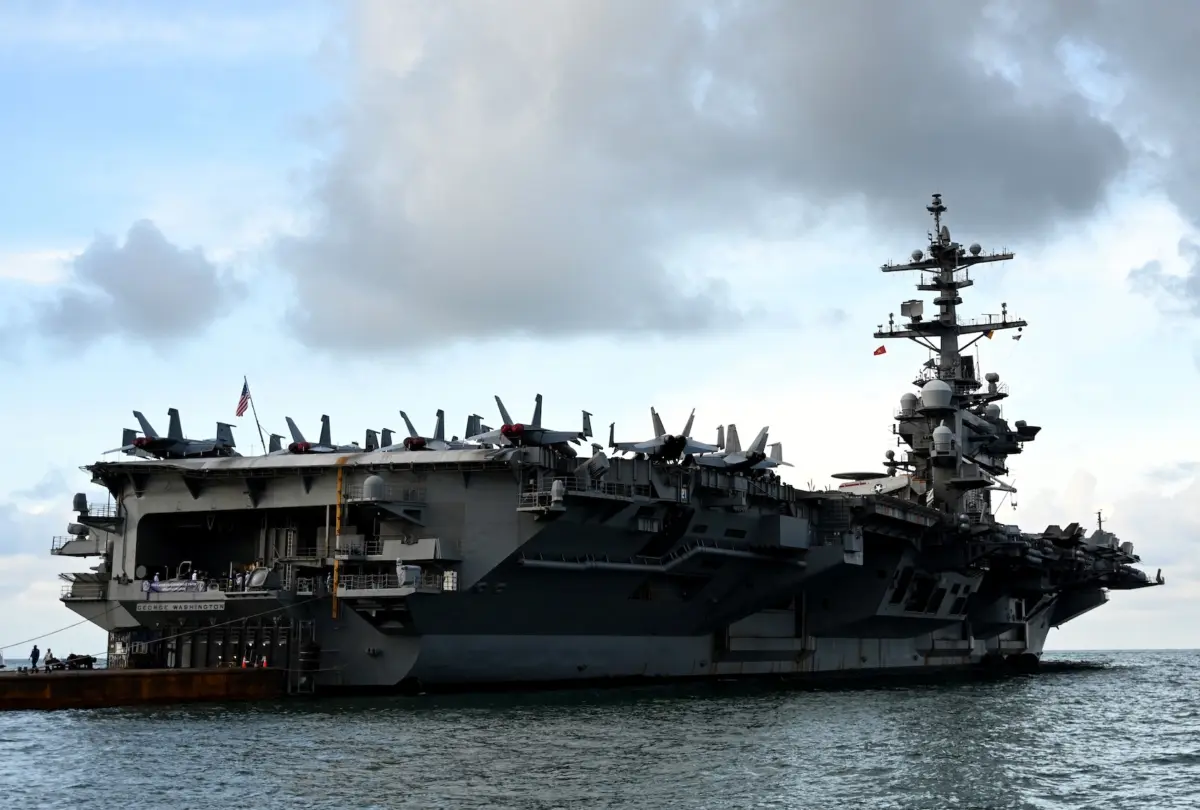
At the center of this realignment is the redeployment of the USS George Washington—the United States Navy’s final forward-deployed aircraft carrier in the Western Pacific—away from its Asian station to relieve the USS Abraham Lincoln. The Lincoln has faced historic deployment extensions exceeding 260 days in the Northern Arabian Sea, battling severe personnel strain and operational wear amid the ongoing conflict with Tehran.
Simultaneously, the White House has ordered the Pentagon to "substantially reduce" joint military exercises with South Korea. This directive follows Seoul’s refusal to participate directly in offensive military maneuvers against the Islamic Republic of Iran. The resulting diplomatic friction has created a vacuum on the Korean Peninsula, one that Beijing is aggressively moving to fill. Chinese statecraft, epitomizing the classic strategic philosophy of "winning without fighting," is seizing the initiative as Washington’s traditional alliance networks experience unprecedented strain.
This essay-based news analysis examines how the compounding effects of resource depletion, geopolitical estrangement, and a sputtering global military footprint are accelerating the erosion of U.S. hegemony. As traditional alliances fray and nuclear proliferation risks tick upward, the international order finds itself navigating a precarious transition toward a multipolar reality defined by Chinese ascendance and American retrenchment.
Detailed Chronology
The Strain on the High Seas
The operational costs of the U.S. military campaign against Iran have reached a critical juncture for the U.S. Navy. For more than 260 days, the USS Abraham Lincoln carrier strike group has maintained a relentless vigil off the Iranian coast in the Northern Arabian Sea. The toll on the ship’s complement has been severe, characterized by deteriorating living conditions, chronic fatigue, and documented psychological crises among the crew.
To prevent a total breakdown in operational readiness and relieve the crew, the Pentagon executed a high-stakes pivot: ordering the USS George Washington out of the Western Pacific. Until this redeployment, the Washington served as the crown jewel of America’s maritime deterrence in Asia, stationed out of Yokosuka, Japan, and later operating across key regional ports like Danang. Stripping the Asian theater of its sole dedicated carrier strike group signals a stark prioritization of Middle Eastern flashpoints over Indo-Pacific containment strategies—a trade-off that defense analysts warn compromises American commitments to regional partners.
The Diplomatic Rupture in Seoul
The realignment of naval assets is mirrored by escalating diplomatic fallout in East Asia. Following the South Korean government’s outright refusal to join U.S.-led military actions against Iran, President Donald Trump took to social media to express his displeasure over Seoul’s recalcitrance. Highlighting a conversation in which he asked South Korean leadership to assist in the "denuclearization of the Islamic Republic of Iran" only to be met with a flat refusal, the administration responded swiftly.
The White House directed the Pentagon to dramatically curtail joint military exercises—a cornerstone of the U.S.–Republic of Korea (ROK) mutual defense framework for over half a century. The announcement caught Seoul entirely unblindside, injecting deep uncertainty into the bilateral relationship. In the wake of this friction, North Korea has continued to recalibrate its own strategic calculations, while Beijing has moved with swift diplomatic agility to capitalize on the widening wedge between Washington and its closest East Asian allies.
Supporting Context & Metrics
Beijing’s Diplomatic Offensive
The strategic vacuum left by American retrenchment has provided Beijing with an "unusually favorable moment," according to regional experts. Chinese Foreign Minister Wang Yi’s high-profile diplomatic visit to Seoul to meet with South Korean President Lee Jae Myung exemplifies China’s patient, long-term approach to regional dominance. By engaging directly on issues concerning North Korea and broader security architectures, Beijing is positioning itself as a reliable alternative guarantor of regional stability.
This diplomatic maneuvering plays directly into Beijing’s broader geopolitical strategy. Analysts point out that China’s restraint regarding active military conflict—often described through the lens of modern geopolitical memes as "doing nothing and winning"—stems from an assessment that the United States and its partners are steadily bleeding their own strategic capital.
Munitions Depletions and the Taiwan Calculus
The intense tempo of the bombing campaign against Iran has inflicted heavy costs on the U.S. defense apparatus, specifically regarding munitions stockpiles. Reports from defense publications, including The National Interest, highlight a growing consensus that critical inventories of precision-guided munitions and interceptor missiles are being depleted at rates far exceeding domestic replenishment capacities.
This depletion has renewed anxieties regarding the defense of Taiwan. While defense planners have long modeled potential cross-strait contingencies, a weakened U.S. logistics chain complicates deterrent postures in the Taiwan Strait. However, many geopolitical scholars argue that Beijing may view a direct military invasion of Taiwan as increasingly redundant. With the United States bogged down in protracted Middle Eastern engagements, domestic economic pressures, and international reputational friction, China’s primary objectives are increasingly achievable through economic coercion, psychological dominance, and diplomatic encirclement rather than costly amphibious warfare.
Footprint Reduction in the Persian Gulf
The structural strain on American power projection is not limited to maritime movements and diplomatic spats. An exclusive report by The Washington Post revealed that the Pentagon is actively evaluating plans to significantly downsize its permanent military footprint across the Persian Gulf and broader Middle East.
For decades, post-9/11 U.S. strategy relied on an extensive network of regional airbases, naval installations, and forward-stationed personnel. However, the sustained missile and asymmetric drone attacks endured by these installations throughout the Iran war have underscored their growing vulnerability. Transitioning away from these high-profile, heavily manned outposts marks a fundamental departure from decades of American military doctrine in the region, signaling an acknowledgement that absolute dominance of Middle Eastern airspace and territory is no longer sustainable or cost-effective.
Official Statements & Reactions
The rapid realignment of American foreign policy has drawn sharp responses from diplomats, regional experts, and international observers:
- The White House: Defending its expectations of international burden-sharing, administration officials have maintained that allies benefiting from the Pax Americana must contribute materially to global security initiatives, particularly when Washington targets perceived threats to international stability.
- Han Lin, China Country Director at The Asia Group: Emphasizing the geopolitical shift during an interview with Bloomberg, Lin noted, "Washington is signaling flexibility toward Pyongyang while simultaneously creating uncertainty in Seoul. China can use that gap to bolster diplomatic influence."
- Former U.S. Ambassador to South Korea Joseph Yun: Speaking on CNN regarding the broader implications of U.S. withdrawal, Yun warned of the cascading dangers of abandonment, pointing out that diminished American security guarantees inevitably incentivize vulnerable states—including North Korea—to double down on indigenous nuclear deterrence programs.
Future Outlook
The compounding developments of 2026 illustrate a historic inflection point for United States foreign policy. The era of unipolar hegemony, characterized by the simultaneous projection of overwhelming military force across multiple global theaters, is visibly buckling under the weight of its own operational overreach.
While the reduction of an overextended military footprint may align with long-term domestic desires to step back from the role of global policeman, the manner of this retreat carries profound systemic risks. As regional powers like North Korea increasingly rely on nuclear arsenals to guarantee their security in the absence of stable U.S. deterrent frameworks, the baseline risk of catastrophic escalation grows.
At the same time, China’s methodical consolidation of economic, diplomatic, and regional influence proceeds largely unchecked by kinetic conflict. Whether Beijing chooses to press its advantage across the Taiwan Strait or simply watches as the American-led security architecture in Asia disintegrates from within, the geopolitical landscape is undeniably shifting. The unravelling of traditional alliances and the decay of imperial hegemony suggest a future defined not by American preeminence, but by a volatile, multipolar struggle for regional spheres of influence—leaving observers and policymakers alike to adapt to a world where Pax Americana is rapidly receding into history.