

By Political Analysis Desk
Published: August 20, 2026
Executive Overview
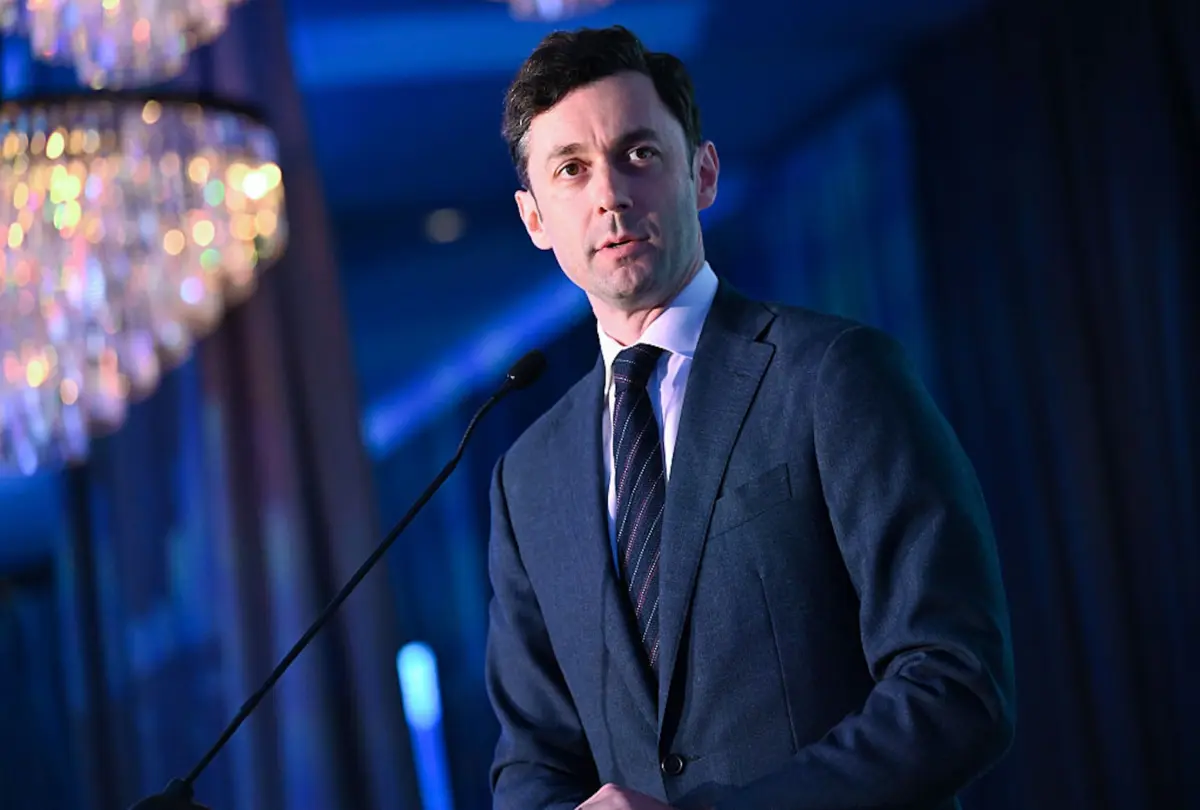
In modern American politics, few moments capture the sudden shift of the national spotlight quite like a single, perfectly aimed phrase. During a campaign stop in Atlanta on Sunday, Senator Jon Ossoff (D-Ga.) delivered a rhetorical strike that reverberated instantly through the corridors of Washington and dominated national discourse. With a deliberate mention of presidential aide Natalie Harp, the Georgia Democrat pierced the armor of the Trump administration, triggering a furious response from the White House and showcasing a sophisticated, razor-sharp political acumen that has taken many by surprise.
While Ossoff has historically cultivated an image in the Senate as a studious, reserved lawmaker who prefers keeping his head down to master the minutiae of governance, his recent remarks demonstrate a formidable talent for baiting and burning political opponents. The ensuing fallout—ranging from volcanic meltdowns on social media by top administration officials to national television victory laps—has amplified Ossoff’s profile far beyond his home state.
More importantly, this episode serves as a case study in modern political communication. By embedding a meticulously crafted critique within a broader policy attack, Ossoff not only maximized media virality but also commanded the news cycle to spotlight critical domestic and international vulnerabilities. As he fights to retain his seat in the nation’s most competitive battleground state ahead of the 2026 midterms, this masterclass in political theater has simultaneously intensified inevitable speculation regarding his trajectory toward the 2028 presidential cycle.
Detailed Chronology: From an Atlanta Stage to a National Firestorm
The sequence of events that transformed a routine campaign event into a multi-day national news cycle unfolded with swift precision:
- Sunday Afternoon, Atlanta, Georgia: Speaking at a local campaign rally, Senator Jon Ossoff pivots from standard stump-speech talking points to launch a direct broadside against President Donald Trump. Addressing the administration’s policy priorities and foreign travel, Ossoff remarks: "So [Trump] doesn’t want to do this job. He wants to build his ballroom and travel with Natalie on their apparently defenseless flying palace gifted by the Emir of Qatar."
- Sunday Evening: The clip, shared widely on social media platforms like X (formerly Twitter), achieves immediate viral velocity. The inclusion of Natalie Harp—a 35-year-old special assistant to the president widely known within the Beltway for managing Trump’s daily routine and volatile moods, but largely obscure to the broader public—shocks political observers.
- Monday Morning: The White House response is immediate and volcanic. Communications Director Steven Cheung takes to social media with profanity-laced attacks against Ossoff. President Trump joins the fray, attempting to insult the senator by comparing him to television character Pee-wee Herman—a tongue-in-cheek recurrence of the president’s earlier verbal slips regarding the pop-culture icon.
- Monday and Tuesday: National cable news programs capitalize on the friction. Ossoff secures high-profile appearances on major networks, including interviews with Jen Psaki and Lawrence O’Donnell. Rather than backing down, the senator doubles down on his core message while expanding his critique to include the administration’s legislative record and his Republican challenger, Georgia Congressman Mike Collins.
- Wednesday: Emerson College releases a new national poll demonstrating Ossoff’s widening appeal in hypothetical national matchups, further cementing the narrative that the Georgia lawmaker is emerging as a formidable political heavyweight on the national stage.
Supporting Context & Metrics: Decoding the Rhetorical Strategy
To understand why Ossoff’s remarks struck such a deep nerve, one must examine the mechanics of the speech itself. Critics and commentators from across the political spectrum rushed to evaluate the rhetorical gamble.
Conservative pundits, including podcaster Megyn Kelly and CNN analyst Scott Jennings, accused the senator of misogyny and inappropriate insinuation. Meanwhile, even seasoned Democratic strategists expressed initial reservations. Former Obama adviser David Axelrod took to social media to chide Ossoff, calling the invocation of Harp "gratuitous and unnecessary," arguing that while it might thrill the party base, it ultimately distracted from substance.
However, political analysts who look past surface-level pearl-clutching argue that Axelrod’s critique misreads the contemporary political landscape. In an era shaped by confrontational rhetoric, Ossoff demonstrated a forensic craft in constructing his remarks.
"Ossoff is trying to harness the increased attention and direct it toward his immediate future: the midterms. Without a win in November, any presidential ambitions… will be harder."
Consider the linguistic construction: Ossoff’s deliberate use of the plural possessive pronoun "their" when referencing Air Force One ("travel with Natalie on their apparently defenseless flying palace") was no accident. It served as a double-edged sword. It subtly spotlighted recent controversies surrounding the administration’s aviation logistics—such as Trump’s reported emergency evacuation from Turkey via a catering truck due to Iranian security threats—while simultaneously mocking the inseparable nature of the president’s inner circle.
Furthermore, by embedding the provocative reference within a dense paragraph of substantive grievances, Ossoff ensured that any media outlet broadcasting the soundbite was forced to broadcast the broader critique. The brief mention of Harp functioned as a Trojan horse, smuggling a devastating array of issues into living rooms across America:
- The deteriorating conditions and reported struggles of U.S. sailors aboard naval carriers.
- Plummeting national strategic reserves of oil and critical munitions.
- Persistent allegations of foreign influence and executive-level corruption, including foreign-gifted aircraft and rushed, controversial White House construction projects.
Official Statements and Media Reactions
The reaction from official Washington underscored just how effectively the senator had disrupted the administration’s messaging operations.
When pressed by Lawrence O’Donnell on his national platform regarding the ensuing White House meltdown, Ossoff offered a cool rebuttal: "Apparently, in the White House, the truth hurts."
He then effortlessly pivoted away from the personal friction to hammer home his populist and economic platform:
"They have lied us into war after promising peace. They’ve driven inflation skyrocketing, thrown people off their health insurance, doubled health insurance premiums for more than a million Georgians after they promised to bring down prices on day one."
Ossoff extended his critique directly to his prospective Senate opponent in Georgia, Congressman Mike Collins, labeling him a "pro-war, pro-tariff, pro-cutting-your-healthcare, bigot congressman, [and] Trump puppet."
Simultaneously, the media blitz served a highly practical, tactical purpose. Understanding that the primary demographic watching cable news leans older and more traditional, Ossoff used his television appearances to directly solicit campaign contributions via telephone and web portals, ensuring that viral momentum was successfully converted into campaign liquidity.
Future Outlook: The 2026 Midterms and the 2028 Horizon
As the dust settles on this week’s political theater, the long-term implications for Jon Ossoff are multifaceted.
On the immediate horizon lies the 2026 midterm cycle. According to the nonpartisan Cook Political Report, Ossoff’s reelection race in Georgia is currently rated as "Lean Democratic," standing as ground zero for control of the United States Senate. Ossoff himself emphasized this reality during his media rounds, reminding viewers: "This is Georgia. This is the most competitive battleground state in the country… I guarantee that within weeks the polling will be within the margin of error, and there is no path back to the Senate majority without winning this race in Georgia."
Beyond his immediate legislative defense, however, the national conversation has firmly established Ossoff as a leading player for the post-Trump era. While the senator has repeatedly batted down presidential speculation—telling the Atlanta Journal-Constitution in June that talk of a 2028 run is mere "fantasy football" that distracts from the immediate midterms—recent polling data suggests otherwise.
A fresh Emerson College poll released this week shows Ossoff outperforming hypothetical national matchups, defeating Vice President JD Vance by five points and Secretary of State Marco Rubio by three points.
Political observers note striking parallels between Ossoff’s current trajectory and that of a former Illinois senator who captivated the nation’s attention two decades ago. Combining youth, high vitality, a willingness to engage in intellectual combat, and an aspirational message, Ossoff is inadvertently channeling the foundational attributes that will command a premium in the 2028 presidential sweepstakes.
Whether he intends to pursue higher office or remain focused on his legislative roots in Atlanta, one reality is now undeniable: Jon Ossoff has proven he knows how to command the national stage, dictate the terms of political engagement, and leave Washington scrambling to catch up.