


Executive Overview
In the hyper-competitive landscape of digital freelance writing, acquiring your first major client can feel like an insurmountable hurdle. Aspiring writers spend countless hours perfecting their portfolios, crafting immaculate pitches, and studying the nuances of search engine optimization. Yet, despite putting their best foot forward, many watch their inboxes remain frustratingly silent.
According to industry veterans and sales data alike, the primary point of failure for new freelancers isn’t a lack of talent or poor writing skills—it is a critical breakdown in the outreach pipeline: the failure to follow up.
Most freelancers approach cold emailing as a one-and-done transactional event. They draft a pitch, hit send, and, upon receiving no immediate reply, cross that prospect off their list. This approach ignores fundamental consumer psychology and sales statistics, which consistently demonstrate that the vast majority of conversions occur only after multiple touchpoints.
This comprehensive report examines the mechanics of successful freelance outreach, the psychology behind why prospects ignore initial emails, and how strategic, respectful follow-up sequences can transform a cold lead into a long-term, high-paying client. Drawing on insights from seasoned entrepreneurs like Location Rebel founder Sean Ogle, we will explore the tools, timings, and tactics necessary to optimize your freelance writing business and secure your first $1,000 in under 30 days.
Detailed Chronology: The Lifecycle of a Cold Pitch
To understand why follow-ups are essential, one must first examine the standard lifecycle of a cold email outreach campaign. Without a structured timeline, freelancers often oscillate between two extremes: bombarding potential clients too aggressively or abandoning leads entirely after a single unanswered message.
Phase One: Research and Personalization (Day 0)
The foundation of any successful cold email campaign is meticulous, yet efficient, research. Generic, template-driven emails sent en masse are universally reviled by business owners, marketing managers, and editors. In an era dominated by automated AI spam, standing out requires a human touch.
- The Problem with Mass Outsourcing: Modern inboxes are flooded with low-effort pitches generated by basic artificial intelligence tools. These emails often lack context, misstate the recipient’s business model, and arrive with daily, unpersonalized follow-ups that alienate potential buyers.
- The Minimum Viable Personalization Rule: True personalization does not require hours of deep research per lead. Industry experts recommend focusing entirely on the first sentence of your email. Acknowledge a recent piece of company news, reference a specific article on their blog, or compliment a recent project. By proving you have taken even two minutes to understand who they are, you instantly rise above 90% of competing applicants.
- The Easy Out: Professional outreach should always conclude with a low-pressure exit strategy—often referred to as a "soft close." Give the prospect an easy way out if they are not currently looking for writing help. This non-intrusive approach disarms the reader, builds trust, and keeps communication channels open for future interaction.
Phase Two: The Initial Silence (Days 1–4)
Once the initial pitch is sent, the waiting game begins. For new freelancers, this window is often fraught with anxiety, leading many to commit the cardinal sin of outreach: following up too soon.
Reaching out within 24 hours of an initial email can feel desperate, aggressive, and pushy. Business owners are inundated with daily operational fires, administrative tasks, and pressing client deadlines. An unanswered email rarely means rejection; more often than not, it simply means the message was buried beneath an avalanche of incoming correspondence.
Phase Three: The Strategic Cadence (Days 5 Onward)
Allowing a respectful window of 2 to 5 days between the initial email and the first follow-up strikes the optimal balance. It demonstrates patience while ensuring your message hasn’t been permanently lost to the archive.
Following this first check-in, freelancers must implement a sustainable cadence—a structured schedule of periodic touchpoints spaced out across weeks and months. Rather than viewing these subsequent emails as nuisances, successful freelancers view them as acts of professional courtesy. Often, a prospect simply forgot to reply, or the timing was wrong during the first encounter. By checking in systematically, you position yourself as a reliable solution provider who happens to appear precisely when a need arises.
Supporting Context & Metrics: The Numbers Behind the Pitch
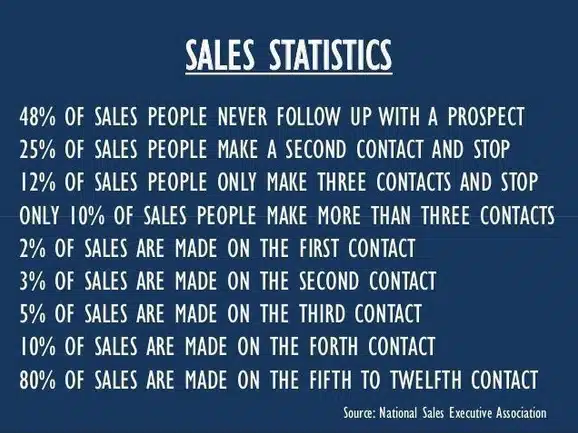
To truly grasp the value of persistence, one must examine the empirical data driving modern sales and outreach pipelines. Sales statistics consistently reveal a stark disconnect between how often salespeople attempt to close a deal and how often buyers actually make a purchase decision.

Sales Touchpoint Conversion Statistics:
[ 1st Contact ] -> 2% of sales made
[ 2nd Contact ] -> 3% of sales made
[ 3rd Contact ] -> 5% of sales made
[ 4th Contact ] -> 10% of sales made
[ 5th-12th Contact ] -> 80% of sales made!
As illustrated by industry sales metrics, a staggering 80% of sales are made between the fifth and twelfth contact. Yet, despite this well-documented reality, historical surveys of sales professionals show that:
- 44% of salespeople give up after a single follow-up.
- 22% give up after two follow-ups.
- 14% give up after three follow-ups.
- 12% give up after four follow-ups.
This means that nearly 92% of all freelancers and sales professionals abandon their prospects before reaching the threshold where the vast majority of deals are closed. If you send a single cold email and move on when you hear nothing back, you are effectively abandoning up to 80% of potential revenue on the table.
The Timing Problem: Why Immediate Need is Rare
When you send a cold email to a prospective client, the statistical probability that they happen to need a freelance writer at that exact second is remarkably low.
Business needs fluctuate cyclically. A startup might have a full content roster today, but experience a sudden departure on their marketing team three months from now. An agency might lack the budget for external writers this quarter, only to secure new funding and expand their content output in the next quarter.
Therefore, the primary objective of your initial cold email is not necessarily to land a gig immediately. The primary objective is to stay relevant and top-of-mind. When the inevitable content bottleneck or staffing shortage hits a prospect months down the road, they are far more likely to search their inbox for the thoughtful writer who checked in regularly than to spend hours scouring job boards for a stranger.
Official Insights: Strategies from Industry Leaders
Building a sustainable freelance writing business requires moving past amateur habits and adopting systems utilized by seasoned digital entrepreneurs. Sean Ogle, founder of Location Rebel, has spent over a decade teaching professionals how to build scalable online businesses and achieve location independence. His philosophy on outreach emphasizes systemic consistency over erratic bursts of effort.
Avoiding the Spam Trap
Ogle warns against the dangers of poorly executed outreach campaigns that give cold emailing a bad reputation.
"I get so many crappy emails," Ogle notes. "They’re not personalized. Perhaps they were written by AI, and then you get follow-ups every day that are also not personalized… If I get an email where I see someone has taken the time to learn about me and the site, I’m way more likely to respond."
The distinction between effective follow-up and spam lies entirely in intent and execution. Spam is generic, relentless, and uninvited. Effective follow-up is personalized, respectful, spaced out, and provides ongoing reminders of how you can alleviate the client’s operational friction. Crucially, professional ethics dictate that if a prospect explicitly requests no further contact, their email address must be immediately removed from your outreach rotation.
Seasonal Hook Points for Quarterly Check-Ins
For long-term client cultivation, Ogle recommends establishing calendar-aligned follow-up touchpoints that provide natural talking points. Instead of asking the same repetitive question ("Did you get my last email?"), tie your check-ins to natural business cycles:
- Late Autumn / Pre-Holiday Season: Reach out to offer assistance with year-end content crunches, wrapping up pending projects, or planning editorial calendars for the upcoming year.
- Mid-January: Send a New Year greeting combined with an inquiry into their strategic content goals for the new fiscal quarters.
- Spring and Summer Check-ins: Periodic pulse-checks designed to see if their content needs have shifted as mid-year business metrics roll in.
Technological Integration: Tracking Your Pipeline Like a Pro
One of the primary reasons freelancers abandon their follow-up routines is the administrative overhead required to manage them manually. Keeping track of dozens—or hundreds—of prospective clients in your head is a recipe for missed deadlines and lost opportunities.
Fortunately, modern digital infrastructure provides powerful tools to automate and streamline the tracking process.
1. Streak for Gmail: Turning Your Inbox into a CRM
For freelancers who operate primarily out of Google Workspace, Streak offers a seamless solution. By integrating directly into Gmail, Streak transforms your standard email inbox into a functional Customer Relationship Management (CRM) system—often at no financial cost.
- Open Tracking: Know precisely when a prospect opens your initial pitch or follow-up email.
- Pipeline Management: Organize leads into distinct columns (e.g., Contacted, Follow-Up 1, Follow-Up 2, Call Scheduled, Client Won).
- Automated Reminders: Set custom calendar reminders tied to your outreach cadence so you never miss a scheduled follow-up window.
2. AI-Assisted Assistants (Claude and ChatGPT)
For writers who prefer to steer clear of traditional spreadsheets, modern generative AI tools like Claude or ChatGPT can serve as tireless marketing assistants.
- Context Retention: By maintaining a running prompt thread updated with dates, outreach actions, and client notes, you can instruct the AI to track your pipeline history.
- Progress Analytics: Ask the AI to generate periodic weekly or monthly summaries. You can review vital metrics such as total cold emails sent, response rates, discovery calls booked, and final client conversion rates.
By implementing either a specialized CRM or an AI-driven tracking workflow, you eliminate the cognitive friction of manual organization, ensuring that persistence becomes an automatic habit rather than a daily chore.
Future Outlook: The Evolving Landscape of Freelance Client Acquisition
As the digital economy matures and artificial intelligence continues to reshape content creation, the nature of client acquisition is undergoing a permanent evolution.
The Death of Mass Outreach
In the coming years, the barrier to entry for sending generic, low-effort cold emails will drop to zero thanks to proliferating AI automation. Consequently, corporate gatekeepers, editors, and business owners will implement increasingly aggressive filtering mechanisms to block generic outreach.
The future belongs entirely to hyper-personalized, relationship-driven prospecting. Freelancers who treat cold outreach as an opportunity to build genuine human connections—grounded in rigorous research, empathetic timing, and polite persistence—will continue to thrive. Those who rely on automated spray-and-pray tactics will find their domains blacklisted and their efforts entirely ignored.
Building a Resilient Freelance Business
Securing your first $1,000 in freelance writing within 30 days is rarely a matter of raw writing talent alone; it is a test of process and discipline. You may possess world-class portfolio pieces and flawless grammar, but without a systematic approach to follow-ups, your business will stall before it ever gains momentum.
By respecting your prospects’ time, personalizing your initial hooks, establishing a disciplined follow-up cadence, and leveraging modern tracking tools to keep your pipeline organized, you stack the statistical deck in your favor.
Stop letting valuable leads slip through the cracks of your inbox. Respect the data, commit to the follow-up process, and transform your cold outreach into a reliable engine for sustainable business growth.