


Executive Overview
In the hyper-competitive digital economy, the difference between a struggling freelancer and a thriving independent professional rarely boils down to raw writing talent. Instead, it rests entirely on the mechanics of client acquisition. For years, digital marketing blogs, business coaches, and copywriting forums have preached the gospel of cold emailing. Freelancers are consistently advised to build a prospect list, craft personalized introductions, and hit "send."
Yet, industry data reveals a staggering blind spot in this methodology: the vast majority of freelancers stop after a single email.
According to outreach analytics and industry veterans, sending a solitary cold email is mathematically equivalent to abandoning a venture before it has a chance to breathe. Most prospective clients are inundated with daily noise, preoccupied with internal business fires, or simply not in immediate need of a writer at the precise moment an initial email lands in their inbox. Success in modern freelance writing is not an event; it is a sustained, methodical process governed by persistence, timing, and strategic follow-ups.
This comprehensive analysis examines the psychology of cold outreach, the structural necessity of multi-touch campaigns, the delicate art of maintaining visibility without crossing into spam territory, and the technological tools—ranging from Gmail CRM extensions to artificial intelligence—that are transforming how modern freelancers scale their businesses.
Detailed Chronology: The Lifecycle of a Cold Outreach Campaign
To understand why single-touch cold emailing fails, one must map out the chronological reality of how business decisions are made. When a freelance writer identifies a target client—be it a burgeoning software-as-a-service (SaaS) startup, a digital media agency, or an established e-commerce brand—the outreach lifecycle begins. However, the prospect’s internal timeline rarely syncs with the freelancer’s financial urgency.
Phase One: The Initial Letter of Introduction (LOI)
The journey starts with the first contact. In an era dominated by automated, AI-generated spam, a successful initial email must cut through the clutter. Seasoned professionals emphasize that personalizing just the opening sentence—referencing a recent company milestone, a specific blog post, or a shared professional interest—drastically elevates response rates. The goal of this initial outreach is not to close a contract or demand a phone call; rather, it is to plant a seed, establish basic credibility, and secure prime digital real estate inside the prospect’s inbox.
Phase Two: The Critical Silence and the 72-Hour Window
Historically, over 70% of initial cold emails receive no immediate reply. This silence often demoralizes novice freelancers, leading them to falsely conclude that their writing samples are inadequate or that the market is saturated. In reality, silence is simply the default state of a busy executive.
Strategic timing dictates that a writer should never follow up the very next day, as this conveys desperation and feels intrusive. Conversely, waiting longer than five days risks allowing the initial email to drift irretrievably into the archive abyss. The sweet spot for the first follow-up lies precisely two to five days after the initial message.

Phase Three: Establishing the Cadence
Beyond the initial follow-up, sustained success requires a structured, multi-touch communication cadence. Rather than firing off messages at random intervals, professional independent contractors deploy a calendar-based strategy.
- The 3-Day Check-In: A gentle, low-pressure nudge to ensure the original message didn’t get buried under urgent operational tasks.
- The Value-Add Touchpoint (3-4 Weeks Later): Instead of asking "Did you see my last email?", this touchpoint introduces new utility—perhaps a fresh content idea relevant to the client’s target demographic or a brief observation on their recent marketing initiatives.
- The Quarterly Touchpoint (3, 6, and 9 Months Out): Transitioning the relationship into a long-term nurturing cycle that aligns with seasonal shifts, such as fourth-quarter budget allocation or first-quarter strategic planning.
Supporting Context & Metrics: The Mathematics of Persistence
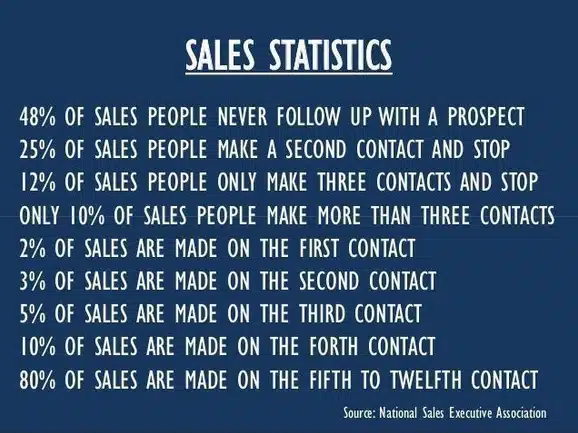
The empirical data supporting multi-touch sales outreach paints a striking picture of lost opportunities. Sales statistics compiled across B2B lead generation sectors consistently indicate that a staggering percentage of all business deals are secured only after multiple points of contact.
[Touchpoint 1] ---> 2% of sales made
[Touchpoint 2] ---> 3% of sales made
[Touchpoint 3] ---> 5% of sales made
[Touchpoint 4] ---> 10% of sales made
[Touchpoints 5-12] -> 80% of sales made
As the data illustrates, a full 80% of sales and long-term client engagements occur between the fifth and twelfth contact. If a freelance writer abandons their outreach after one, two, or even three emails, they are systematically disqualifying themselves from the vast majority of potential conversions.
The Psychology of Timing and Readiness
Why do later touchpoints yield exponentially higher results? The answer lies in market timing. At any given moment, only a tiny fraction of a freelancer’s target market is actively seeking writing services. A content manager might have a full roster of freelancers today, but three months from now, two of those writers may depart, or the company may secure a new round of funding that demands an immediate scaling of content production.
When that sudden operational need arises, executives rarely launch a frantic, open-market job search on public boards. Instead, they search their internal archives for familiar names—professionals who have consistently, respectfully, and professionally remained top-of-mind over the preceding months. By maintaining a steady follow-up cadence, the freelancer effectively positions themselves as the default solution the exact moment the client’s problem materializes.
The Fine Line Between Persistence and Spam
One of the most pervasive fears among independent writers is that regular follow-ups will annoy prospective clients, damage their professional reputation, or result in being marked as spam. Industry experts draw a sharp, unambiguous distinction between constructive persistence and predatory spamming.
The Anatomy of Respectful Outreach
Respectful follow-up is rooted in a service mindset. The writer is not demanding a favor; they are offering a valuable commercial service designed to alleviate the client’s content bottlenecks. Key principles of maintaining professional etiquette include:
- The "Easy Out": Concluding emails with a frictionless exit clause—such as acknowledging their busy schedule or granting explicit permission to ignore the message if timing isn’t right—relieves psychological pressure and paradoxically increases response rates.
- Immediate Compliance with Opt-Outs: If a prospect explicitly states they are not interested or requests no further communication, ethical freelancers immediately purge that email address from their tracking systems.
- Contextual Anchoring: Tying follow-ups to natural calendar events provides organic talking points. Reaching out in late autumn to assist with year-end content crunches, or in mid-January to align with new fiscal year strategies, transforms the email from an unwanted interruption into a timely, helpful proposition.
The Plague of Unpersonalized Automation
The backlash against cold emailing is largely driven by poorly executed automation. When prospective clients receive generic, unpersonalized templates day after day—often clearly generated by unsophisticated AI tools without human review—frustration mounts. This lazy approach ruins deliverability metrics and poisons the well for professionals who execute their outreach with genuine research, tailored opening lines, and respectful pacing.
Technological Integration: Tracking and Automation Systems
Managing dozens—or hundreds—of active outreach campaigns manually is a recipe for missed opportunities and administrative burnout. To scale effectively, modern freelance writers are increasingly turning to specialized software and artificial intelligence to serve as virtual administrative assistants.
Gmail CRM Extensions (e.g., Streak)
For freelancers operating within Google Workspace, customer relationship management (CRM) tools integrated directly into email clients have revolutionized outreach management. Platforms like Streak transform a standard Gmail inbox into a dynamic pipeline.
Writers can track precisely when a prospect opens an initial email, monitor click-through rates on portfolio links, attach contextual notes detailing specific client preferences, and establish automated reminders for upcoming follow-up intervals. This transforms a chaotic inbox into a streamlined engine for client acquisition.
Leveraging Artificial Intelligence as a Strategic Assistant
Beyond traditional CRMs, advanced artificial intelligence tools such as Claude and ChatGPT have emerged as powerful allies for independent operators who despise administrative spreadsheets.
Writers can maintain a running conversational thread with an AI model, inputting daily outreach logs, dates of initial contact, client industry niches, and response statuses. By querying the AI periodically, the freelancer can instantly generate comprehensive weekly or monthly performance audits—tracking metrics such as cold email volume, conversion rates from email to discovery call, and total cost-per-acquisition metrics. This automated administrative oversight ensures that no lead ever falls through the cracks.
Future Outlook: The Evolution of Freelance Client Acquisition
As the digital landscape continues to evolve, the tools of freelance writing will shift, but foundational human psychology will remain constant. With artificial intelligence lowering the barrier to entry for content generation, the market is experiencing an unprecedented influx of mediocre, commodity-level writing services. In response, corporate clients are becoming increasingly selective, relying more heavily on trusted, established relationships rather than transient gig-economy marketplaces.
For freelance writers aiming to secure high-paying retainers and build sustainable, location-independent businesses, the mandate is clear. Building a brilliant portfolio and crafting a single compelling introductory email is merely the prologue. The true work—and the vast majority of financial reward—lies in the disciplined execution of a strategic, respectful, and persistent follow-up cadence.
By embracing systematic tracking tools, respecting the operational realities of busy corporate executives, and committing to long-term relationship nurturing, ambitious writers can transform cold outreach from a frustrating guessing game into a predictable, high-yield pipeline for professional success.